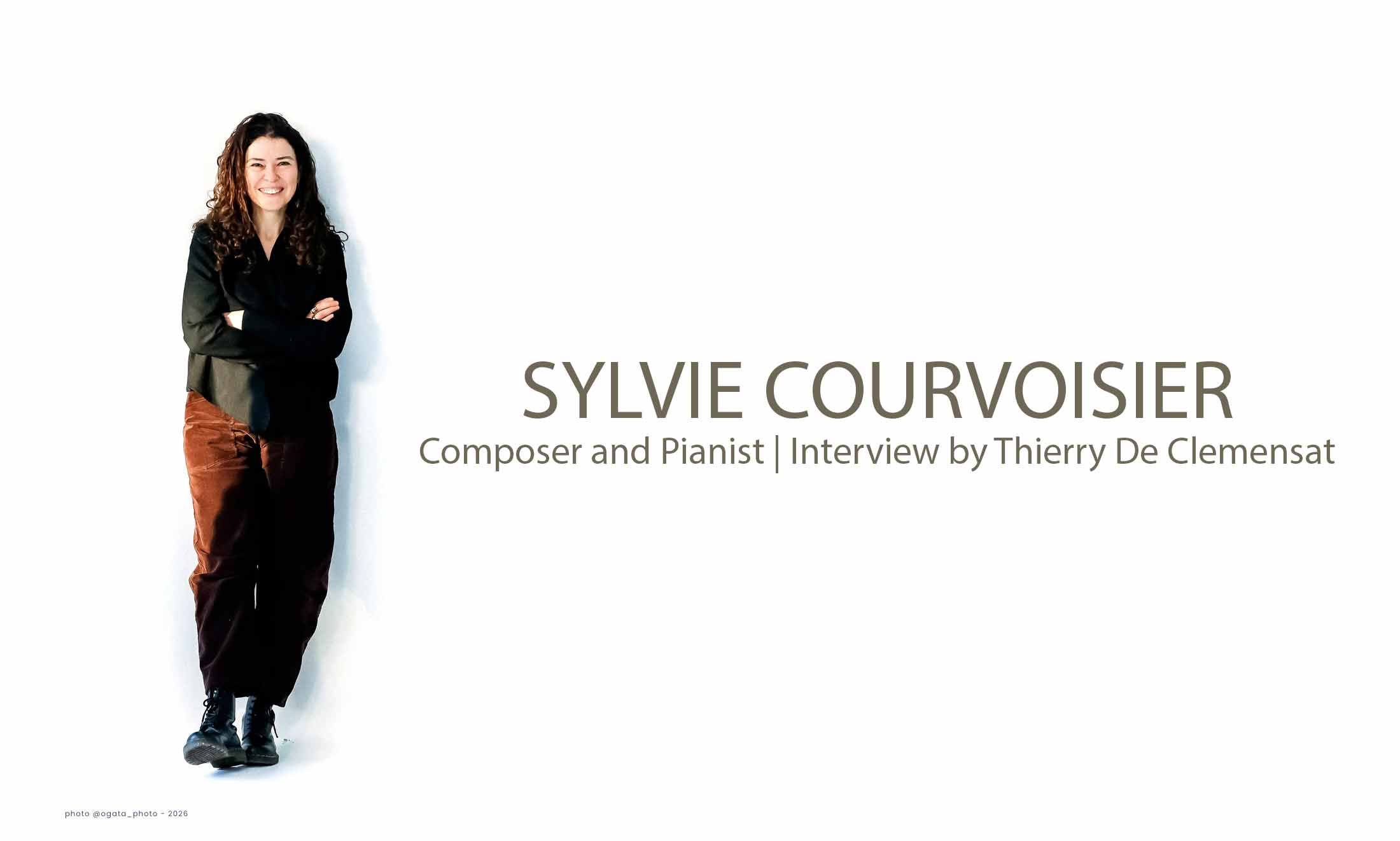
Sylvie Courvoisier – Composer and Pianist
ITW by Thierry De Clemensat
Member at Jazz Journalists Association
USA correspondent for Paris-Move and ABS magazine
Editor in chief – Bayou Blue Radio
November 10th, 2026
::::::::::::::::::::
Since 1994, the name of pianist and composer Sylvie Courvoisier has been making its way through the international music scene. And, it must be said, whether leading her own projects, collaborating with extraordinary musicians such as trumpeter Wadada Leo Smith and guitarist Mary Halvorson, or working on her latest album, Amalthea, with the outstanding vibraphonist Patricia Brennan, every project seems to be a success. What becomes increasingly clear is that, in her music, substance matters more than form. There is something of Marguerite Yourcenar’s poetic sensibility in her writing, but above all, there is a genuine artistic identity in which European musical influences meet those of the most remarkable artists who have shaped the history of jazz in the United States. In that sense, Sylvie Courvoisier might also be seen as a spiritual daughter of Amina Claudine Myers. Since this year we are focusing on composers, it seemed only fitting to shine a spotlight on Sylvie Courvoisier and learn more about her art and the way she continues to develop it.
Thierry De Clemensat: Before the concert halls, festivals and collaborations that have shaped your career, there was a first piano, an initial fascination, perhaps even a sense of mystery. Do you remember when this instrument first entered your life and what drew you to it? Was it the pleasure of playing, the discovery of sounds, or perhaps an early feeling that the piano could become a language in its own right?
Sylvie Courvoisier: I was fortunate to grow up in a family where music was always present. My mother sang in a choir, my father played jazz piano, mostly swing and Dixieland, and my brothers played trumpet and accordion. We weren’t a family of professional musicians, but music was part of our everyday lives. I started making up little melodies at a very young age, without even realizing that I was improvising! For me, the piano was an extraordinary playground, a place where I could create my own world. When I was six, I announced to my parents that I wanted to become a pianist and an orchestra conductor! My parents were happy that I loved music, but they were more hesitant about the idea of making it my profession. Still, that desire never left me.
Thierry De Clemensat: You grew up in Switzerland, in a musical environment where the European tradition plays an important role. What memories do you have of your early musical training? Was there a particular work, composer, teacher or encounter that profoundly shaped your imagination, and whose influence you can still hear in your music today, perhaps without even realizing it?
Sylvie Courvoisier: I grew up in Savigny, a village near Lausanne. I studied classical piano at the Lausanne Conservatory, where I earned my classical piano diploma, although I never completed my thesis. At the same time, I was extremely interested in jazz. I studied at the Montreux Jazz School and at EJMA in Lausanne, attended the summer workshops at Siena Jazz in Italy, and took private lessons with Jacques Demierre. Jacques played a very important role in my musical development. He encouraged me to explore different approaches to the piano and to develop my own musical language. I’ve always loved Bach, Debussy and Messiaen, but also Monk, Cecil Taylor and Paul Bley. I’ve never felt the need to choose between these different worlds.
Thierry De Clemensat: Musical studies demand considerable discipline, daily patience and a certain submission to rules before one can hope to move beyond them. How did you experience this period of training? Was it a time of personal and artistic fulfillment, or did you feel fairly early on that you needed to break free from an approach to teaching that didn’t fully satisfy your curiosity?
Sylvie Courvoisier: Classical training gave me essential foundations: technique, discipline, knowledge of the repertoire and a sense of attention to detail. But fairly early on, I felt the need to go beyond the written score and find my own way of expressing myself. I don’t see technique as an end in itself. It’s a tool that should serve the music. Later, in New York, I completely reworked my technique with Edna Golandsky. That profoundly changed my relationship with the piano, particularly the way I use my body, produce sound and play with less physical tension. I believe a solid musical education is invaluable, but you also have to learn how to move beyond it in order to develop your own personality.
Thierry De Clemensat: At what point did you realize that playing other people’s music wouldn’t be enough for you? Do you remember your first compositions, what might have been awkward, daring or deeply personal about them? And, above all, what did you discover about yourself when you began writing your own music?
Sylvie Courvoisier: I started inventing my own music at a very young age, so composition came quite naturally to me. In the 1990s, I developed my first projects in Switzerland, including Ocre, with Pierre Charial and his barrel organ, as well as my Quintetto. My collaboration with Pierre Charial was particularly important. I discovered the world of mechanical instruments, the works of Conlon Nancarrow and the fascinating possibilities of punched paper rolls. I spent a great deal of time in his Paris workshop working on graphic scores, geometric shapes and complex rhythmic structures. I also loved the accidents, the punching errors that produced unexpected results. That experience profoundly influenced the way I think about composition, particularly the relationship between architecture, rhythm, timbre and chance.
Thierry De Clemensat: Your journey has taken you from classical music into jazz, improvisation and the more elusive territories of contemporary creation. Was this transition gradual, or did it come about through a revelation, a concert, a recording or a decisive encounter? What were you looking for at the time that you could no longer quite find within the musical forms you already knew?
Sylvie Courvoisier: I don’t really see it as a transition from one world to another. I grew up with classical music and jazz at the same time. My father played jazz at home while I was studying the classical repertoire at the conservatory. When I was seventeen, I went to San Francisco as an au pair. I thought I would take a little break from music, but very quickly I missed the piano terribly. Fortunately, there was one in the home where I was staying. That was when I realized that I truly wanted to devote my life to music. After that, my encounters with Jacques Demierre, Pierre Charial and many other European musicians broadened my horizons. I never wanted to abandon one tradition in favor of another. I wanted, rather, to bring all these influences together in a language that felt like my own.
Thierry De Clemensat: When we listen to your music, we hear a meeting point between the discipline of the European tradition, the energy of jazz and a sense of freedom that sometimes seems intent on breaking established boundaries. How have these different worlds come together in your work? Did you consciously set out to bring them closer, or did this synthesis emerge naturally through your experiences and artistic development?
Sylvie Courvoisier: I never consciously set out to synthesize different styles. All these kinds of music are part of my personal history and my musical language. I love the rigor of certain classical forms, the rhythmic energy of jazz, the sonic possibilities of contemporary music and the contrasts between these different worlds. When I compose, I don’t think in terms of categories. I often start with a motif, a rhythm, a harmony or a structural idea. I’m particularly interested in working with opposites: density and transparency, highly rhythmic passages and more suspended moments, lyricism and abstract textures. This mixture has developed naturally through my experiences.
Thierry De Clemensat: Your move to the United States marked an important turning point in your life as a musician. Why did you decide to cross the Atlantic, and what did you hope to find in New York that you couldn’t find in Europe? Was it primarily an artistic decision, a personal necessity, or a desire to immerse yourself in an environment where music seemed capable of reinventing itself every night?
Sylvie Courvoisier: In Switzerland, I already had my own groups and was playing regularly throughout Europe. But I needed a new challenge, to step outside my comfort zone and start over somewhere else. I met violinist Mark Feldman at the Baden-Baden Jazz Meeting in Germany in 1995, and joined him in Brooklyn in 1998. We were married for about twenty years and divorced in 2021. I’ve remained in Brooklyn ever since. For me, New York represented an extraordinary concentration of musicians I admired. I wanted to be immersed in that energy, to listen, learn and meet other artists. I knew it would be difficult, but I wanted to challenge myself with something new. I’ve now been living in New York for twenty-eight years, and the city continues to inspire and stimulate me. It wasn’t just an artistic decision, but also a personal adventure that allowed me to grow and constantly reassess myself.
Thierry De Clemensat: New York is a city where jazz traditions, improvised music, the avant-garde and the most radical forms of artistic expression intersect, without necessarily seeking to reconcile their differences. What were your first major discoveries or shocks when you arrived? Were there musicians, concerts or particular situations that made you realize you would have to rethink the way you played, listened and perhaps even composed?
Sylvie Courvoisier: What struck me immediately was the energy and diversity of the music scene. There were extraordinary concerts almost every night, musicians from all over the world and a multitude of different scenes. I went out constantly to listen, discover new things and meet artists. My encounter with John Zorn was fundamental. He’s a musician I deeply admire, both for his immense knowledge of music and for his creativity and energy. He encouraged me to explore my ideas more deeply, even the most unusual ones, and to trust my own musical personality. New York also taught me to be more demanding of myself. There are so many extraordinary musicians in this city that you’re constantly being challenged and inspired.
Thierry De Clemensat: American jazz cannot be reduced to an aesthetic or a set of instrumental techniques: it carries a history, a collective memory and a distinctive cultural experience. As a European musician who has built an essential part of her career in the United States, how have you made this legacy your own? How does one find a place within that history without imitating it, while still remaining aware of what makes it so profoundly unique?
Sylvie Courvoisier: I have enormous respect for the history of jazz and for the African American musicians who created and developed this music. It’s a cultural, human and social history that cannot be separated from the music itself. I’ve learned an enormous amount from listening to Thelonious Monk, Duke Ellington, Cecil Taylor and so many others. I’ve also had the tremendous privilege of playing with Yusef Lateef and Wadada Leo Smith, two extraordinary musicians who have profoundly shaped the history of jazz and improvised music. But I’m not trying to imitate their language. I come from a different background, with a classical and contemporary European education, and I think it’s important to remain true to who you are. For me, the best way to respect this legacy is to study it, listen to it deeply and understand its history, while continuing to search for your own voice.
Thierry De Clemensat: There are musicians whose influence cannot be measured solely by what they played, but by the way they transformed our perception of music. Which artists have most profoundly changed the way you listen, whether in jazz, classical music or the avant-garde? Is there a particular recording you return to regularly, not out of nostalgia, but because it continues to teach you something?
Sylvie Courvoisier: There are so many! Bach is fundamental to me, particularly the Goldberg Variations and the St. Matthew Passion. I also have a deep love for Debussy, Messiaen, Ligeti and Sofia Gubaidulina. On the jazz side, Thelonious Monk, Duke Ellington, Paul Bley, Cecil Taylor, Chick Corea, Keith Jarrett and Bill Evans have all been enormously important to me. I could mention Chick Corea’s Early Circle, which was a real revelation: its intensity, architecture, compositions and poetry. Messiaen’s Vingt Regards sur l’Enfant-Jésus is another essential recording, as are Keith Jarrett’s Life Between the Exit Signs and Paul Bley’s Open, to Love. What fascinates me about all these musicians is that they developed languages that are immediately recognizable. Their music has such a strong personality, and I continue to discover new things in it.
Thierry De Clemensat: Your musical world seems to be shaped by sensibilities that extend far beyond jazz. Do literature, visual arts, cinema or certain forms of philosophical thought play a role in your compositional process? Can an image, a text or an idea trigger a musical work, or does the music need to emerge on its own, from a gesture, a sound or an intuition that is difficult to explain?
Sylvie Courvoisier: Absolutely. Inspiration can come from anywhere: a book, a painting, a sculpture, nature, a city or simply a sensation. I’m particularly drawn to visual art, sculpture and architecture. What interests me are the relationships between shapes, volumes, materials and spaces. A visual work can give me an idea for a structure or a texture, without my necessarily trying to translate it literally into music. At other times, everything begins at the piano, with a chord, a rhythm or a particular sound. I like allowing these ideas to develop and gradually discovering the shape they might take.
Thierry De Clemensat: Freedom is often invoked when people talk about improvisation, as though it simply meant playing without rules. Yet the musicians who go furthest are often those with the deepest understanding of structures and constraints. Does freedom begin, for you, when you abandon the rules, or when you know them well enough to bend them? And is there an element of risk in improvisation without which the music would lose its appeal?
Sylvie Courvoisier: For me, freedom actually comes from knowledge. The more thoroughly you master your instrument, the more possibilities you have for expressing yourself. But you also have to know how to forget that knowledge when you play, in order to be completely present. Improvisation is a balance between experience, intuition and spontaneity. What fascinates me is creating music that didn’t exist a few seconds earlier. That requires great concentration, but also the ability to embrace the unknown. Sometimes you have to dare to take a direction without knowing where it will lead. It’s that element of risk that makes every experience unique.
Thierry De Clemensat: The piano is an instrument steeped in history, yet its possibilities seem inexhaustible. Under your hands, it can become percussive, lyrical, abstract, almost orchestral, and sometimes shed its traditional role to explore unexpected sonic territories. When you compose, do you first hear an inner music, or do you go directly to the instrument in search of sounds you have never encountered before? What place does physical experimentation occupy in your relationship with the piano?
Sylvie Courvoisier: I’ve always considered the piano an instrument with almost infinite possibilities. It can be melodic, harmonic, percussive, orchestral, and sometimes become something entirely different. I love exploring the inside of the piano, its strings and resonances, different preparations and the objects that allow me to alter its timbre. For me, sound begins in the body. Touch, gesture, breathing and physical energy are essential. Sometimes I begin a composition with a very precise musical idea. At other times, a sonic discovery at the piano sets everything in motion. I particularly like thinking of the piano as an orchestra, with different layers, colors and registers coexisting. And every piano has its own personality. When I arrive at a venue, I need to get to know the instrument and its acoustics before I play.
Thierry De Clemensat: In your work, the score doesn’t always seem to represent a definitive boundary between what must be played and what is still allowed to emerge. How do you decide what to write down precisely and what to leave open to the performers’ freedom? Is this purely a musical decision, or does it also depend on the personalities of the musicians entrusted with your music?
Sylvie Courvoisier: It depends very much on the project and the musicians I’m working with. Some parts of my compositions are written out very precisely: the rhythms, harmonies, structures and ensemble passages. But I also like leaving spaces where the musicians can develop their own ideas. I often compose with the people I’m going to play with in mind. I know their sounds, their strengths and the way they approach music. In my trio with Drew Gress and Kenny Wollesen, for example, we’ve developed a shared language over the years. I can write very complex passages knowing that they will give them an energy and dimension I could never have imagined on my own. So the score is an architecture from which the music can continue to evolve.
Thierry De Clemensat: There is a constant tension in your compositions between construction and unpredictability, between sometimes highly elaborate architecture and moments when everything seems on the verge of falling apart. How do you find the right balance? When working on a piece, do you try to control every detail, or do you accept that part of the music may escape you, even when you are the one performing it?
Sylvie Courvoisier: I really enjoy working on the form and architecture of a composition. I can spend an enormous amount of time on details, proportions, transitions and the relationships between different motifs. Some pieces are built around very precise rhythmic structures, while others revolve around contrasts in texture or dynamics. But I don’t want that architecture to become rigid. A composition needs to breathe and evolve through its interaction with the musicians. I think the balance lies precisely in that tension between a solid structure and the possibility of transforming it.
Thierry De Clemensat: Some of your pieces convey a sense of genuine drama: sounds emerge, collide and recede, while silences become just as eloquent as the notes themselves. Do you think of composition as a form of storytelling, with its characters, tensions and twists, or would you rather allow listeners to create their own paths through the music? How important is what remains unplayed?
Sylvie Courvoisier: I think a great deal in terms of contrasts, tensions, movement and colors. There can be a dramatic dimension to my music, but I’m not necessarily trying to tell a specific story. I like the idea that listeners can imagine their own stories. Silence is very important. Over the years, I’ve learned to give it more space. When I was younger, I wanted to explore every possibility of the piano, every texture and every degree of density. Today, I think I can sometimes say more with fewer notes. Silence creates space, anticipation and tension. It also gives greater strength to what comes before and after it.
Thierry De Clemensat: You have developed an immediately recognizable musical language without allowing yourself to become trapped in a formula. How do you prevent artistic identity from turning into a repeated signature, a way of meeting the expectations that audiences or critics eventually associate with a particular name? When you begin a new composition, do you seek to extend what you have already discovered or, on the contrary, deliberately put yourself in an unfamiliar and uncomfortable position?
Sylvie Courvoisier: I think it’s important not to systematically reproduce what has already worked. Every new composition raises different questions. Sometimes I start with an idea that extends something I’ve explored in an earlier work. At other times, I want to explore an instrumentation, a form or a technique that is less familiar to me. The musicians I work with also play an essential role in this evolution. Over the years, I’ve learned to trust my choices more and to worry less about external expectations. I believe an artistic identity develops naturally over time, through experiences, encounters and personal transformations.
Thierry De Clemensat: Your collaborations with Wadada Leo Smith and Mary Halvorson reveal your interest in musicians who don’t simply inhabit their instruments, but constantly redefine their possibilities. What attracts you to these artists? Is it their distinctive sound, their way of thinking about music, or their ability to take you somewhere you might never have explored on your own?
Sylvie Courvoisier: What attracts me above all is their musical personality, their sound and their way of thinking about music. Wadada Leo Smith has an absolutely unique language. Every note carries weight, intention and depth. He can create an incredible sense of tension with very few notes. Our album Angel Falls is entirely improvised and composed in the moment. Nothing was written beforehand. All the music emerged from our dialogue, from the way we responded to one another and built a musical form together in real time.
With Mary Halvorson, it’s a different adventure, one that is more focused on composition. On each of our albums, we each contribute half the repertoire, writing specifically for one another. We explore the harmonic possibilities offered by the combination of piano and guitar. They are two harmonic instruments capable of creating very rich, sometimes complex overlays, but also extremely delicate colors and textures. I love the way our two musical languages complement one another and sometimes clash. Mary has an extraordinary imagination, a highly individual sense of harmony and rhythm, and a wonderful sense of musical humor. We’ve recorded three duo albums, including Bone Bells in 2025.
These two collaborations are very different, but they share a genuine musical connection and the pleasure of discovering what we can create together.
Thierry De Clemensat: When two artists each have a strong and clearly defined musical world, their encounter can produce real chemistry, but it can also reveal disagreements or resistance. How does dialogue develop in your collaborations? Do you like arriving with a clear idea of what you want to accomplish, or do you prefer the first rehearsals to become a space for exploration, even if that means abandoning some of your original intentions?
Sylvie Courvoisier: It depends very much on the project. In some groups, we work with highly structured compositions. In others, such as ShortCuts with Ned Rothenberg and Nasheet Waits, we create the entire music together, without a score. In both cases, what matters is the musicians’ personalities and the quality of the relationship. I like working with artists who have strong ideas and aren’t afraid to suggest something unexpected. You also have to accept that others may transform an idea. I’ve been playing with Drew Gress and Kenny Wollesen in my trio for more than ten years. We’ve developed an almost intuitive understanding of one another’s reactions, which allows us to approach very complex compositions with great flexibility. For me, a successful collaboration is one in which everyone retains their own identity while contributing to a shared musical language.
Thierry De Clemensat: With Amalthea, your project with vibraphonist Patricia Brennan, you chose to explore the possibilities of an instrumental dialogue particularly rich in colors, resonances and contrasts. What made you want to work with her? How did you envision the relationship between piano and vibraphone, two instruments whose sounds can either blend together or stand in opposition? And what did you discover through this encounter that you hadn’t anticipated at the outset?
Sylvie Courvoisier: I’d wanted to develop a project featuring vibraphone for a long time. I greatly admire Patricia Brennan. She’s a very creative musician with a strong personality and a highly original approach to her instrument. The piano and vibraphone have fascinating possibilities when it comes to resonance. Their sounds can blend and complement one another, but they can also create very interesting contrasts. I envisioned Amalthea with Patricia on vibraphone, Thomas Morgan on double bass and Dan Weiss on drums. I composed this music with their individual personalities and the possibilities for dialogue between us in mind. I particularly love the way the sounds of the piano and vibraphone can sometimes become almost indistinguishable, only to suddenly separate again. Thomas brings extraordinary depth and sensitivity, while Dan has an incredible rhythmic imagination.
What struck me when playing with this quartet was the richness of the colors we could create together. At times, the four instruments form a single texture; then each one finds its own voice again. It’s an ensemble that offers an enormous range of compositional and orchestral possibilities.
Thierry De Clemensat: Over the years, you have worked with musicians from very different generations, traditions and artistic backgrounds. How do you choose the people you want to commit to a new project with? Is it primarily a matter of personal affinity, musical curiosity or trust? And do you ever deliberately seek out the company of a musician whose language is unfamiliar to you, because you sense that this encounter might take you somewhere new?
Sylvie Courvoisier: It’s a combination of musical and personal affinity. Of course, I have to deeply appreciate their music, their sound and their artistic personality. But the human aspect is just as important. When you work with musicians for years, you share an enormous amount: concerts, tours, travels, difficult moments and wonderful experiences. I like musicians who have a strong identity but are also generous and open to other people’s ideas. And I particularly appreciate meeting artists who come from worlds very different from my own. Those differences can lead to musical combinations I would never have imagined by myself.
Thierry De Clemensat: Making music collectively requires a kind of trust that cannot simply be declared into existence. You have to listen, take risks, leave room for others and sometimes give up an idea that you nevertheless consider excellent. How does this collective intelligence develop within your ensembles? Are you a musician who likes to lead and structure the work, or do you prefer those moments when the group finds an unexpected direction on its own?
Sylvie Courvoisier: When I’m leading an ensemble for which I’ve composed the music, I have a fairly precise vision of what I’d like to hear. I enjoy working on the details, articulations, dynamics, colors and structures. But I don’t want the musicians simply to execute my ideas. I compose specifically for musical personalities I admire, and I want them to bring something of their own to the music. In my trio, for example, Drew and Kenny know my writing very well. We can work with extraordinary precision during rehearsals and then give the music another dimension onstage. What interests me is the moment when the ensemble begins to function like a single organism, without anyone needing to direct every detail.
Thierry De Clemensat: Today, the boundaries between jazz, contemporary music, free improvisation and experimental music have become increasingly porous, even if institutions, festivals and the music industry continue to place artists in clearly defined categories. Do you feel that you belong to a particular tradition, or do these labels seem too narrow to describe what you do? And when you are introduced as a jazz pianist, do you feel that this definition sheds light on your work or leaves out an essential part of it?
Sylvie Courvoisier: I understand that categories are useful for journalists, festivals and record labels. You need to find words to introduce the music somehow. But personally, I don’t think in terms of labels. I have a classical background, I grew up with jazz and I feel deeply connected to contemporary music. All these influences are part of my musical language. If someone introduces me as a jazz pianist, I don’t mind. But that definition tells only part of my story. I would simply prefer to be regarded as a pianist, composer and improviser. What matters to me isn’t the musical genre, but the artist’s personality, imagination and sincerity.
Thierry De Clemensat: Contemporary creation seems to be under constant pressure to innovate: artists are expected to surprise, push boundaries, invent new forms and never repeat themselves. Does this expectation stimulate you, or does it sometimes strike you as artificial? Does a work necessarily have to be new to be important, or can its strength lie in finding a different way of inhabiting older forms and traditions?
Sylvie Courvoisier: I don’t think you absolutely have to invent something new to make good music. Originality shouldn’t be an end in itself. What interests me is developing a personal voice, remaining sincere and continuing to search. You can create something profoundly original from very simple elements or from older forms. I love Bach, Ligeti, Messiaen, Monk and Ellington, and their music continues to surprise and inspire me. I believe innovation comes naturally when you work deeply on your own musical language and dare to follow your instincts. But trying to be original at all costs can become just as restrictive as the traditions you’re trying to break free from. For me, music must above all have an inner necessity.
Thierry De Clemensat: The way musicians are perceived can eventually confine them to a handful of emblematic collaborations, a few reference albums or an aesthetic that people believe they have already fully understood. How do you look at your own journey today, from your earliest experiences to your most recent projects? Are there aspects of your work that you feel have not yet been sufficiently heard or understood? And do you feel a need to surprise those who already think they know your music?
Sylvie Courvoisier: I’ve never really had a career plan. In fact, I don’t particularly like the word “career” when we’re talking about art. I’ve followed my instincts, my musical desires and the encounters that have come my way. Looking back, I can see a continuity in my work, but also many transformations. My different ensembles allow me to explore very different aspects of my writing. My trio with Drew Gress and Kenny Wollesen is a project I’m particularly attached to. We’ve developed a shared language over more than ten years, and our album Éclats – Live in Europe bears witness to that evolution. With Amalthea, I’m exploring another sonic palette, while my collaborations with Mary Halvorson and Wadada Leo Smith take me into very different forms of musical dialogue. With CHIMAERA, I’m exploring yet another sonic world, featuring two drummers, Nasheet Waits and Kenny Wollesen, trumpet player Nate Wooley, double bassist Drew Gress and the electronic textures of the magician Christian Fennesz. This ensemble allows me to work with sound masses, contrasts and very particular instrumental combinations.
In 2025, I received the Swiss Grand Award for Music as well as a Music Award from the American Academy of Arts and Letters. Both honors meant a great deal to me, especially after so many years spent in New York. I don’t feel a need to surprise people who think they already know my music. I’d rather let my projects evolve naturally and continue exploring the things that interest me.
Thierry De Clemensat: Women have long had to fight for recognition in musical environments where artistic authority and virtuosity were instinctively associated with men. Jazz and improvised music are no exception to this history. Throughout your career, have you encountered situations in which your work was perceived differently because you are a woman? And despite recent progress, do you believe women musicians now have the same opportunities to lead ensembles, establish their compositions and be recognized as major figures in contemporary music?
Sylvie Courvoisier: Things have changed enormously, but there’s still work to be done. When I was young, there were far fewer visible women instrumentalists and composers in jazz and improvised music. I was fortunate to have known Irène Schweizer since I was in my twenties and to have played three concerts with her. She was an extraordinary musician, with an incredible personality and energy. She opened many doors. Today, I’m happy to see so many remarkable women musicians developing their own projects, leading ensembles and composing highly personal music. I’m thinking in particular of Mary Halvorson, Patricia Brennan and many others. But it’s important that women be recognized above all for their music, and not simply because they are women. Equality also means equal opportunities for creating, producing, programming and receiving recognition. I don’t like the idea of competition in art. What matters is the diversity of voices and the opportunity for everyone to develop their own language.
Thierry De Clemensat: Your music demands time, attention and a certain openness of mind from the listener. It doesn’t necessarily seek to seduce immediately and may even unsettle those who expect familiar reference points. At a time when music is constantly circulating, often reduced to a few seconds of listening, how do you approach your relationship with the audience? Is it important to you that listeners understand what you are doing, or would you rather offer them an experience that resists explanation and continues to resonate in their imagination long after the concert is over?
Sylvie Courvoisier: I don’t think you need to understand music intellectually to be moved by it. You can experience a very powerful emotion without knowing exactly what’s happening harmonically or rhythmically. I like the idea that every listener can have their own experience, imagine their own images and find their own way through the music. Of course, some kinds of music require more time and attention. We live in an age when everything moves very quickly, when it’s easy to jump from one thing to another. But I believe a concert remains a precious space where we can share a collective experience and concentrate fully on listening. There’s something unique about the physical presence of musicians and audience members, the energy of a room, the silences and the surprises. I simply hope my music can touch people and encourage them to listen in a different way.
Thierry De Clemensat: Composition is often presented as a solitary activity, even though music only truly comes to life through its encounter with others. How much solitude do you need to write, explore and have doubts? And when your compositions are performed by other musicians, do you experience a sense of loss of ownership, as though the work is finally slipping away from you, or rather the satisfaction of discovering that it can live in ways you hadn’t imagined?
Sylvie Courvoisier: I need solitude to compose. It’s a very personal time when I can experiment, search, make mistakes, start again and allow ideas to develop at their own pace. I spend a great deal of time at the piano exploring sounds, harmonies, rhythms and structures. But the music changes completely when it encounters other musicians. I often compose with specific people in mind, thinking about their sound, the way they play and their personalities. And when they begin performing the music, they give it a new dimension. I don’t experience that as a loss of ownership, but rather as a transformation. A composition isn’t a fixed object. It can evolve, breathe and reveal things I hadn’t imagined. It’s this encounter between solitary work and collective intelligence that fascinates me.
Thierry De Clemensat: After so many years devoted to the piano, composition and collaborations that have broadened your horizons, what still surprises you about music? Are there questions you still cannot answer, territories you haven’t yet dared to explore or ideas that seem impossible to realize at this point? And has your relationship with the instrument changed over time? Do you now play with greater freedom and awareness, or with the same unruly curiosity as ever?
Sylvie Courvoisier: Fortunately, there are still an enormous number of things that surprise me! Every musician, every piano and every concert hall can lead me to discover something new. I think my relationship with the instrument has evolved. Over the years, I’ve become more comfortable with my own musical language, more attentive to sound quality and to the way I construct a musical form. I’ve also learned to make better use of space and silence. But I still have many desires and projects. In particular, I’d like to develop my work with larger ensembles and orchestras. I’m working on a project for the Basel Sinfonietta, featuring my trio and Ingrid Laubrock, which will allow me to explore the relationship between orchestral writing and the musical language Drew, Kenny and I have developed together. What I enjoy is being able to imagine ambitious projects, sometimes difficult ones to realize, and then figuring out how to bring them to life.
Thierry De Clemensat: If you were to look back at your journey not as a succession of albums, concerts and collaborations, but as an artistic quest whose final destination you still don’t know, what would its central question be? What would you like people to hear in your music beyond virtuosity, originality or compositional complexity? And if you could leave just one door open for those who will listen to your work twenty or thirty years from now, what would it be: a different way of hearing the piano, of thinking about freedom, or simply of understanding that music remains a territory where everything is still waiting to be invented?
Sylvie Courvoisier: I think the central question has always been the same: how can you develop a personal voice while continuing to evolve? I’ve never tried to build my career according to a precise plan. I’ve followed my instincts, the people I’ve met and the projects that mattered to me. What interests me is creating music with a genuine identity, with its contrasts, tensions, colors and emotions. But beyond the complexity of the writing or the technical possibilities of the piano, what I’d really like is for people to feel something human. For me, music is a way of communicating, sharing and creating connections between human beings. If I could leave just one door open, it would be the door to imagination.