| Jazz |
ENRICO RAVA AND JOE LOVANO’S CORNERS: THE ART OF KEEPING JAZZ IN MOTION
There is something immediately recognizable about an ECM recording. It is not simply a matter of sound quality, although that has always been central to the label’s identity. It is an aesthetic, a particular way of approaching music, of shaping space, and of allowing instruments to exist within it. For decades, ECM has maintained an extraordinary degree of artistic consistency without becoming trapped by its own conventions. Under producer Manfred Eicher, the label has developed a musical language in which recording and performance are inseparable. The depth of the acoustic space, the natural separation of instruments, the attention to silence and the extraordinary sensitivity to tonal color are not technical embellishments. They are part of the artistic statement.
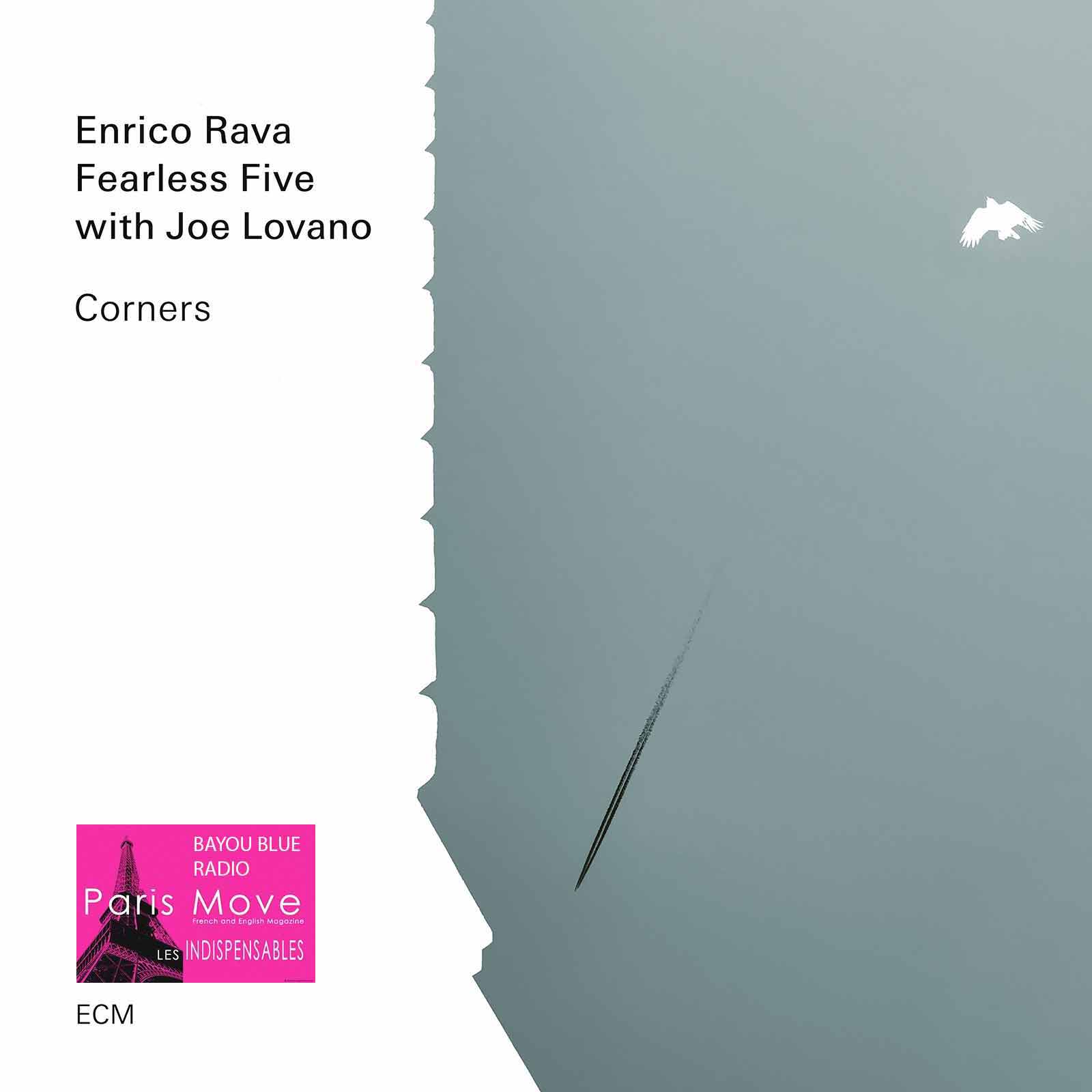
That continuity is one of ECM’s greatest achievements. Its sound has evolved, certainly, but its underlying philosophy has remained remarkably intact. Each new release therefore invites a particular kind of attention. There is little room for casual listening or superficial judgment; the music demands time, repeated encounters and an appreciation of the smallest details. With Corners, the new recording by Italian trumpeter Enrico Rava, his Fearless Five ensemble and American saxophonist Joe Lovano, ECM once again demonstrates that its commitment to a recognizable aesthetic need not come at the expense of artistic discovery.
Rava has long seemed like one of the musicians most naturally at home within the ECM universe. Yet that association should not obscure the independence of his artistic personality. Few European jazz musicians have developed such a distinctive relationship with melody, phrasing and musical space. His trumpet playing is immediately identifiable, not because it relies on a signature gesture, but because of the way he approaches a musical idea: with restraint, intelligence and an instinctive understanding of when to let a phrase speak for itself. There is rarely any need for unnecessary display. Rava understands that what remains unsaid can be just as important as what is played.
At this stage of his career, one might reasonably expect an artist of his experience to look backward, revisiting familiar territory and drawing upon the achievements of earlier decades. Rava, however, appears more interested in what remains possible. That willingness to remain curious is one of the most compelling aspects of Corners.
For this project, he has assembled Fearless Five, an Italian ensemble featuring trombonist Matteo Paggi, guitarist Francesco Diodati, bassist Francesco Ponticelli and drummer and vocalist Evita Polidoro. They are joined by Joe Lovano, whose participation gives the recording an additional dimension. This is not simply a meeting between two established figures of international jazz, nor an exercise in combining an American saxophone tradition with a European sensibility. The music reflects a genuine artistic affinity, one grounded in listening, mutual respect and a willingness to allow individual personalities to shape the direction of the group.
The origins of Fearless Five go back to an impromptu performance near Rome in 2022. What began as an informal musical encounter developed into a more substantial collaboration, eventually taking shape as the ensemble heard here. The name also recalls an earlier Rava composition, recorded in 1978, offering a subtle connection between different periods of his career. Corners marks the group’s first recording for ECM and consists entirely of original compositions.
One of the most interesting aspects of the project is the shared responsibility for the writing. Rava has explained that because all the musicians lead their own groups and work as composers, it seemed natural to invite everyone to contribute material. That decision is more significant than it might initially appear. Corners does not revolve around a celebrated bandleader with a supporting cast of accomplished sidemen. Instead, it develops through the interaction of distinct musical personalities, each bringing an individual perspective to the larger composition. Rava remains the group’s central presence, but he is clearly not interested in controlling every aspect of its identity.
Recorded July 21-23, 2025, at Rome’s Auditorium Parco della Musica and produced by Manfred Eicher, the album is inventive from the outset. Its compositions move through unexpected harmonic territory, shifting rhythms and carefully constructed melodic passages. Yet the music never sounds complicated merely for the sake of appearing modern. Its sophistication lies in the musicians’ ability to respond to one another, to recognize an opening and to take the music somewhere neither player might have anticipated alone.
It would be tempting to describe Corners as a European jazz recording, but that would be an incomplete assessment. Its cultural identity is considerably more open. The Italian character is unmistakable, yet the music moves comfortably across geographical and stylistic boundaries. American jazz traditions, Mediterranean sensibilities and contemporary improvisational approaches coexist without any attempt to reconcile them artificially. What emerges is neither a national statement nor a stylistic manifesto, but an international musical conversation.
There is, however, something distinctly Italian in the album’s emotional landscape. Listening to certain passages, I found myself thinking of Italian cinema in the 1950s and 1960s, a period when music played an essential role in establishing atmosphere and emotional depth. I am thinking particularly of the relationship between melody and image, of the ability to suggest an entire landscape through a few carefully chosen notes. There is something cinematic about the way some of these compositions unfold. They seem to carry fragments of stories, places and memories without ever spelling them out. This is a personal association, of course, but one that says something about the evocative power of Rava’s music.
The opening composition, Rava’s Certi Angoli Segreti, establishes this sensibility with considerable elegance. The flugelhorn introduces a reflective atmosphere, while Paggi’s trombone gradually enriches the texture. Diodati’s guitar is particularly important here. Rather than simply providing harmonic support, he creates much of the surrounding sonic landscape, introducing subtle colors and shifting the emotional balance of the piece. His playing is remarkably effective because it rarely demands attention for its own sake. He understands how to shape an atmosphere from within, allowing the other instruments to emerge naturally.
The second track, Sin Peso, is where the relationship between Rava and Lovano becomes especially compelling. Written by Diodati, the composition has a slightly mysterious quality, balancing melancholy with a restrained sense of movement. The exchange between trumpet and saxophone is one of the album’s defining moments. What makes it so engaging is the absence of competition. Neither musician appears interested in demonstrating superiority or claiming the foreground. Instead, their lines seem to anticipate one another, sometimes extending an idea, sometimes deliberately leaving it unresolved.
Lovano has an exceptional ability to inhabit different musical environments without losing his own identity. His tenor saxophone can be expansive and muscular, deeply rooted in the American jazz tradition, yet he is equally capable of a more reflective, almost abstract approach. Against him, Rava brings his characteristic lyrical restraint, his carefully shaped phrases and his ability to suggest more than he actually states. The two musicians share an understanding that goes beyond technical compatibility. They seem to recognize the possibilities contained in one another’s playing.
At this point, I found myself thinking of certain recordings from Miles Davis’s bebop period. The comparison is not intended to suggest a direct influence or a stylistic imitation. It is a more personal response to the musical interaction itself. What I hear is that same fascination with the space between two soloists, with the tension created by a phrase that is deliberately left incomplete, or by an unexpected response that changes the direction of the music. In some of Davis’s early groups, the dialogue between instrumental voices was as important as the individual solos. Something of that spirit emerges in the exchanges between Rava and Lovano.
But Rava is very much his own musician. His language is different, more contemplative and, at times, more cerebral. His melodic instincts are rooted in a sensibility that cannot be reduced to any single historical reference. The connection to Davis exists in the freedom of the dialogue, not in the imitation of a sound. It is precisely this distinction that makes the comparison meaningful to me. Evita Polidoro provides another important dimension to the album. Primarily heard as a drummer, she reveals her vocal abilities on Le Mie Gambe, a composition she also wrote. Her voice enters the music without disrupting its balance. It feels less like a separate vocal feature than an extension of the instrumental conversation. The piece introduces a more intimate atmosphere, revealing a melodic sensitivity that complements the exploratory character of the surrounding compositions. Polidoro’s contribution also reinforces the impression that Fearless Five is a group of musicians who are not content to remain within narrowly defined roles.
With Sun Rava, a composition by Lovano, the atmosphere shifts toward something more rhythmically assertive. There is a blues sensibility at work, but the piece never settles into familiar patterns. Lovano explores its possibilities with considerable freedom, while the rhythm section of Polidoro and Ponticelli provides a constantly shifting foundation. Their contribution is particularly important because they do not merely accompany the soloists. They help determine the direction of the music, adjusting the rhythmic emphasis and responding to the smallest changes in the improvisations. The result is a performance that feels alive to the moment.
Rava’s Hitchcock at the Beach introduces another distinctly cinematic dimension. The title suggests a landscape in which apparent calm conceals an underlying tension, and the composition plays with that ambiguity. Its melodic development is understated, almost nostalgic, but never sentimental. Rava has always possessed a remarkable ability to evoke emotion without underlining it. Here, a few carefully placed notes are enough to create an atmosphere that lingers long after the piece has ended. Tone, Shape and Colours, developed from an idea by Lovano, takes the ensemble into more abstract territory. The saxophonist’s use of the tárogató adds an unusual tonal dimension, while the interplay among the three horn players creates a richly varied musical texture. The emphasis is less on conventional solo exchanges than on the movement of sound itself. Ideas are introduced, transformed and passed between the musicians, sometimes converging, sometimes moving in different directions. It is an especially revealing example of the group’s collective intelligence.
Francesco Ponticelli’s Ça va sans dire offers a more concise statement. Its understated elegance provides a welcome moment of repose after the more exploratory passages that precede it. The piece demonstrates that musical invention does not necessarily depend on elaborate structures or extended improvisation. A small number of carefully developed ideas can be enough to establish a complete emotional world.
Bowery Dance, another Rava composition, brings a more urban energy to the recording. The title evokes New York, a city that has played an important role in the trumpeter’s artistic life. The rhythmic drive and more assertive character of the piece provide an interesting contrast with the album’s more reflective moments. There is a sense of movement and memory here, but not the kind of nostalgia that turns the past into a museum piece. Rather, the experience of earlier musical encounters seems to have been absorbed into the present language of the group.
The album closes with Mamma, a composition by Matteo Paggi. Its delicacy makes for a particularly satisfying conclusion, and the choice of composer is significant. The final word belongs not to Rava, but to one of the younger members of the ensemble. That decision captures the spirit of the entire project. Corners is not simply an album built around the personality of a famous musician. It is the result of a genuine exchange in which experience creates room for new voices rather than overshadowing them.
This is perhaps the recording’s most important achievement. Rava does not use his considerable experience as a form of authority. He puts it at the service of a creative environment in which younger musicians are allowed to contribute on equal artistic terms. Lovano, for his part, brings the breadth of his own experience without imposing an external identity on the group. The music develops through a balance of individual expression and collective responsibility, a balance that is increasingly valuable in a musical culture often driven by recognizable formulas and established expectations.
ECM’s contribution should not be overlooked. The recording has the depth, clarity and spatial precision that have long distinguished the label’s finest productions. Each instrument retains its natural character and acoustic presence. Diodati’s guitar has both texture and definition, Ponticelli’s bass remains grounded without becoming heavy, the horns possess their full tonal richness, and Polidoro’s drums occupy a space that allows every subtle gesture to register. Nothing feels artificially separated or excessively emphasized. The recording allows the ensemble to breathe, and that sense of acoustic freedom is central to the listening experience.
Corners is ultimately a thoroughly persuasive album, one that rewards repeated listening without demanding that the listener approach it as an intellectual exercise. It is modern without being self-consciously experimental, lyrical without becoming sentimental, and sophisticated without losing its sense of spontaneity. Rava brings the wisdom of experience, Lovano contributes a remarkable capacity for musical dialogue, and the younger Italian musicians give the project an energy and identity that belong entirely to the present. What stays with me most, however, is the album’s ability to bring different musical memories into the same listening experience. Some passages lead me back to Miles Davis, others to the visual and emotional world of Italian cinema, and still others to the nocturnal landscapes that have become so closely associated with ECM. These references do not define the music. They are part of what the music makes possible, the associations it awakens and the personal history it invites the listener to bring to it.
That, to me, is one of the great pleasures of listening to jazz. A truly successful recording does not simply offer a series of accomplished performances. It changes the way we hear what comes next. It creates connections between musicians, between traditions and, ultimately, between the music and the listener’s own experience. Corners is an especially appropriate title. Its music explores angles, unexpected turns and changes of perspective, yet never loses its sense of direction. Rava and his partners remind us that jazz remains a living art precisely because it refuses to stand still. There is no need to choose between honoring its history and imagining its future. The two can exist in the same musical moment, provided the musicians remain willing to take risks and listen to one another.
Perhaps that is what makes Enrico Rava so compelling at this stage of his career. He has nothing left to prove, yet he continues to explore, to question and to invite others into the process. Corners is not a retrospective statement or a summation of past achievements. It is evidence of an artist who remains engaged with the possibilities of the present. And that, more than any stylistic label or historical comparison, is what gives this album its lasting significance.
Thierry De Clemensat
Member at Jazz Journalists Association
USA correspondent for Paris-Move and ABS magazine
Editor in chief – Bayou Blue Radio, Bayou Blue News

PARIS-MOVE, November 6th, 2026
Follow PARIS-MOVE on X
::::::::::::::::::::::::
Musicians :
Fearless Five
Enrico Rava: Trumpet, Flugelhorn
Matteo Paggi: Trombone
Francesco Diodati: Guitar
Francesco Ponticelli: Double Bass
Evita Polidoro: Drums, Vocals
Joe Lovano: Tenor Saxophone
Travk Listing:
Certi Angoli Segreti
Sin Peso
Mie Gambe
Sun Rava
Hitchcock at the Beach
Tone Shape and Colours
Ça Va Sans Dire
Bowery Dance
Mamma