| Jazz |
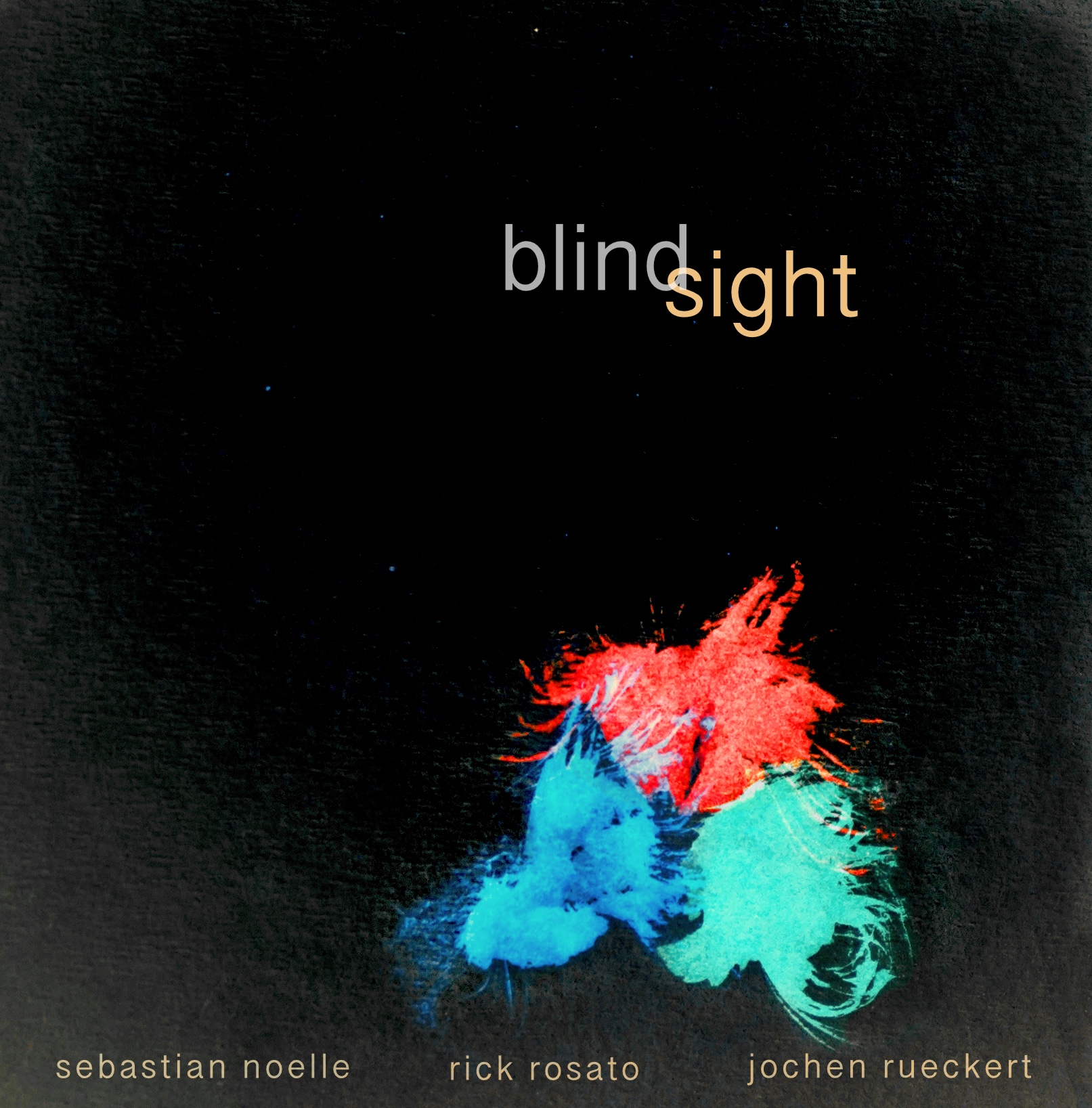
Sebastian Noelle Trio’s Blindsight Review: A Jazz Guitar Trio That Trusts Instinct, Melody and Silence
German-born guitarist and composer Sebastian Noelle has lived in New York since 2002, and in more than two decades he has become a fixture of the city’s creative scene, leading his own groups and playing as a sideman. He has been a member of Darcy James Argue’s Secret Society for over twenty years and has also worked with the Chris Potter Big Band and the Jim McNeely Big Band, among others. His earlier records, including Shelter (2016), which The New York Times praised for its mix of lyrical intricacy and rockish swagger, and System One, were known for dense, labyrinthine writing.
Blindsight, his fifth album as a leader, is his first as a leader in the guitar-trio format. Sebastian says that on his past albums he communicated mainly through the density of the compositions, and that this time he wanted to feature his playing more and see what happens when the architecture is simpler, with room for longer solos and more direct communication. The result is a looser, more human record, and one of his most engaging.
The title of the album comes from neurology, where ‘blindsight’ is the ability to respond to visual stimuli without being consciously aware of them: a kind of subconscious navigation of space. Noelle uses it as a metaphor for the way the three musicians play, trusting instinct over intellect, seeing without seeing. You can feel that in the music. The trio moves like three people who know the room well enough not to need the lights on.
The album does not settle into a single mood. It is neither uniform nor purely contemplative. There is swing, movement and acceleration, sometimes slow and sometimes more complex, a calm that quietly washes over you, and a real collective energy, as on the title track “Blindsight”, a high-velocity sprint requiring telepathic trust, and on the trio’s reading of Monk’s “Evidence”, reimagined in 9/4. Elsewhere there is a 3/4 waltz take on George Shearing’s “Conception”, the stillness of “Little Buddha”, written for Noelle’s son, and the Bill Evans-inspired “Sugar High”.
What I look for in a trio is real interaction, and that is exactly what happens here. Bassist Rick Rosato and drummer Jochen Rueckert naturally support the guitarist, but they also play with complete independence, freed from the usual role of a rhythm section. Bass and drums form a living organism around the guitar, able to support a theme or a melody but also to move it, to contradict it if necessary, and to open another door.
The best example is “Blue’s Turn”, a swinging tribute to a childhood rivalry with Noelle’s brother, in which the three players give each other space and invite one another into a solo. It sounds simple, but they do it with such obvious pleasure that you want to press “replay” as soon as it ends.
Blindsight belongs to that rare category of records that seem easy to enter from the first listen and slowly reveal far more richness than you expected. What makes it so interesting is that it is not only a guitarist’s album but a composer’s album, and that distinction changes a lot. Noelle does not try to convince us that he can play, though his technical level leaves no doubt. He wants to show what he can do with a melody, a rhythm and a trio able to understand each other and to leave everyone plenty of freedom.
Building the programme from eight originals and two reinterpreted jazz classics is consistent with that approach. He could have leaned on standards and on the collective memory of jazz, which sometimes saves time. Instead he took the risk of presenting his own music, and that risk is what gives Blindsight its identity. Many of the originals come from his own life: “Village Life” links his childhood in the rural German village of Hoyershausen with his life in Greenwich Village and its jazz clubs, “River” is a 7/4 meditation inspired by German Romanticism, and the closing “Noh” takes its slow-building circular melody from the minimalist intensity of Japanese theatre.
The guitar playing is remarkable, with no doubt about it. Sebastian masters his instrument with a talent that could easily lead to showing off, but that is not the path he chose. He has a real discipline of melody. He knows where it begins, where it can go, when to develop it, and above all when to stop and leave room for the bassist and then the drummer. The record is full of small choices that make all the difference: a short phrase instead of a long solo, a silence instead of one more note, a change of rhythm at the moment you don’t expect it. None of these is spectacular on its own, but together they create an album you can listen to on a loop. It is also why this record can appeal both to the experienced jazz fan and to the listener who doesn’t know the codes. The music is an open door to discovery.
What pleases me most about Blindsight is that it has a real atmosphere, its own atmosphere, without ever becoming an “ambient” record in the narrow sense. The guitar keeps all its fragility and richness, and the bass and drums create a space for conversation that turns a good trio record into a genuine musical encounter. It is, in the end, an album that makes you sit down in order to listen better, to feel and to pay attention: attention to the sound, and attention to the silences between the notes. Perhaps that renewed relationship with time is Blindsight’s finest achievement.
Noelle is also a professor of jazz guitar at Hunter College in New York, and he gives lessons. The philosophy on his lessons page throws a nice light on this album: he says guitarists sometimes focus so much on technique that they forget that jazz is, first of all, a language, a way of communicating ideas in the moment, and that learning it serves to express the spirit of one’s personality. Blindsight is that idea put into practice.
Warm, intelligent, generous and beautifully played, Blindsight is a guitar-trio album that rewards the first listen and the fiftieth. It is Sebastian Noelle’s most intimate and revealing performance to date. A must!
Frankie Pfeiffer
Editor in chief – PARIS-MOVE
PARIS-MOVE, November 5th, 2026
Follow PARIS-MOVE on X
:::::::::::::::::::::
To order the album on the Bandcamp
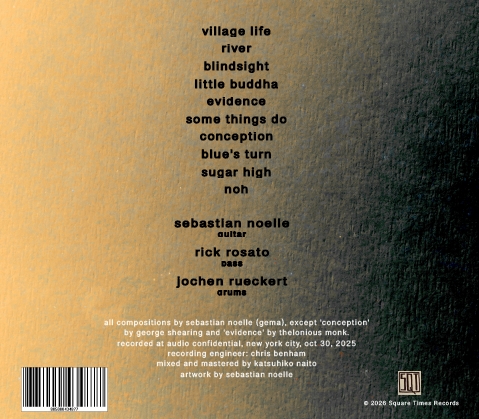
Tracklisting:
- Village Life
- River 06:59
- Blindsight 06:26
- Little Buddha
- Evidence
- Some Things Do
- Conception
- Blue’s Turn
- Sugar High
- Noh
All compositions by Sebastian Noelle, except “Concepion” by George Shearing, and “Evidence” by Thelonious Monk.
Musicians:
Sebastian Noelle – guitar
Rick Rosato – acoustic bass
Jochen Rueckert – drums
Credits:
Recorded on Oct 30, 2025 at Audio Confidential
Recording engineer: Chris Benham
Mixed & mastered by Katsuhiko Naito
CD: Gatefold Digipak with artwork by Sebastian Noelle