| Jazz |
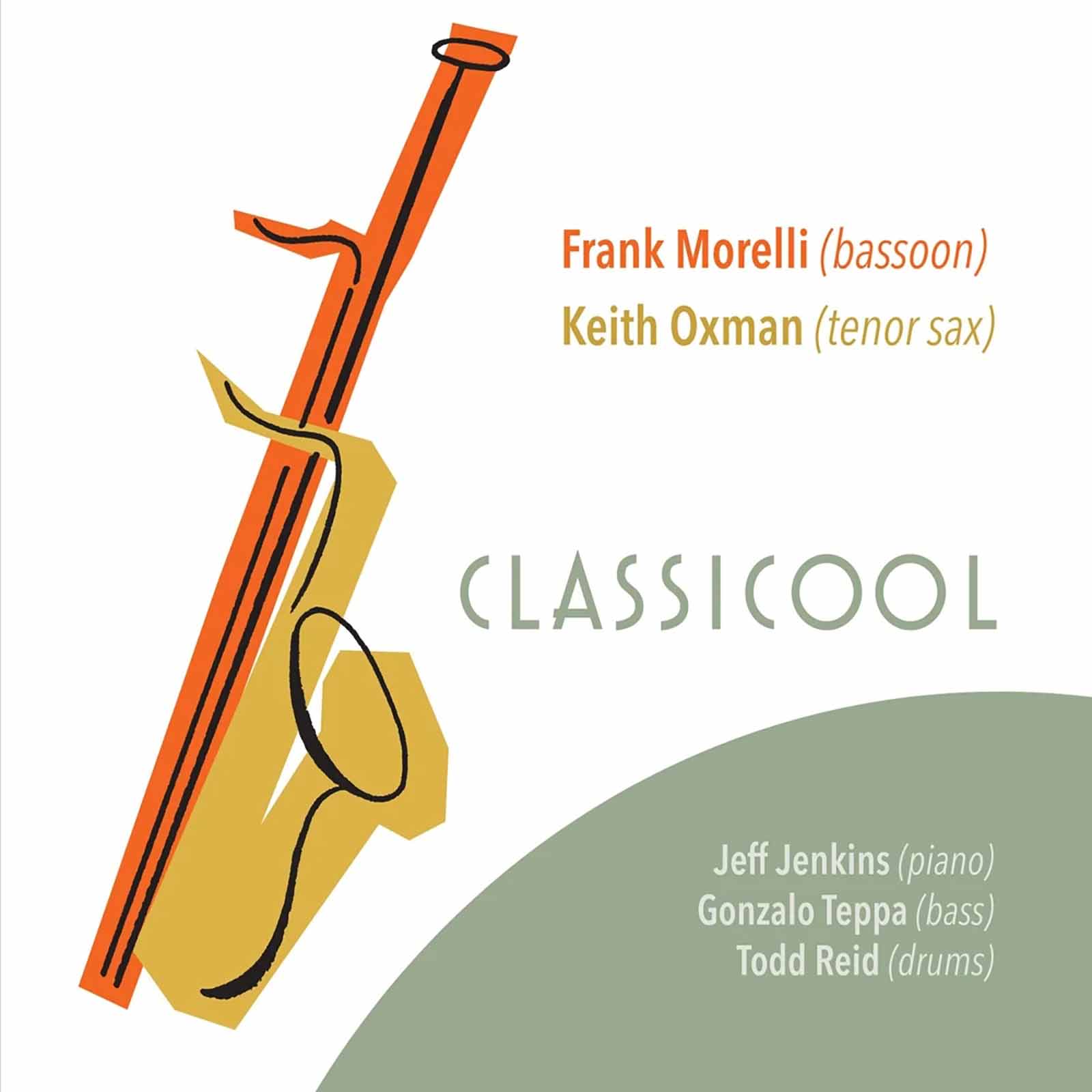
Classicool: When the Saxophone and Bassoon Decide to Blur the Lines
There are Sunday mornings that seem designed to make the world bearable. A steaming cup of coffee, an American croissant-generously sized, if not always faithful to its French ancestor-and a little music. Not the kind that demands to be understood, classified, or defended in polite company. Just music that knows what it is doing, and has the good manners not to announce it.
Classicool, the collaboration between saxophonist Keith Oxman and bassoonist Frank Morelli, belongs to that rare category. The album offers an encounter between two instruments that are not usually found sharing the same musical conversation. The saxophone, with its capacity for warmth, breath, and improvisational freedom; the bassoon, an instrument too often relegated to the margins of the orchestral landscape, despite its unmistakable voice and extraordinary expressive range. Together, they do more than make an unusual pairing. They quietly challenge the assumptions that keep musical worlds apart.
Jazz has always been fond of boundaries-provided someone is willing to cross them. Its history is a succession of encounters between traditions, instruments, cultures, and sensibilities that were not necessarily expected to get along. Yet the genre has also developed its own conventions, its own hierarchies, and, at times, its own little customs office. Certain instruments are welcomed without question; others are asked to explain what they are doing there.
The bassoon, in particular, has often been treated as an eccentric guest at the jazz table. Its association with the orchestral repertoire has tended to obscure its potential for improvisation, swing, and intimate musical exchange. Classicool does not arrive with a manifesto. It makes its argument through sound, with the confidence of musicians who understand that the most convincing revolutions are sometimes conducted without raising their voices.
Keith Oxman is a saxophonist whose musical identity has been shaped by the rich and demanding tradition of jazz. Based in Denver, he has worked with a range of musicians and performed in settings that include the big-band world, among them the Buddy Rich orchestra. Such experience leaves its mark: an instinct for phrasing, a sensitivity to ensemble dynamics, and an understanding that virtuosity is not an end in itself. Oxman’s playing is grounded in the language of jazz, but it is never imprisoned by its familiar vocabulary.
Frank Morelli brings a different musical history to the encounter. A graduate of the Manhattan School of Music and Juilliard, he has spent decades navigating the worlds of chamber music and orchestral performance. His long association with the Orpheus Chamber Orchestra, spanning some forty-five years, and his work with the Chamber Music Society of Lincoln Center place him firmly within the classical tradition. His recording history, which extends across roughly two hundred albums, suggests a musician who has made a career not merely of mastering an instrument, but of exploring what it can say.
On paper, the meeting might seem like an exercise in contrast: jazz saxophone on one side, classical bassoon on the other. In practice, the distinction proves less useful than expected. What matters is not the musical passport each performer carries, but the way they listen. Oxman and Morelli do not approach one another as representatives of rival institutions. They meet as musicians, with curiosity, patience, and a shared respect for the melody.
That is where Classicool finds its most compelling territory. The album is not built around a collection of original compositions designed to announce a new aesthetic. Instead, it draws on familiar material, allowing the arrangements and the instrumental dialogue to do the work. This is an important distinction. The ambition is not to prove that the saxophone and bassoon can play together. They plainly can. The more interesting question is what happens when they stop trying to sound like themselves in the most predictable sense.
The title itself offers a clue. Classicool is a small linguistic contraption, joining “classical” and “cool” with the ease of a musician finding the right note. It is playful without being frivolous, and it captures the album’s essential balance: a classical instrument stepping into a jazz conversation, a jazz musician discovering new colors, and neither one obliged to surrender an identity in the process.
The opening track, “Cool,” sets the tone. The title might suggest a knowing wink, but the performance avoids the trap of turning its own cleverness into a spectacle. The music unfolds with an understated assurance. The saxophone’s supple phrasing meets the bassoon’s darker, more textured voice, and the two instruments begin to exchange ideas rather than simply alternate solos. Their differences remain audible, and that is precisely the point. Harmony does not require uniformity; sometimes it depends on the pleasure of hearing two distinct voices remain distinct.
The bassoon’s sound is particularly revealing in this setting. Its low register can provide weight and grounding, but its middle range has a surprising capacity for lyricism. It can be woody, intimate, almost conversational. Against the saxophone, it offers neither a novelty effect nor a mere supporting role. It becomes a partner, capable of shaping a phrase, answering a musical question, or gently redirecting the conversation.
Oxman, for his part, understands the value of restraint. Jazz musicians are often praised for the speed and complexity of their improvisations, as though the number of notes were a reliable measure of intelligence. But a phrase can say more by leaving something unsaid. Here, the saxophone’s warmth and flexibility serve the music rather than the performer’s ego. Morelli responds with a similarly attentive approach, allowing the bassoon to inhabit the space between its classical pedigree and its less conventional possibilities.
The result is not a contest between genres, nor an attempt to dissolve them into a vague musical compromise. It is something more satisfying: a conversation in which each participant brings a distinct history and discovers that the other has been listening all along. The arrangements make room for that exchange. They do not overload the material with cleverness or insist on drawing attention to the unusual instrumentation. Their elegance lies in their clarity.
There is, of course, a certain irony in the fact that an album featuring a saxophone and a bassoon can sound so natural. We are accustomed to thinking of musical categories as if they were laws of nature. Classical music belongs in one room, jazz in another; one instrument is expected to behave according to its tradition, another according to its reputation. Yet these divisions are largely cultural habits, reinforced by institutions, marketing, and the comforting belief that everything has its proper place.
Classicool gently unsettles that belief. It reminds us that musical identity is not a fixed address. It is something musicians carry with them, adapt, and sometimes discover anew in the presence of another voice. Oxman and Morelli do not need to make a grand statement about crossing boundaries. Their playing makes the statement for them.
And perhaps that is the album’s quietest achievement. In a musical environment increasingly shaped by algorithms, playlists, and the relentless sorting of listeners into categories, Classicool proposes a more human form of discovery. It asks us to listen before deciding what something is supposed to be. It trusts that curiosity can do what classification rarely manages: bring us somewhere unexpected.
So, on a Sunday morning, with coffee cooling beside the plate and the croissant shedding its customary crumbs, one might do worse than spend a little time with this unlikely pairing. The saxophone and the bassoon have found common ground-not by pretending their differences do not exist, but by making those differences part of the music. A small lesson, perhaps, for the rest of us: the world does not always need another category. Sometimes it simply needs two people who know how to listen.
Thierry De Clemensat
Member at Jazz Journalists Association
USA correspondent for Paris-Move and ABS magazine
Editor in chief – Bayou Blue Radio, Bayou Blue News
PARIS-MOVE, November 1st, 2026
Follow PARIS-MOVE on X
::::::::::::::::::::::::
Musicians :
Frank Morelli – basson
Keith Oxman – saxophone ténor
Jeff Jenkins – piano
Gonzalo Teppa (ou Teppo) – contrebasse
Todd Reid – batterie (tracks 1 & 2)
Track Listing :
Cool
I Remember You
Tangerine
My Reverie
Come Sunday
Softly As In A Morning Sunrise
Sicilenne
Not Since Ninevah
And This Is My Beloved
Modinha
Lover Come Back To Me
There’s A Boat Dat’s Leavin’ Soon For New York