| Jazz |
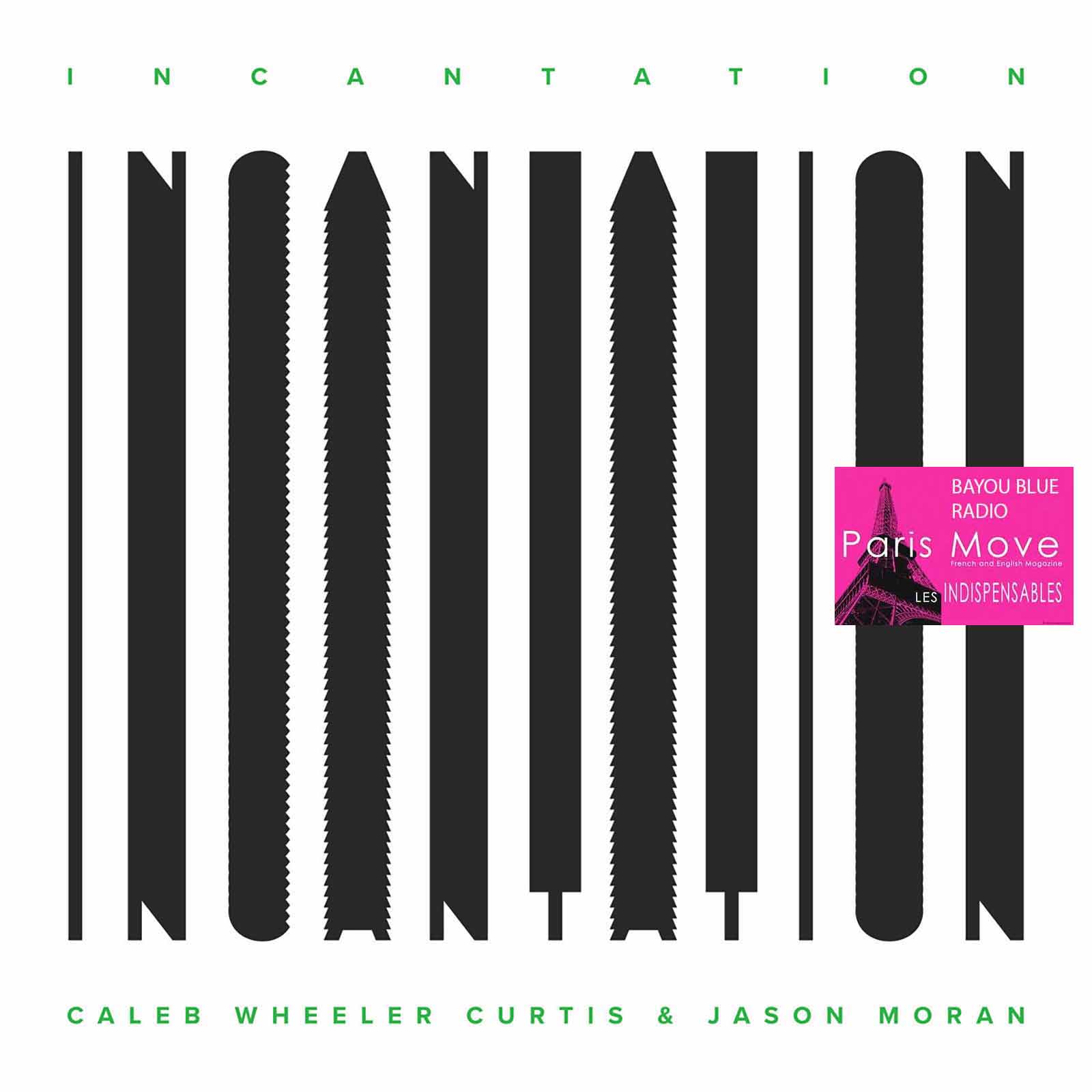
Summary: Caleb Wheeler Curtis and Jason Moran reinvent jazz tradition on Incantation.
Incantation: Caleb Wheeler Curtis and Jason Moran Reimagine Jazz’s Living Tradition
What better way to begin an October weekend than with a musical encounter as elegant as it is quietly commanding? The day has barely begun, coffee is steaming on the desk, and outside the window, squirrels dart from branch to branch with the restless energy of creatures seemingly oblivious to the world beyond their immediate concerns. The opening notes of Incantation, the new album by Caleb Wheeler Curtis and Jason Moran, released October 23, provide an unexpectedly perfect soundtrack to this small morning spectacle. There is something delightful about watching these animals leap about while a music of such depth invites us to slow down, pay attention and rediscover the pleasures of time ungoverned by urgency. Yet the scene also points toward something more substantial. From the first notes, the listener is drawn into the intimacy of this encounter, struck by the intelligence of the exchange and the rare sense of understanding that develops when two musicians have the experience, patience and confidence to listen as carefully as they play. Curtis, the multi-instrumentalist and composer whose work I have followed with particular interest, joins Moran, one of the most distinctive pianists and musical thinkers of his generation. Could this be the ideal duo of the 21st century? The question may sound extravagant, but it captures something essential about their partnership. Both musicians have developed unmistakable artistic identities, yet they move effortlessly between classical traditions, the many languages of jazz and the freedoms of contemporary improvisation. They do not appear troubled by the need to choose between inheritance and innovation. They understand that the two are inseparable, and that a musical tradition remains vital only when artists have the courage to make it their own.
Writing about musicians of this caliber inevitably invites the familiar vocabulary of critical praise: the complexity of a composer’s writing, the imagination of an improviser, the breadth of a musician’s cultural knowledge. Such assessments have their place. Curtis possesses a rare ability to unite structural rigor with an imagination that resists confinement, while Moran brings an extraordinary harmonic resourcefulness to his playing, discovering unexpected possibilities within seemingly familiar musical ideas. Yet words, however well chosen, can sometimes build a wall around the very music they are meant to illuminate. Ultimately, what matters is not the number of superlatives critics accumulate or the categories into which they attempt to place an artist. Our relationship with music is more personal than that, shaped by the instincts of the heart and mind, by impressions that resist easy explanation and remain with us long after the final note has faded. Incantation belongs to the kind of album whose full significance emerges gradually, through the coherence of its vision and the honesty of its expression. It asks neither for specialized knowledge nor for elaborate preparation. It simply asks us to listen. Before long, the experience feels less like attending a performance than joining a conversation among friends, with the reassuring sense that nothing needs to be proved and nothing must be anticipated. The music unfolds on its own terms, and we are free to follow wherever it leads.
The album’s title happens to echo Ritual, Curtis’s recent sextet recording, and the connection is worth considering. Both words suggest a ceremonial dimension, a way of placing music within a space that extends beyond the immediate pleasures of sound. Curtis has described the music as, in a sense, a call to the ancestors. He speaks with gratitude about the musicians who passed this extraordinary legacy down to subsequent generations, recognizing that playing jazz inevitably means invoking those who came before. The masters and artists we admire continue to inhabit the music, sometimes consciously, sometimes through gestures and inflections that have become almost instinctive. For Curtis, participating in the same history as Thelonious Monk and Eric Dolphy, Johnny Hodges and Duke Ellington, Cannonball Adderley and Jaki Byard, Orrin Evans and Jason Moran is an extraordinary honor. The sentiment might sound like a conventional declaration of reverence were it not so convincingly reflected in the music itself. This is neither an attempt to sanctify the past nor an effort to turn its legacy into a collection of obligatory references. Tradition survives through renewal, when works once regarded as monuments become living material capable of generating new questions and new forms of expression. In Curtis and Moran’s hands, their musical forebears never weigh down the creative process. They form its underlying memory, a presence that nourishes invention without dictating its direction.
Jazz has always developed through this productive tension between inheritance and independence. Its history makes clear that the most inventive musicians rarely create from nothing. They absorb what they have heard, transform it and sometimes challenge the conventions they inherited. Each generation receives gestures, sounds, rhythmic ideas and harmonic structures that it eventually reshapes. Fidelity does not necessarily mean repetition, just as novelty alone does not guarantee artistic substance. What matters is the ability to turn memory into an active force, allowing it to inform the present without imposing an idealized version of the past. Incantation occupies precisely this territory. Curtis and Moran draw on a wealth of influences, but they never present them as quotations designed to reward the recognition of an informed listener. Those influences have been absorbed, reconsidered and integrated into a language that belongs to the musicians themselves. One may hear echoes of jazz piano’s long history, the melodic freedom of saxophonists who pushed beyond bebop or the daring of musicians who moved outside established frameworks. Yet nothing here feels like an academic exercise. These references are not displayed like objects in a collection. They circulate through the music, almost invisibly, like memories that lend depth to a conversation without ever becoming its sole subject. The result is a music conscious of its past but entirely engaged with the present.
Curtis and Moran last met in the studio in 2018, recording Freebird, a postmodern tribute to Charlie Parker with the members of Walking Distance. At the time, their professional positions were somewhat different. Moran, already an established force in contemporary jazz, appeared as a featured guest alongside a collective still making its way into wider view. Walking Distance was recording its second album, and the result was compelling enough to earn a place on The New York Times’ list of the year’s 20 best jazz albums. Since then, Curtis has continued to develop a distinctive artistic identity, expanding his musical horizons and pursuing new avenues of exploration. His interest in the stritch, a rare straight-bodied relative of the alto saxophone, and his work with the trumpet reflect a curiosity that refuses to settle for familiar achievements. His collaborations and independent projects reveal a musician who regards instrumental expression as an open territory, one whose possibilities remain to be discovered. Moran, meanwhile, continues to explore the connections between jazz, history, collective memory and other forms of artistic expression. By the time they reunite for Incantation, the differences in reputation that may once have shaped their relationship have largely receded. Moran remains a major figure, but Curtis is no longer simply a younger musician crossing paths with an established master. Each has developed a voice strong enough to make this encounter something more than a mentorship or a passing collaboration. Their partnership rests on genuine artistic equality, on the possibility of bringing two musical worlds together without requiring either to surrender its identity.
That equality is audible in the album’s conception and execution. The program draws on compositions from the musicians’ respective repertoires, a new work, pieces by colleagues and predecessors, and passages of free improvisation. Such variety could easily have resulted in a fragmented collection. Instead, it creates a remarkable sense of continuity, as though each track were another stage in a conversation whose participants understand its underlying rules well enough to disregard them when necessary. Curtis’s saxophone can be supple and winding, then suddenly incisive, without ever relying on sheer force of expression. Moran’s piano does not merely accompany or reinforce the melodic line. It questions it, sometimes resists it, opens unexpected paths or leads it into territory where it seems to discover its own possibilities anew. The roles are constantly shifting. A phrase begun by one musician becomes the starting point for the other’s response; an interruption, a silence or a subtle change in inflection can redirect the entire exchange. The dialogue does not stop when one instrument falls silent. On the contrary, it is often in the spaces left open, in what remains unresolved, that their understanding becomes most apparent. Each musician makes room for the other without retreating into passivity. The music’s vitality depends on that balance between individual conviction and the willingness to be surprised.
There is also a striking awareness of time at work throughout the recording. At a moment when cultural production seems compelled to compete for immediate attention, when works are routinely judged by their ability to make an instant impression, Curtis and Moran take a different approach. They allow for detours, pauses and phrases that appear to search for direction before finding it. They understand that freedom does not mean the absence of structure, just as complexity does not require accumulation. Each note seems to have its place, but that place is never entirely fixed. Silence is not an empty space to be filled; it becomes part of the musical argument, allowing listeners to extend the experience of what they have just heard. This command of time gives the album an almost meditative quality without reducing it to background music. There are moments of tension, sharper exchanges and abrupt turns that remind us improvisation is not synonymous with tranquility. Yet even when the musicians challenge one another, their opposition never becomes a display of virtuosity for its own sake. It retains the precision of a conversation in which each participant is willing to be changed by the other. What emerges is not a contest between two accomplished players but a shared investigation into what music can become when neither musician feels compelled to dominate.
That willingness becomes particularly revealing in Archaeology, an improvisation recorded toward the end of the session in which Curtis plays trumpet. Relatively new to the instrument, he confronted a vulnerability he made no attempt to conceal. He has described looking at the trumpet nearby, wondering when he would find the courage to pick it up and cross that threshold. In a duo this exposed, where every decision is immediately audible, risk cannot be concealed behind the density of a larger ensemble. Hesitation, fragility and uncertainty become part of the experience. What might have been an obstacle instead becomes a resource because both musicians are willing to relinquish some control. This is essential to artistic creation: mastering an instrument is not enough; one must also be willing to confront what one has not yet learned to do. Freedom does not mean abandoning discipline or standards. It means accepting the unknown despite one’s experience, despite the work already completed and despite the understandable desire to succeed. Archaeology carries the trace of that willingness to take a chance. Its significance lies not only in the result but also in what it reveals about the relationship between the two musicians: a trust strong enough to allow uncertainty itself to become music. The episode also offers a glimpse of Curtis’s broader artistic temperament. Rather than treating experience as a guarantee of security, he seems to regard it as a reason to keep moving toward the unfamiliar.
One of Incantation’s greatest strengths is its refusal to reserve complexity for listeners already fluent in the language of contemporary jazz. The writing is demanding, the interplay often subtle, and certain passages reward particular concentration. Yet the album never tries to intimidate its audience. It does not require listeners to know the genealogies of jazz or the theories of improvisation to appreciate what is happening. One need only remain attentive, allow the pieces to unfold and follow the shifting conversation. This marks an important distinction between music that uses knowledge as a boundary and music that treats it as an invitation. Curtis and Moran are not trying to prove that they know their classics, possess impeccable technique or can push improvisation toward ever more extreme territory. Their knowledge has become sufficiently integrated that it no longer needs to announce itself. It emerges through the precision of their choices, through the decision to hold back rather than extend a gesture, through the intelligence of a response that feels anything but automatic. The result has an intimacy that in no way diminishes its artistic ambition. At times, listening feels like sitting at a table with friends whose conversation unfolds naturally, complete with moments of lightness, silences and disagreements. Only gradually does one recognize how much sustained attention, listening and precision lie beneath that apparent ease. This is music that trusts the listener, and that trust is part of its generosity.
It would nevertheless be reductive to regard Incantation simply as a demonstration of rapport between two exceptional musicians. Beyond the quality of the performances, what makes the album compelling is the way it considers the artist’s place within a collective history. Curtis and Moran do not present themselves as custodians charged with preserving an intact inheritance. They are creators who understand that memory matters only when it continues to generate movement. Their music neither attempts to summarize jazz nor offers a definitive account of what it should be. Instead, it reveals the genre’s capacity to accommodate different sensibilities, bringing discipline and risk, reflection and emotion, intimacy and invention into the same space. The approach has implications beyond music. At a time when novelty is often treated as an imperative and tradition is sometimes reduced to a marketing device, Incantation reminds us that genuine creation cannot be confined to either category. Innovation does not require a systematic break with the past; respect for an inheritance does not mean giving up the right to transform it. Everything depends on how an artist engages with what has been received and what he chooses to do with it. Curtis and Moran offer no manifesto, yet their music makes a persuasive case for an artistic culture in which history is neither discarded nor worshiped, but continually reexamined through the act of creation.
By the end of the album, I am reminded of what has long drawn me to musicians who turn their knowledge into a source of freedom rather than a badge of distinction. They understand that the works of the past belong neither exclusively to them nor entirely outside their reach. Their responsibility is to make those works resonate differently, to bring them into the present without erasing their history. Incantation succeeds precisely because it sustains that balance. It does not strain to impress, lose itself in technical display or sacrifice feeling to intellect. Instead, it moves with the quiet assurance of artists who have worked their language long enough to step beyond their own certainties. On this October morning, as the coffee cools and the squirrels continue their restless journeys outside the window, the album comes to an end before I have quite noticed the passage of time. What remains is the rare feeling of having been present for a conversation in which not a word was wasted, a conversation whose silences continue to resonate after the speakers have left the room. Perhaps that is the finest measure of this duo’s achievement: the reminder that music, when guided by intelligence, memory, attentive listening and the heart, does not need to raise its voice to reach us. Nor does it need to proclaim its modernity. It simply needs to be alive.
Thierry De Clemensat
Member at Jazz Journalists Association
USA correspondent for Paris-Move and ABS magazine
Editor in chief – Bayou Blue Radio, Bayou Blue News
PARIS-MOVE, October 24th, 2026
Follow PARIS-MOVE on X
::::::::::::::::::::::::
Musicians:
Caleb Wheeler Curtis – stritch, soprano saxophone (1, 4, 7), trumpet (9)
Jason Moran – piano
Track Listing:
That Which Cannot Be Replaced
Miss Nancy
Ain’t No Storm
Gangsterism on a River
One Hundred Years
Tiramisu for Two, Restin’
Incantation, Archaeology
Big Small
Flotation Device and the Shivers
Storm (reprise).
Tracks 1, 3, 8, 11, and 12 by Caleb Wheeler Curtis (BMI)
Tracks 4 and 7 by Jason Moran (JAMO PUBLISHING, BMI)
Tracks 5 and 9 by Caleb Wheeler Curtis & Jason Moran
Track 2 by Arthur Blythe (RAY ART MUSIC, BMI)
Track 6 by Noah Garabedian (NOAHGNOAHG, BMI)
Track 10 by Orrin Evans (BIG JIMMY MUSIC, SESAC)
Recorded December 18, 2025 at The Bridge Studio, Brooklyn, NY by Amon Drum, Greg Tock, and Urosh Jovanovich
Mixed and Mastered by Dave Darlington at Bass Hit Recording, New York, NY
Artwork and Design by Nico Raddatz
Produced and Edited by Caleb Wheeler Curtis