
| Jazz |
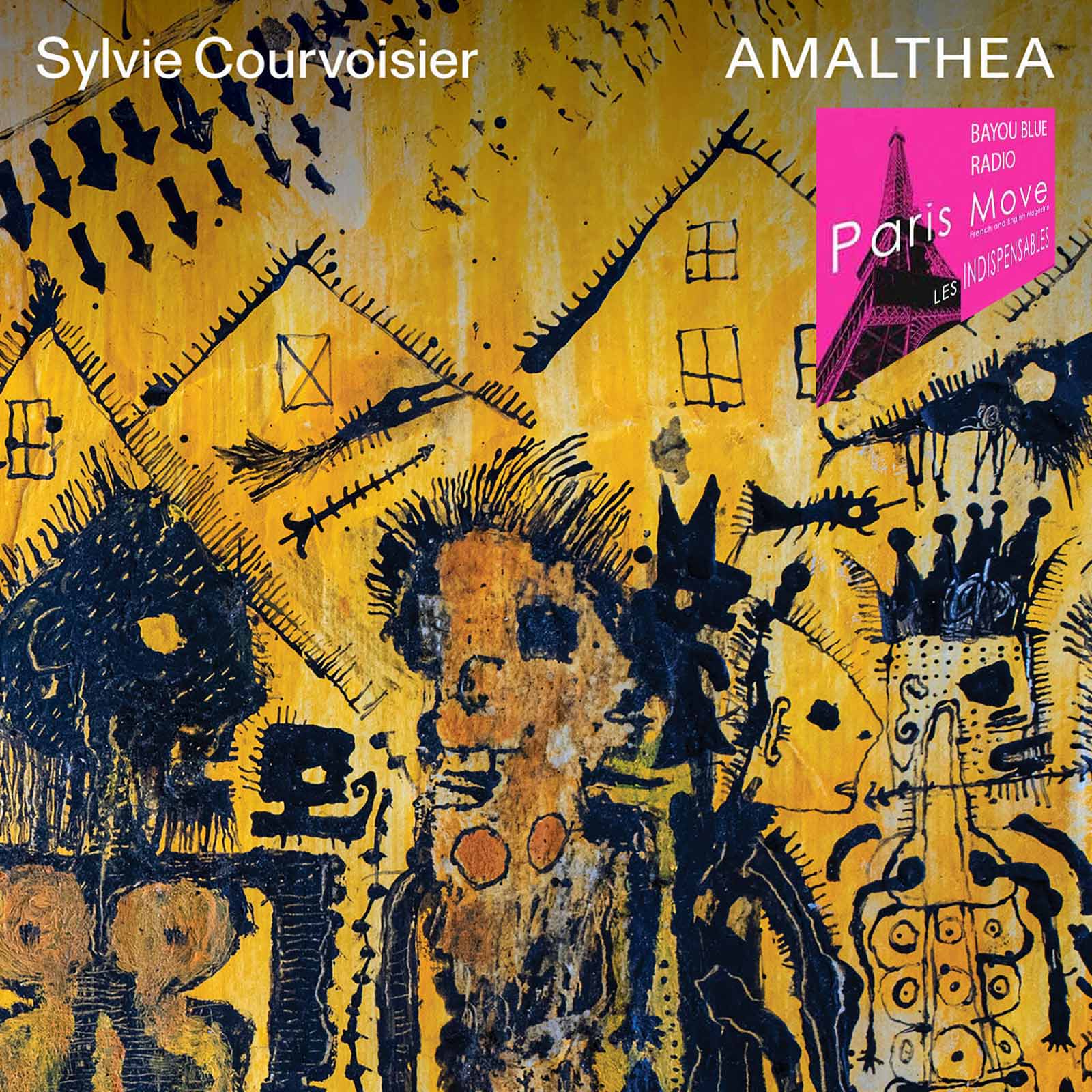
Summary: Sylvie Courvoisier and Patricia Brennan explore adventurous contemporary jazz on Amalthea, blending improvisation, inventive composition and rhythmic complexity.
Sylvie Courvoisier and Patricia Brennan: The Art of Taking Chances on Amalthea
Sylvie Courvoisier is unquestionably one of the most talented musicians of her generation. That alone would be reason enough for me to pay attention to a new recording, but the presence of vibraphonist Patricia Brennan makes Amalthea an even more enticing proposition. Here are two artists whose musical personalities are strong enough to sustain projects of their own, yet who seem to find particular inspiration in working together. Add bassist Thomas Morgan and drummer Dan Weiss, both musicians of uncommon imagination, and I hardly need another reason to listen. What I did not want was simply another album on which four accomplished players take turns demonstrating what they can do. We have heard plenty of those, and technical mastery, however impressive, is rarely enough to sustain my interest for long. Fortunately, that is not what happens here. From the first notes of “La Chimère aux yeux verts,” the quartet establishes a musical identity that is both demanding and inviting. The writing is intricate without becoming a puzzle for its own sake, and the performances have a collective coherence that matters more than any individual display of virtuosity. Formerly known as Poppy Seeds, the group has developed into a project in which the musicians’ distinct personalities serve the music rather than compete for attention. What interests me most is the quality of their interaction: the sense that every instrument has a reason to be there, and that the music would be diminished if any one of them were missing.
For anyone who has not yet discovered Courvoisier, her career offers a good place to begin. Born in Switzerland and now based in Brooklyn, she brings a formidable classical education to jazz and improvised music, but has never seemed inclined to remain within the boundaries that education might have prescribed. Her collaborations with artists such as the extraordinary trumpeter and composer Wadada Leo Smith and guitarist Mary Halvorson offer some indication of her range and curiosity. She is a pianist who can make the instrument sound almost percussive one moment and unexpectedly tender the next, without making either side seem like a departure from the other. What interests me is not simply her command of different musical vocabularies, but the way she puts them to work. Her classical training can be heard in the architecture of a composition, the precision of a gesture and the sense that even the most unruly passage has been carefully considered. Yet she never sounds as though she is demonstrating her credentials. The music takes precedence over the display of knowledge. On Amalthea, her compositions provide a recognizable structure while allowing the performers to discover details that might not be apparent on the page. This is where Courvoisier’s experience as both pianist and composer becomes particularly valuable: she understands how to give a piece shape without exhausting its possibilities in advance.
The meeting between Courvoisier’s piano and Brennan’s vibraphone is where much of the album’s character takes shape. I have always found the vibraphone an intriguing instrument, capable of sounding both sharply defined and strangely elusive, its notes continuing to resonate after the musician has moved on to something else. Brennan knows how to use that quality without falling into the trap of making atmosphere an end in itself. Her playing has substance, direction and a rhythmic intelligence that makes her a genuine partner to Courvoisier. The piano, with its wider range of attack and weight, might easily dominate such an exchange. It does not. Instead, the two instruments continually change the way we hear one another. A phrase that sounds almost aggressive under Courvoisier’s fingers can take on another meaning when Brennan enters; a vibraphone figure can reveal a shape in the piano writing that was not immediately apparent. Their exchanges are not always smooth, and that is precisely the point. The occasional friction gives the music its edge, while their shared sense of timing prevents the differences from becoming disconnected gestures. Brennan is not there merely to soften the piano’s sharper contours, nor is Courvoisier simply providing a framework for the vibraphone. Each contributes ideas that alter the direction of the other, producing a musical relationship that is more substantial than the novelty of the instrumental pairing might initially suggest.
Brennan deserves particular recognition for the independence of her contribution. It would be easy to describe her role primarily in terms of timbre, emphasizing the brightness and resonance of the vibraphone against the piano’s greater physical weight. But that would miss what makes her playing so effective. She is not there simply to provide a contrasting color. Her phrasing, rhythmic choices and ability to sustain a musical argument make her an equal participant in the construction of the music. Collaborations between strong instrumental personalities can sometimes become exercises in accommodation, with each musician making room for the other without the music itself developing much beyond the sum of its parts. Here, the exchange feels more consequential. Brennan can challenge the expectations established by Courvoisier, just as Courvoisier can redirect the way we hear Brennan. Their differences are not obstacles to be smoothed over; they are what make the collaboration interesting. Amalthea does not rely on the novelty of putting two unusual instrumental voices together. It gives those voices enough compositional and rhythmic substance to discover something beyond the obvious possibilities of the pairing.
Thomas Morgan and Dan Weiss are equally essential to the result. The bass and drums can so easily become the part of a group that listeners take for granted, especially when the piano and vibraphone attract most of the attention. That would be a mistake here. Morgan has the ability to give the music a point of reference without weighing it down, while Weiss approaches rhythm as something to be shaped, questioned and occasionally thrown off balance. Neither is content merely to keep things moving. They help determine where the music goes, and their decisions often open up possibilities that the other two musicians immediately recognize. I find the cohesion of this quartet more impressive than any individual display of technique. Four distinct personalities are present, but the music never feels like a negotiation over who gets the last word. Everyone seems to understand that a well-placed note, a sudden change in emphasis or a little space left unfilled can accomplish more than an elaborate solo. The rhythm section is not simply the ground on which the other instruments can move; it is an active force in the music’s development. Morgan can provide direction while leaving the harmony unsettled, and Weiss can change the character of a passage without resorting to the obvious punctuation of a conventional beat. Their contributions may not always announce themselves, but the quartet’s coherence depends on them.
There is something in Amalthea that takes me back to Béla Bartók. Those of you who, like me, spent part of your youth torturing yourselves trying to play his music will understand what I mean. Bartók could make a rhythmic figure feel both inevitable and completely foreign, as though the music were following rules that our ears had not yet learned to recognize. The challenge was not simply to get the notes right. One had to understand how they related to one another, where the emphasis belonged, and why a phrase that looked perfectly logical on the page could feel so resistant under the fingers. I hear a related spirit here, not because Courvoisier and her colleagues are trying to reproduce Bartók’s language, but because they share a willingness to let musical ideas resist easy resolution. The harmonies can be sharp, the accents unexpected, the movement of a phrase difficult to predict. There is a particular satisfaction in recognizing something of that world in a contemporary improvising quartet, although the resemblance should not be pushed too far. The music on Amalthea belongs to its own time and to the individual imaginations of its performers. What links these musical experiences, for me, is the willingness to listen beyond familiar patterns and accept that a composition may require us to reconsider our assumptions before it begins to reveal its logic.
There are also moments that bring repetitive music to mind, in which a pattern returns and, through the smallest changes, becomes something else. I have always found this approach fascinating when it is done well. It asks us to listen more carefully rather than simply wait for the next event. A figure that initially seems straightforward begins to reveal its internal tensions; what sounded familiar a moment ago becomes less certain. Repetition can establish stability, but it can also expose how fragile that stability really is. A slight alteration in emphasis, a note that arrives earlier than expected, or a change in the relationship between instruments may be enough to transform an entire passage. Movement does not always mean advancing in the conventional sense. Sometimes the music develops by looking at the same idea from another angle. These are associations I bring to the record, not labels I would impose on it. Amalthea draws on a broad musical culture, but its achievement is not that one can identify its influences. It is that those influences have become part of a language with its own character. The listener does not need to recognize Bartók, repetitive music or any other point of reference to appreciate the record. Such connections enrich the experience, but they should never become a substitute for hearing what the musicians are actually doing. A work of art is not made more interesting merely because we can attach it to an established lineage. What matters is whether it has something of its own to say.
I realize perfectly well that this is not an album for everyone. It requires concentration, and listeners who want an immediately memorable melody or a rhythm that settles comfortably into place may find it demanding. I have no desire to pretend otherwise. Nor do I believe that complexity, on its own, makes music more worthwhile. We have all heard difficult music that gives little back for the effort it demands, just as we have heard apparently simple music whose emotional depth reveals itself only after repeated listening. Difficulty is neither a guarantee of quality nor a reason to dismiss a work before giving it a chance. The question is whether the listening experience becomes richer as we spend more time with it. In the case of Amalthea, I believe it does. The compositions have substance, the musicians have something to say, and the performances reward attention without making a spectacle of their own sophistication. One does not have to understand every musical decision to feel that it belongs. Indeed, the desire to explain every detail can sometimes get in the way of listening. There is a point at which analysis must give way to experience, when we have to allow the music to affect us before deciding what it means. For me, listening to a record like this requires both an open mind and an open heart. I want to follow the construction of the music, but I also want to be moved by it, caught off guard by a turn of phrase, or amused when a passage refuses to behave as expected. Art loses something when we approach it only to test our own knowledge. Sometimes we need to stop analyzing long enough to let the music get under our skin.
And that brings me to something I particularly appreciate about this album: its humor. For all its sophistication, Amalthea does not take itself quite as seriously as its musical vocabulary might suggest. There is a mischievous quality in the way the musicians play with expectations, allowing a passage to develop before taking it somewhere the listener may not have anticipated. The humor is not an attempt to make demanding music more accessible, nor does it undermine the seriousness of the compositions. On the contrary, it is part of what gives them life. These musicians are prepared to take chances, and taking chances means accepting that the outcome cannot always be predicted. I find that attitude refreshing. Contemporary music can sometimes be presented as though its principal purpose were to demonstrate intellectual rigor, leaving the listener with the impression that enjoyment is somehow secondary. But there is nothing inherently more profound about music that seems determined to keep its audience at a distance. A composition can be complex without being forbidding, and a musician can be serious about the work without appearing to have forgotten why making music is worth the effort. Courvoisier, Brennan, Morgan and Weiss understand that rigor and pleasure are not opposing forces. Their occasional musical surprises, shifts in character and unexpected turns of phrase give the album a liveliness that prevents its formal sophistication from becoming an end in itself.
What also appeals to me is the absence of any obvious need to demonstrate that these musicians belong to a particular school or tradition. Jazz, contemporary composition and improvisation have long shared musical territory, but the relationship between them is not always as fruitful as it might be. Sometimes the result sounds like a stylistic compromise, with one vocabulary used to soften the edges of another. Sometimes the music seems more concerned with announcing its modernity than with developing a coherent artistic identity. I do not hear that problem on Amalthea. The quartet does not need to erase the differences between its influences, nor does it have to make every passage immediately recognizable as jazz. It can allow a composition to unfold according to its own demands, trusting the musicians to find the appropriate balance between structure and spontaneity. This is a more convincing way of approaching musical tradition than treating it as a set of rules to be either obeyed or rejected. The musicians know what they bring to the table, and they seem comfortable enough with their own identities not to need constant confirmation of them. One can follow the interplay of the instruments, attend to the rhythmic construction, recognize certain compositional affinities or simply enjoy the succession of sounds and unexpected turns. None of these approaches cancels out the others, and none is a prerequisite for appreciating the record.
I would not claim that Amalthea offers a definitive solution to the relationship between composition and improvisation. That would be asking too much of a single album, and it would also miss the point. These questions have occupied musicians for generations, and there is no reason to expect them to be settled once and for all. What matters is the quality of the answer offered on a particular recording. Here, the answer lies in the quartet’s ability to make written music feel alive in performance, while ensuring that the improvised passages remain connected to a larger design. A tightly constructed passage does not sound rigid, and a sudden change of direction does not make the music feel arbitrary. The musicians preserve the character of the compositions while allowing the performance to reveal details that could not simply be written into a score. This is where Courvoisier’s compositional intelligence and the contributions of Brennan, Morgan and Weiss come together most successfully. The album feels considered without sounding mechanical. It does not confuse unpredictability with artistic purpose, and it never relies on complexity alone to hold the listener’s attention. Anyone who spends time with adventurous music knows how difficult it can be to find this kind of balance, particularly when four strong personalities must contribute to a single musical argument.
What remains with me after listening to Amalthea is the conviction that these four musicians have found a particularly fruitful way of working together. Courvoisier and Brennan bring contrasting sensibilities to the music, while Morgan and Weiss contribute a rhythmic imagination that is inseparable from the compositions themselves. The result is neither a compromise between jazz and contemporary music nor an attempt to dissolve every distinction between them. It is something more convincing: musicians who know their traditions well enough to draw on them without being confined by them. I do not expect every listener to share my enthusiasm, and there are records I admire intellectually without feeling any particular desire to hear them again. This is not one of those records. Amalthea has the kind of musical substance that makes me want to return to it, to hear what I missed and reconsider what I thought I understood. Of the albums I have heard this year, it is certainly among the most compelling. Its brilliance lies not in the fact that these musicians can play difficult music, but in the way they make that music feel necessary, alive and open to surprise. I began listening because Courvoisier and Brennan seemed to me an irresistible combination. I finished with a renewed appreciation for the quartet as a whole, and for the intelligence, humor and musical sensitivity that bind the record together. That is a considerably rarer achievement than technical perfection, and a far more satisfying reason to recommend an album.
Thierry De Clemensat
Member at Jazz Journalists Association
USA correspondent for Paris-Move and ABS magazine
Editor in chief – Bayou Blue Radio, Bayou Blue News
PARIS-MOVE, October 17th, 2026
Follow PARIS-MOVE on X
::::::::::::::::::::::::
Musicians :
Sylvie Courvoisier: piano, composition
Patricia Brennan: vibraphone
Thomas Morgan: double bass
Dan Weiss: drums
Track Listing :
La ChimèRe Aux Yeux Verts
Queen Of Spades
King Of Hearts
Simone
At Risk
Knots And Dander
Circumbent
Le Pavot Rouge
Credits:
All compositions by Sylvie Courvoisier (SUISA, ASCAP)
Produced by Sylvie Courvoisier
Recorded by Ryan Streber on April 22, 2025 at Oktaven Audio, Mount Vernon, NY
Edited by Owen Mulholland at 35 Street Studio, NYC
Mixed by James Farber on November 1 & 2, 2025 at Reservoir, NYC
Mastered on January 28, 2026 at Skye Mastering by Denis Blackham
Album art by Philippe Azéma, photographed by Mario Del Curto
Portrait by Véronique Hoegger
Design by Michael Dyer / Remake
Special thanks to the American Academy of Arts and Letters, James Farber, Owen Mulholland, Kris Davis, Ned Rothenberg, Nate Wooley, and David Breskin