| Jazz |
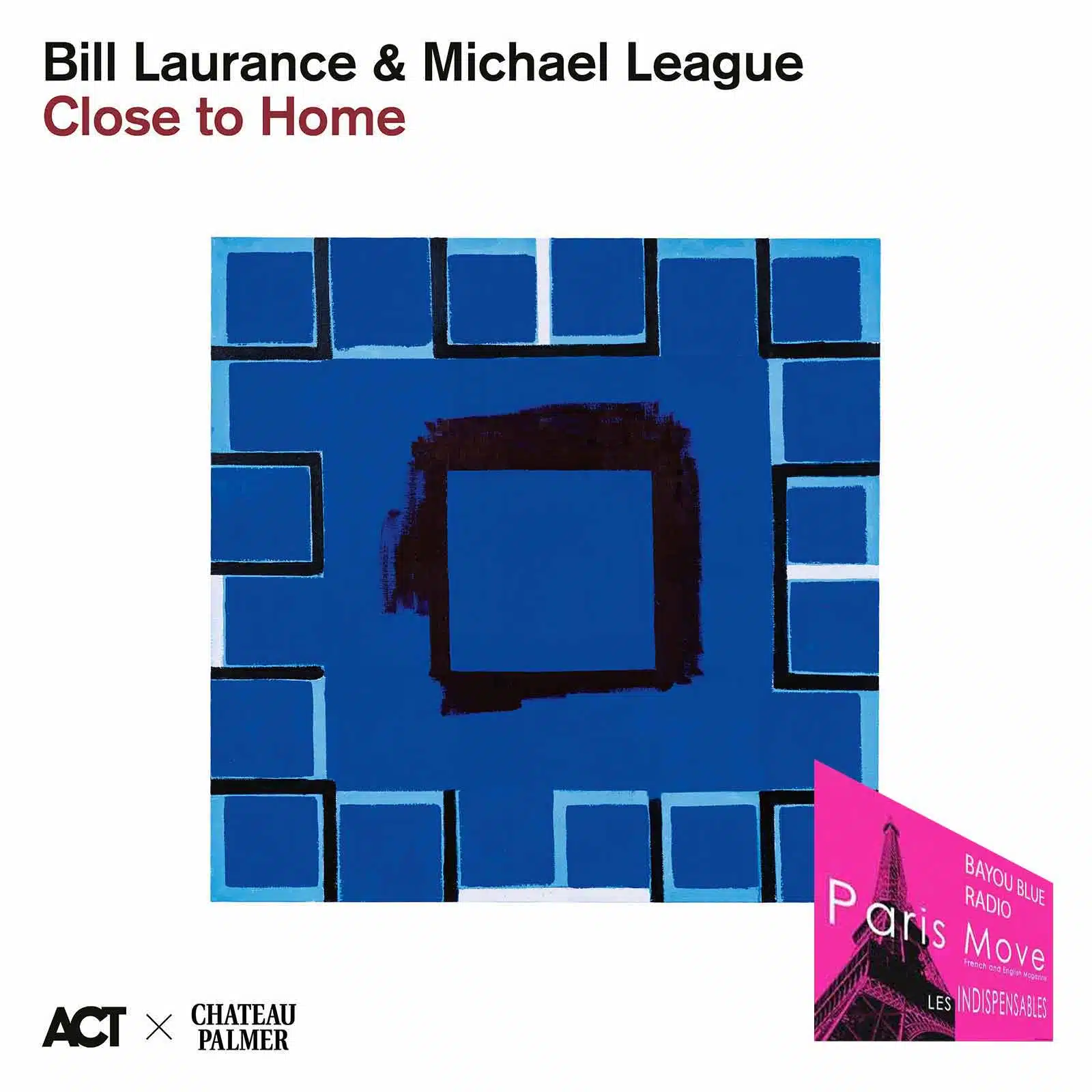
Summary: Bill Laurance and Michael League’s Close to Home explores contemporary jazz through piano, bass, oud and minimalist musical interplay.
Bill Laurance and Michael League: Close to Home and the Art of Musical Conversation
In the visual arts, minimalism has its own pantheon of pioneers, among them Tony Smith, Donald Judd and Carl Andre, whose work challenged conventional ideas of form, material and space throughout the 20th century. By stripping away ornament, narrative and representational excess, these artists demonstrated how a reduction of means could intensify an experience rather than diminish it. Their sculptures drew attention to the object itself, its physical presence and its relationship to the surrounding space. In music, the pursuit of such economy has taken a different course, but the underlying question remains: How much can be expressed with the fewest possible means? Pianist and composer Bill Laurance and bassist, composer and oud player Michael League explore that question on Close to Home, their third album as a duo, scheduled for release Nov. 13, 2026, on ACT Music. From the opening of “Luray” to the melodic appeal of “Never Miss a Thing,” the album combines supple rhythms, carefully shaped harmonies and understated virtuosity. Laurance and League demonstrate that simplicity is not the absence of complexity but its distillation. Their arrangements leave room for each idea to develop, and their economy of means gives the music both clarity and depth.
The album’s strength lies in the musicians’ ability to listen and respond to one another. The piano never monopolizes the melodic conversation, and the bass is not confined to a supporting role. Ideas pass between them, gathering momentum, changing direction or giving way to silence. Neither musician needs to assert his presence at the expense of the other. Their previous albums and performances have earned them a devoted following, built on a distinctive musical language rather than novelty. Close to Home develops that language without relying on familiar formulas. Its compositions are carefully structured yet remain open to spontaneous interaction. Beneath their apparent ease lies a sophisticated balance of rhythmic variation, harmonic movement and melodic restraint. Repeated listening brings details into focus: a shift in emphasis, an unexpected chord or a phrase whose significance emerges from the space around it.
For this third collaboration, Laurance and League traveled to Château Palmer in France’s Bordeaux region, an estate known for its wines and for its growing involvement in artistic projects. Since 2023, the château has hosted an annual recording initiative developed by Andreas Brandis, ACT’s managing director and producer, and Thomas Duroux, the estate’s director. The setting matters less for its prestige than for the working conditions it provides. Away from the pressures of conventional recording schedules, musicians can develop ideas without having to rush toward a finished product. In an industry shaped by constant output, visibility and rapid consumption, that freedom offers a welcome alternative. Music requires time not only to be composed and performed but also to acquire its final form.
“When we arrived at Château Palmer in late April 2026, time seemed to slow down instantly,” the musicians write in the album notes. “It’s a place where nature is allowed to take its course, to take all the time it needs; it was the perfect setting for recording.” That unhurried atmosphere informs the album without turning the surrounding landscape into a musical program. The compositions develop through gradual changes, pauses and shifts in direction. Their contemplative quality never becomes inertia: The music remains alert, responsive and rhythmically alive. Rather than imposing a predetermined emotional narrative, Laurance and League allow the listener to follow the progression of their ideas and discover their subtler implications.
Recording engineer Nic Hard helps preserve the directness of the performance. The musicians describe Close to Home as an exploration of the duo in its purest form, from composition to interpretation, and the recording reflects that intention. The clarity of the sound allows variations in touch, tone and timing to register without drawing attention to the production itself. Such restraint requires more than technical proficiency. It depends on knowing when to develop an idea, when to leave it unresolved and when to let the other musician take the lead. Silence becomes part of the musical structure rather than an interval to be filled. The result feels spontaneous without sacrificing precision, and intimate without becoming self-indulgent.
League’s bass provides the rhythmic foundation and much of the music’s forward motion. Deep, warm and flexible, it establishes the pulse while remaining responsive to changes in the piano’s phrasing. His lines do more than support the harmony: They shape the direction of the compositions, introduce tension and create openings for the other instruments. League knows when to reinforce the groove and when to soften it, maintaining momentum without making the rhythm predictable. His playing gives the music a physical presence while preserving its lightness. The bass is central to the duo’s balance, connecting rhythmic stability with the freedom to depart from it.
Laurance’s piano brings melodic clarity and harmonic invention. His phrases are fluid, but their apparent spontaneity rests on a strong sense of structure. Rather than turning his formidable technique into a display of virtuosity, he concentrates on the possibilities contained in a melody, the color of a chord or a subtle change in phrasing. His playing draws on League’s rhythmic foundation while continually testing its boundaries. The resulting exchange keeps the music moving between stability and uncertainty. Laurance’s harmonies add depth without obscuring the melodies, which remain accessible precisely because they are not overloaded with ornament. His restraint is not a limitation but a deliberate artistic choice.
The oud introduces a different melodic and timbral dimension. Unlike the bass, which anchors the rhythmic and harmonic movement, the oud offers a distinct voice shaped by its resonant wooden body and its long associations with Arab and Mediterranean musical traditions. Its sound brings an earthy, finely articulated quality that contrasts with the piano’s clarity and the bass’s depth. League integrates the instrument into the duo’s musical language rather than using it as an exotic flourish. The oud changes the texture, introduces different melodic inflections and expands the dialogue beyond the familiar exchanges of piano and bass. Its presence acknowledges a broader musical geography, shaped by centuries of contact and exchange, without reducing cultural traditions to decorative references. The instrument retains its identity while contributing to a coherent contemporary jazz language.
Rhythm unites these elements without imposing a rigid framework. The bass establishes a pulse that the piano can extend, interrupt or redirect, while the oud adds another layer of melodic movement. The interaction remains fluid, giving the compositions energy even in their quieter passages. “Luray” establishes a mood of quiet intrigue, while “Never Miss a Thing” more directly demonstrates the duo’s gift for memorable melody. Both pieces reward repeated listening, revealing details that may initially escape notice. Close to Home is accessible without being simplistic, sophisticated without becoming forbidding, and technically accomplished without making technique its principal attraction.
The album also raises a broader question about how music is produced and consumed. In a cultural economy dominated by the rapid circulation of content and the pressure to capture attention immediately, Laurance and League offer a different measure of artistic value. Their music does not rely on spectacle or constant escalation. It asks the listener to pay attention to relationships between melody, rhythm, harmony and silence. This is not an argument for slowness as an end in itself, nor a rejection of technological change or musical abundance. It is a reminder that art can do more than attract attention: It can sustain it and deepen the experience of listening. The album’s intimacy is not an escape from contemporary life but an invitation to approach sound with greater care.
Close to Home succeeds because its discipline never comes at the expense of warmth. League’s bass provides rhythmic grounding and momentum; Laurance’s piano contributes melodic clarity and harmonic complexity; the oud broadens the music’s cultural and expressive range. Their roles remain flexible, each musician adapting to and transforming the other’s ideas. The achievement lies not in the modest scale of the ensemble but in the possibilities the two musicians discover within it. The album invites repeated listening because its details continue to emerge, not because it withholds some grand revelation. Laurance and League demonstrate that mastery need not announce itself, that restraint can strengthen expression and that a close musical dialogue can reach well beyond its immediate setting. Their achievement is a work of quiet assurance, grounded in the conviction that a few well-chosen notes, played with intelligence and purpose, can say more than an excess of gestures ever could.
Thierry De Clemensat
Member at Jazz Journalists Association
USA correspondent for Paris-Move and ABS magazine
Editor in chief – Bayou Blue Radio, Bayou Blue News
PARIS-MOVE, October 16th, 2026
Follow PARIS-MOVE on X
::::::::::::::::::::::::
Limited “Edition Palmer” vinyl / regular vinyl / cd / digital
Musicians :
Bill Laurance: piano
Michael League: oud, fretless bass, vocals
Track Listing :
01 Luray 2:50
02 Wisdom 4:27
03 Tiny Little Flames 2:51
04 Kings & Queens 4:01
05 Tenant 3:39
06 Like It’s Nothing 3:01
07 Sol Do Sul 3:54
08 Mass of Moon Glow 3:28
09 Trust In You 4:47
10 Ma 3:10
11 Reach 3:54
12 Never Miss A Thing 3:44
Composed by Bill Laurance & Michael League
Recorded at Château Palmer in Margaux-Cantenac, France, April 28–30, 2026
Recorded by Nic Hard
Piano tuning by Téo Nesprias
Mixed by Nic Hard
Mastered by Dave McNair
Produced by Andreas Brandis, Bill Laurance and Michael League
Production coordination by Floriane Schroetter
Artist management by Mike Chadwick
Cover Art by Bettina Blohm, “Blue Square” 2024, ACT Art Collection – 122 x 122 cm oil on linen
Design by Siggi Loch