
| Jazz |
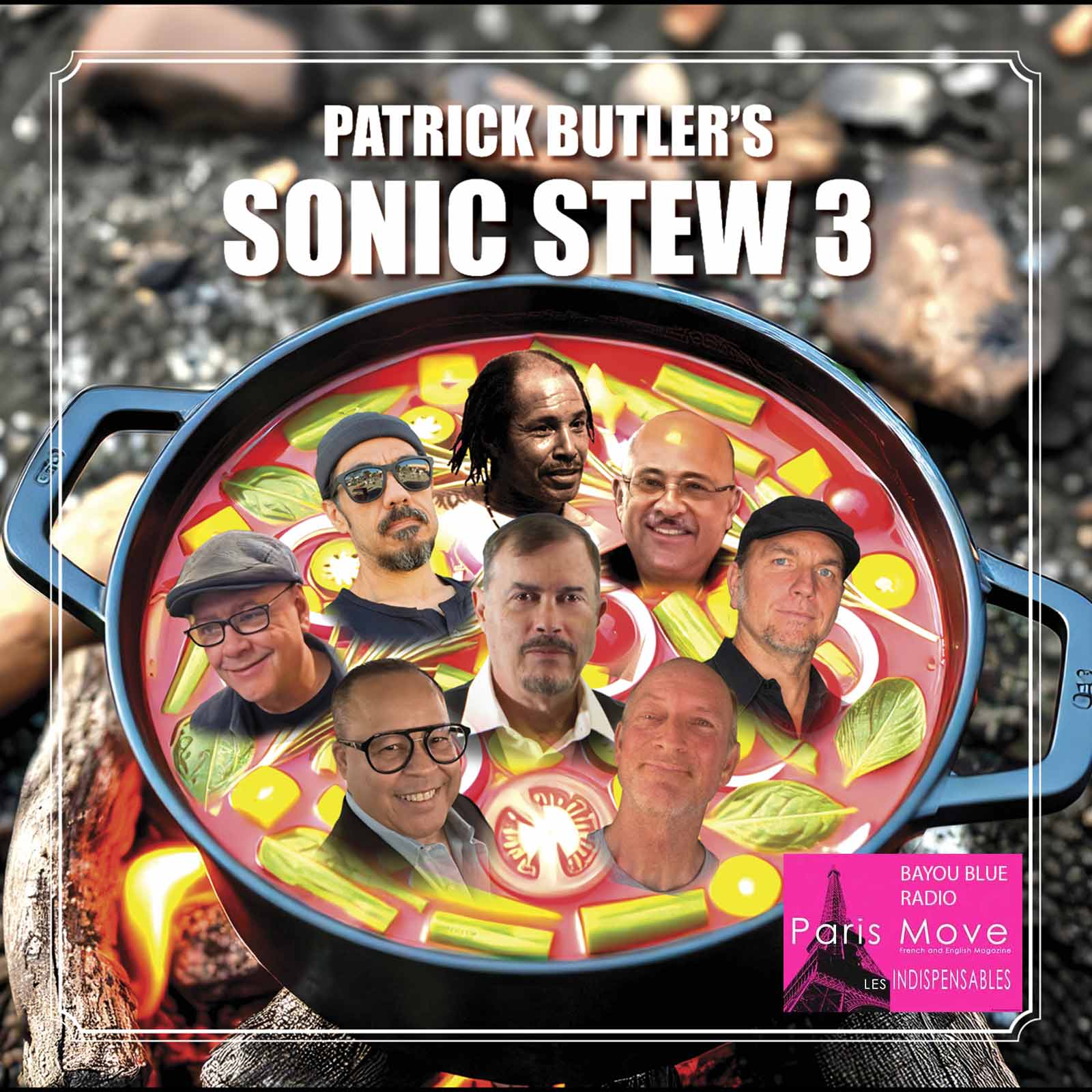
Summary: Discover how guitarist and composer Patrick Butler reimagines modern jazz on Sonic Stew Three, blending modal improvisation, funk, rock, and collective musical exploration.
Patrick Butler and the Art of Reinventing Jazz from Within
Some musicians deserve to be heard beyond the familiar measures of instrumental virtuosity. What distinguishes their work is not simply the command of an instrument, but the ability to shape musical ideas into a coherent artistic vision, to build compositions that breathe and evolve, and to give an ensemble a personality of its own. Guitarist and composer Patrick Butler belongs to this category. With Sonic Stew Three, he brings together jazz, funk, rock and the exploratory spirit of electric music in a sound that feels both deeply rooted and refreshingly independent of genre. The achievement lies not in the number of influences he draws upon, but in the way he transforms them into a language that is unmistakably his own. There is no forced eclecticism here, no parade of references designed to demonstrate musical sophistication. Instead, Butler constructs an intricate, rhythmically adventurous world in which carefully conceived arrangements coexist with spontaneity, humor and an instinctive feel for the physical pleasure of music. Above all, Sonic Stew Three makes a persuasive case for Butler as a composer whose imagination, rather than his desire to occupy the spotlight, gives the music its identity.
The album announces its intentions immediately with “Eb Dorian,” a spirited opening statement that wastes no time getting to the heart of the matter. The rhythmic architecture is demanding, the arrangements tightly constructed, and the interplay among the musicians requires a level of collective precision that would make this an impressive way to open a live performance. Every shift in accent, every displaced beat and every interlocking instrumental figure calls for sustained concentration. Yet the music never sounds like an exercise in technical endurance. Its complexity is animated by an unmistakable sense of purpose, and its energy carries the listener forward even when the underlying structure becomes difficult to anticipate. That balance is central to Butler’s achievement. He understands that sophisticated music need not advertise its sophistication, and that a composition can challenge the ear without sacrificing the immediate pleasure of listening. The musicians negotiate the arrangement with assurance, finding room for individual expression while preserving the momentum of the whole. What emerges is not a display of virtuosity for its own sake, but a compelling demonstration of what a well-conceived composition can make possible.
There is a revealing distinction here between music that merely provides space for improvisation and music whose structure actively shapes the possibilities of improvisation. Butler belongs firmly to the latter tradition. His arrangements establish a framework, but they do not dictate every movement within it. The musicians are free to explore, respond and redirect the music, provided they remain attentive to the larger design. The rhythm section is particularly important in this respect. Rather than serving as a neutral foundation for the soloists, it participates in the composition’s internal drama, shifting the balance, opening new spaces and creating the tensions that allow the music to develop. Butler’s guitar moves through this landscape without demanding permanent attention. It can lead, punctuate, connect or withdraw, allowing another instrument to take an idea further. Such restraint is not a denial of individual identity. It is evidence of a musician who understands that authority in an ensemble comes as much from what one makes possible for others as from what one plays oneself. At a time when technical mastery can easily become the principal selling point of a jazz performance, Butler’s commitment to the collective deserves particular attention.
His musical history helps explain this approach. Raised in New Jersey, Butler grew up absorbing a broad range of American musical traditions. Celtic music and bluegrass entered his world early, followed by rock and funk, which would leave a lasting imprint on his sense of rhythm, phrasing and sonic texture. His jazz education included studies with guitarist and teacher Harry Leahey, as well as Roland Prince, whose experience helped broaden his musical perspective. He also studied with Uli Jon Roth, extending an education that never confined itself to a single musical vocabulary. These experiences matter because they reveal the foundations of a compositional approach built on exchange rather than allegiance. Butler does not treat musical traditions as closed systems to be mastered and reproduced. He approaches them as bodies of knowledge whose underlying principles can be examined, challenged and adapted. The result is a musician who thinks not only in terms of notes and chords, but also in terms of movement, density, atmosphere and the relationship between sound and physical response.
After high school, Butler encountered jazz musicians Richie Cole and James Spaulding, although he never recorded with either. His hometown of New Brunswick, closely associated with the legacy of guitarist Joe Pass, sits within a New Jersey region rich in jazz-guitar history. Butler might have chosen to follow that tradition directly, concentrating on its established techniques and extending its familiar language. Instead, his professional life took a different course. For roughly two decades, funk and rock occupied much of his musical world. What might appear to be a departure from jazz ultimately became one of the defining influences on his work as a composer. Touring, performing and working in studios taught him how music operates under different conditions, how a band sustains momentum, and how rhythmic relationships can determine the character of an entire performance. Those years also provided a practical education in economy. In music built around a strong groove, every gesture must count, and the smallest rhythmic adjustment can alter the energy of the whole.
Funk, in particular, offers a distinctive understanding of time. Repetition is never merely repetition; it creates tension, establishes expectation and makes subtle changes increasingly significant. Rock contributes a different sense of physical force, sonic density and dramatic progression. Butler has carried these lessons into his jazz writing, where the groove can remain insistent without becoming mechanical, and harmonic complexity never comes at the expense of the music’s bodily appeal. His career offers a useful reminder that musicians are shaped by more than the genres with which critics eventually identify them. They are also formed by detours, collaborations, professional demands and experiences that may initially seem peripheral but later prove essential. In Butler’s case, the years spent working outside the conventional boundaries of jazz did not interrupt his development. They gave him a wider vocabulary and a more flexible understanding of what a composition can do.
That breadth is evident throughout Sonic Stew Three, where influences emerge not as recognizable quotations but as elements of a thoroughly assimilated musical language. The expansive sensibility of Pharoah Sanders can be felt in the way certain passages privilege atmosphere and physical intensity over conventional melodic development. Miles Davis, particularly the period surrounding In a Silent Way, offers another point of reference. The emphasis on recurring patterns, evolving textures and sustained musical environments suggests an understanding of composition in which the gradual transformation of sound can be as important as the succession of chords or the arrival of a solo. Butler does not attempt to recreate the work of either musician. What interests him is the freedom their music made possible: the freedom to loosen established formal expectations, to let repetition become a vehicle for change, and to explore the relationship between improvisation and carefully organized musical space. Their influence is present in the questions he asks, rather than in any attempt to reproduce their answers.
This approach extends to the album’s treatment of instrumental color. Sonic Stew Three is shaped as much by timbre and texture as by melody, harmony or soloing. The decision to use a warm, rounded electric bass rather than an upright bass contributes significantly to the ensemble’s character. The instrument gives the music a deeper, more substantial foundation, drawing certain passages toward jazz-funk while preserving their harmonic and rhythmic flexibility. The bass does not merely outline chord changes; it helps determine the physical weight of the music, its elasticity and its capacity to sustain a groove. Percussion adds further layers of movement, introducing accents and subtle rhythmic variations that prevent the pulse from settling into predictability. Together, these elements create a sound that feels grounded without becoming heavy, intricate without losing its sense of forward motion. Rhythm becomes both the framework and the substance of the music, the force that connects the individual instruments while allowing each to retain its character.
At times, the album approaches a distinctly psychedelic atmosphere, recalling the period when electric jazz began absorbing the language of funk, rock and studio experimentation. But Butler is not interested in nostalgia for an imagined golden age. His references to the past are neither decorative nor dependent on the listener’s recognition. They are starting points for further exploration. A passage may evoke the expansive textures of electric-era jazz before moving into a more contemplative space, and these shifts feel natural because they emerge from the music’s internal logic. The influences gradually overlap, their boundaries becoming less important than the new relationships they create. This is where Butler’s compositional intelligence becomes most apparent. He does not juxtapose genres to demonstrate how much music he knows. He brings them into contact, allowing their contrasting rhythmic instincts, tonal qualities and expressive possibilities to produce something that could not have existed within any one tradition alone.
The album’s use of the Ionian mode, the familiar major-scale framework, provides another key to understanding its construction. Each composition draws on a modal foundation that helps establish its melodic and harmonic character, while leaving considerable room for variation in rhythm, arrangement and instrumental interaction. The theoretical principle itself is hardly new; modal thinking has a long history in Western music and has played an important role in jazz for generations. What matters is the way Butler uses it. A shared structural idea becomes the basis for distinct musical environments, each shaped by its own tempo, texture and distribution of instrumental roles. The theory remains beneath the surface, guiding the composition without becoming an intellectual obstacle for the listener. One need not identify a mode or understand the mechanics of the arrangement to hear the differences in mood, tension and movement from one piece to another.
That distinction is essential to appreciating Butler’s work. Musical knowledge can deepen the listening experience, but it cannot substitute for it. Sonic Stew Three does not ask its audience to study the score before enjoying the music. Its structures are audible in their effects, even when their technical foundations remain invisible. The compositions provide enough definition for the musicians to maintain a shared direction, yet enough openness for them to explore the possibilities within that framework. Constraint becomes a source of freedom rather than its opposite. It gives the players something substantial to work against, while ensuring that individual improvisations remain connected to the larger musical argument. Butler’s achievement lies in making this balance sound natural, as though the intricacy of the arrangements and the spontaneity of the performances were not competing demands but complementary aspects of the same idea.
“F Ionian” offers a particularly revealing example. Its rhythmic character and treatment of texture recall aspects of the musical world explored by Miles Davis in In a Silent Way, but the resemblance never hardens into imitation. The instruments seem to inhabit a shared landscape rather than occupy sharply defined territories. Motifs emerge and recede, timbres blend, and familiar patterns acquire new significance as the composition unfolds. Repetition does not freeze the music in place; it allows small changes to become more noticeable, gradually altering the listener’s perception of the whole. The piece does not depend on a dramatic climax or a succession of obvious instrumental statements. Its interest lies in the way the musical environment evolves, inviting the listener to notice movement within what initially appears stable. It is a quiet but effective reminder that musical development does not always require a change of direction. Sometimes it is enough to change the way we hear what is already there.
This emphasis on atmosphere gives the album a subtle narrative dimension. The compositions do not tell stories in any conventional sense, but they establish situations, suggest images and open spaces for the imagination. The listener moves between passages of almost physical intensity and more spacious, contemplative moments, between assertive grooves and sequences in which the music seems to suspend its forward motion. The result is a succession of sonic portraits, fleeting impressions and landscapes that never become entirely fixed. Some melodies linger in the memory; other passages leave their mark through a particular instrumental color, a rhythmic turn or the way several sounds combine and then separate. The music encourages a form of active listening in which the audience gradually constructs its own associations. This is one reason Sonic Stew Three rewards repeated attention. It offers an immediate sense of energy, but its deeper pleasures emerge over time, as the relationships among its different elements become clearer.
The ensemble itself is indispensable to that achievement. The addition of drummer Damian Smith, bassist Jose Ramirez and saxophonist Michael Mays brings fresh perspectives to the group, while the other musicians expand its range of instrumental colors. Keyboards broaden the harmonic palette, flute introduces a lighter melodic presence, and percussion adds rhythmic detail without overcrowding the arrangements. With so many elements available, the music could easily become congested, each instrument competing for attention. Butler avoids that trap through careful decisions about balance, contrast and space. Instruments move into the foreground when the composition requires them to do so, then recede to make room for another voice. The arrangements are dense when they need to be, but they also know when to leave something unsaid. That sensitivity gives the music room to breathe and allows its complexity to remain inviting rather than exhausting.
Butler’s willingness to share the spotlight is especially revealing. His guitar remains an identifiable presence, but it does not dominate every passage or turn every composition into a vehicle for personal display. Instead, it functions as a connective thread, guiding transitions, reinforcing relationships and allowing other instruments to develop ideas of their own. This is not simply a matter of temperament. It reflects a compositional philosophy in which writing for an ensemble means creating the conditions for collective expression. The composer’s role is not to ensure that every moment points back to him, but to build a musical structure in which the contributions of others become essential to the whole. In that sense, the album’s most impressive achievement may be the degree to which its individual parts remain distinctive while serving a common purpose. The musicians are neither reduced to supporting roles nor left to pursue unrelated ideas. Their freedom is made meaningful by the music that connects them.
There is a playful quality to Butler’s approach, too. The title Sonic Stew suggests a mixture of flavors, a preparation in which different ingredients retain their character while contributing to something larger. The metaphor captures the album’s stylistic range, but it should not obscure the discipline behind the result. What sounds spontaneous is carefully organized; what feels loose rests on a clear understanding of structure. Butler’s humor lies partly in refusing to make this rigor solemn. The music can be intricate without becoming forbidding, ambitious without announcing itself as an intellectual exercise. It surprises the listener, occasionally takes an unexpected turn and preserves a freshness that prevents its arrangements from feeling mechanical. That lightness is not an incidental quality. It is part of what makes the album’s sophistication so appealing.
Sonic Stew Three also invites a broader reflection on what distinguishes a compelling jazz musician in an era when technical proficiency is increasingly easy to display. Virtuosity matters, but it cannot by itself establish an artistic identity. Nor does the accumulation of influences guarantee originality. The real challenge is to organize those influences into a coherent vision, to understand what each tradition contributes and to make their interaction serve a purpose beyond stylistic variety. Butler meets that challenge by placing composition at the center of his work. Funk, rock, modal jazz and the exploratory legacy of electric music are not separate territories he visits to advertise his versatility. They have become integral parts of his musical vocabulary, available to him not as ready-made styles but as resources for invention.
The album also resists the familiar division between sophisticated music and popular appeal. Its arrangements demand considerable instrumental skill, and its rhythmic and harmonic structures reflect sustained thought. Yet the groove remains central, and the melodies retain the capacity to stay with the listener long after the music has stopped. Butler does not treat accessibility as a concession, nor does he use complexity to establish artistic credentials. Both qualities serve the same purpose. The music should be felt before it is analyzed, but it should also reward the listener who returns to it with greater attention. This balance is difficult to achieve, and it is one of the record’s strongest qualities.
With repeated listening, details that initially seemed incidental begin to reveal their importance. A rhythmic figure changes the way a melody is perceived. An instrumental entrance alters the balance of a passage. A transition that first appeared merely functional turns out to be central to the composition’s larger design. The music becomes more familiar without becoming predictable. This capacity to sustain interest is an important measure of compositional achievement. A record’s value lies not only in the impact it makes on first encounter, but also in what it reveals once its internal relationships begin to emerge. Sonic Stew Three has that kind of staying power. Its energy draws the listener in, its arrangements sustain attention, and its underlying coherence gradually establishes a deeper connection.
Ultimately, the album’s significance lies in the compositional vision that holds it together. Praising Butler’s guitar playing alone would miss the larger accomplishment. His instrumental voice finds its fullest expression within a world he has designed, organized and entrusted to musicians capable of bringing its details to life. His gift as a composer is the ability to unite disparate influences without reducing them to a formula, to preserve the tension between structure and freedom, and to make intellectually considered music that remains immediate and physical. He does not need to prove that jazz can absorb funk, rock or the legacies of electric experimentation. Those traditions are already part of his musical history. The more interesting question is what he can make of them, and Sonic Stew Three offers a persuasive answer.
With this album, Butler deepens a musical inquiry that has developed over the course of his career. He makes no grand claim to redefining contemporary jazz, nor does he need to. His achievement is more modest in appearance and more substantial in practice: demonstrating that a tradition remains alive when its inherited forms become materials for reinvention rather than templates for imitation. Butler retreats neither into nostalgia for the great experiments of the past nor into the pressure to sound perpetually new. He draws on his own experiences, trusts the intelligence of his collaborators and gives equal importance to composition, collective listening and the exploration of sound. His music does not demand attention through a catalogue of references. It earns it by transforming those references into a coherent artistic statement.
What remains, then, is more than the accomplishment of a talented ensemble or the work of a guitarist capable of bringing distant musical worlds into conversation. It is the vision of a composer who has turned the detours of his career, his encounters and his professional experiences into a distinctive language. Butler does not need to dominate every moment. He builds a space in which instruments can answer one another, rhythmic complexity becomes a source of movement, and influences enrich the music without trapping it in the past. Sonic Stew Three is generous, inventive and, at its best, delightfully unpredictable. Its coherence comes not from uniformity but from the freedom with which its elements interact. The album’s lasting strength lies in its rare combination of compositional intelligence, interpretive openness and the sheer pleasure of musicians making music together. In Patrick Butler’s hands, the guitar is a voice, but composition is the world that gives it meaning: a world in which jazz remains a living art, sustained by curiosity, shaped by encounters and continually renewed by the freedom to imagine what comes next.
Thierry De Clemensat
Member at Jazz Journalists Association
USA correspondent for Paris-Move and ABS magazine
Editor in chief – Bayou Blue Radio, Bayou Blue News

PARIS-MOVE, October 16th, 2026
Follow PARIS-MOVE on X
::::::::::::::::::::::::
Musicians :
Patrick Butler: Guitar
Gilberto Torres: Flute
Michael Mays: Tenor and Soprano Sax
Damian Smith: Drums
Jose Ramirez – Acoustic Bass
Ron Scott: Keyboards
Mel Wiggins: Percussion
Julio Muniz: Percussion
Gary Bogdanoff- Engineer
Track Listing :
1.Eb Dorian 04:48
2.C# Ionian 03:45
3.B Ionian 06:57
4.F Ionian 04:53
5.A Mixolydian 04:40
6.C Ionian Guitar 03:32
7.C Ionian Sax 03:48
8.C Ionian Flute 04:09
9.C Ionian Organ 03:15
10.Ab Dorian 04:15
11.D# Aeolian 03:36
12.Db Mixolydian 05:30
13.F3 Ionian 04:26