| Jazz |
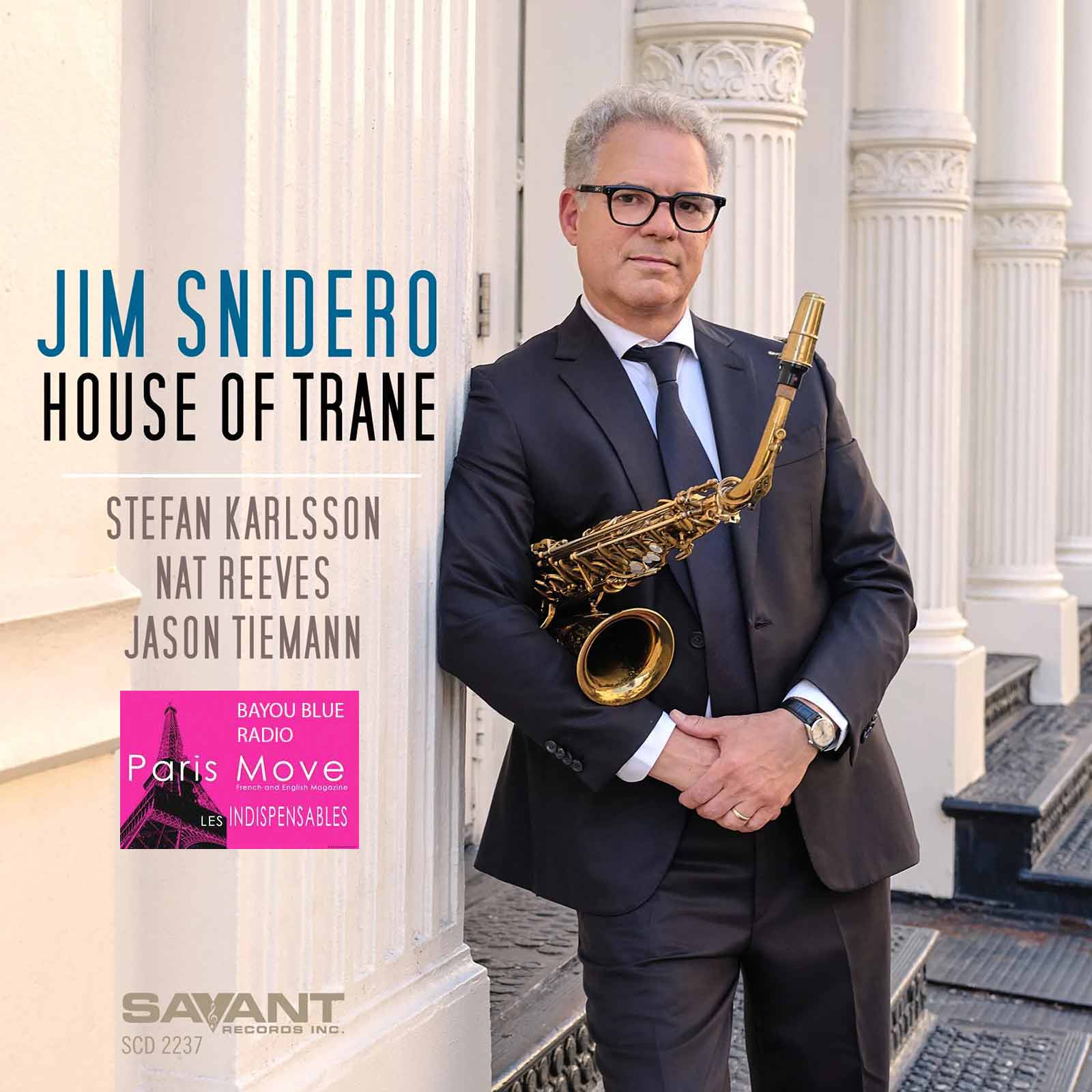
Summary : Jim Snidero’s House of Trane transforms John Coltrane’s legacy into a deeply personal jazz statement, inspired by the Coltrane family home and a lifetime of musical influence.
Jim Snidero’s House of Trane: A Personal Dialogue with John Coltrane
The sun has returned, as it sometimes does after the rain, bringing with it that particular light that makes familiar things seem suddenly deeper. There may be a connection to Jim Snidero’s music. With House of Trane, his twenty seventh album as a leader, the American alto saxophonist is not simply looking back at a history that has mattered to him for most of his life. He is returning to a source that has been part of his musical consciousness for nearly half a century and has helped shape the musician he became. The starting point for this new album was a visit to the home of John and Alice Coltrane in Dix Hills, New York, where John Coltrane lived with his family from 1964 until his death in 1967 and where A Love Supreme was composed. The visit might have remained a private moment, an emotional encounter preserved in the memory of a musician. Instead, it became something more consequential. It set a series of compositions in motion and eventually led to an album due for release on October 30, 2026, during a year in which the jazz world is marking the centennial of John Coltrane’s birth. The timing might seem almost too perfect were it not for the fact that Snidero’s relationship with Coltrane reaches back to the late 1970s. House of Trane was therefore not conceived as a commemorative project. It grew from an old musical memory that, confronted with an actual place, suddenly acquired a new intensity. That is the difference between an homage dictated by an anniversary and a work that emerges from genuine artistic necessity.
Snidero has described the visit as an overwhelming experience, one that brought him to tears. Standing in front of the fireplace where Coltrane had been photographed playing, climbing the staircase leading to the room in which A Love Supreme was composed, entering a space that no longer belongs simply to history because it still carries physical traces of the people who lived there, all of this seems to have altered his relationship to music he had known for decades. There is a particular power in places where history stops being an abstraction. Biographies give us dates, discographies give us titles, photographs give us faces, recordings give us voices and instruments. A house gives us something else, something quieter and perhaps more unsettling. It reminds us that works that eventually become monuments were created in ordinary rooms, by people whose lives continued around the act of creation. A Love Supreme, which we now tend to hear as one of the great monuments of twentieth century music, was composed in a house, by a musician who had a wife, children, habits, concerns and a daily life unfolding around him. To walk through that house is therefore to approach the physical circumstances in which the music came into being. For Snidero, that proximity seems to have transformed admiration into a need to respond.
The challenge was considerable. How does a musician write music inspired by John Coltrane without becoming trapped in imitation? How can an artist approach a figure of such magnitude without falling into the familiar gestures associated with his legacy? How does one acknowledge an influence without becoming its prisoner? Jazz history is full of musicians who have had to confront precisely this dilemma. Every generation learns by listening to the generation before it, absorbing sounds, rhythms, harmonic ideas and ways of phrasing. But there eventually comes a moment when listening has to become a departure. With Coltrane, that challenge is particularly demanding because his influence on generations of saxophonists has been almost impossible to escape. Snidero could easily have made a record filled with obvious references, modal structures, extended improvisations and gestures designed to remind the listener of Coltrane at every turn. He could have produced an album that satisfied the audience’s expectations while saying very little about himself. House of Trane chooses another path. It does not attempt to resurrect Coltrane. It asks a more interesting question: what remains of Coltrane inside a musician who has spent nearly fifty years living with his music?
That distinction is at the heart of the album. Influence is not imitation. It is transformation. A musician receives something, absorbs it, tests it against his own experiences and his own musical history, and eventually turns it into something that belongs to him. That seems to be what happened with Snidero. When he was studying at the University of North Texas in the late 1970s, Coltrane had been dead for only about a decade. His music did not yet possess the historical distance it has today. For young musicians of Snidero’s generation, Coltrane was not an untouchable monument from another era. He was still close, urgent and alive in the imagination. Snidero has recalled how deeply that music occupied the thinking of young players at the time. Its presence can be heard in his early development, including his work with the One O’Clock Lab Band and on his first recordings as a leader. Nearly fifty years later, the musician returning to Coltrane is no longer the student absorbing a master’s language. He is an established saxophonist, composer, educator and bandleader whose own career has been shaped by decades of playing, recording and listening. He comes back to Coltrane with an identity of his own. That distance is what makes the dialogue possible.
Memory, in music as in literature, is never a faithful reproduction of the past. It selects, rearranges, preserves certain images and allows others to fade. It is easy to imagine what might have been present in Snidero’s mind when he entered the Dix Hills house. For decades he had accumulated memories of Coltrane’s sound: the albums, the melodies, the harmonic language, the tenor tone, the relationship between the saxophone and the rhythm section, the spiritual dimension of certain performances. All of this must have been somewhere inside him. Yet the more difficult task was to quiet those accumulated references and listen to what the place itself might provoke. That is where artistic creation begins. Snidero was not there to write Coltrane. He was there to discover what being physically close to Coltrane’s world would make him want to say. The difference is fundamental. A musician who reproduces his master remains attached to the past. A musician who allows the past to change him can still move forward.
House of Trane is built around that movement. The album contains eight tracks, including six original compositions by Snidero, Victor Young’s A Weaver of Dreams and a new interpretation of Resolution, the second movement of A Love Supreme. Its architecture is revealing. Snidero does not simply place a few original pieces alongside Coltrane material. He constructs a musical journey through the house and through his own memory. The original compositions are connected to specific spaces and sensations. Ascent evokes the staircase leading to the room where A Love Supreme was conceived. Hearth Felt refers to the fireplace that has become one of the defining images of the house. Glass Ring draws inspiration from the circular stained glass window connecting the living room to the meditation room. Free to Be comes from the basement, a space that attracted John and Alice Coltrane because of its possibilities for music and creative work. Faith touches on the spiritual dimension of their lives. Relaxin’ in Dix Hills draws on images of Coltrane walking quietly through the property. The house becomes a silent score, but Snidero is not translating architecture into music. He is allowing architecture to trigger memory, and memory to become sound.
That relationship between physical space and musical imagination gives House of Trane an almost cinematic quality. Each composition seems connected to a room, an image or a sensation, yet the album never turns into a guided tour. Snidero does not describe the house. He transforms what he encountered there. The fireplace, the staircase, the stained glass and the basement are not merely subjects for song titles. They become starting points for thinking about memory, spirituality, movement and freedom. The album can be heard without any knowledge of the house and still retain its force. But knowing where the music began gives it another dimension. The deeper subject of House of Trane may therefore not be the house at all. It may be the mysterious ability of a place to awaken something that has been dormant inside an artist for years.
The musicians surrounding Snidero are central to that achievement. Pianist Stefan Karlsson, bassist Nat Reeves and drummer Jason Tiemann understand the tradition well enough that they never need to announce it. At the same time, each brings enough personality to prevent the album from becoming an exercise in reverence. Karlsson contributes a sense of lightness and openness that contrasts with Reeves’s more grounded presence. Tiemann possesses the rare ability to support the music without attempting to dominate it. The quartet plays with a kind of confidence that comes from listening. They know when to occupy space and when to leave it empty. That restraint matters enormously in a project connected to Coltrane. The easiest mistake would have been to confuse intensity with volume or freedom with constant activity. Instead, the album often becomes most persuasive when it allows silence, hesitation, breathing room and tension to become part of the music.
Free to Be is one of the clearest examples. Inspired by the basement of the Dix Hills house and by the freedom that space represented for John and Alice Coltrane, the piece is built on a modal structure that gives Snidero room to develop without being confined by a rigid harmonic progression. Tiemann’s drumming occasionally recalls the expansive energy associated with Elvin Jones without attempting to reproduce his sound. Reeves provides the deep pulse that gives the saxophone room to rise, while Karlsson knows when to withdraw and allow the quartet to breathe. Space becomes an active element of the composition. Silence is not an absence but part of the conversation. Snidero moves toward the rhythm section, away from it, back toward the theme, then outward again. The music feels less like a demonstration than an act of discovery. This is perhaps where Coltrane’s influence becomes most meaningful, not in the reproduction of a vocabulary, but in the conviction that improvisation should remain a form of inquiry.
Ascent, the album’s opening track, takes that idea in another direction. Built around a repetitive and angular motif formed by two four note cells separated by a tritone, the piece refers directly to the staircase leading to the room where A Love Supreme was composed. Yet the idea of ascent carries a meaning beyond architecture. Coltrane’s music was repeatedly driven by the desire to move beyond the known limits of musical language toward something larger. Spirituality was not simply a subject in his work. It was embedded in his relationship to sound, time and improvisation. Snidero does not attempt to reproduce that experience, because no one could. Instead, he searches for his own musical equivalent. His alto moves through wide intervals and shifting tensions, supported by a rhythm section that maintains a quiet sense of forward motion.
Hearth Felt approaches the same history from a more intimate angle. The fireplace, immortalized in photographs of Coltrane playing, has become one of the most recognizable images associated with the house. Snidero resists the temptation to turn that image into an icon. Instead, he responds with a warmer and more meditative melody, allowing the alto to explore its lower register while the drums establish a deep, patient pulse. The effect is not unlike looking at an old photograph without trying to reproduce it. What survives is the atmosphere, the feeling of being close to something that happened long ago but has not entirely disappeared.
Glass Ring works through dialogue. The circular stained glass window becomes the inspiration for a composition in which Snidero and Karlsson continually answer one another. The piano does not simply accompany the saxophone. It responds, redirects and develops its ideas. The circular visual form becomes a musical principle as the composition returns to itself, changes shape and gradually finds resolution. It is a reminder that musical creation can begin outside music itself. Architecture, photography, landscape and light can become musical material when an artist knows how to listen to them. Snidero does not tell us what he saw in the house. He gives us a way of hearing what it made him feel.
Alice Coltrane is an essential part of that story. The title House of Trane might suggest another album devoted exclusively to John, yet the house belonged to both artists. Alice lived there with John and their children until his death and remained there until 1973. She worked there, developed her own musical vision there and used the basement as a creative space. The house therefore represents a family and artistic history considerably larger than the story of one man. This matters because the history of jazz has too often been narrated through its male figures, while the women around them have been treated as secondary characters. Alice Coltrane was herself a major twentieth century artist. Her work after John’s death was not an extension of his legacy but the development of a singular and deeply spiritual musical language of her own. The Dix Hills house consequently belongs to her history as much as it belongs to John’s.
The effort to preserve the house adds another dimension to the album. For decades, the building faced neglect, legal disputes and the threat of disappearing altogether. It is now being prepared for a future as a museum. That transformation is significant because cultural memory does not preserve itself. It requires attention, resources and a willingness to recognize that physical places can carry meanings that no archive can fully replace. The house is listed on the National Register of Historic Places and has been recognized as a National Treasure by the National Trust for Historic Preservation. What is being protected is therefore more than a building. It is a physical location in which a crucial part of American musical history happened. A record can be reissued. A photograph can be restored. A manuscript can be archived. A house gives history a geography. It allows us to stand, however imperfectly, where an artist once stood.
We need such places because artistic memory is not purely intellectual. It is physical. We know where writers lived, where painters worked and where composers wrote. We know the places associated with Miles Davis, Charlie Parker and Thelonious Monk. Jazz, however, has often been treated as a music of disappearance, something created in clubs and on stages, existing only for the length of a performance. But the places where jazz happened are themselves part of its history. Clubs close. Houses disappear. Studios change their purpose. Neighborhoods are transformed. With time, the geography of jazz becomes an archive of its own. The Dix Hills house reminds us that music requires places in which to take shape, even when what remains afterward appears to be nothing more than sound.
This is also why the centennial of John Coltrane matters. An anniversary can easily produce predictable tributes, reissues and familiar declarations. House of Trane offers something more valuable because its origins have little to do with the calendar. Snidero did not begin thinking about Coltrane because 2026 happened to be the centennial year. He has been living with this music since his student years. He studied it, played it, absorbed it and carried it through his own career. When he entered the house, he did not discover Coltrane for the first time. He discovered a familiar presence in an unfamiliar way. That distinction is crucial. We can listen to the same record for forty years and suddenly hear it differently because an experience has changed our relationship to it. Memory does not remain fixed. It changes as we do.
For that reason, House of Trane should not be reduced to a commemorative album. Snidero’s relationship with Coltrane long predates the centennial, and the record has enough musical substance to exist independently of the anniversary. The centennial provides a particular context, but context should never be allowed to become a substitute for music. A record that depends entirely on its historical moment will eventually become a document of that moment. House of Trane has the potential to remain something more durable. Its connection to Coltrane gives it a point of departure, not a final destination.
There is a deeper logic to that approach because Coltrane himself never treated music as something finished. His career was defined by constant movement. From bebop to hard bop, from modal jazz to the increasingly radical explorations of his final years, he repeatedly questioned the limits of what he had already achieved. His influence therefore lies not only in the sounds he left behind but in the example of a musician who refused to stop searching. If Snidero is going to enter into a genuine dialogue with Coltrane, the only credible way to do it is to continue searching himself, with his own instrument, his own experience and his own voice.
That helps explain the presence of A Weaver of Dreams and Resolution. A Weaver of Dreams takes Snidero back to Coltrane’s 1959 period with Cannonball Adderley, before the phase of Coltrane’s career most listeners now associate with his most celebrated work. The choice broadens the portrait. Snidero is not interested in a single, frozen version of Coltrane. He is interested in the musician’s evolution. Resolution, placed at the end of the album, carries a more direct symbolic weight. It is the second movement of A Love Supreme, the work that was composed in the very house that inspired this project. Snidero reworks it through the harmonic and improvisational vocabulary he has developed over decades. The album therefore returns at the end to the music that stands at the center of its origin, but it returns transformed. What began as a visit has become a statement of identity.
The structure gives House of Trane a circular quality. We enter the house, move through its rooms, encounter images and memories, and eventually return to A Love Supreme. But the listener who arrives there is not quite where he began. Coltrane remains present, yet he has become the Coltrane carried within Snidero’s own musical memory. That may be the most honest way to honor an artist who is no longer here. Not by imagining what he might have done today, not by reproducing his language, but by recognizing what he gave us and accepting the responsibility of transforming it.
Not every Coltrane listener will hear the album in the same way. That is inevitable, and it is healthy. Any attempt to engage with a figure of his importance invites comparison. Some listeners will search for the clearest traces of the master. Others will listen more closely to the places where Snidero separates himself from him. For me, that distance is exactly what makes the record worth hearing. I do not listen to House of Trane as though Snidero were being judged against Coltrane. I hear a musician who has spent much of his life listening to another musician and who, at a certain point in his own journey, felt the need to answer. The achievement of the album therefore lies less in resemblance than in the honesty of that response.
The quartet makes that response possible. A project of this nature could easily have become solemn, reverential and weighed down by its own historical importance. It never does. Karlsson, Reeves and Tiemann keep the music alive in the present. Their playing reminds us that jazz is not simply a conversation with the past. It is a collective art created in real time. The musicians may carry the entire history of jazz behind them, but once they begin to play they still have to listen, react, take risks and leave space for one another. That capacity to remain present is what prevents House of Trane from becoming nostalgic.
Nostalgia looks backward and regrets that the past is gone. Creation looks backward and asks what the past can still make possible. Snidero is doing the latter. He is not trying to resurrect the 1960s or suggest that John Coltrane is still somewhere inside the walls of the Dix Hills house. He understands that time has passed. He also understands something equally important: music can cross generations in ways that history alone cannot explain. A musician who has been dead for nearly sixty years can still alter the way a contemporary saxophonist hears melody, harmony, rhythm or silence. A house can remain standing and give that transmission a physical form. A record can grow out of a private visit and then allow listeners thousands of miles away to participate in the emotion it created.
Ultimately, House of Trane is less an album about John Coltrane than an album about what it means to have a master. It is about the debt every artist carries toward those who came before, but also about the necessity of transforming that debt into freedom. Snidero does not erase Coltrane in order to become himself, nor does he imitate him in order to prove his devotion. He accepts what he owes him and continues on his own path. That may be the most honest response possible to an artist of Coltrane’s stature. The best way to honor Coltrane is probably not to sound like him. It is to preserve the courage to keep searching, the very quality that defined so much of his own work.
The sun has returned after the rain, and the image that opened this story no longer seems quite so simple. Jim Snidero’s music is not John Coltrane’s, and it does not need to be. It is the music of a musician whose life was profoundly shaped by another musician, and who, after decades of listening, found himself standing inside the physical world where some of that music was born. House of Trane emerged from a house, an emotion, a lifetime of listening and a desire to understand what that history might still have to say. More importantly, it reminds us that jazz is not a sequence of styles sealed inside particular decades. It is an ongoing conversation between those who have left us and those who continue to play.
I would not expect every Coltrane listener to share my response to House of Trane. Nor should they. A serious jazz record should leave room for disagreement, debate and private discovery. But one conclusion seems difficult to avoid. Jim Snidero has made a major and deeply personal album that deserves to be heard on its own terms, rather than measured against an impossible standard. This is not an album made in the manner of Coltrane. It is an album made because of Coltrane, and that is something altogether different. Inside a house where John and Alice Coltrane lived, worked, loved and created, Snidero found not a music to reproduce, but another reason to pursue his own. Perhaps that is the most meaningful way to keep a musical memory alive: not by freezing it in the past, but by allowing it to continue generating movement, emotion and music.
Thierry De Clemensat
Member at Jazz Journalists Association
USA correspondent for Paris-Move and ABS magazine
Editor in chief – Bayou Blue Radio, Bayou Blue News

PARIS-MOVE, October 6th, 2026
Follow PARIS-MOVE on X
::::::::::::::::::::::::
Musicians:
Jim Snidero, alto saxophone
Stefan Karlsson, piano
Nat Reeves, bass
Jason Tienmann, drums
Track Listing:
Ascent
Hearth Felt
Glass Ring
Free to Be
Faith
Relaxin’ in Dix Hills
A Weaver of Dreams
Resolution
Tour Dates:
October 8, 2026: Clasijazz, Almeria, Spain
October 9, 2026: Jazzazza, Murcia, Spain
October 10, 2026: Sunset, Girona, Spain
October 11, 2026: Cafe del Teatre- Auditori, Sant Cugat, Spain
October 14, 2026: Jimmy Glass- Valencia
October 15, 2026: Bilbaina Jazz Club, Bilbao
October 16, 2026: Casal de Camps Blancs, Mostra de Jazz, Sant Boi, Spain
October 17, 2026: Jamboree, Barcelona, Spain
October 18, 2026: Concert Inaugural JazzTardor, Llieda, Spain
October 28, 2026: Zig Zag, Berlin, Germany
October 29, 2026: Bix, Stuttgart, Germany
October 30, 2026: Hemingway’s, Karlsruhe, Germany
October 31, 2026: Sunset, Paris, France
November 2, 2026: Maastricht Conservatory, Maastricht, Netherlands
November 3, 2026: King Georg, Cologne, Germany
November 7, 2026: Watermills, Dallas, TX
November 10, 2026: Monk’s, San Antonio, TX
November 11, 2026: JazzTX- Austin
November 13, 2026: Rothman Jazz Party- Detroit
November 14, 2026: Jazz Blue, Akron, OH
November 15, 2026: The Rex, Toronto, Canada
November 16, 2026: The Rex, Toronto, Canada
November 18, 2026: Merrimans’ Playhouse, South Bend, IN
November 19, 2026: Ginger Rabbit, Columbus, OH
November 20, 2026: Bop Stop, Cleveland, OH
November 21, 2026: Caffe Vivace, Cincinnati, OH
November 22, 2026: Louisville Jazz Society, Louisville, KY
December 11, 2026: The 5 Spot, New York, NY
December 12, 2026: The Side Door, Old Lyme, CT
January 13, 2027: Blues Alley, Washington, DC