| Jazz |
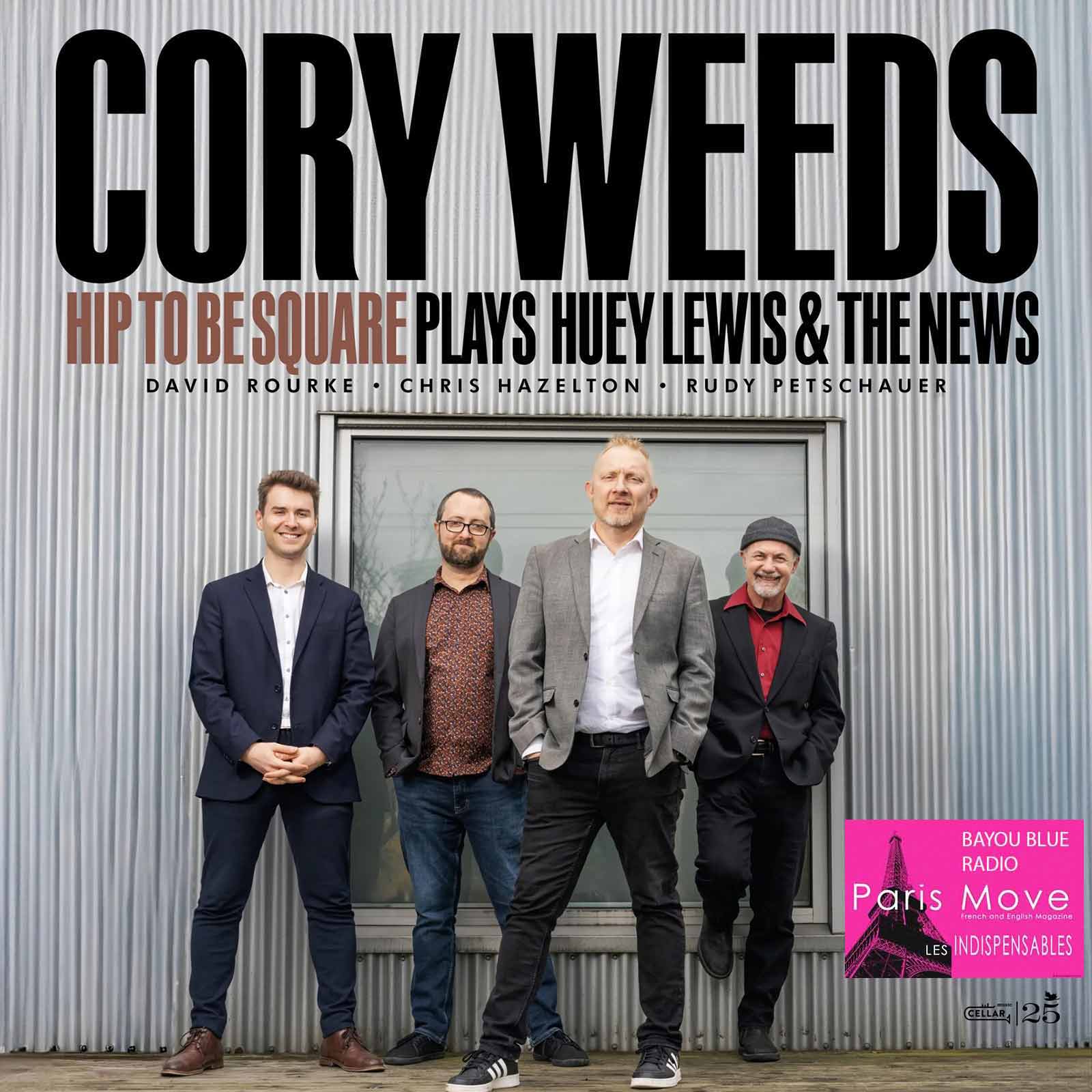
Sometimes a creative project begins with nothing more dramatic than a broken piece of technology. No flash of inspiration, no sleepless night spent chasing an idea, no sudden revelation about the direction music ought to take. Sometimes it begins with a CD that will not eject, a long drive and a record you are forced to hear over and over again. In 2013, Cory Weeds, the Canadian saxophonist, composer, producer and founder of Cellar Music Group, was in the American Midwest at the invitation of organist Chris Hazelton, with whom he was scheduled to play a series of concerts and workshops. The two musicians were driving from Kansas City to St. Louis in Hazelton’s father’s car when a Huey Lewis & The News CD became permanently lodged in the player. There was no way to get it out. The songs kept coming. Again and again. What might have been an unbearable four hour drive instead became the unlikely beginning of a musical idea. Listening to the record repeatedly, Weeds began to hear past the polished production of the early 1980s, past the keyboards, the tightly arranged guitars, the huge choruses and the unmistakable sheen of American pop, and into something underneath it all: strong melodies, durable grooves and a blues and soul foundation that seemed capable of surviving a completely different treatment. A question began to take shape, half serious and half ridiculous: What would happen if Huey Lewis & The News were turned into an organ jazz quartet?
It was hardly an obvious proposition. Huey Lewis & The News belonged to another musical world: FM radio, mainstream rock, pop soul, rhythm and blues filtered through the machinery of the American record business, and the particular sound of the 1980s, when a song had to make an immediate impression to survive on the radio. Sports, released in 1983, became one of the defining albums of the decade. Its songs entered movies, television, advertising and the collective memory of an entire generation. But nostalgia alone does not make a song worth revisiting. Simply putting a Hammond B3 behind a few familiar hits would have been little more than a novelty. The real challenge was to find out what was still there once the original production was stripped away. Weeds was not trying to prove that Huey Lewis had secretly been a jazz musician all along, nor was he attempting to give pop music a kind of jazz seal of approval. He was interested in something more basic: whether songs people already knew could reveal another life when placed in the hands of musicians who were willing to take them apart, reshape them and, most importantly, listen to them without condescension.
Hazelton began writing arrangements. The idea moved forward, then stalled. It resurfaced, disappeared again, and remained for years in that peculiar state familiar to musicians: not quite abandoned, but never quite alive either. There were arrangements, conversations and intentions, but no record. It could easily have remained another good idea that never made it into the studio. Then, in 2024, something happened that seemed almost too perfectly timed to be real. Weeds and Hazelton were touring with the James Hunter Six, opening for Bonnie Raitt. During a stop in Portland, Ore., they wandered into a record store. An employee accidentally bumped into Weeds. When he turned around, the employee was holding 25 vinyl copies of Sports. After more than a decade of fits and starts, the project had suddenly found its reminder. Weeds later joked that “the universe had spoken.” Perhaps. But the universe, as usual, still expected them to do the work.
There is something revealing about that story because popular music lives as much in memory as it does in sound. We rarely hear a song in isolation. We hear it alongside the movie where we first encountered it, the car where we played it, the radio station that broadcast it, the people who were around us at the time. Eventually, a song becomes more than a recording. It becomes part of the cultural furniture. Sports is now inseparable from that kind of memory. More than four decades after its release, it is no longer simply an album from 1983. It is a document of a particular American moment, carrying with it the sounds, images and assumptions of its era. To revisit those songs, then, is to work with something listeners already remember. Weeds and Hazelton were not trying to erase that memory. They were trying to move it somewhere else. The invitation was not to forget Huey Lewis, but to hear him from a different angle.
That is where interpretation becomes more important than the concept itself. A cover is not interesting simply because the original is famous. It becomes interesting when the musician doing the interpreting has enough of a musical identity to make the material pass through his own language. A simple song can become remarkably deep in the right hands, while a supposedly great composition can be reduced to a lifeless imitation. The source material never guarantees the result. In this case, Weeds and Hazelton understood early on that the least interesting option would be to play Huey Lewis with jazz instruments and call it a day. The 1980s production had to fall away. What remained, melody, rhythm, harmony, space, had to be strong enough to stand on its own. The organ quartet gave them a way to find out.
Weeds had already demonstrated an interest in music that sat outside the conventional jazz repertoire. In 2017, he explored the music of Earth, Wind & Fire with pianist Mike LeDonne. But Huey Lewis presented a different challenge. Earth, Wind & Fire already occupy a musical territory deeply connected to jazz, funk, soul and the broader African American traditions that have shaped American music. Huey Lewis & The News seemed much farther away. That distance was precisely what made the project worth pursuing. Weeds has acknowledged that Huey Lewis was probably not high on the list of artists most jazz musicians would name as an influence. But he heard possibilities in the songs. Hazelton heard them, too. The project survived because they were listening for the same thing.
Much of the responsibility for turning that intuition into music fell to Hazelton. Hearing the possibility inside a song is one thing. Building an arrangement that allows other musicians to inhabit it is something else entirely. Hazelton had to redistribute the musical roles, rethink the tempos, create room for improvisation and preserve enough of the original melody for the listener to recognize where the music came from. The balance is delicate. Stay too close to the original and the exercise becomes pointless. Move too far away and the connection disappears. The sweet spot lies somewhere between familiarity and surprise, where the memory of the song remains intact while the musicians are free to take it somewhere new.
The resulting album, Hip to Be Square, Plays Huey Lewis & The News (Boop Bop Bing Bash!), is consequently more than a collection of clever covers. It unfolds in two parts. The first six tracks revisit Huey Lewis & The News through Hazelton’s arrangements. The following seven, grouped under the title Boop Bop Bing Bash!, expand the musical picture with original compositions and pieces drawn from the soul jazz and organ jazz repertoire. That second half is important because it keeps the album from becoming a one joke concept. It places the Huey Lewis material inside the quartet’s broader musical vocabulary and shows what Weeds, Hazelton, guitarist David Rourke and drummer Rudy Petschauer sound like when they are no longer working against the listener’s memory of a hit record.
There is also a practical story behind that structure, one that says something about how independent music is actually made. Cellar Music Group received support from FACTOR Canada, and the requirements attached to that support influenced the shape of the album. The Huey Lewis material alone could not constitute the entire eligible program, so original compositions and pieces from the organ jazz tradition had to be included. What began as a practical constraint ultimately gave the album a wider musical horizon. Instead of producing 13 variations on Huey Lewis, the quartet created a record in which the familiar songs lead naturally into the music that has shaped the players themselves.
That musical history includes soul jazz, blues, boogaloo, swing, bossa nova and hard bop. Jazz has always had a complicated relationship with popular music because, in reality, the two have never been as separate as their categories suggest. Jazz musicians have always played songs people knew. They have borrowed melodies, rhythms and harmonies, changed the tempos, altered the arrangements and made room for improvisation. The boundaries that look so firm from the outside have generally been much less important to the musicians inside them. A good melody is still a good melody. A strong groove remains a strong groove. The interesting question is what happens when someone changes the context.
Take “Hip to Be Square.” The original is almost brutally efficient. The melody is immediate, the chorus unforgettable, the structure straightforward and the energy unmistakable. That very efficiency makes it difficult material to reinvent. There is nowhere obvious to hide. Yet once Weeds and the quartet take hold of it, the song begins to open up. Weeds effectively assumes the role of Huey Lewis, but on tenor saxophone. He is not imitating the singer’s voice. He is carrying the melodic responsibility the singer carried, giving the tune a warm, human quality before allowing it to move into improvisation. The distinction matters. The saxophone is not trying to impersonate the original recording; it is translating it.
The Hammond B3 changes the song even more dramatically. It supplies bass weight, harmonic depth and the unmistakable atmosphere of an organ jazz room. Rourke’s guitar adds another layer without crowding the arrangement, while Petschauer keeps the groove moving with the kind of rhythmic authority the format demands. What makes the performance convincing is that nobody seems embarrassed by the material. There is no sense that Huey Lewis needs to be rescued from pop music and elevated into something more respectable. The musicians simply play the songs as music. They enjoy them. That pleasure is audible.
The absence of irony may be one of the album’s most important qualities. It would have been easy to treat the project as a sophisticated joke: take the ultimate 1980s pop songs, dress them in Hammond organ and jazz vocabulary, and let the contrast do the work. But that would have worn thin quickly. Weeds is not making fun of Huey Lewis. He is not claiming that jazz is somehow superior to pop. He is interested in the conversation between the two. Once the musicians take the songs seriously, the premise stops being a gimmick and becomes a musical question.
“I Want a New Drug” makes that particularly clear. The original already has a strong groove, a certain looseness and a sense of humor that lend themselves naturally to reinterpretation. The challenge was to remove the layers of 1980s production without removing the song’s identity. Once the surface is gone, what remains is a structure sturdy enough to support improvisation. The song does not have to be rebuilt from scratch. It simply has to be given enough space to breathe.
The same process applies to “The Power of Love,” “Bad Is Bad,” “Do You Believe in Love” and “If This Is It.” Each arrives with its own burden of familiarity. Listeners already know where the melody goes, when the chorus arrives and what certain phrases are supposed to sound like. The arrangements therefore have to negotiate with memory rather than fight it. Recognition becomes the entry point. Then the music begins to move. The pleasure comes from the gap between what the listener expects and what the quartet actually does.
That kind of freedom requires trust, particularly because this was not a quartet that had spent years playing together. Once the project was revived, the musicians were brought together for a 13 day tour and 12 concerts. They arrived at their first engagement in Austin without having previously performed together as a quartet and without having fully rehearsed the program. It is an unusual way to build an ensemble, but it also gave the music a quality that a heavily rehearsed project might not have had. The musicians had to discover one another while discovering the arrangements.
There is an old truth in jazz that some things cannot be learned on paper. An arrangement can look perfect in rehearsal and behave differently once four musicians are actually playing it in front of an audience. A tempo that seemed right can suddenly feel too slow. A space that looked empty can turn out to be exactly what the music needs. A small rhythmic idea can grow into the defining feature of a performance. The tour gave Hazelton and the quartet the opportunity to make those discoveries in real time. The songs stopped being arrangements and became lived music.
The album was eventually recorded at Afterlife Studios in Vancouver on Nov. 17 and 18, 2025, with John Raham engineering and Chris Gestrin mixing. That timeline gives the project a useful perspective. Between the CD stuck in the player in 2013 and the completed album lie 13 years of false starts, interruptions, touring, arrangements and renewed enthusiasm. The record’s long gestation is almost invisible in the music, which is probably a good thing. It does not sound like a project weighed down by its own history. It sounds like musicians who finally got the chance to make the record they had been carrying around for years.
Rourke and Petschauer are central to that sound. Rourke is not simply filling the spaces between saxophone and organ. His contribution to “Meezy’s Back in Town,” in particular, gives the album another dimension, evoking the imagined soundtrack of a television show that might have existed somewhere between a 1970s sitcom and a late night jazz club. There is humor in the piece, but the joke never overwhelms the music. Petschauer brings a different kind of historical weight. His long association with Brother Jack McDuff places him directly inside the Hammond organ tradition that gives the quartet its identity. An organ quartet is not simply a convenient combination of instruments. It comes with its own history, its own rhythmic language and its own expectations about how melody, groove and improvisation interact.
The second half of the album makes that history explicit. “There Arno Answers,” written by Weeds and Hazelton, opens the Boop Bop Bing Bash! section with a direct, earthy organ groove. The title has a personal story behind it, but the music itself remains uncomplicated and immediate. “Meezy’s Back in Town” continues the playful spirit, while Harold Ousley’s “The People’s Choice” shifts the mood. “Up in Gavin’s Flat” carries a particularly local connection, pointing to Gavin Walker, an important figure in Vancouver’s jazz history whom Weeds rediscovered while digging through a rare 1973 album by Brute Force. That detail matters because jazz history is not made only by the names that dominate the textbooks. It is also built by local musicians, clubs, record stores, promoters, radio hosts and listeners who keep a scene alive long after the spotlight has moved elsewhere.
Even the title Boop Bop Bing Bash! captures something essential about the project. Weeds says he was immediately drawn to the phrase when he encountered Billy Gardner’s composition on a George Braith record. His “marketing brain,” he recalls, was already working before he had even heard the music. The joke says something about the album’s personality. This is a serious musical undertaking, but it does not believe seriousness requires solemnity. There is room here for craft, history and a little mischief.
“At Long Last,” by John Lee, changes the pace again, before Jimmy Owens’ “Get the Money Bluze” closes the album on what Weeds describes as “pure pleasure.” The sequence makes sense. By the time the record reaches its final tracks, the initial question, what would Huey Lewis sound like through an organ jazz quartet?, has already been answered. There is no need to keep proving the premise. The musicians can simply play.
And that may be the larger point of Hip to Be Square. The interesting question is not whether Huey Lewis can somehow be declared “jazz.” That would impose a category where the music itself does not need one. Jazz is not a certification. It is a way of approaching material: listening, interpreting, reshaping, improvising and entering into conversation with a song. The more revealing question is whether a familiar popular composition can withstand that process and emerge with another identity. On this record, the songs make a convincing case for themselves.
The project also belongs to a much older musical tradition. Jazz musicians have always borrowed from popular songs. Before the word “standard” became attached to a particular canon, musicians were playing what audiences already knew. They changed the harmony, altered the rhythm, invented new introductions, stretched the melody and improvised around it. The song was not treated as a sacred object. It was material to be worked with. That tradition is still alive here.
There is a temptation, particularly when looking back at the 1980s, to confuse a song with the production choices that surrounded it. Synthesizers, gated drums, layers of effects and the characteristic polish of the decade have become so closely associated with the era that they can obscure the underlying compositions. Hazelton’s arrangements perform a kind of musical excavation. They remove some of the historical surface and ask what remains underneath. The answer, at least in these songs, is that the structures are strong enough to survive.
That does not mean every pop song from the period would withstand the same treatment. There has to be something there to move: a melody, a groove, harmonic space, a rhythmic idea. Choosing the repertoire is therefore part of the artistic statement. Weeds and Hazelton selected songs in which they heard that potential. Their achievement lies not only in how they play the material, but in hearing possibilities that were not necessarily obvious in the first place.
That instinct is closely connected to who Weeds is as a musician and producer. He is not simply a saxophonist who happened to make an unusual album. Through Cellar Music Group, he has spent years documenting and supporting jazz musicians while building an independent catalog out of Vancouver. The label celebrates its 25th anniversary in 2026. That history gives Hip to Be Square another layer. The album is part of a broader philosophy in which jazz is not a closed repertory but a living musical practice, one that can preserve tradition while remaining curious about what exists outside its usual boundaries.
There is something almost inevitable about an independent jazz producer eventually making a record like this. Institutions tend to organize music into categories. Musicians are often more interested in what happens between them. Looking outside your own genre does not require abandoning your identity. Sometimes it is precisely how you discover what that identity can do.
Weeds never loses his own voice in the process. His tenor remains firmly rooted in jazz, with a warm, muscular sound that keeps the melodies recognizable while leaving room for improvisation. He does not attempt to become Huey Lewis, and he does not imitate the sound of an 1980s pop saxophonist. He remains himself. That is what makes the interpretations feel like interpretations rather than impersonations.
The same is true of Hazelton. His role goes far beyond playing organ. He is the person who turns the original intuition into a workable musical architecture. Without his arrangements, the stuck CD story would remain a great anecdote. With them, it becomes a record. He decides what survives, what changes, where the spaces are and how much of the original song needs to remain visible. The project may have started with Weeds hearing something in the car, but it became music through Hazelton’s ability to build around that intuition.
That distinction between an idea and its realization is easy to overlook. Music is full of clever concepts. Far fewer become convincing records. A funny premise can give you a title, but then you still need 13 tracks that hold together. You need dynamics, sound, pacing, musicians who know when to step forward and when to leave space. Most of all, you need the listener to remain interested after the initial surprise has worn off. Hip to Be Square does not rely on the novelty of its premise for very long. The music takes over.
As the album progresses, Huey Lewis gradually becomes less of a subject and more of a starting point. That is the crucial transformation. The listener begins by trying to recognize the songs. Eventually, recognition becomes secondary. The quartet has taken possession of the material without pretending to own it. What began as a Huey Lewis song becomes a piece of music played by these four musicians, in this particular room, at this particular moment.
“Hip to Be Square” is perhaps the clearest example. At first, the pleasure is simply in recognizing it. Then the organ enters, the saxophone takes the melody, the rhythm section reshapes the groove and the guitar creates new openings. At some point, the listener stops comparing the performance with the original recording. The song is no longer merely a jazz version of Huey Lewis. It has become part of the quartet’s own language. That is where the reinterpretation really begins.
“I Want a New Drug” works in much the same way. Its original character, the groove, the humor, the slight sense of detachment, survives the transition. But the new setting gives it room to breathe. The song acquires a different rhythmic weight and a different relationship to improvisation. It is not secretly a jazz tune that has finally been exposed. It is simply a strong composition being asked a different question.
Genres do not own melodies. They do not own grooves. They provide languages for musicians to work with. Jazz does not own swing; rock does not own the electric guitar; soul does not own groove; pop does not own the chorus. American music has always evolved through musicians crossing those boundaries, borrowing from one another and returning the material in altered form. That movement is not an exception to musical history. It is musical history.
Which is why the album becomes more interesting the longer you listen to it. On paper, the premise, a jazz saxophonist reworking Huey Lewis with an organ quartet, sounds like a clever idea. On record, the cleverness quickly becomes secondary. What remains is a group of musicians engaging seriously with songs they happen to enjoy. The anecdote about the stuck CD explains where the project began, but it does not explain why the album works. The music has to do that.
The Portland record store story adds another layer because it captures something true about how creative ideas sometimes return to us. Weeds had lived with the project for more than a decade. Then, almost absurdly, he found himself standing in front of 25 copies of the album that had started the whole thing. It was not fate in any literal sense. But coincidence can be enough to reopen a door that we had quietly closed.
What followed was not coincidence. It was work. The 12 concert tour gave the musicians a chance to learn one another, to test the arrangements and to discover what worked in front of an audience. By the time they entered the Vancouver studio in November 2025, the material had already been played, adjusted and lived with. The recording was the culmination of the process, not the beginning of it. That may be why the performances feel settled without sounding over rehearsed.
That balance is particularly important in an organ quartet. With only four instruments, there is nowhere to hide. The saxophone has to carry the melody. The organ has to supply both harmony and rhythmic weight. The guitar has to find its place without filling every available space. The drums have to maintain momentum without turning the music into a blunt object. Every musician is exposed. The group succeeds to the extent that the players listen to one another as carefully as they play.
And listening may ultimately be the album’s defining quality. It listens to Huey Lewis. It listens to the blues and soul jazz traditions. It listens to the Hammond organ lineage. It listens to the musical history of Vancouver. It listens to the memory of the 1980s without becoming trapped by it. And it listens to the musicians themselves, allowing the arrangements to breathe rather than forcing every song into a predetermined shape.
The result is an album that can be serious without becoming solemn, carefully constructed without sounding labored, funny without turning into a joke and nostalgic without becoming trapped in nostalgia. Those are difficult balances. Too much nostalgia and the record becomes a retro artifact. Too much self conscious jazz and it becomes an exercise in style. Too much humor and the music disappears beneath the premise. Here, the different elements remain in conversation.
The familiarity of the repertoire certainly helps. Listeners know these melodies, which gives the quartet an immediate point of contact. But familiarity also creates the album’s central challenge. It is easy to make a familiar song recognizable. It is much harder to make a listener hear it differently. The real test begins after the recognition has passed.
That is why the record’s lightness should not be mistaken for a lack of ambition. Its central question is a serious one: What can musicians discover in music that did not originally belong to their world? The answer is not that one genre is superior to another. It is that music can travel. Huey Lewis meets soul jazz. The 1980s meet the Hammond B3. Pop meets the jazz club. Vancouver meets a piece of American popular memory. And Cory Weeds meets an idea he had been carrying, intermittently, for more than a decade.
The strangest part is that none of it had to happen. If the CD player had worked properly in 2013, Weeds might never have heard the songs enough times to start wondering what was underneath them. If Hazelton had not begun writing arrangements, the idea might have remained a conversation in a car. If the project had not stalled, disappeared and returned, the eventual record might have sounded completely different. If Weeds had not been bumped into at that Portland record store, the 25 copies of Sports would have remained just another stack of vinyl. Creative work is often shaped by details that seem meaningless when they happen.
But coincidence can only open the door. It cannot walk through it. The record exists because the musicians kept returning to the idea and eventually did the work required to make it real. Behind the charming story of a stuck CD is a project that took more than a decade to find its final form. The idea survived because Weeds and Hazelton continued to believe there was something in those songs worth pursuing.
What they ultimately found was not hidden inside Huey Lewis’ reputation or the nostalgia surrounding the 1980s. It was in the songs themselves. Strip away the original production, change the instrumentation, alter the rhythm and make room for improvisation, and the compositions have to stand on their own. These do. That is what makes the experiment more than a clever premise.
The point is not that Huey Lewis has somehow become jazz. Huey Lewis remains Huey Lewis. Weeds remains Weeds. Hazelton remains Hazelton. But when their musical worlds meet, something else emerges. That space between them is where the album lives.
Music has always depended on that kind of movement. A musician hears something that was not written for his or her particular musical world, carries it somewhere else, reshapes it and eventually gives it back to listeners in another form. That process is at the heart of every living tradition. A tradition that cannot change becomes a convention. Music that remains open to transformation stays alive.
Weeds seems to understand that instinctively. He runs an independent label deeply invested in the history of jazz while making a record centered on a band associated with a completely different chapter of American popular music. That is not a rejection of jazz. It is a reminder that jazz has never been a fortress.
Perhaps that is also why the album works without ever seeming to insist that it should. It does not lecture. It does not apologize. It simply plays. After a few tracks, the story of the stuck CD becomes almost incidental. What remains is an organ quartet with a strong sense of history, a healthy sense of humor and enough curiosity to take familiar songs somewhere they have never quite been before.
In the end, the most improbable ideas are not necessarily the least serious. They may simply require more patience before anyone can hear what was there from the beginning. Huey Lewis was hardly the obvious artist to bring into the orbit of an organ jazz quartet. That is precisely what makes the journey worth hearing. The obvious choice would have given us another record. The unlikely one gave these musicians a question to answer.
On Hip to Be Square, Cory Weeds takes on the role of the singer without ever trying to become Huey Lewis. His tenor carries the melodies through the filter of his own musical history. Hazelton’s organ gives the songs a new architecture. Rourke’s guitar adds space, color and humor. Petschauer anchors the quartet in a rhythmic tradition that reaches back decades before the 1980s. Together, they turn familiar songs into something that belongs neither entirely to the past nor entirely to the present.
It took a stubborn CD player, four hours on the road, a project that refused to stay dead, a record store in Portland, an accidental collision, 25 copies of Sports, a 12 concert tour, a set of carefully developed arrangements and two days in a Vancouver studio for Huey Lewis to finally walk into a jazz club. That is a pretty good story for an album. But it is not really the story of the album. The real story begins when the joke ends, the musicians stop talking about the idea and start playing.
From there, there is not much left to explain. The music makes the case for itself. Sometimes a work of art begins with chance. It becomes something else when someone decides that chance is worth following.
Thierry De Clemensat
Member at Jazz Journalists Association
USA correspondent for Paris-Move and ABS magazine
Editor in chief – Bayou Blue Radio, Bayou Blue News

PARIS-MOVE, October 4th, 2026
Follow PARIS-MOVE on X
::::::::::::::::::::::::
Musicians :
Cory Weeds, tenor saxophone
David Rourk guitar
Chris Hazelton, Hammon organ
Rudy Petschauer, drums
Track Listing :
The Power of Love
Bad Is Bad
I Want a New Drug
Hip to Be Square
Do You Believe in Love
If This Is It
There Arno Answers
Meezy’s Back in Town
The People’s Choice
Up in Gavin’s Flat
Boop Bop Bing Bash
At Long Last
Get the Money Bluze
Executive Producer: Cory Weeds, Patrick Julian, Carl Kincaid, Susan Munro, Robin Ford
Produced by: Cory Weeds & Chris Hazelton
Recorded at Afterlife Studios in Vancouver, BC, Canada, November 17 & 18, 2025
Engineered by John Raham
Mixed by Chris Gestrin
Lacquer cutting by Kevin Gray at Cohearent kAudio
LP Pressing by Fidelity
Production Manager: Dominic Duchamp
Photography by Tom Gould (unless otherwise noted)
Design and layout by John Sellards