| Ambient, Contemporary music |
Abby Fisher, Continuous Interior: A Sublime, Immersive Journey Through Sound and Space.
Most albums ask to be heard. Continuous Interior, the new solo record from percussionist Abby Fisher, asks to be inhabited. Across two extended works – one a three-movement meditation on boundless architectural space, the other a single twenty-four-minute arc built from one gradually dissolving rhythmic figure – Abby Fisher and composers Robert Honstein and Andrea Mazzariello construct something closer to an enchanting setting than a sequence of pieces. You don’t just listen to Continuous Interior, you walk into it, you dive into it, and you don’t want to leave.
Released on Neuma Records in April 2026, Continuous Interior unveils a genuinely fresh take on solo percussion, pairing Fisher’s vibraphone with electronic playback, glockenspiel and kick drum to explore how scale, space and perception can be rendered in sound. The title work is Honstein’s evocative Continuous Interior, inspired by the distinctly modern experience of being inside a space that feels at once limitless and bounded – a shopping mall, an airport terminal, a vast warehouse – translated into waves of resonant vibraphone tone floating above neon, quasi-techno synth textures. The album’s second work is Mazzariello’s Figure to Ground, written expressly for Fisher, which takes a single syncopated rhythmic figure and stretches it across an entire side of music until the listener’s very sense of pulse begins to dissolve, only to be gently, movingly reasserted by a late melody.
As Abby herself puts it, the two works are bound together by a shared sense of exploration and scale: Honstein’s piece moves the listener through a vast, unfolding interior space, while Mazzariello’s focuses in on a single figure and unfolds it on an equally massive scale. Both, in her words, demand and reward deep, patient listening, and having lived with and performed both pieces so closely, she brings an interpretive authority to this recording that’s audible in every phrase.
But “who is Abby Fisher?” many Paris-Move readers will ask me. Abby is a percussionist and educator whose career has been devoted almost entirely to the growth and performance of new music. She has appeared at the Big Ears Festival, the Percussive Arts Society International Convention, One World Trade Center, Stony Brook University’s TEDx, the Transplanted Roots Percussion Symposium and venues across the US, Mexico and beyond. She currently holds the Steven Hemphill Endowed Professorship in Percussion and directs the Percussion Studies program at Northern Arizona University’s Kitt School of Music, where she also leads the NAU Percussion Ensemble. Beyond academia, she’s co-artistic director of the new-music collective Nief-Norf, President of the Arizona Percussive Arts Society chapter, a member of the Flagstaff Symphony Orchestra and of NAU’s contemporary ensemble Ensemble Flageolet, and an active performer in the improvisatory trio Parallel Play. She co-founded the acclaimed Fisher/Lau Project percussion duo with Matthew Lau, whose debut album was praised as a genuine contribution to the percussion-duo repertoire, and released her first solo album, 100 works in resonant aluminum by D. Edward Davis, on CMNTX Records in February 2025. She’s also a proud artist for Marimba One, Black Swamp Percussion, Vic Firth and Zildjian. Continuous Interior is, in other words, the work of an artist with both the technical command and the institutional standing to champion exactly this kind of ambitious new repertoire, and she does it full justice here.
And who are the two composers? Robert Honstein, born in 1980 and raised in New Jersey, is a New York-based composer whose orchestral, chamber, vocal and film music has been praised by the New York Times for its waves of colourful sound and by The New Yorker for its smart, appealing craft. A founding member of the composer collective Sleeping Giant, his music has been performed by ensembles including Eighth Blackbird, the American Composers Orchestra, the Albany Symphony and the Mivos Quartet, choreographed by companies from the National Ballet of Canada to the Cincinnati Ballet, and heard on NPR’s Tiny Desk Concert series. Continuous Interior was originally commissioned by the Vibraphone Project with support from New Music USA, and Fisher’s recording with electronics follows the piece’s earlier premiere in a vibraphone-and-string-quartet version with the Bergamot Quartet, a version this album nods to with its bonus digital track, offering a fascinating point of comparison for listeners who want to hear how the same material breathes differently in each setting.
Andrea Mazzariello is a composer, performer, writer and teacher who moves fluidly between electronic music, notated concert music and songs, alongside scholarly writing on listening and musical media. His concert music has been commissioned by and created in collaboration with Sō Percussion, Mobius Percussion and others, performed throughout North America and Europe, and supported by organizations including New Music USA, ASCAP and the McKnight Foundation. He teaches composition and music technology at Carleton College and directs the composition program at the Sō Percussion Summer Institute. Writing specifically for Fisher, Mazzariello has praised her fierce advocacy for new music and her sensitive, technically exceptional performance, and dedicated Figure to Ground to her as a direct testament to their collaborative bond.
The album opens with the first movement of Honstein’s title work, “Flickering, light”. Electronic pulses dart unpredictably across the stereo field from the very first seconds, restless and almost tactile, appearing and vanishing in flickers that feel genuinely ephemeral, until Fisher’s vibraphone enters and grounds the whole space with warm, resonant continuity. The push and pull between the electronics’ sense of fragmentation and the vibraphone’s sense of presence becomes the movement’s central drama, and it’s a gripping one: Fisher doesn’t simply lay vibraphone lines over the top of the electronic textures, she actively converses with them, sometimes reinforcing their motion and sometimes gently resisting it, building a soundscape that feels both intimate and vast at once. There’s also a genuine warmth of nostalgia running through this movement: the synth textures carry a glow reminiscent of early-’80s electronic pop, a kind of hopeful, semi-futuristic shimmer that feels both of its own era and of ours.
“Languid, dreamy”, the second movement, is where the album turns fully inward, and it may be its emotional heart. The pace slows dramatically, letting the vibraphone’s natural resonance bloom inside a more spacious electronic field. A simple opening motif gradually swells into something almost orchestral, with electronic textures suggesting violin-like tones rising above darker, cello-like undercurrents, as if a hidden chamber ensemble were emerging directly out of the vibraphone’s own harmonic spectrum. There’s a genuinely psychedelic, cinematic quality here, almost theatrical in scope, and Fisher’s control of decay and dynamics is extraordinary, she lets notes linger exactly long enough to create continuity without ever letting the music go static. Time itself seems to stretch inside this movement, and it’s easily one of the most beautiful passages on the record.
“Urgent, breathless” closes Honstein’s triptych with renewed motion and a sharper sense of urgency. Electronic pulses return, now more insistent and rhythmically driving, and Fisher’s vibraphone threads a remarkably clear melodic line through increasingly dense surrounding textures, energized, tightly controlled, and colourful, bringing the work to a satisfying close while still preserving the spatial ambiguity that defined the whole piece. It’s a joyous, warmly lit movement, full of the same bright, slightly nostalgic glow that opened the album, now pushed into a more insistent, dance-like gear.
And then comes “Figure to Ground,” Mazzariello’s twenty-four-minute centrepiece and, quite simply, one of the most captivating pieces of contemporary percussion music released in the last ten years. It opens with extraordinary restraint: isolated vibraphone tones emerge one at a time, each left to ring out fully before the next arrives, with a barely-there kick drum pulse providing the faintest possible grounding beneath. It feels almost like an act of recalibration, inviting the listener to abandon their ordinary sense of time before the piece has even properly begun. Gradually, Abby layers in the glockenspiel’s shimmering, bell-like upper register, opening a gorgeous interplay between low and high registers that only ever adds richness, never clutter. What makes the piece so compelling is how the central rhythmic figure keeps dissolving and reassembling, stretching toward abstraction before quietly reasserting itself, exactly the “liquified listening” Mazzariello has described wanting to create. Fisher never imposes a rigid shape on this material, she lets it evolve organically, shaping each phrase with complete awareness of where it sits in the larger arc, and there’s a palpable physical presence to her playing throughout, music that feels as much as it’s heard. It’s genuinely immersive, meditative, ambient in the very best sense, the kind of piece that, the moment it ends, makes you want to hit replay and let it loop indefinitely. Captivating, emotionally overwhelming, and quite simply sublime, “Figure to Ground” alone is worth the price of the album.
Digital listeners get one more treat: a bonus string-quartet version of “Languid, dreamy,” recorded following the work’s premiere with the Bergamot Quartet, offering a gorgeous alternate lens on the album’s emotional high point.
Continuous Interior is a triumph of patience, restraint and deep listening, performed by an artist with the rare combination of technical mastery and genuine interpretive generosity needed to make such slow-unfolding music feel essential rather than merely ambient. Robert Honstein and Andrea Mazzariello have given Abby Fisher two extraordinary vehicles for her artistry, and she, in turn, gives their music everything it needs to breathe. This is an album that rewards total immersion: put it on, settle in, and let it dissolve your sense of time completely. A genuinely essential release from Neuma Records, and one of the most quietly stunning percussion albums in recent memory.
Frankie Pfeiffer
Editor in chief – PARIS-MOVE
PARIS-MOVE, October 3rd, 2026
Follow PARIS-MOVE on X
:::::::::::::::::::::
Download the record from Abby Fisher’s Bandcamp
Order the CD on NEUMA Records’ website
Tracklisting
CD:
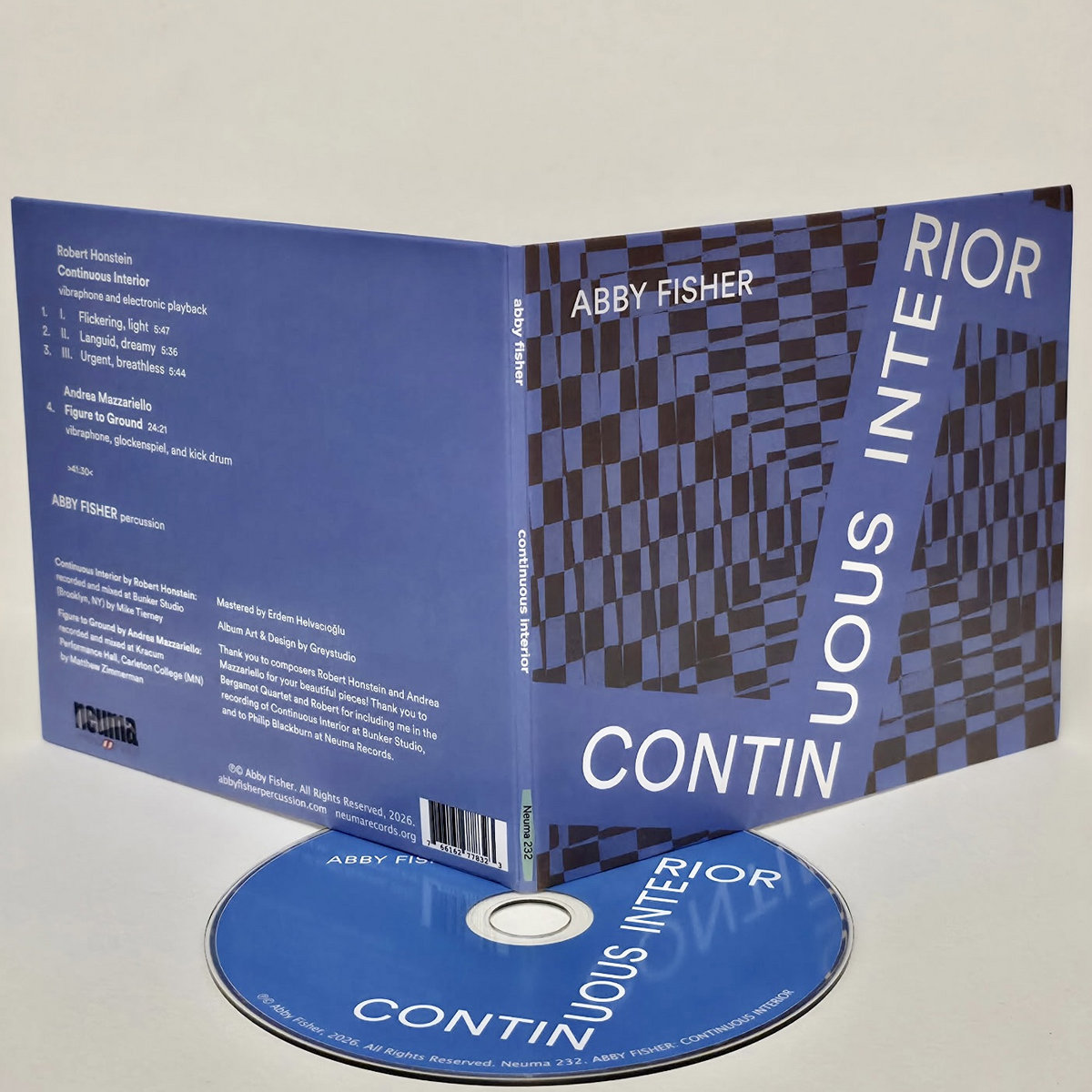
- Robert Honstein: Continuous Interior – I. Flickering, light – 5:47 (vibraphone and electronic playback)
- Robert Honstein: Continuous Interior – II. Languid, dreamy – 5:27 (vibraphone and electronic playback)
- Robert Honstein: Continuous Interior – III. Urgent, breathless – 5:44 (vibraphone and electronic playback)
- Andrea Mazzariello: Figure to Ground – 24:21 (vibraphone, glockenspiel and kick drum)
Digital bonus track:
5. Robert Honstein: Continuous Interior – II. Languid, dreamy (string quartet version)
Credits:
Abby Fisher – percussion
Continuous Interior recorded and mixed at Bunker Studio (Brooklyn, NY) by Mike Tierney
Figure to Ground recorded and mixed at Kracum Performance Hall, Carleton College (MN) by Matthew Zimmerman
Mastered by Erdem Helvacıoğlu
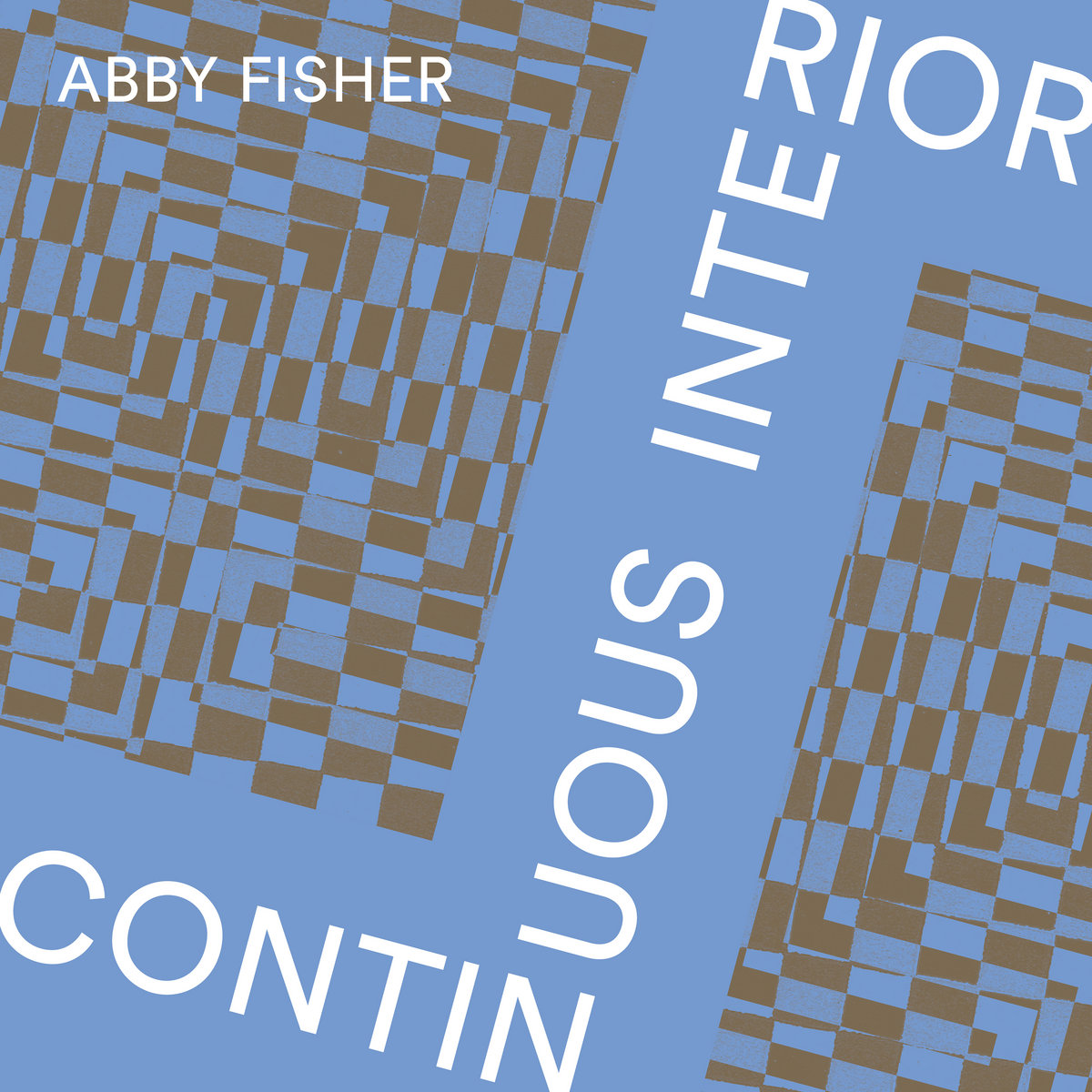
Album art & design by Greystudio
Neuma Records (Neuma 232), April 2026