| Jazz |
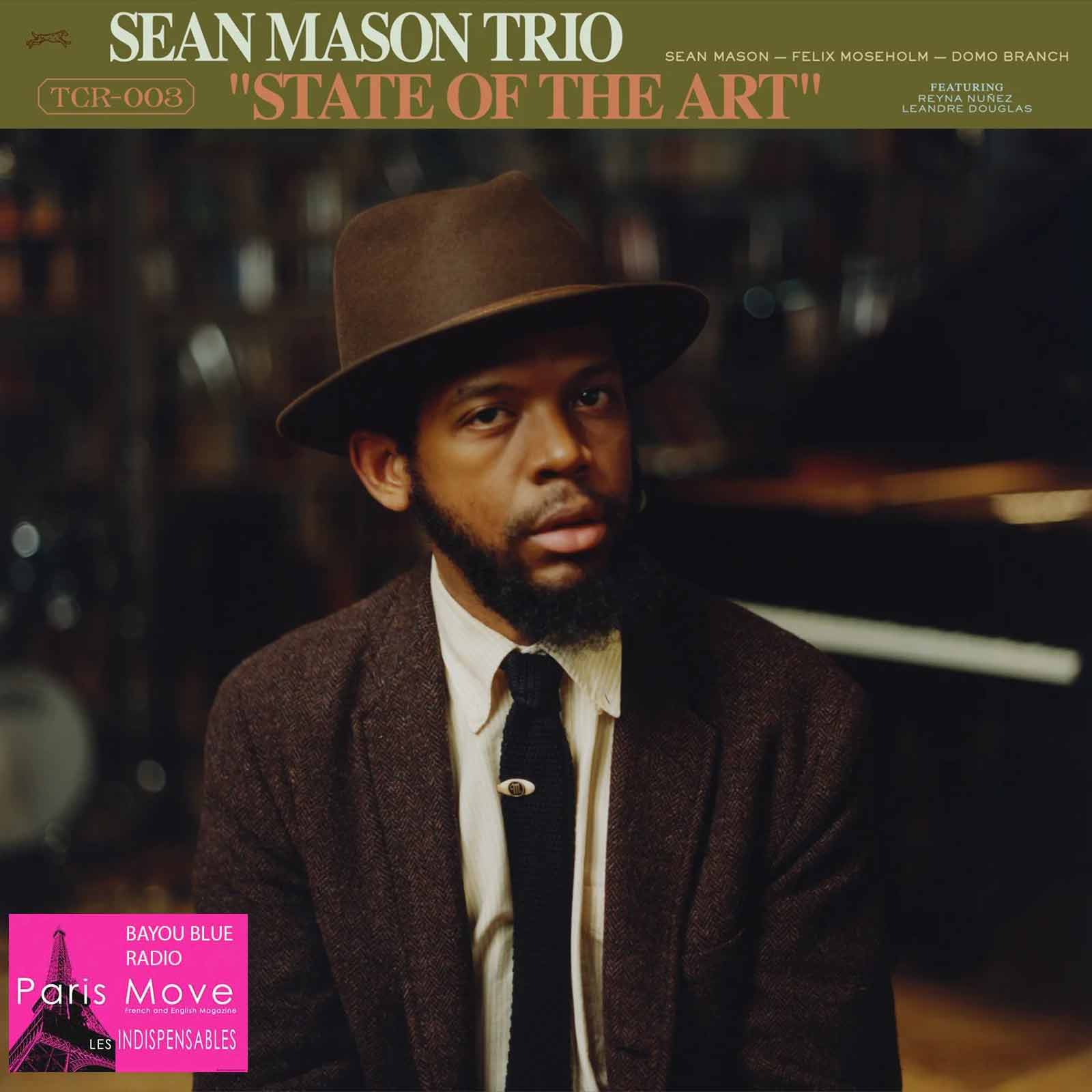
Summary: Sean Mason’s State of the Art brings jazz, soul, hard-bop and social dance together in a contemporary trio album rooted in tradition and improvisation.
Sean Mason’s State of the Art: Jazz, Dance and the Art of Keeping Tradition Alive
Some albums begin with a kind of quiet assurance. Sometimes, simply seeing the musician’s face on the cover is enough to suggest that what follows is worth hearing. There are artists whose names carry a promise before the first note has even been played. Sean Mason’s new album, State of the Art, creates precisely that feeling. Joined once again by his longtime collaborators, Felix Moseholm on bass and Domo Branch on drums, Mason returns to a trio that has clearly learned how to breathe as one. And why change a winning team? When three musicians have learned to anticipate one another, to listen closely and, most importantly, to resist the urge to overpower the music, sometimes the best thing to do is simply let them play. That is exactly what happens from the opening seconds of “Secure the Bag,” the first track on the album. Moseholm lays down a firm pulse, Branch gives the music motion without ever boxing it in, and Mason enters with his singular ability to move the piano seamlessly between melody, rhythm and harmony. The piece initially settles into an especially satisfying hard-bop groove, then gradually begins to shift, moving toward something almost repetitive before finding its way back to post-bop. Nothing in that progression feels accidental. Mason knows where he wants to take the listener, yet he leaves enough space for the music to feel as though it is unfolding in real time. That may be one of the first great qualities of State of the Art: the album is carefully constructed without ever sounding constrained by its own design. Mason composed and produced all seven tracks, and the result feels less like seven unrelated pieces than seven different ways of allowing the same musical language to breathe. Swing, post-bop, soul, contemporary groove and rhythms rooted in social dance meet here without turning into a catalogue of influences. They are absorbed into a musical vocabulary that belongs unmistakably to Mason. His rhythm section plays an essential role in making that possible. Moseholm and Branch know his language, but more importantly, they know when to follow him and when to push him somewhere unexpected.
That chemistry gives the record an impressive sense of movement, but Mason has done more than simply bring his trio back together. He has also invited Reyna Nuñez and LeAndre Douglas, artists from the world of social dance, directly into the creative process. For listeners who still think of jazz primarily as music to be heard rather than music to be experienced physically, that choice might initially seem incidental. It is anything but. It sits at the center of what Mason is trying to accomplish. He does not simply want to play for dancers. He wants to play with them. The distinction is important because it means movement is no longer merely a response to music; it becomes one of the sources of the music itself. Nuñez and Douglas bring their steps, voices, physical rhythms and reactions into the process, influencing the trio’s decisions as the performances unfold. The album therefore becomes a record of an encounter rather than simply a document of musicians executing compositions that had already been completely determined. As I often say, the acoustic trio remains one of the best ways to discover what a musician is really capable of. There is very little room to hide. There is no horn section providing instant grandeur, no oversized arrangement filling every available space, no production designed to conceal a weakness. There are simply three musicians, three personalities and the ability to listen. On that ground, Sean Mason is consistently impressive. He uses the rhythm section to make his melodies emerge while allowing Moseholm and Branch enough freedom to ensure that the trio never becomes a vehicle built merely to showcase the pianist. That relationship gives State of the Art much of its depth. Mason can move freely across the rhythmic foundation because he knows it is there not only to support him but to answer him. Moseholm brings an almost organic weight to the trio, while Branch seems constantly alert to what might happen next. He does not simply keep time. He makes time breathe.
With those two musicians behind him, Mason can let the piano step away from the melody, wander into another direction and return to the theme without ever losing the thread. That sense of control is what allows the album to sound contemporary without chasing the idea of being contemporary. For Mason, tradition is not a prison. It is a vocabulary. The echoes of hard-bop, post-bop, soul and the long history of jazz piano are unmistakable, but nothing feels inserted simply to demonstrate that he knows his history. He knows it, and that is precisely why he can move through it so freely. What makes that freedom even more compelling is his determination to put the body back at the center of jazz. At the heart of State of the Art is a joyful, spontaneous exchange among five individuals, musicians and dancers responding to one another in real time. By bringing Nuñez and Douglas into the recording session as genuine collaborators, Mason reconnects with a history as old as jazz itself, a history in which listening and dancing were never separate activities. It is easy to forget, after decades of jazz moving increasingly into concert halls and becoming increasingly conscious of its own history, that the body was always part of the music. Swing was meant to move people. Rhythm was an invitation. Music could be judged by what it made the body do. Mason is not attempting to recreate that earlier world. He is asking what the relationship between music and dance might become today. His answer is particularly compelling: the dancer should no longer be merely the person receiving the music. The dancer can help create it. Once we hear the dancers’ footsteps and recognize their reactions as part of the recording, something that might initially seem like a minor detail becomes one of the album’s central ideas. The studio is no longer a closed laboratory. It becomes a meeting place.
We are therefore listening to a jazz trio that naturally belongs to the long history of the form, from Bill Evans to Oscar Peterson, from Ahmad Jamal to so many others, but the atmosphere of State of the Art brings Miles Davis to mind most strongly. Not because Sean Mason is trying to imitate Davis, which would hardly be interesting, but because there is a similar belief here in finding depth through economy. Think of Blue Haze and the recordings associated with Davis in 1953 and 1954. There is a comparable sense that music does not have to be overloaded to be ambitious. Davis often worked with larger formations, but his smaller configurations could reveal something particularly powerful: the spaces between musicians. That is what I hear in Mason. State of the Art is unquestionably a contemporary album, but when its depth is placed alongside some of Davis’s recordings from that period, there is a similar search for what is essential. Mason has little interest in spectacle for its own sake. What matters is the relationship between the instruments. At certain moments, there is also something of Horace Silver in his approach, particularly in his ability to build themes that are immediately memorable, place them over strong rhythmic foundations and let jazz converse with soul and blues without underlining the reference. This is music that knows where it comes from. It also understands that it cannot remain there. That is one of the central challenges for any musician working within a tradition as rich as jazz: how to avoid becoming imprisoned by what you admire. Mason seems to have found a simple answer. He treats history not as a museum but as raw material. Bill Evans, Oscar Peterson, Horace Silver, Miles Davis and those who came before them are not models to be reproduced. They are musicians with whom Mason can still have a conversation. That attitude may be the most interesting thing about his work. He does not attempt to erase jazz history in order to suggest that he has invented something from nothing. He does the opposite. He embraces that history and asks what it can still produce. Even the title State of the Art, which might initially sound ambitious, takes on another meaning once the music is heard. The state of the art is not necessarily technical sophistication, the newest technology or the most elaborate production. It can also mean the ability to make old ideas work in a new context. Mason seems to understand that the real challenge is not necessarily to invent an entirely new language, but to find new ways of making the language we already have come alive. His modernity does not come from rejecting the past. It comes from making the past move differently.
Some listeners might look at seven tracks and conclude that the album is relatively short. That misses the point. The length of a record is not measured simply by the number of songs, and certainly not by their running time. What matters is what each composition has to say. Mason gives his pieces time to breathe, to settle, to develop their ideas and, at times, to move away from where they began before finding their way back. He has little interest in forcing the music into radio-friendly formulas, and that is a strength. The compositions are allowed to follow an idea to its natural conclusion without having to wonder every few minutes whether it is time to prepare a chorus or an ending. “Secure the Bag” establishes the album’s language immediately, but its structure makes clear that Mason is after more than an efficient hard-bop workout. “Honey Pie” takes the relationship between jazz and dance even further, bringing the world of Lindy Hop into music that remains unmistakably contemporary. “A Good Day” has a different kind of warmth, rooted in the musical culture of Charlotte in which Mason grew up, where jazz, gospel, soul, funk and Black American popular music were never entirely separate worlds. “Carolina Waltz” provides another kind of breathing space, while “This or That” allows Moseholm to step more prominently into the foreground and reinforces the sense that this is genuinely a collective rather than a pianist with two musicians in the background. “Nightcap” slows the movement further, creating a more intimate atmosphere and revealing a side of Mason that seems less interested in demonstrating what he can do. Then there is “One United,” recorded live, carrying the particular quality of a piece that has already lived a life. The composition appeared previously on The Southern Suite, but its return here demonstrates how a piece can continue to evolve once it leaves the hands of its composer. That is important to understanding Mason. He does not necessarily treat his compositions as finished objects. They continue to live through the musicians who perform them. They change in concert, through encounters, through interactions with dancers and through the reactions of audiences. In that sense, his approach runs almost against the grain of a music industry that constantly encourages artists to produce more, release more and keep digital platforms continuously supplied with new material. Mason seems to suggest another possibility: write less, and give the music more time to become something. Seven tracks can therefore amount to much more than seven songs. They can become a repertoire.
It also matters that Sean Mason did not arrive at this music without a history of his own. Born and raised in Charlotte, North Carolina, he grew up in an environment where jazz was never completely separated from gospel, soul, funk or popular music. His grandfather, Raymond “Flat Tire” Mason, was a jazz drummer and club owner, and that family history appears to have shaped the way the young Mason came to understand music. He began playing piano at 13, continued his training and eventually attended Juilliard after, among other encouragement, being urged to audition by Branford Marsalis. A path like that could easily have produced a musician confined within an academic conception of jazz. Instead, the opposite seems to have happened. The further Mason has moved in his career, the more determined he has become to bring musical worlds together rather than separate them. His first album as a leader, The Southern Suite, was already an exploration of his roots and of the way family history could become musical material. His work with dancers, his collaborations, his experiences with quintets and his return to the trio all point toward a musician who refuses to regard jazz as closed territory. That may help explain the presence of Reyna Nuñez and LeAndre Douglas on State of the Art. Their participation is not a decorative experiment designed simply to give the album a different color. It is consistent with a larger conception of music as a collective experience. Mason has expressed that idea with a simplicity that almost summarizes the entire project: he wanted the trio’s mission to be helping everyone become more fully themselves. He also wanted to play with dancers rather than for dancers. Nearly everything is contained in that distinction. Shouldn’t a good jazz group work in much the same way? Shouldn’t it allow each person to become more fully themselves rather than asking everyone to disappear behind a predetermined idea of the group? That is what seems to happen here. Moseholm remains Moseholm, Branch remains Branch, the dancers remain dancers, and Mason never tries to turn them into extensions of his own personality. Instead, he creates a framework in which their individual voices can meet. It is a profoundly jazz conception of the collective. Jazz has never been a music in which the individual disappears inside the group. It is a music in which the individual exists because the group gives that person room to speak. The real magic comes when those different voices manage to tell a story together.
Perhaps that is where State of the Art moves beyond the question of the trio itself and becomes an album about the way we listen to music now. What Mason puts into play, intentionally or not, is a tension between music conceived as an object and music conceived as an experience. The two are not mutually exclusive, but the digital age has accustomed us to treating a recording as a finished product: perfectly calibrated, polished and stripped of anything that might remind us of the circumstances in which it was created. Everything is expected to be clean, precise, immediately available and easily identifiable. Mason chooses another path. He keeps the moment, the reactions, the breathing, the possible imperfections and even the sounds produced by the dancers. What might once have been regarded as a flaw becomes part of the story. The album acquires a kind of truth that has little to do with technical perfection and much more to do with the feeling that something actually happened in that room. That sensation becomes especially powerful when we know that some of the pieces were recorded in very few takes. The music does not try to eliminate risk. It makes risk part of its identity. That, in turn, connects deeply with the history of jazz. From its beginnings, the music has been built around the tension between what is known and what has not yet happened. You have to know the tune in order to escape from it. You have to know the rhythm in order to move it somewhere else. You have to know the tradition in order to challenge it. Improvisation is not the absence of rules. It is the possibility of transforming them from within. That is precisely what Mason does. He never destroys the form, but he keeps it open enough for something unexpected to happen. In “This or That,” when Moseholm takes a more prominent role, the piano accepts the need to step back. In “Honey Pie,” dance changes our perception of rhythm. In “Carolina Waltz,” the ostinato and percussion create a different atmosphere. In “One United,” the live performance reminds us that a composition continues its life after the studio. Each time, the principle is the same: give the music enough structure to welcome the unexpected. It is an old idea, but it acquires particular force in an era that often tries to control everything. Sean Mason does not seem interested in controlling the music down to its last detail. He wants to create the conditions in which it can live.
That is also why the references to Miles Davis, Horace Silver, Bill Evans and Oscar Peterson should not be understood as a way of placing Sean Mason inside some reassuring genealogy. They help clarify the nature of his ambition. He is not trying to become the new Horace Silver or the new Bill Evans. He is asking what those musicians contributed to the trio and what that form can still make possible today. The trio is a paradoxical structure: extremely old, yet new every time three different personalities enter the same room. Technique alone is not enough. You have to listen to the others, anticipate their reactions and accept that a piece may suddenly take a different direction from the one imagined only seconds earlier. Mason has that quality, and it may be what gives his playing its sense of freedom. He never seems in a hurry to prove that he can play. He plays because the music calls for it. The distinction may seem small, but it changes everything. In a musical world where virtuosity has become highly visible, sometimes even measurable, it is worth remembering that a musician’s talent is defined not only by what he can play but also by what he chooses not to play. Mason’s piano can be powerful, fast and virtuosic, but he also knows when to become quiet, when the bass or drums need to speak. That reciprocal listening gives the album a depth that may not reveal itself on the first listen. You have to return to it to hear the small shifts, the responses, the silences and the changes in dynamics. And that is probably where the seven tracks find their real justification. They are not designed to be consumed and immediately replaced by whatever comes next. They ask to be inhabited. Return to “Secure the Bag” and you hear more of its rhythmic architecture. Return to “Honey Pie” and the relationship with dance begins to sound different. Return to “Carolina Waltz” and you start following the bass and percussion more closely. Return to “Nightcap” and the trio’s ability to completely change atmosphere becomes clearer. A good jazz album is not necessarily the one that impresses you immediately. Often, it is the one that continues to reveal something after several listens. State of the Art belongs to that category.
So what, ultimately, does Sean Mason want to do with jazz? Listening to this album, the answer is certainly not to save it, and even less to modernize it for the sake of modernization. Jazz does not need to be saved. It needs musicians willing to keep it alive. Mason appears to understand that. He is not trying to erase the past in order to appear contemporary, nor is he reproducing the past simply to be recognized as a guardian of tradition. He moves between the two. That movement is what makes State of the Art so compelling. Here are Charlotte and New York, gospel and post-bop, soul and hard-bop, the club and the concert hall, musician and dancer, composition and improvisation. Nothing is completely separate. Perhaps that absence of separation is the real subject of the album. Mason is not telling us that jazz needs to become what it once was. He is showing us that it can still be several things at once. It can be sophisticated and popular, complex and immediately physical, deeply rooted in its history and completely open to its own moment. It can be played by three musicians in a studio while, at the same time, making room for the movements of two dancers. It can revisit an older composition from its creator’s repertoire and give it another life. It can look toward Miles Davis without becoming an exercise in nostalgia, toward Horace Silver without turning into a hard-bop imitation, toward Bill Evans or Oscar Peterson without attempting to reproduce their conception of the trio. And above all, it can still surprise us.
That may be the most important thing. When the final notes of State of the Art disappear, what remains is not the impression of having heard a demonstration of what jazz once knew how to do. It is the feeling of having heard musicians searching together for what this music might still become. Seven tracks may seem like very little, but they are more than enough when they are this fully inhabited. Sean Mason has not made an album that claims to offer a definitive answer to the history of jazz. He has done something more interesting: he has added his own voice to a conversation that has been going on for more than a century. And that voice belongs to a musician who understands that tradition remains alive only when we are willing to put it in motion. So yes, why change a winning team? Perhaps Mason simply had to let them play, bring two dancers into the room, close his eyes and listen. The rest belongs to the music.
Thierry De Clemensat
Member at Jazz Journalists Association
USA correspondent for Paris-Move and ABS magazine
Editor in chief – Bayou Blue Radio, Bayou Blue News
PARIS-MOVE, October 1st, 2026
Follow PARIS-MOVE on X
::::::::::::::::::::::::
Musicians :
Sean Mason, piano & compositions
Felix Moseholm, bass
Domo Branch, drums
Movement artists:
Reyna Nuñez and LeAndre Douglas
Track Listing :
- Secure the Bag
- A Good Day
- Honey Pie
- Carolina Waltz
- This or That
- Nightcap
- One United (Live at Dizzy’s Club)