| Latino |
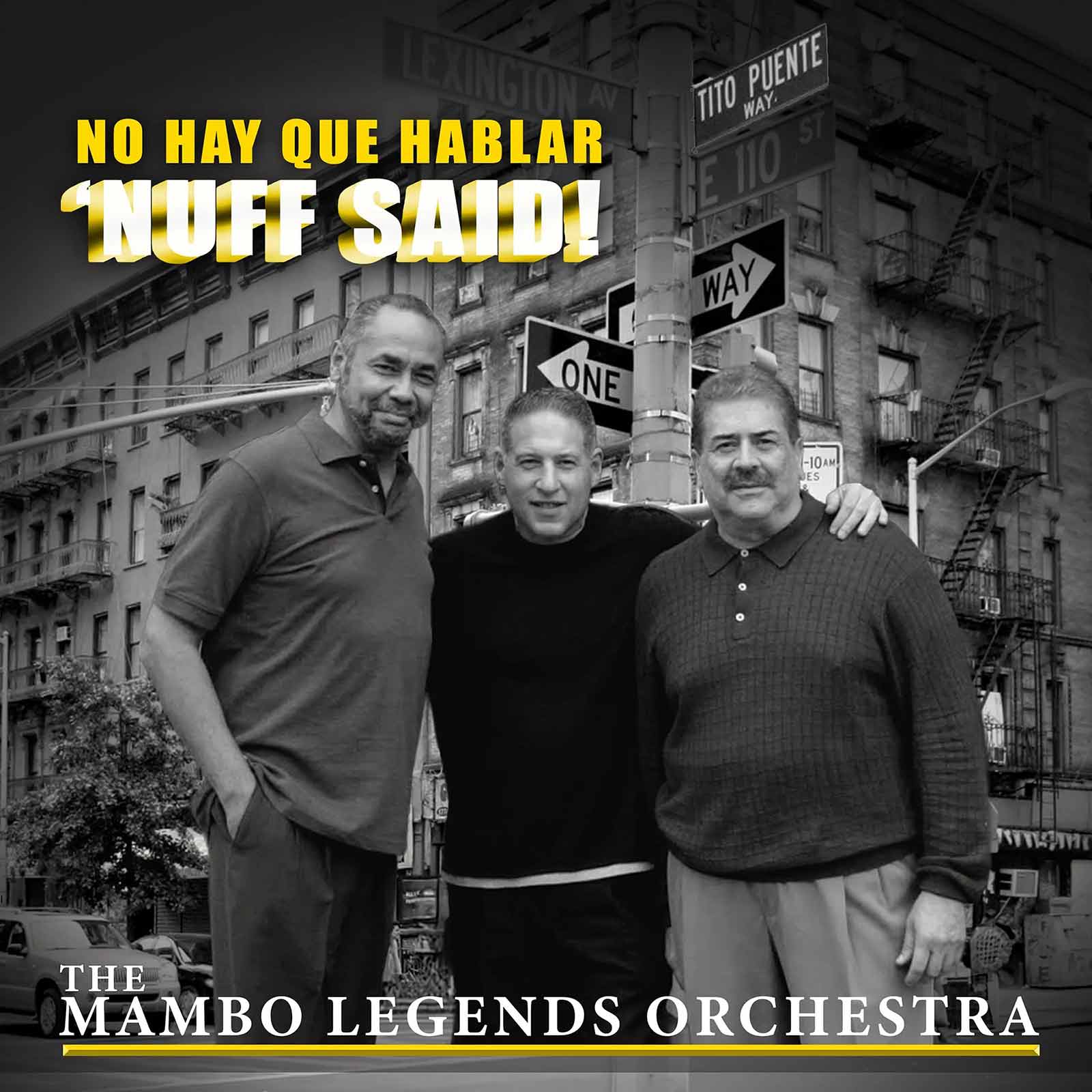
Summary: Exploring the Mambo Legends Orchestra, Tito Puente, the Palladium Ballroom, and the enduring musical dialogue between mambo, Latin jazz, salsa, and New York.
No Hay Que Hablar ‘Nuff Said!: The Mambo Legends Orchestra Keeps the Palladium Sound Alive
THE MAMBO: A SPECIALIST’S AFFAIR
The sun is coming up, and with it comes this album, No Hay Que Hablar ‘Nuff Said!, a title that could loosely be translated, for those of us who, like me, don’t understand a word of Spanish, as “No need to say anything more. Everything has been said.” From the very first listen, it is clear that this is a specialist’s affair, and The Mambo Legends Orchestra is certainly one of the finest expressions of it. There is something about this album that goes well beyond the simple pleasure of hearing a great Latin big band. You immediately hear the precision of the arrangements, the importance of the brass, the work of the percussion, the conversation between the different sections, and that very particular way of keeping the music moving without ever losing its momentum. Everything sounds natural, almost effortless, even though it has presumably taken years to reach this level of collective mastery.
For more than half a century, the music of Machito, Tito Puente and Tito Rodríguez has been one of New York’s great cultural exports. It helped define the sound of the Palladium Ballroom and shaped generations of Latin jazz and salsa musicians. The Palladium was not simply a dance hall. It was one of those places where a musical culture took shape through the encounter between Afro-Cuban traditions, Latin American popular music and New York jazz. Mambo found part of its identity there, and, perhaps more importantly, developed that remarkable ability to bring the sophistication of orchestral writing together with music that remained deeply connected to movement and dance.
Countless bands have drawn inspiration from that era, but very few can claim a connection as direct as the Mambo Legends Orchestra. These are not musicians who simply decided to revisit an old repertoire after studying the original charts. The band brings together maestros whose careers were forged within Tito Puente’s orchestra and whose experience is directly rooted in this history. Founded by Jose Madera, Mitch Frohman and the late John “Dandy” Rodriguez, the Mambo Legends Orchestra set out to bring audiences around the world the vibrant music that helped define Latin jazz and salsa.
That is probably what gives this album its remarkable sense of authenticity from the very first bars. You never feel as though you are listening to a reconstruction. The music is not being treated like some old object taken down from a shelf and carefully dusted off. It is being played with an intimate knowledge of its rules, its language and, above all, its spirit. Mambo is therefore clearly not just a matter of rhythm, theatrical vocals and well-arranged brass. It is first and foremost an identity and a culture, a specialist’s affair both for the musicians who practice the art and for the listeners and dancers who have made mambo part of their own lives.
It is always a little dangerous, then, to talk about this music without saying something foolish. I certainly would not pretend to know all of its secrets, because that would probably mean missing precisely what makes it so fascinating. There is an architecture to mambo that is difficult to reproduce without possessing the culture behind it. You can know the rhythms, learn the arrangements and put twenty musicians together who are all perfectly capable of playing their individual parts, but there is still that particular vision that comes from the identity of the music itself. You have to understand how the sections answer one another, how the percussion organizes the movement, how the brass enters the conversation and, above all, how all of it is supposed to breathe together.
That apparent ease is probably one of mambo’s greatest strengths. The music is bright, joyful and immediately accessible, yet its architecture follows very precise rules. That contrast is exactly what strikes me about No Hay Que Hablar ‘Nuff Said! You can listen simply for the pleasure of it, let yourself be carried along by the brass and percussion, but listen a little more closely and you begin to discover a much more elaborate construction underneath. Immediate pleasure never comes at the expense of depth. If anything, it may be the best way into it.
JAZZ ENTERS THE MAMBO
This album also needs to be heard with the particular relationship between mambo and jazz in mind. The story is often told as a matter of American jazz influencing Latin music, but that would be far too simple. The exchange went both ways, particularly in New York, where Cuban, Puerto Rican and American musicians had been meeting, playing together and influencing one another for decades. Jazz borrowed from Afro-Caribbean cultures, while mambo itself absorbed elements of the jazz vocabulary and incorporated them into its own musical universe.
You can hear that especially clearly in a song like “I’ve Got a Crush on You.” Originally, we are dealing with a song associated with George Gershwin and the great American songbook. Here, it enters the world of mambo and acquires an entirely different way of breathing. The melody remains, but the rhythmic architecture gives it another personality. Jazz, in a sense, allows itself to be absorbed by mambo, whereas we are so often accustomed to hearing jazz borrow elements of other cultures and incorporate them into its own language. That reversal is fascinating because it shows just how porous the boundaries between these musical worlds have always been.
The big band becomes the ideal setting for these encounters. Brass, percussion, piano, bass and voices make it possible to build a music in which every element has its place. Mambo demands that collective dimension. It is not simply a matter of putting instruments next to one another, but of creating a genuine sonic architecture. The sections have to be able to talk to one another, answer one another, push the music forward, allow a soloist to step into the spotlight and then bring the whole orchestra back to the common pulse.
This is where the experience of the Mambo Legends Orchestra musicians becomes essential. They are not trying to demonstrate that they know how to play mambo. They know because they have been playing it for decades. Their experience with Tito Puente, Machito and Tito Rodríguez is therefore much more than an interesting biographical detail. It helps explain why this orchestra has such a particular way of making the music sound. There is a kind of knowledge that cannot be found in the charts alone. It comes from practice, from listening, from playing night after night and from understanding what happens between the notes.
The project grew out of the desire to bring together, within a single orchestra, many longtime friends and collaborators in order to celebrate both the timeless talent of the Palladium generation and the musicians who continue to keep this musical language alive. That idea seems particularly important to me because it prevents the album from becoming merely a celebration of the past. The record looks backward, obviously, but it plays very much in the present.
The title itself reflects that collective experience. Mitch Frohman explains, in essence, that the orchestra brings together musicians who played alongside Tito Puente, Machito and Tito Rodríguez, and that nothing can replace the experience gained from sharing the stage with those masters for so many decades. “Everything has been said,” in a way. And after listening to the album, you understand the phrase a little better. There is no need to add much when the music itself carries that kind of authority.
The presence of guests such as Eddie Palmieri, José Alberto, Gilberto Santa Rosa, Danny Rivera, Tony Vega and Tito Nieves broadens that perspective even further. They are not simply there to add star power or decoration to the project. They too belong to the history of Latin jazz and salsa, and each of them shows, in his own way, just how far this musical language has traveled. The album becomes a meeting place for different generations and different sensibilities without ever losing the backbone of the big band.
And perhaps this is where mambo becomes particularly interesting for anyone listening to it today. This is not music that needs to be artificially modernized in order to remain relevant. It already contains more than enough substance to enter into a conversation with the present. The real challenge is to understand what has been handed down and decide what to do with it. That is a question we find in every great musical tradition, but it takes on a particular dimension here because mambo is also a culture of movement.
A MUSIC THAT REFUSES TO REMAIN IN THE PAST
When we talk about the big band, mambo requires that kind of musical mass that allows the arrangements to reach their full scale. Twenty musicians are not there simply to make more noise. They create contrasts, responses, breathing spaces and tensions that a smaller ensemble could never produce in quite the same way. The brass can explode, the percussion can establish its language, the piano can push the movement forward, and the voice can come in and tell its story somewhere inside this larger construction. Everything has to work together, and it is precisely that relationship between the musicians that gives mambo its particular energy.
On No Hay Que Hablar, every arrangement reflects this fundamental philosophy: preserving the sound of the Palladium era does not mean freezing it in the past. That is probably one of the most important aspects of the project. It would have been very easy to fall into the trap of making a nostalgic record, attempting to reproduce an era as faithfully as possible and assuming that success means making us believe we have somehow traveled several decades back in time. That is not what happens here. The orchestra treats that history as living material.
That distinction changes everything. The past is no longer a destination, but a starting point. The Mambo Legends Orchestra is not trying to replace the bands of Machito, Tito Puente or Tito Rodríguez, which would obviously be impossible. It is showing us what their music made possible and why it continues to matter to musicians several decades after its golden age.
That is also what helps us understand the relationship between mambo and Cuban jazz. The musicians we know today did not appear in some musical vacuum. They grew up surrounded by these sounds, these big bands, these arrangements and this particular way of thinking about rhythm. Mambo helped create a musical environment in which several generations could learn, experiment and develop their own voices.
One of the great pleasures of this album, in fact, is that it reminds us that the history of Latin jazz did not begin with the artists we know today. It has deep roots, and they are sometimes far more complicated than we imagine. Mambo is one of the threads running through that history. It connects the orchestras of the Palladium with contemporary musicians and helps explain why certain forms of Latin jazz possess that particular combination of energy, precision and intimate relationship with dance. And then there is Cuba, of course. It would be impossible to talk about mambo without talking about Cuban culture, but it would be equally reductive to confine this music to Cuba. Mambo as it developed in New York was the product of movement, encounter and transformation. It belongs to Cuba, but it also belongs to New York. It belongs to the musicians who played it, to the dancers who brought it to life and to all those who eventually carried it somewhere else.
That ability to travel is what fascinates me. A music can emerge from a very specific context and eventually become an international language. But for that to happen, someone has to keep playing it. That is where the Mambo Legends Orchestra becomes so important, not as the guardian of a frozen heritage, but as an orchestra capable of putting this music back into circulation.
We also have to accept that this history comes with its share of losses. John “Dandy” Rodriguez, an essential figure in this adventure, is no longer with us. Other musicians from that generation have also passed away. Their absence inevitably gives the album a particular resonance. But this is not a funeral monument. Quite the opposite. It is full of life, movement and the energy that has always defined mambo. Perhaps the best way to honor the people who built this music is to keep playing it.
FROM THE PALLADIUM TO TODAY, MAMBO KEEPS DANCING
When you think about the longevity of mambo, one question inevitably comes back: who could have imagined, in the 1930s or 1940s, that this music would still be here beyond the year 2000? Fashions change, clubs close, orchestras disappear, instruments move in and out of popular music, and yet certain musical forms simply keep going. Mambo belongs to that rare group of musical languages that have managed to outlive the circumstances in which they were born.
No Hay Que Hablar ‘Nuff Said! is especially interesting because it allows us to hear that continuity without turning it into nostalgia. The album does not attempt to recreate the Palladium. It shows us what the Palladium produced. And what it produced can still be heard in the work of these musicians, in their arrangements, in the way they play together and in their conception of the big band as a place for dialogue.
For me, that is probably the part that speaks to me most. We could talk about the great names, the solos, the arrangements, the quality of the performances, the brass or the percussion, but behind all of that there is something much harder to define. A form of musical memory that passes through gestures and listening. Someone played this music before them. They heard it, learned it, absorbed it, transformed it in their own way, and now they are playing it for us. There is nothing mystical about that. It is simply what happens when a great musical culture manages to remain alive.
Perhaps that is also why this album needs to be approached with a little humility. Mambo is complex enough that you can miss a great deal on the first listen. Even on the tenth. There are details in the arrangements, exchanges between sections and rhythmic subtleties that do not reveal themselves immediately. But that does not diminish the pleasure in the slightest. Quite the opposite. The record becomes more fascinating as you begin to discover what lies beneath that apparent simplicity. Because this music remains, above all, music that makes you want to dance. That is worth remembering. It would be a shame to turn mambo into an academic subject to the point where we forget that it was made to make a room vibrate. The musicians can be virtuosos, the arrangements can be complex, but the body still has to be able to follow. It is that relationship between sophistication and pleasure that gives the music its strength.
And perhaps that is also why jazz has borrowed so much from this culture. It finds another way of thinking about rhythm, movement and the relationship between instruments. But with No Hay Que Hablar, we sometimes hear almost the reverse: jazz enters mambo, comes looking for something, and mambo answers on its own terms. That ability to absorb without disappearing is probably one of the great strengths of this music.
In the end, what we have here is indeed a page of history, but a page that has not yet been turned. The Mambo Legends Orchestra brings together musicians whose careers are directly connected to the great names of the Palladium and who continue to make this music heard several decades after its golden age. That alone is enough to understand the importance of the project, but the album goes further because it never simply looks backward. It looks forward, too.
And perhaps that is the best way to talk about mambo today. Not as a vanished music that needs to be resurrected, but as a language that still possesses enough strength to be played, heard and danced to. The past is there, of course, in every arrangement and every reference, but it never overwhelms the present. The sun is now fully up and the album is still playing. I would never claim to have understood everything about mambo, because that would probably be the surest way of proving that I have understood nothing about this music. I would rather remain where I belong: as a passionate listener, someone who listens, tries to understand and discovers, with every new hearing, something he had not noticed the time before.
What I can say, however, is that No Hay Que Hablar ‘Nuff Said! is a genuine journey into the heart of a musical culture that goes far beyond the simple boundaries of mambo. You hear Cuba, New York, jazz, salsa, the big band, dance, and several generations of musicians who helped build this language. Above all, you hear music that refuses to become a memory. And perhaps, in the end, the title says everything that needs to be said. “No Hay Que Hablar.” No need to say any more. After all, when an orchestra has this kind of experience, and when its musicians have shared the stage with Tito Puente, Machito and Tito Rodríguez, there is something much more interesting to do than multiply the explanations: listen.
The record keeps playing, the brass answers the percussion, the piano sets the whole machine in motion again, and mambo finds its rhythm once more. The sun is out, the day is beginning, and this old music from New York, Cuba and the Palladium suddenly sounds as though it has not aged a day. Everything has been said. Or rather, everything has been played.
Thierry De Clemensat
Member at Jazz Journalists Association
USA correspondent for Paris-Move and ABS magazine
Editor in chief – Bayou Blue Radio, Bayou Blue News
PARIS-MOVE, September 29th, 2026
Follow PARIS-MOVE on X
::::::::::::::::::::::::
Leaders & Core Musicians:
- José Madera – Timbales, arrangements, and musical director
- Mitch Frohman – Tenor saxophone and flute
- John “Dandy” Rodríguez – Bongos (co-leader)
- Bobby Porcelli – Alto saxophone
- John Walsh, Pete Matter, Richard Viruet– Trumpet
- Doug Beavers, Jimmy Bosch, Koyumori Kajiwara, – Trombone
- Zaccai Curtis, piano
- Gerardo “Jerry” Madera, bass
- George Delgado, congas
Vocalists:
- Frankie Vázquez
- Cita Rodríguez
- Marco Bermúdez
- Jorge Maldonado
Special Guests:
- Eddie Palmieri – Piano
- José Alberto “El Canario” – Vocals
- Gilberto Santa Rosa
- Danny Rivera
- Tony Vega
- Tito Nieves
Track Listing:
“Sabroso Guaguancó” (featuring Eddie Palmieri, piano; José Alberto, vocals)
“I’ve Got a Crush on You” (featuring John Walsh, trumpet; Doug Beavers, trombone; Frankie Vázquez, vocals)
“La Rumbantela” (featuring Pete Nater, trumpet; Gilberto Santa Rosa, vocals)
“Preludio en Ritmo” (featuring Mitch Frohman, flute; Marco Bermúdez, vocals)
“Que Me Digan Feo” (featuring Tony Vega, vocals)
“Empego Naroco” (featuring John Rodriguez, bongos; Tito Nieves, vocals)
“De Papi Con Amor (From Daddy With Love)” (featuring Mitch Frohman, tenor saxophone; Danny Rivera, vocals)
“Camagüey (Piñeiro Tenía Razón)” (featuring Richard Viruet, trumpet; Gilberto Santa Rosa, vocals)
“El Trabajador” (featuring Jimmy Bosch, trombone; Richard Viruet, trumpet; Frankie Vázquez, vocals)
“Abaniquito” (featuring Bobby Porcelli, alto saxophone; Pete Nater, trumpet; José Madera, timbales; Frankie Vázquez, vocals)
“The MLO Swing” (instrumental; featuring John Walsh, trumpet; Tokunori Kajiwara, trombone; Bobby Porcelli, alto saxophone; Zaccai Curtis, piano)