| Jazz |
Summary : A personal look at Julieta Eugenio’s Mi Boathouse, exploring its blend of contemporary jazz, Argentine roots, New York influences, nature, memory, healing and improvisation.
Julieta Eugenio’s Mi Boathouse: Jazz, Memory, Healing and Inner Space
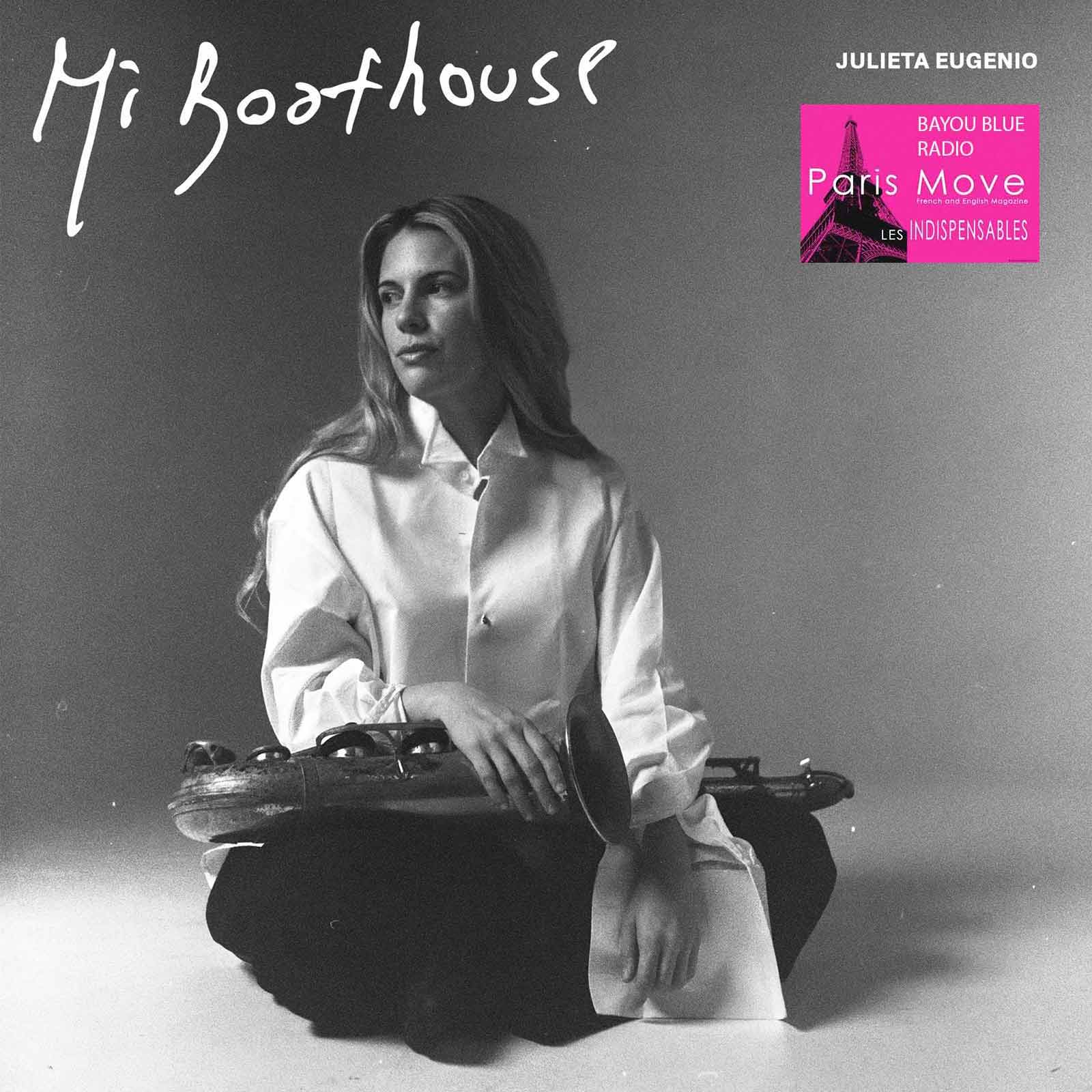
Black and white, shades of gray, a restrained cover. Julieta Eugenio sits cross-legged at the center of the image, her saxophone resting on her lap, her gaze turned to the right. There is something about this photograph that, from the very first glance, seems to tell part of the story of the music that is about to follow. Nothing spectacular, nothing deliberately striking, but a presence, a sense of restraint, a way of looking elsewhere, as if the musician were already inhabiting a space that belongs entirely to her. That is exactly what I felt when I discovered Mi Boathouse: the feeling of gradually entering an inner world without the door ever being fully opened. You have to listen, wait, let the sounds settle, accept the breaths, the silences and the changes of direction. From “Tree Breath,” the opening track, Julieta Eugenio establishes this particular atmosphere, and I have to admit that I was drawn in from the very first listen. There is something cinematic about this music, not because it tries to illustrate images, but because every composition seems to have its own setting, its own light, its own imaginary camera movements, its moments when we move closer to a character before suddenly pulling away. You listen and almost begin to see landscapes, streets, trees, silhouettes, spaces that open and then close again, memories whose stories we do not necessarily know but whose presence we immediately feel. Julieta Eugenio’s Argentine roots are obviously an important part of this story, but it would be too easy to reduce her music to that one identity. What interests me more is the way several worlds seem to coexist within her musical language. Her background necessarily carries the memory of Argentine musical culture, an affinity with classical music and certain folk traditions, but all of that has been confronted with a deeply New York experience. Eugenio has lived and worked in New York since 2013, after studying jazz in Argentina and continuing her education at Queens College. She has since established herself as a tenor saxophonist, composer and bandleader in a scene where influences are constantly crossing paths. But rather than trying to identify the precise origin of every musical phrase, I prefer to listen to what this coexistence produces. What we hear is a musician who seems to have accepted that she does not have to choose between the different parts of her story. Argentina is not a decorative layer added to the music, any more than New York is simply a backdrop. Both experiences seem to have shaped, at a deeper level, the way she thinks about sound. New York inevitably leaves its mark when you live there, play there and build a career there. The city imposes its rhythm, its density, its contradictions, its speed, but it also forces you to find an inner space so that you are not constantly swept away by the movement around you. And perhaps that is precisely the space Julieta Eugenio is trying to build with Mi Boathouse.
The title of the album immediately offers a key, but it is a key that does not unlock everything. In a poem written for the project, Eugenio speaks of a boathouse made of feelings, experiences, countless stories, her story. The image might seem simple at first, but it becomes much more powerful when you listen to the ten pieces that make up the album. Trees, breath, breeze, waves, bees, healing, time: an entire vocabulary of nature runs through the record. Yet this is never descriptive music. Eugenio is not trying to make us literally hear a tree or the wind. Nature becomes a language for speaking about what is happening inside. It becomes a way of representing memory, wounds, change, moments of calm and those moments when everything seems to lose its balance. She describes Mi Boathouse as a space of peace she has built within herself over the years, an abstract and spiritual place where she can protect herself from the chaos of the world, allow music to circulate, let pain dissolve into the breath of nature and recover a sense of movement. This idea feels essential to understanding the record because it allows us to hear it differently. We are not simply listening to a collection of contemporary jazz compositions; we are listening to a musician transforming her experiences into sound and using composition to build a place where those experiences can coexist. And this is where the word “space” becomes so important. Mi Boathouse is an album that breathes. That may sound paradoxical when you consider that the quartet gives the music a relatively dense sonic texture, but it is precisely that density that makes the spaces between the sounds so important. Julieta Eugenio is joined by Glenn Zaleski on piano, Matt Dwonszyk on bass and Jonathan Barber on drums. These three musicians are not simply there to accompany the saxophonist; they are part of the construction of the musical space itself. The trio formed by Dwonszyk and Barber already has a long history together, while the addition of Zaleski considerably expands the harmonic and contrapuntal possibilities. Eugenio explains that she began writing more for piano, and that this evolution led her to explore the lines between instruments, colors and textures, but also to give the music more room to breathe and develop. You can genuinely hear that in the record. Every instrument has its own voice, but none seems to need to occupy the entire space. The musicians know when to step in and, perhaps more importantly, when to let someone else speak. There is something in this way of playing together that feels deeply connected to the composer’s personality: music that is thoughtful but open to the unexpected, carefully constructed but unwilling to become rigid.
This way of working probably explains why the album has such a strong sense of movement. The saxophone melodies are never completely detached from the rest of the group. They circulate, return and change. The piano can extend an idea, the drums can shift its center of gravity, the bass can create an anchor while the saxophone moves further away. You think of a succession of waves, and Eugenio herself describes the melodies as moving through an ocean of rising and falling motion. This is particularly noticeable in the pieces that form the heart of the album, “Mantra” and “Mi Boathouse,” which seem to carry an essential part of its message. There are moments of closeness and separation, tensions, returns, passages where the music seems to be searching for its way before finding a new direction. These are not pieces that reveal their architecture immediately. They take time. And I think that is also one of the reasons the album held me from the first listen: it makes you want to return because a first listen only allows you to glimpse what lies beneath the first layer. “Tree Breath” establishes this relationship with nature from the very beginning. The title itself may sound almost programmatic, but the music never slips into illustration. It suggests more than it describes. Then comes “Brisa,” like a shift in the air, followed by “A Talk with the Trees,” which takes this almost intimate relationship with the natural world even further. Eugenio explains that this composition grew out of a walk in Prospect Park, when she looked up at the sky through the trees and watched them moving in the wind. The movement stopped her, giving her the feeling that she had entered into a conversation with them, eventually feeling herself becoming a tree among the others. There is no need to overinterpret the psychology of the moment; what matters is the way such an ordinary experience becomes the starting point for a composition. A walk, a glance toward the sky, the movement of branches, the wind: something happens, and the musician turns it into music. Perhaps that is ultimately what a composer does: learns to recognize, within ordinary events, the possibility of a language.
There is also a form of introspection throughout this album that never becomes entirely confessional. “Hurtwave” already carries an obvious tension in its title, a wave of pain that arrives, recedes and perhaps returns in another form. “Healing” could easily have fallen into the familiar language of repair or resilience, yet within the broader context of the album, the word takes on something less declarative. Healing is not presented as an outcome. It feels more like a process. Something that takes time, that involves going backward, moments of doubt, periods when you think you have found your balance only to realize that you have to begin again. “The Heart’s Time” extends this idea through a conception of time that seems less chronological than emotional. The heart’s time is not the time of the clock. It moves differently, with its accelerations, its pauses, its memories returning without warning. Julieta Eugenio’s music seems to operate according to precisely this logic: it does not always follow the straight line we expect, and it accepts the detours. “The Bee” brings yet another image into the picture. Again, what interests me is not finding a literal translation for every title, but looking at the way these elements gradually construct the world of the album. The tree, the breeze, the bees, the waves, healing, time: everything seems to belong to the same mental landscape. There is a desire to move closer to the living world, to recover something that escapes the constant noise of contemporary life. This feels particularly interesting coming from a musician who has made her home in New York, a city where silence has almost become a scarce resource. But Eugenio does not completely escape the city. She carries its tensions with her. Her jazz remains deeply urban in the way it approaches the group, rhythm, interaction and freedom. It is intellectual jazz without ever feeling cold, contemporary without needing to prove its contemporaneity. And above all, it retains a form of humanity that allows the listener to recognize something of themselves in it.
The title “Mi Boathouse” probably brings all of these contradictions together more clearly than anything else. To my ears, it is also the most complex piece. The combination of Spanish and English is not insignificant, even if it does not necessarily need to become an identity theory. Two languages meet in just a few words, and one can see in that meeting the image of two worlds coexisting within the musician. One belongs to her personal history, the other to the environment in which she has chosen to live and work. But above all, “Mi Boathouse” refers to a place that exists nowhere on a map. It is not a physical location. It is an inner construction. Eugenio describes it as a protective space shaped by her experiences, emotions, memories and personal stories, a place where the soul can rest, heal and prepare for whatever comes next. The boathouse metaphor is ultimately quite beautiful: it is not about keeping the boat from sailing, but about giving it somewhere to take shelter between journeys. This image also seems to correspond to the role of the saxophone throughout the album. Eugenio never plays as though she needs to prove that she can play. The technique is obviously there, but it is placed at the service of an intention. That is probably what I take from the way some critics speak of expressive depth and technical virtuosity. Neither concept is particularly interesting on its own; what matters is when the two meet. Virtuosity alone can impress for a few minutes; expression alone can sometimes lack the means to carry an idea all the way through. Here, one feeds the other. The saxophone can become expansive, fragile, incisive or almost whispered. It can carry the melody or disappear into the collective movement. There is always something to hear behind the foreground. One note calls for another, but more importantly, one note seems to call up a memory, an image, a sensation.
It is also worth emphasizing the role of the pieces in which Eugenio works alone with her saxophone and pedals. They give the album an additional layer of intimacy. Her compositional process sometimes begins with an extremely simple gesture: sitting down with her saxophone, taking a deep breath, and allowing the melodies to emerge. She then uses pedals to create bass lines, record them, play over them, build counterpoint and reharmonize certain ideas. The process may sound purely technical, but it actually reveals something very organic about the way she composes. She does not necessarily begin with a pre-existing architecture; she allows a piece of material to appear and then works on it. There is a form of trust involved here, in the instrument and in time itself. The music is not forced. It is allowed to find its own rhythm before being structured. And then there is “I’m Lost.” It is the only composition on the album that was not written by Julieta Eugenio, and its position at the end of the record strikes me as particularly interesting. After moving through this collection of inner landscapes, ending with a piece carrying such a direct title as “I’m Lost” introduces almost one final contradiction. You might expect the journey to lead toward some form of peace, since Mi Boathouse is precisely this space of protection and healing. Yet the album ends with being lost. Perhaps that is exactly the most honest thing it could do. Even when we build an inner refuge, we do not stop getting lost. We simply learn to have somewhere to return to when it happens. Musically, the piece works for me almost like a door left slightly open. The saxophone is particularly prominent, supported by Matt Dwonszyk’s bass, whose warm, deep sound gives Eugenio the foundation she needs to develop her statement without rushing. It is a piece that made me want to return to the beginning of the album, and I fell into that trap several times. There are worse musical traps.
Ultimately, what strikes me most about Mi Boathouse is its ability to make several dimensions coexist without ever placing one above the others. The composer and the performer, the Argentine musician and the New Yorker, writing and improvisation, control and freedom, pain and healing, movement and silence. Nothing is completely resolved, and that is probably what makes the album feel so alive. Every artist carries their own complexities. Those who manage to turn them into something personal are not necessarily the ones who erase them, but the ones who accept them and transform them into a story. Julieta Eugenio seems to have chosen that path. She does not explain who she is; she allows us to hear the traces of what she has lived through. And it is up to the listener to walk the rest of the way. It is also interesting to see how much this music comes from genuine collective work. Eugenio wrote the pieces, but then accepted the idea of placing them in the hands of musicians she trusts. The result never feels like a simple leader album with a backing band. What we hear is a group that has learned how to breathe together. Dwonszyk and Barber have known Eugenio for several years, and their musical relationship is an important part of that cohesion. Zaleski brings another dimension, particularly through his work at the piano and his ability to understand the idea of space that the composer places at the center of the project. There is something very right about the idea of “finding yourself inside the piece.” The musicians are not simply playing together; they are finding their place within a structure that remains open enough to accommodate their own contributions.
As I listen, I keep coming back to that cover photograph. Julieta Eugenio sitting at the center, the saxophone resting across her lap, her gaze turned elsewhere. She does not seem to be posing for us. She seems to be waiting, thinking, listening to something we cannot hear yet. The image eventually becomes a kind of visual summary of the album. Mi Boathouse is not a record that gives itself away immediately. You have to enter it. You have to accept taking your time, returning to certain passages, allowing the compositions to develop their own landscapes. And the more you return to it, the more the image of the boathouse begins to make sense. This imaginary place is not an escape from the world, but a way of returning to it differently. It protects without imprisoning. It allows you to step away without disappearing. It offers a moment of silence before you set out again. That is ultimately what explains my fascination with this album from the very first listen. There is something in every theme, every musical idea, that makes me think of a scene from a film whose story I have not discovered yet. A light appears, a figure crosses the frame, the landscape changes, then everything disappears before returning in another form. The music leaves enough room for the imagination for each listener to place their own images inside it. And perhaps this is where Julieta Eugenio accomplishes something truly precious: she starts from her own story without ever trapping the listener inside it. She transforms her personal experience into a space large enough to accommodate someone else’s.
Mi Boathouse is therefore more than the musical portrait of an Argentine saxophonist who became a New York musician. It is the result of a journey, a memory and a collective effort, but also the patient construction of a language. Music that knows where it comes from without needing to repeat it, that looks at the present without entirely belonging to it, and that seems above all to be searching for that fragile place where the noise of the world can finally become silence. Julieta Eugenio moves through it with her saxophone, surrounded by three musicians who understand that the point is not to fill the space but to inhabit it. She invites us into this imaginary boathouse where trees, breath, wind, wounds, healing, memories and time all meet. And when “I’m Lost” finally closes the door, one simple desire remains: to start again from the beginning. To listen to “Tree Breath” once more, take the journey again, find the trees, the breath, the waves, the silences, and see whether this time, too, something new will appear. Perhaps that is, ultimately, the clearest sign of what Mi Boathouse achieves: it makes us want to go back.
Black and white, shades of gray, a quietly understated cover. Julieta Eugenio sits cross-legged at the center of the frame, her saxophone resting across her lap, her gaze turned somewhere to her right. There is something about the photograph that seems, from the very first glance, to anticipate the music that follows. Nothing spectacular, nothing that insists on being noticed, just a presence, a certain reserve, the feeling that Eugenio is looking beyond the frame and listening to something that belongs to her alone. That was more or less my first impression of Mi Boathouse: the feeling of being gradually invited into an inner world without ever being given the whole key to it. The music asks you to slow down, to listen between the sounds, to let the breaths and silences have their place, to accept that a melody may change direction without warning. From “Tree Breath,” the opening track, Eugenio establishes a world that immediately caught my attention. There is something cinematic here, but not in the obvious sense. This is not music attempting to score imaginary images. Rather, each composition seems to carry its own landscape, its own light, its own sense of movement, as though an unseen camera were moving toward a figure, pulling back, changing perspective, allowing one scene to dissolve into another. Before long, the listener begins supplying the images: streets, trees, open spaces, shadows, distant figures, fragments of memories whose stories remain unknown but whose emotional weight feels unmistakable. Julieta Eugenio’s Argentine background is part of that story, certainly, but it would be far too simple to make it the explanation for everything that happens here. What I find more compelling is the coexistence of several worlds within her musical language. There is the memory of Argentina, of its musical culture, of classical music and folk traditions, and there is the very different experience of New York, where Eugenio has lived and worked since 2013 after studying jazz in Argentina and continuing her education at Queens College. She has become a tenor saxophonist, composer and bandleader within one of the most constantly shifting musical environments imaginable. But rather than listening for a passport stamp in every phrase, I am more interested in what happens when these experiences meet. Argentina does not sit on top of the music like an added layer, and New York is not simply a backdrop. Both seem to have entered the way Eugenio thinks about sound, movement and space. New York teaches you about density, speed and constant motion, but perhaps it also teaches you the necessity of creating somewhere inside yourself where all of that noise cannot reach you. Mi Boathouse feels like an attempt to build precisely such a place.
The album’s title offers a way into that idea without explaining it completely. In a poem written for the project, Eugenio describes a boathouse made of feelings, experiences, countless stories, her own story. The metaphor becomes increasingly resonant as the album unfolds. Trees, breath, breeze, waves, bees, healing and time return again and again, forming a vocabulary that belongs to nature but is ultimately used to speak about something much more intimate. Eugenio is not attempting to reproduce the sound of nature. The tree is not simply a tree, the wind is not merely wind. These things become ways of speaking about memory, wounds, change, balance and the slow movement of healing. Eugenio describes her Mi Boathouse as a peaceful inner space built over the years, an abstract and spiritual refuge where she can step away from the chaos around her, allow music to move freely, and let pain gradually dissolve into something more organic. Once you understand that, the album begins to reveal another dimension. These are not simply ten contemporary jazz compositions placed next to one another. They are pieces of an interior architecture, an attempt to give different experiences somewhere to exist together. That makes the idea of space central to the entire record. Mi Boathouse breathes. It has density, but it also has room. Glenn Zaleski’s piano, Matt Dwonszyk’s bass and Jonathan Barber’s drums give the quartet plenty of weight, yet the music never feels crowded. Dwonszyk and Barber bring an established musical relationship to the project, while Zaleski opens up new harmonic and contrapuntal possibilities. Eugenio has spoken about writing more for piano and about discovering new relationships between instruments, colors and textures. What matters is that the quartet seems to understand the value of leaving something unfinished, of allowing a phrase to breathe rather than immediately filling the space around it. Every musician has a distinct voice, but nobody seems determined to dominate the conversation. They know when to speak and, just as importantly, when to listen. That balance feels very close to the personality of the music itself: carefully thought out, but never overcontrolled.
There is a particular freedom in the way Eugenio works with these musicians. She brings the compositions, explains what each piece means to her, and then allows the players to take them somewhere she may not have anticipated. She has said that she trusts their musicality deeply and enjoys being surprised by the way they interpret her work. I think that is one of the most revealing things about the album. There is confidence in knowing what you want, but also confidence in letting other people change it. The result is music that sounds composed without ever sounding imprisoned by composition. The melodies move through the group rather than simply sitting on top of it. A piano phrase can extend a saxophone idea, the drums can alter its center of gravity, the bass can establish a point of stability while Eugenio moves away from it. The effect is often tidal, a constant rising and falling, a sense of motion that never needs to announce itself. “Mantra” and “Mi Boathouse,” in particular, feel like central pieces in this architecture, full of returns, departures, tensions and moments when the music seems to search for its next direction. They do not reveal everything immediately. They ask for another listen. That quality was one of the things that kept pulling me back to the album in the first place. A first listen gives you the outline; subsequent listens begin to reveal the rooms behind it. “Tree Breath” establishes the relationship with nature almost immediately, while “Brisa” seems to arrive like a change in the air. “A Talk with the Trees” takes the idea further. Eugenio has explained that the piece came from a walk in Prospect Park, when she looked up through the trees and watched the branches moving in the wind. The experience was simple, almost ordinary, but something about the movement stopped her and created the feeling of being in conversation with the trees, even of becoming one of them. I am less interested in turning that moment into a psychological explanation than in what happened afterward: an everyday experience became music. A walk, a sky seen through branches, wind, movement, attention. Perhaps that is one of the quiet mysteries of composition, the ability to recognize that an apparently insignificant moment may already contain the beginning of a musical language.
The introspective side of Mi Boathouse is equally important, but it never becomes confessional in the conventional sense. “Hurtwave” carries its tension in its very name, suggesting something that arrives in waves, recedes and then returns. “Healing” could easily have become a predictable statement about recovery, yet the album treats healing as something much less conclusive. It is not a destination. It is a process, with reversals, uncertainty and the occasional realization that the ground beneath you is not as stable as you thought. “The Heart’s Time” seems to extend that idea by replacing clock time with something more emotional. The heart has its own rhythm. It accelerates, pauses, remembers, returns. Eugenio’s music seems to follow that internal sense of time rather than any straight chronological path. “The Bee” adds another element to the same landscape, another small living presence within a larger world. Taken together, the titles create a kind of mental geography: trees, wind, waves, bees, healing, time. There is a desire to move closer to the living world, perhaps to recover something that becomes difficult to hear amid the constant noise of modern life. That desire is especially interesting in the context of New York. Eugenio has not escaped the city; she has absorbed it. Her jazz remains urban in its sense of rhythm, interaction and freedom, yet it is never cold. It is thoughtful without becoming academic, contemporary without making a point of announcing its contemporaneity. Most importantly, it remains human. There is room for the listener inside it.
“Mi Boathouse” itself may be the clearest expression of everything the album is trying to hold together. Even the title contains a meeting of worlds, Spanish and English sharing the same small space. I would not reduce that to a simple statement about identity, but the combination is suggestive: one language connected to personal history, another to the place where Eugenio has chosen to live and work. More importantly, the boathouse is not a real location. It exists somewhere inside her. Eugenio describes it as a protective space shaped by experience, memory, emotion and personal history, somewhere the soul can rest, heal and prepare for whatever comes next. The metaphor becomes especially effective because a boathouse is not meant to prevent a boat from leaving. It simply gives the boat somewhere to return between journeys. That feels like a fitting image for the album itself. The saxophone is never used as a demonstration of technique for its own sake. Eugenio clearly has the technique, but it is always directed toward something beyond technique. The playing can be broad, fragile, sharp or almost whispered. Sometimes the saxophone leads; sometimes it seems to disappear into the larger movement of the quartet. There is always another layer behind what first catches the ear. A note becomes a phrase, a phrase becomes a memory, a sound becomes an image. This is also where the album’s more intimate solo passages become important. Eugenio sometimes begins composing by simply sitting with her saxophone, taking a deep breath and allowing a melody to emerge. Her pedals then give her the possibility of building bass lines, recording them, playing over them, creating counterpoint and reshaping the harmony. It is a technical process, but there is something remarkably physical and intuitive about it. Rather than imposing an architecture on the instrument, she seems to let the material appear and then discover what it can become. The music is given time before it is given structure.
And then, at the very end, comes “I’m Lost.” The only composition on the album not written by Eugenio, it arrives almost like a final question. After an entire record devoted to creating an inner refuge, why end with being lost? Perhaps because finding shelter does not mean that you stop getting lost. It simply means that you know where you can return when you do. There is something quietly moving about that contradiction. The saxophone takes center stage, supported by Matt Dwonszyk’s deep, rounded bass sound, and the piece unfolds without urgency. For me, it works almost like a door left open at the end of a journey. And, more than once, it sent me straight back to the beginning of the album. There are certainly worse ways for a record to trap you. What remains most striking about Mi Boathouse is the way it allows so many opposites to coexist without forcing them into resolution: composer and performer, Argentine and New Yorker, writing and improvisation, control and freedom, pain and healing, movement and silence. Nothing is neatly settled, and that may be exactly why the music feels alive. Every artist carries contradictions. The interesting ones are not necessarily those who resolve them, but those who find a way to transform them into something that can be shared. Eugenio does not tell us exactly who she is. She gives us the traces, the sounds and the spaces through which we can begin to understand what she has lived. The rest belongs to the listener.
That sense of shared creation is important, too. Eugenio wrote the music, but she trusted it to musicians who could reshape it without losing its essence. The album therefore never feels like a leader surrounded by hired accompaniment. It sounds like a group that has learned how to listen to one another. Dwonszyk and Barber bring years of musical familiarity with Eugenio, while Zaleski expands the group’s vocabulary and seems particularly attuned to the composer’s interest in space. There is a wonderful distinction between playing inside a composition and simply playing the composition. These musicians seem to inhabit the pieces. They leave room for one another, respond to one another and allow the music to change shape in real time. That may be why the album feels so natural despite the care that has clearly gone into its construction. Nothing sounds accidental, but nothing sounds locked into place either.
And eventually I find myself returning to the cover photograph. Eugenio sits there with her saxophone across her lap, looking somewhere we cannot see. She does not appear to be posing for the listener. She looks as though she is waiting, thinking, perhaps hearing something before we are able to hear it. The photograph becomes, almost without trying, a visual summary of the album. Mi Boathouse does not reveal itself all at once. You have to enter slowly. You have to give the compositions time to develop their landscapes and allow certain passages to return in your memory before you understand what they were doing there. The more you listen, the more the boathouse metaphor begins to make sense. It is not an escape from the world so much as a way of returning to it with a different sense of balance. It offers shelter without becoming a prison. It allows retreat without disappearance. It creates silence without making silence the end of the journey. That is probably why the album stayed with me from the first listen. Each piece feels like a scene from a film whose story I have not yet discovered. A light comes into view, a figure crosses the frame, the landscape changes, then the image disappears before returning in another form. The music leaves enough room for us to bring our own memories and images into it. And that may be one of Julieta Eugenio’s most valuable achievements here: she begins with something deeply personal without ever making the listener feel like an outsider to it. She transforms her own experience into a space large enough for someone else to enter.
Mi Boathouse is therefore more than the musical portrait of an Argentine saxophonist who built a life and career in New York. It is the result of a journey, a memory and a collective musical relationship, but also the patient construction of a language that feels entirely her own. It knows where it comes from without needing to keep pointing back to it. It engages with the present without being consumed by it. Above all, it seems to search for that fragile place where the noise of the world can finally become silence. Eugenio moves through that space with her saxophone, surrounded by three musicians who understand that the goal is not to fill every corner but to inhabit the space together. She invites us into a boathouse that exists nowhere except within the music, a place where trees, breath, wind, wounds, healing, memories and time can coexist. And when “I’m Lost” finally brings the journey to a close, the most natural response is also the simplest one: start again. Return to “Tree Breath,” follow the path once more, find the trees, the breath, the waves and the silences, and see what appears this time. Perhaps that is the most convincing thing about Mi Boathouse. It does not ask us to understand everything. It simply gives us a reason to return.
Thierry De Clemensat
Member at Jazz Journalists Association
USA correspondent for Paris-Move and ABS magazine
Editor in chief – Bayou Blue Radio, Bayou Blue News

PARIS-MOVE, September 29th, 2026
Follow PARIS-MOVE on X
::::::::::::::::::::::::
Musicians:
Julieta Eugenio, saxophone, compositions
Matt Dwonszyk, bass
Jonathan Barber, drums
Glenn Zaleski, piano.
Track Listing:
- Tree Breath
- Brisa
- A Talk with the Trees
- Mantra
- Hurtwave
- The Bee
- Mi Boathouse
- Healing
- The Heart’s Time
- I’m Lost
On The road:
October 2nd at Jazz Gallery
October 7th at Smalls Jazz Club
October 9th at Bar Bayeux