| Jazz |
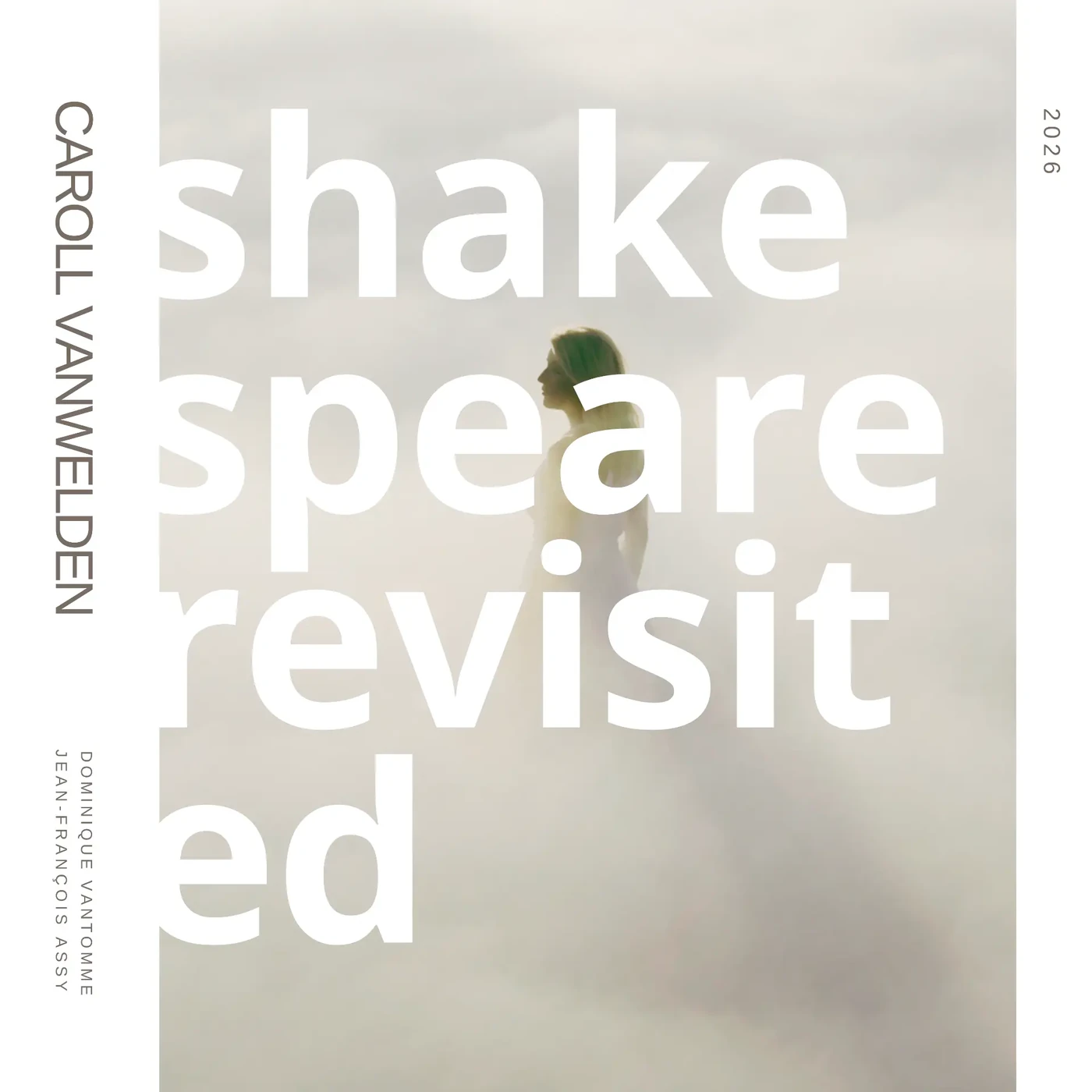
Caroll Vanwelden, Shakespeare Revisited: Four-Century-Old Sonnets Sung as if Written Yesterday
“If music be the food of love, play on“, says Duke Orsino in the opening line of Twelfth Night (Act 1, Scene 1). Few artists have taken that invitation as literally as Caroll Vanwelden. On Shakespeare Revisited, the Belgian singer, pianist and composer sets Shakespeare’s sonnets to music for the fourth time. Instead of repeating herself, she strips the project down to voice, piano, cello, keyboards and electronics. The result is thirteen songs in which words more than four centuries old sound startlingly close, like a voice at your shoulder rather than a recitation from a lectern. It is, quite simply, a great album.
Caroll trained as a classical pianist from the age of seven before turning to jazz, studying at the Ghent Conservatory and then at London’s Guildhall School of Music & Drama. She has recorded under her own name since 2008, almost entirely self-produced on her own JAZZ’n’ARTS label. Her Shakespeare project made her name: three albums released between 2012 and 2017, setting the sonnets’ own words as lyrics inside her own jazz compositions. The trilogy was built around a working jazz quartet, so a fourth volume could easily have been more of the same. She says she was invited to the Shakespeare Festival in Neuss for the fifth time and didn’t want to come back with the same songs, musicians and approach, so she rethought the material completely.
The new line-up reflects that. She cut the drums altogether and brought in two Belgian musicians, having moved back to Belgium herself, and found that the absence of drums gave the music far more space and freedom. The nine years since the trilogy weren’t idle either. In between, she made a French-language electronic album entirely on her own, eighteen original songs, and says that experience fed naturally into this record. You can hear it in the way electronic textures drift through these songs as atmosphere rather than gadgetry.
Dominique Vantomme, born in Menen on the French-Belgian border, grew up surrounded by his father’s guitar, keyboard and trumpet. He began as a blues and jazz pianist and has spent the last decade in pop, rock and jazz projects. Here he handles keyboards and electronics, and he is a master of depth and space. Cellist Jean-François “Jeff” Assy is one of Belgium’s most in-demand and discreet string players. He has toured and recorded with Alain Bashung, William Sheller, Miossec, Dominique A and Daan. He plays a fully acoustic cello with a microphone mounted above it and a set of effects pedals, so he can shift from a classical line to reverb-drenched textures or even guitar-like distortion. Bashung reportedly told him he’d stay interesting as long as he kept searching for sounds, and that restlessness is all over this album. The cello goes far beyond accompaniment. It is a second voice in constant conversation with Vanwelden’s own.
And what a voice it is. Vanwelden’s singing is alluring and spellbinding, ideal for these texts. It soars, envelops you and carries you along on a journey, and its combination with cello, piano and keyboards creates a soundscape all its own. Jazz remains the foundation, but the music opens out towards chamber music, art-pop, electronic textures and a cinematic atmosphere. Nothing is overloaded. Every note, every word and every silence is given weight. Her stated aim is not to explain Shakespeare but to make his words felt again, and the album achieves exactly that.
Part of the album’s magic is that it was captured live. Roughly half comes from the trio’s first Neuss concert, and the rest was recorded during a rehearsal at Vanwelden’s own home, with the singer wanting to preserve spontaneity rather than polish everything. You can hear it in the spontaneous reactions, the organic dynamics and the sense of three musicians listening to each other in real time. That fits, since the Neuss festival’s own billing praised the trio’s transparent inventiveness in wrapping the strict sonnet form. Vanwelden also produced, recorded, mixed and mastered the album herself, which explains its remarkable coherence.
The album opens with “So Shall I Live Supposing” (Sonnet 93), a restless, tension-filled piece about the fragile balance between trust and doubt, in which the possibility of deception never quite leaves the room. “Shall I Compare Thee” (Sonnet 18) is the opposite: a warm, luminous reading of Shakespeare’s most famous sonnet, where the tenderness and clarity of the text come through immediately. “Two Loves” (Sonnet 144), at just over seven minutes the longest track, is a wide-ranging, intense piece in which conflicting loves collide, and rhythmic and harmonic friction give the text a strikingly modern urgency. “No Longer Mourn For Me” (Sonnet 71) is the album’s intimate, cinematic heart, a meditation on memory, farewell and the quiet dignity of letting go, where voice, piano, cello and electronics create a fragile closeness. These last three were also the singles that previewed the album over the summer, released in April, May and June.
Elsewhere, the sequence moves through the sonnets’ great themes: the wry realism of “My Mistress’ Eyes” (Sonnet 130), the steadfast devotion of “The Marriage of True Minds” (Sonnet 116), and the relentless tide of time in “When I Do Count the Clock” (Sonnet 12) and “Like as the Waves” (Sonnet 60). Vanwelden has now set forty-eight of Shakespeare’s 154 sonnets to music, and this collection feels less like a survey than a single, continuous conversation about love, doubt, memory and time.
Shakespeare Revisited is the rare “reimagining” that justifies its own existence. It does not lean on Shakespeare’s prestige, and it does not treat the sonnets as museum pieces. Instead, Caroll Vanwelden, Dominique Vantomme and Jean-François Assy make them breathe as living, contemporary songs, fragile and powerful at the same time. The album came out on 11 September 2026, and the trio are touring Belgium and Germany through 2026 and 2027, which is well worth catching. A beautiful, intelligent and deeply moving record. An album we love, that we adore.
Frankie Pfeiffer
Editor in chief – PARIS-MOVE
PARIS-MOVE, September 28th, 2026
Follow PARIS-MOVE on X
:::::::::::::::::::::
Tracklisting :
- So Shall I Live Supposing – Sonnet 93 – 5:18 (*)
- Who Will Believe – Sonnet 17 – 3:34 (*)
- I Never Saw That You Did Painting Need – Sonnet 83 – 3:32 (**)
- My Mistress’ Eyes – Sonnet 130 – 5:07 (**)
- Shall I Compare Thee – Sonnet 18 – 3:59 (*)
- Two Loves – Sonnet 144 – 7:07 (*)
- No Longer Mourn For Me – Sonnet 71 – 3:36 (*)
- When I Do Count the Clock – Sonnet 12 – 4:29 (*)
- Let Those Who Are in Favour – Sonnet 25 – 5:20 (**)
- The Marriage of True Minds – Sonnet 116 – 4:09 (*)
- How Can I Then Return in Happy Plight – Sonnet 28 – 6:31 (**)
- If My Dear Love – Sonnet 124 – 6:31 (**)
- Like as the Waves – Sonnet 60 – 2:49 (**)
(*) Recorded live @ home by Caroll Vanwelden
(**) Recorded live @ Neuss by Alexander Kuhn
Musicians:
Caroll Vanwelden: voice, piano and electro
Dominique Vantomme: keyboards and electro
Jean-François Assy: cello and electro
Music and arrangements: Caroll Vanwelden
Texts: William Shakespeare
Production, recording, mix and mastering: Caroll Vanwelden