| Jazz |
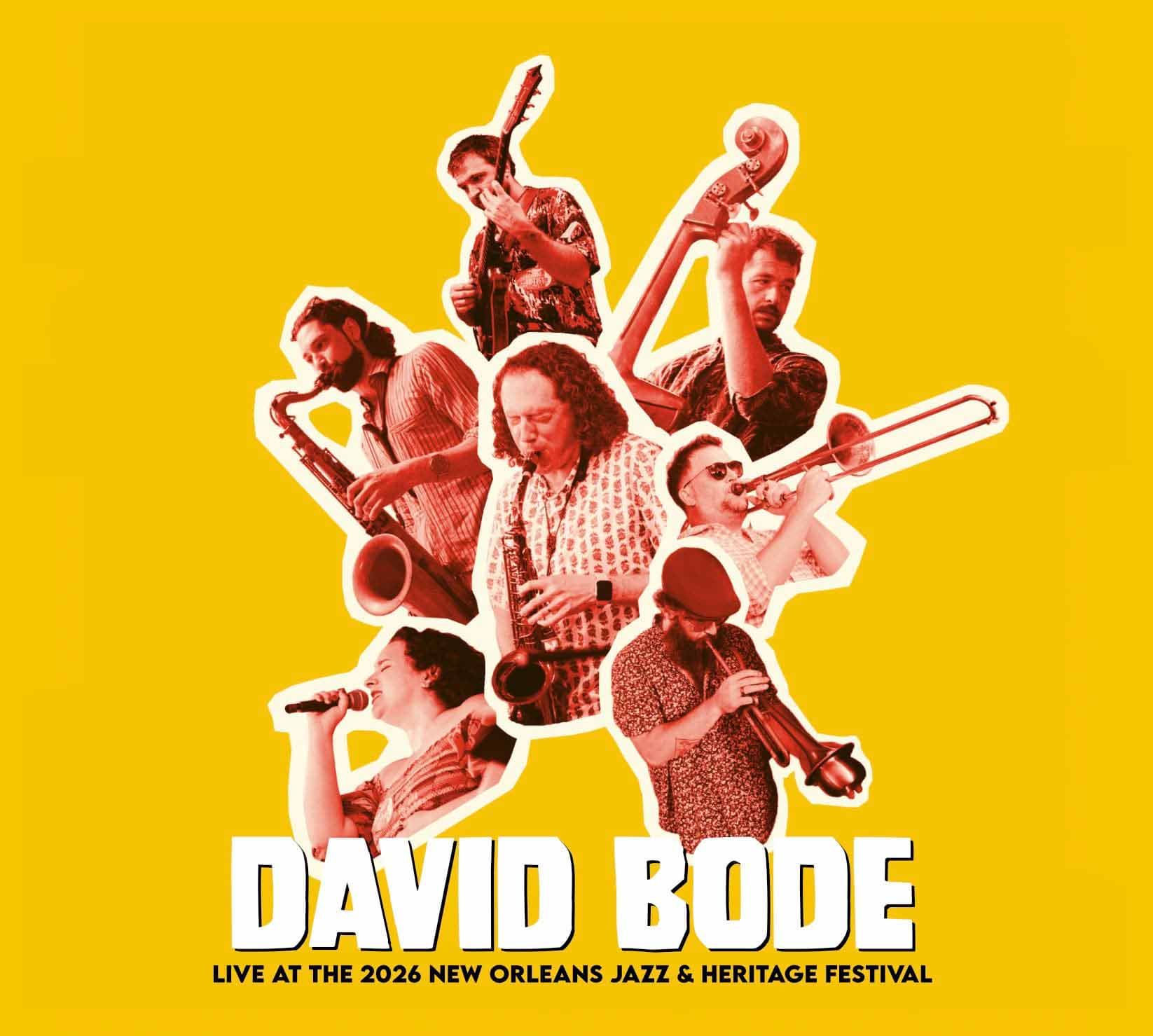
David Bode is a musician from New Orleans, and from the first few seconds of this concert, the city is already there. The introduction comes in English, the presenter’s Acadian accent hanging in the air before Kenny Garrett’s “Happy People” finally gets things moving. Then the twenty-two-piece David Bode Big Band comes in, and the room changes. There is an immediate sense of movement, a loose, contagious energy that belongs as much to New Orleans as it does to the music itself. After a first studio album, Bode has chosen the live setting for his next statement, recording this performance at the 2026 New Orleans Jazz & Heritage Festival. It is a sizeable undertaking for a musician who is only now beginning to step fully into the role of leader.
For years, Bode had been part of the festival as a sideman or as a member of other groups. Having his own name on the program, and on the stage, carries a particular weight. Yet what comes through in his account is less a sense of arrival than a feeling of gratitude toward the musicians around him. That matters, because the David Bode Big Band is not simply a larger vehicle for the saxophonist’s music. It has its own character, its own voices and colors, and enough personality to turn the arrangements into something collective rather than merely orchestral.
There is always a risk in putting twenty-two musicians on the same stage. More players do not automatically mean more music. A big band can become heavy very quickly when volume and density take over. Bode seems aware of that danger. His background is broad enough to move between classical music, jazz, rock, pop and funk, but bringing all of those worlds into a large ensemble requires more than adding a few horn parts. The pieces have to be rebuilt from the inside. Lines have to be redistributed, sections have to breathe, and the original character of each composition has to survive the transformation. Much of the interest in this recording comes from that process.
The repertoire makes the intention clear. Kenny Garrett, James Black, Billy Strayhorn and John Coltrane sit alongside Jeff Buckley, Radiohead and the Beatles, with Bode’s own “Cold Train Funk” adding another piece to the puzzle. On paper, it is an eclectic program. In practice, it feels less like a collection of references than a musician moving naturally through the music that has shaped him. Bode is not particularly interested in drawing borders between genres. He treats these songs and compositions as material, something that can be rearranged, opened up and made to speak in another setting.
That approach makes sense coming from New Orleans, where musical traditions have rarely stayed in their own lanes. Jazz, blues, gospel, funk, brass bands, rhythm and blues and popular music have been crossing paths for generations. Bode draws from that history without turning it into a postcard. There is no need here to prove that he comes from New Orleans. It is already in the way the music moves.
“Happy People” is a natural way into the concert. Garrett’s composition already has the rhythmic drive to carry a large ensemble, and Bode’s arrangement gives it room without simply making it louder. Sections answer one another, soloists rise out of the larger sound, and the music keeps shifting rather than settling into one massive block. The strength of the arrangement is in those changes of scale. The band can sound full without losing its sense of space, which is perhaps the first thing a good big band has to understand.
James Black’s “Monkey Puzzle” continues in much the same spirit. The different sections become part of a conversation, with the soloists stepping forward and then folding back into the ensemble. There are no constant attempts to impress. Instead, Bode works with density, accents and contrasts, allowing the arrangement to breathe. The orchestra feels less like a machine and more like a group of individual musicians who happen to be moving in the same direction.
Then comes “Lush Life,” and the atmosphere shifts. Billy Strayhorn’s song asks for restraint, and singer Jenna Winston gives the performance another center of gravity. With twenty-two musicians behind her, there would be plenty of opportunity for the arrangement to overwhelm the voice. It does not. The band surrounds her rather than competing with her, creating a darker and more spacious setting for the song. It is one of those moments when the scale of the orchestra becomes almost invisible, which is usually a sign that the arranging is doing its job.
Jeff Buckley’s “Lover, You Should’ve Come Over” takes the project somewhere else again. It is a very different emotional landscape from Strayhorn or Coltrane, but Bode does not seem concerned with smoothing those differences away. He finds the melodic and harmonic qualities that can survive the move into a big-band setting and builds from there. The point is not to make Buckley sound like jazz. The point is to hear what the song becomes when it is placed inside Bode’s musical world.
Radiohead’s “Airbag” makes the rhythmic side of the project even more obvious. The groove gives the orchestra something physical to work with, and the arrangement opens toward the pulse and movement associated with New Orleans. Yet the surprise of hearing Radiohead played by a big band is not the real attraction. What matters is that the song does not become a novelty. Bode changes its surroundings without stripping away its identity.
The Beatles pieces, “Don’t Let Me Down” and “Dear Prudence,” carry a similar weight. These songs are so deeply embedded in collective memory that arranging them always involves a certain risk. Bode treats them neither as sacred objects nor as material for a gimmick. He simply moves them somewhere else. That, after all, is one of the oldest ideas in jazz: take something familiar, change its colors, alter its proportions, and see what remains when the context has shifted.
“Cold Train Funk” is perhaps the clearest indication of where Bode himself is heading. His description of the piece brings together John Coltrane, The Meters and Johann Sebastian Bach, which sounds almost deliberately improbable until the music makes the connection feel less strange. Coltrane provides harmonic exploration and improvisational freedom, The Meters bring the groove and the New Orleans connection, while Bach suggests a more architectural approach to composition. Rather than presenting these influences as a list of credentials, Bode turns them into a way of thinking about music: disciplined but instinctive, sophisticated without losing its physical pulse.
This is where the decision to record the project live becomes important. A studio can give you control. You can adjust balances, fix details and build a carefully contained sound. A festival stage does not offer that kind of comfort. Twenty-two musicians have to breathe together, react to one another and respond to the audience. There is always something slightly outside the plan. The recording keeps some of that tension alive. The crowd is not simply sitting on the other side of the music. It becomes part of the exchange.
The spoken introductions, transitions and audience reactions reinforce the feeling that this is a concert rather than a studio project with applause added afterward. That distinction matters. Large ensembles depend on momentum, and momentum is difficult to manufacture after the fact. Here, the music feels as though it is happening in front of us. A section comes in, a solo opens up, the energy rises and falls, and the orchestra has to follow it. The best moments are not necessarily the loudest ones. They are the moments when the entire band seems to move as a single organism.
For Bode, there is also something personal at stake. After years of appearing in other people’s projects, he is now standing in front of an orchestra carrying his own name. Leading twenty-two musicians requires more than stepping into the center of the stage. It means having a musical vision strong enough to give very different personalities a common direction. On this recording, that vision is not completely formed yet, and that is part of what makes the project interesting. You can hear a musician beginning to occupy the space of a leader rather than simply filling it.
The future of the David Bode Big Band may ultimately be more interesting than the success of this particular concert. Bode has spoken about continuing with the ensemble, and there is enough substance here to make that idea feel worthwhile. The orchestra already functions as more than a one-night experiment. It can become a working laboratory for new compositions, new arrangements and a more personal language. The first step is visible. What comes next could be where the real story begins.
There is something fitting about attempting a project of this scale in New Orleans. A twenty-two-piece band might seem, elsewhere, like an expensive argument with the past. Here, collective music remains part of the city’s living vocabulary. That does not mean the big band needs to reproduce an old golden age. Quite the opposite. Its future depends on what musicians are willing to do with the form now.
Bode appears to understand that. He knows the tradition without treating it as a destination. He knows jazz without allowing it to become a boundary. Rock, pop, funk and classical music are not guest appearances in his music; they are part of the same conversation. New Orleans gives him a point of departure, but it does not dictate where he has to go.
After the studio album that first established the outlines of his musical world, this live recording feels like another step away from the sidelines. The repertoire is ambitious, the arrangements ask a great deal from the band, and the format leaves plenty of room for risk. But the most encouraging thing about the record is not its size or its list of names. It is the sense that Bode is beginning to discover what this orchestra can be when it is allowed to develop its own identity.
The David Bode Big Band therefore feels less like a finished statement than the beginning of a longer conversation. The Jazz Fest performance shows an ensemble capable of power without abandoning nuance, and a musician gradually finding his place at the front of it. Kenny Garrett, Coltrane, Strayhorn, Jeff Buckley, Radiohead and the Beatles are not simply references scattered across a set list. Together, they reveal a musician who does not want to choose between the different musical worlds that made him.
And that may be the quiet strength of this live recording. Bode is not trying to prove that every kind of music is essentially the same. He is allowing them to meet. Jazz can sit beside Radiohead, the Beatles can pass through a big band, Bach can find a place next to Coltrane, and the funk of New Orleans can hold the whole thing together. The arrangement becomes more than an exercise in style. It becomes a way of listening, and of making familiar music unfamiliar again.
With this concert, David Bode takes an important step toward becoming the author of his own musical territory. It is a territory rooted in New Orleans but not confined by it, informed by tradition but unwilling to live entirely inside it. The twenty-two musicians on this stage already sound like more than an enlarged version of a solo project. They sound like the beginning of an ensemble with somewhere to go. And perhaps that is what remains after the final note: not the feeling that Bode has arrived, but that he has finally started moving.
Thierry De Clemensat
Member at Jazz Journalists Association
USA correspondent for Paris-Move and ABS magazine
Editor in chief – Bayou Blue Radio, Bayou Blue News
PARIS-MOVE, September 18th, 2026
Follow PARIS-MOVE on X
::::::::::::::::::::::::
Musicians :
Woodwinds:
David Bode (alto sax)
Lori LaPatka (alto sax)
Ari Kohn (tenor sax, flute)
Byron Asher (tenor sax)
Thad Scott (bari sax)
Trumpet & Flugelhorn:
Michael Joseph Christie
Kasey Ball
Matt Venora
Matt Perronne
Ricio Fruge
Trombone:
Peter Gustafson
Evan Oberla
Greg Hicks
Ethan Santos
Jimmy Williams (tuba)
Rhythm Section:
Daniel Meinecke (piano & keyboards)
Ethan Stern (organ)
Eric Merchant (guitar)
Calvin Morin-Martin (acoustic & electric bass)
Ronan Cowan (drums)
Xavier Molina (percussion)
Vocals: Jenna Winston
Announcer: Allen Gale
Track Listing :
Introduction
Happy People
Lover You Should’ve Come Over
Stage Banter 1
Monkey Puzzle
Stage Banter 2
Lush Life
Syeedan’s Song Flute
Stage Banter 3
Cold Train Funk
Stage Banter 4
Airbag
Dear Prudence / Don’t Let Me Down