| Contemporary music |
Summary: thèriot’s The Other is a deeply personal and genre-defying album blending jazz, contemporary composition, orchestral textures and progressive rock. Through shifting rhythms, rich instrumentation and themes of identity, memory and vulnerability, Kyle Saulnier creates an ambitious yet deeply human musical experience.
thèriot – The Other: Jazz, Contemporary Composition and Progressive Rock
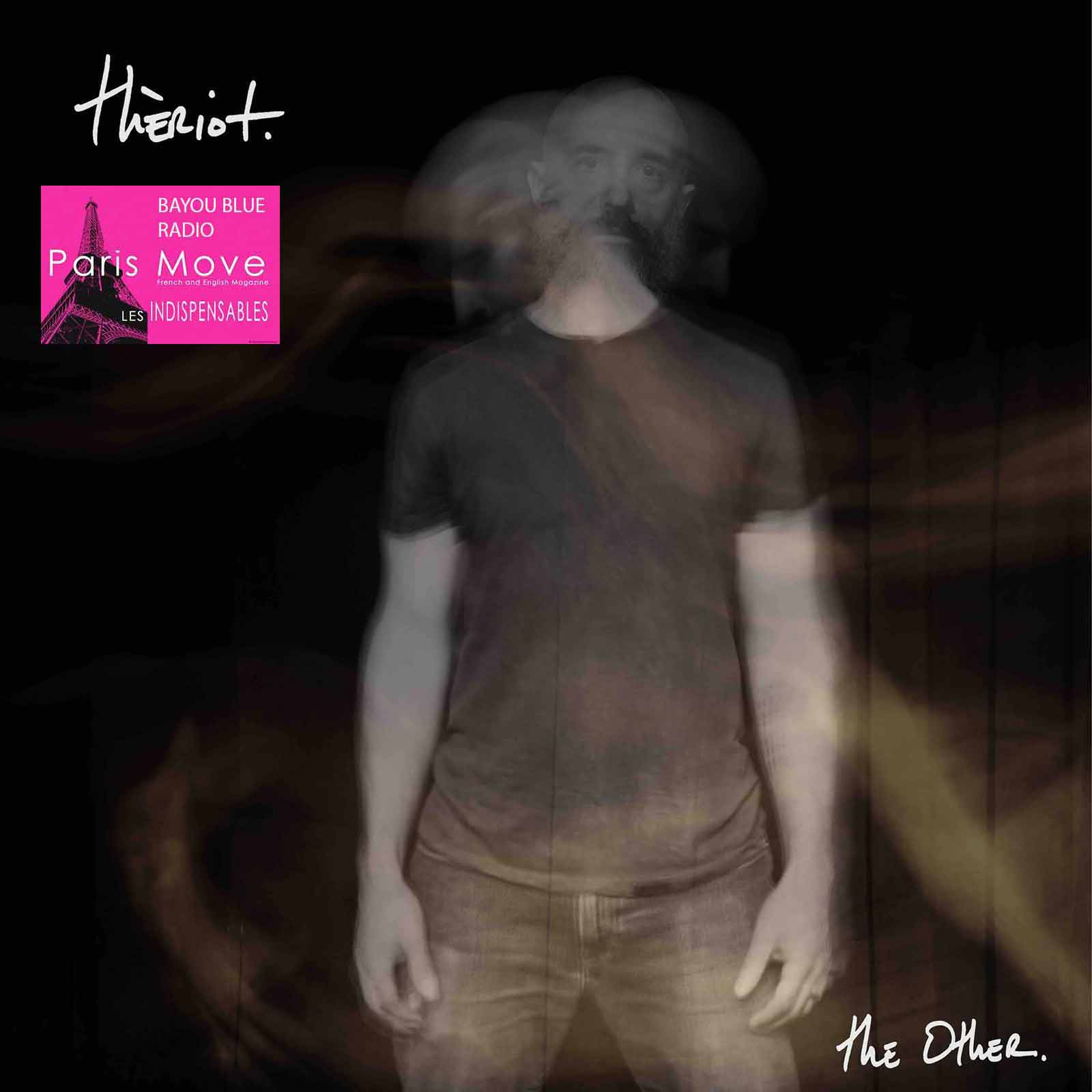
A deeply personal work in which jazz, contemporary composition, orchestral textures and progressive rock meet inside a constantly evolving sound world. Some trees seem to have held on to the traces of an unusually long summer, as though the heat had left a final imprint on their leaves before the season turned. The birds grow quieter, the rosebushes begin another brief bloom, and as the temperature drops, the landscape seems to discover a different kind of breath. I return slowly to the studio, still caught in that particular late-summer light, when a record cover catches my eye. Brown, almost earthy tones frame a man whose head appears swept up in sudden motion, as if the image itself refuses to hold its subject still. In the upper left corner is the name thèriot; in the lower right, The Other. Curiosity takes over, and I press play.
From The Other Part. 1 onward, the music occupies a territory that refuses easy classification. Avant-garde composition, contemporary music, jazz, orchestral writing, traces of progressive rock and an almost cinematic sensibility intersect without ever sounding like a collage of influences. The vibraphone introduces a melody that initially feels childlike, almost innocent, but its simplicity soon begins to acquire an uneasy quality. The rhythm section remains restrained, winds appear in brief gestures, and the music advances less through assertion than through transformation. Nothing seems permanently fixed. Every element can become something else, and the listener is continually asked to reconsider what seemed familiar only moments earlier.
That instability is one of The Other’s defining strengths. thèriot does not begin with a genre and then attempt to escape it. Instead, he works in the space where genres cease to function as borders and become materials. His writing is highly controlled, but it remains sufficiently open to allow interpretation, improvisation and interaction. The score establishes conditions rather than dictating every gesture. Musicians can respond to one another, shift the balance between foreground and background, thicken a texture or leave it suspended. It is a conception of contemporary composition in which writing is not necessarily about controlling every detail, but about creating an environment where the unexpected can exist without destroying the underlying architecture.
The quality of the musicians gathered around Kyle Saulnier is central to that achievement. Nadje Noordhuis, Andrew Gutauskas and Samuel Quiggins appear alongside several important figures from Vermont’s creative music community, including Michael Chorney, Matthew LaRocca, Brooke Quiggins, Jane Boxall and Daniel Ryan. Their backgrounds extend across jazz, orchestral music, contemporary composition, musical theater, rock and independent music. What could easily have become a simple accumulation of stylistic references instead produces an ensemble with a remarkably distinctive depth. Each player seems to bring a different understanding of rhythm, timbre and phrasing, and thèriot allows those differences to remain audible rather than smoothing them into a single uniform voice.
As the compositions unfold, it becomes equally clear that thèriot has little interest in stylistic repetition or virtuosity for its own sake. One piece may establish an almost minimalist texture before a change of tempo or the arrival of another instrument suddenly alters our perception. Elsewhere, structures that occasionally evoke King Crimson reveal an awareness of progressive rock’s possibilities, particularly its use of asymmetrical forms, rhythmic tension, recurring motifs and dramatic contrast. Yet these references never feel like quotations. They are absorbed into a broader language in which stylistic memory serves the composition instead of determining it. Jazz, rock, orchestral music and contemporary composition become different ways of shaping the same underlying question.
Repetition is particularly important because it changes the listener’s relationship with time. A motif returns, but the world around it has shifted, and therefore the motif itself seems altered. What was once familiar gradually becomes strange. The process recalls the workings of memory, where nothing truly returns in exactly the form in which it was first experienced. We remember faces, places, conversations and emotions, but every recollection is also a reconstruction. The shape remains while the substance changes, and The Other repeatedly turns that tension between recognition and transformation into musical form.
That shifting sense of time gives the album a psychological dimension without requiring literal illustration. The Other is deeply personal, rooted in grief, depression, vulnerability and the masks people wear in order to give the outside world the impression that everything is fine. Yet thèriot’s intelligence lies in refusing to turn those experiences into straightforward confession. He does not ask the music to describe suffering directly. Instead, he gives those experiences a structure. Pain becomes tension, doubt becomes displacement, memory becomes repetition, fragility becomes silence, and instability becomes a compositional principle. The personal remains present, but it is transformed into something that can be experienced rather than simply explained.
The choice of the name thèriot adds another layer to that process. Kyle Saulnier adopts a name connected to his Acadian roots while creating distance from the artist he once was. The gesture suggests both continuity and rupture. The past remains part of the story, but it no longer defines the person standing in the present. The new name becomes a way of acknowledging transformation, and that transformation is reflected throughout the album. The composer who created The Other is not exactly the same person who made the music that came before it, just as the listener who reaches the end of the album is not quite the same listener who pressed play.
The title itself consequently takes on several meanings. The Other can be the person we see from the outside, the self we hide from others, the person we become after an experience changes us, or the version of ourselves that remains when an old definition is no longer sufficient. That question of identity is embedded in the instrumental writing as well. The vibraphone begins as a melodic presence before becoming texture; winds move between support and foreground; strings alter the density of the ensemble; guitars occasionally introduce a sharper electric edge; and drums and percussion operate less as a conventional metronomic foundation than as physical forces within the composition. The instruments do not simply perform fixed functions. They continually renegotiate their identities.
The orchestra therefore behaves like a living organism. Its individual parts constantly redefine one another, and the resulting music gains its coherence not from uniformity but from movement. There is something impressive about the way thèriot creates music that remains sophisticated without becoming cerebral. The danger in a project of this scale is that the concept can become more important than the sound, but The Other largely avoids that trap because the writing remains connected to the pleasure of listening. Melodies exist, timbres are explored for their own sake, contrasts create immediate emotional reactions, and moments of density are balanced by space. The listener can hear the intelligence of the construction without having to analyze it in order to be moved.
That warmth is essential because it prevents the album from becoming an extended exercise in melancholy. The darkest passages are repeatedly crossed by unexpected light. A simple melody appears inside an unsettled texture, a warm timbre interrupts a colder sequence, and a pulse restores movement just as the music seems ready to stop. The album does not present sadness as a permanent condition. Instead, it acknowledges its contradictions, its returns, its moments of exhaustion and its brief flashes of clarity. The music understands that vulnerability is rarely pure and that even the darkest emotional states contain movement.
The pieces gradually begin to resemble an inner map. They do not necessarily describe successive events so much as different states of consciousness. Their unity comes from a shared logic of transformation rather than from a single stylistic vocabulary. Each composition carries something from what precedes it while opening another possibility, allowing the album to develop as a continuous psychological and musical trajectory. The listener is not given a conventional narrative, but there is a strong sense of passage, of moving from one state into another without ever completely leaving the previous one behind.
This makes The Other feel almost like a question addressed directly to the listener. Who is this other? Is it the person we hide from others, the person we hide from ourselves, the self revealed through grief, or the artist discovered only when an old identity has become impossible to maintain? The album offers no definitive answer, and its refusal to resolve the question is one of its strengths. The musicians preserve that openness because the underlying architecture is clear without suppressing individual gestures. Each performer remains part of the larger structure while retaining a distinct presence, and the ensemble becomes a temporary community built around precision, listening and response.
There is also a distinctly physical quality to the music. Changes in density, entrances and exits, rhythmic ruptures and shifts in texture create something almost choreographic. One can imagine the bodies of the musicians, the exchanged glances, the breathing, the gestures and the signals that exist between the written notes. The Other seems designed to be experienced as much as heard. Its tension belongs not only to the score but to the act of musicians inhabiting that score together, which makes the album feel particularly suited to the stage as well as the recording studio.
Then Francesca Blanchard’s airy voice enters and opens another dimension in the journey. After the density of the instrumental writing, her voice introduces an unmistakably human presence, almost as though someone has stepped out from behind the layers of sound. Yet she does not resolve the questions that have accumulated throughout the album. Instead, she changes the perspective. Her arrival suggests that another threshold has been reached without requiring the music to cross it completely, and that ambiguity allows the ending to retain its emotional tension.
When the final passage disappears, the impulse to return to the beginning comes naturally. The first listening was an introduction; the second becomes a reconsideration. The opening vibraphone no longer sounds quite as innocent, the melodies carry different meanings, the silences become more apparent, and the repetitions feel more unsettling. Even the moments of light seem more fragile because we now understand what surrounds them. The ending has altered the beginning, which is perhaps the clearest indication that The Other has been conceived as a complete work rather than a sequence of unrelated tracks.
thèriot achieves something relatively rare by making complexity feel physical and immediate. The Other is carefully constructed without becoming cold, experimental without becoming arbitrary, and personal without closing in on autobiography. It draws from a wide range of musical traditions while refusing to belong entirely to any of them. Jazz, orchestral music, contemporary composition, repetition, improvisation and progressive rock function here not as categories to be checked off but as different languages within a single inner landscape.
Ultimately, the album is less about defining the other than about confronting the difficulty of remaining the same person. We carry multiple faces, memories and versions of ourselves, some visible and others concealed, some belonging to the past and others emerging only when circumstances force us to change. thèriot turns that fragmentation into sonic architecture. Music does not repair what has been broken, but it can give broken pieces a form in which they temporarily coexist, and that may be the most honest kind of resolution the album could offer.
That is why The Other continues to resonate after the final notes disappear. It does not seek a definitive solution to grief, depression or vulnerability, nor does it pretend that transformation is a clean or linear process. Instead, it accepts movement itself as part of being human: continuing, returning, remembering, changing and listening differently. Outside the studio, the season keeps turning, the leaves eventually fall, the birds move on, and the roses linger a little longer. Inside the music, the opening vibraphone returns, along with the winds and that strange melody that first seemed almost childlike, but now we hear something else beneath its surface. thèriot does not simply reveal another side of himself; he reminds us that behind the person we present to the world there is always another self, silent and shifting, sometimes vulnerable, waiting for music to give it a voice.
There are records that announce themselves immediately and others that reveal their character only after repeated listening. The Other belongs to the second category, although its first sounds are disarming enough to invite attention. Outside the studio, the last traces of an unusually long summer still seem to cling to the trees, the birds have grown quieter, and the rosebushes are making one of their final attempts at another brief bloom before the season changes. Returning to the studio in that late-summer light, I notice a record cover dominated by brown, almost earthy tones, with the blurred figure of a man whose head seems caught in a sudden movement. The image refuses stillness, and so does much of the music inside. The name thèriot appears in one corner, The Other in another, and curiosity does the rest.
From the opening of The Other Part. 1, it becomes obvious that this is not a record interested in staying inside a single musical vocabulary. Jazz, contemporary composition, orchestral writing, avant-garde music and progressive rock are present, but none of them functions as a fixed point of reference. They are elements within a larger compositional language that continually changes its balance. The vibraphone introduces a melody whose apparent innocence is almost deceptive, while the rhythm section remains understated and the winds enter with carefully placed gestures. The music seems less interested in arriving somewhere than in showing how one state can become another. A sound appears, establishes an identity and then quietly loses it.
That sense of transformation is at the heart of Kyle Saulnier’s approach. Rather than treating genre as a set of rules to be obeyed or rejected, thèriot treats musical history as a vocabulary that can be rearranged. Contemporary composition provides structural discipline, jazz contributes interaction and improvisational possibility, orchestral writing expands the available colors, and progressive rock introduces another sense of form, weight and rhythmic tension. These elements are not presented as separate influences. They are folded into one another until the boundaries become difficult to locate, which is precisely what gives the album its particular character.
The musicians are crucial to making that process convincing. Nadje Noordhuis, Andrew Gutauskas and Samuel Quiggins are joined by musicians including Michael Chorney, Matthew LaRocca, Brooke Quiggins, Jane Boxall and Daniel Ryan, drawing on a community whose experience extends well beyond a single genre or scene. Jazz, orchestral music, contemporary composition, musical theater, rock and independent music all leave traces in the ensemble, but the result never feels like an all-star exercise in stylistic accumulation. Instead, the differences between the musicians become part of the sound. Each player seems to bring a distinct relationship to phrasing, attack, silence and rhythm, and those individual approaches give the compositions their changing internal perspective.
There is a particular pleasure in listening to the way the pieces resist predictability. A texture may seem settled before another instrument changes its character, or a rhythmic figure may establish a pattern only to be interrupted by a shift in density. At certain moments, the influence of progressive rock, and occasionally King Crimson in particular, becomes audible through asymmetrical structures, repeating motifs and a taste for instability. But thèriot never seems interested in recreating that tradition. He extracts possibilities from it and places them inside another framework. The reference becomes useful because it has been transformed, not because it has been reproduced.
The same principle applies to repetition. Motifs return throughout the album, but they rarely return unchanged in meaning. Their context has shifted, and the listener has shifted with it. What sounded simple at first may become unsettling later, while something initially obscure can acquire clarity after repeated exposure. This is where the album’s connection to memory becomes particularly strong. Memory is repetitive, but it is never exact. We revisit the same experiences internally, yet each return is influenced by everything that has happened since. The Other turns that familiar human mechanism into a compositional strategy.
The personal dimension of the album is therefore impossible to separate from its musical construction. Grief, depression, vulnerability and the experience of presenting a composed exterior to the world are part of the emotional territory behind the project, but thèriot avoids turning those subjects into literal narrative. The music does not illustrate sadness or attempt to dramatize pain for its own sake. Instead, those experiences seem to have been translated into musical relationships: tension and release, repetition and interruption, density and emptiness, movement and suspension. The result is more powerful precisely because it does not tell the listener what the emotion is supposed to mean.
The name thèriot adds another dimension to that transformation. By adopting a name connected to his Acadian roots, Saulnier creates a new artistic identity without pretending that the previous one never existed. The gesture suggests that identity can be inherited and reinvented at the same time. The past remains underneath the new name, much as previous experiences remain beneath the music. The Other can consequently be understood not only as an album about another person or another self, but as an exploration of what happens when an artist recognizes that he has changed and decides to give that change a new form.
The title becomes increasingly suggestive as the album progresses. The Other might be another person, another version of oneself, a hidden self, or simply the part of an identity that cannot be reduced to the image presented publicly. The instruments seem to enact the same uncertainty. Their roles are fluid rather than fixed. The vibraphone shifts between melody and atmosphere, the winds move between support and foreground, strings reshape the depth of the ensemble, guitars introduce moments of electricity and abrasion, and percussion often functions as an element of physical energy rather than a straightforward rhythmic anchor. The composition itself becomes an argument against fixed identity.
This fluidity could easily have produced music that feels overly intellectual, but The Other consistently resists that tendency. The sophistication is there, but it remains subordinate to the act of listening. There are memorable melodic gestures, striking instrumental colors, changes in texture that register immediately and rhythmic moments that create a physical response before the intellect has time to interpret them. The album asks for attention without demanding that the listener approach it like a puzzle. Its complexity is audible, but it is not used as a barrier between the music and the audience.
That distinction becomes especially important in the album’s darker passages. The music frequently approaches heaviness without surrendering completely to it. A warm timbre can suddenly emerge from a colder texture, a simple melody can interrupt a complicated passage, and a pulse can return after a period of suspension. These moments prevent the emotional landscape from becoming monochromatic. The record understands that sadness contains contradictions and that even difficult states of mind can contain humor, tenderness, beauty, memory and movement. The darkness is therefore not an aesthetic destination but one part of a larger emotional geography.
The album’s structure reinforces that impression. Rather than feeling like a collection of compositions placed next to one another, the pieces gradually reveal relationships. Motifs, colors and rhythmic ideas seem to carry information from one section into another, creating continuity without requiring stylistic repetition. The music moves through different states rather than simply progressing from one track to the next. It resembles a journey through consciousness in which earlier experiences remain present even after the surface has changed.
This is where the title The Other becomes most compelling, because the music never settles the identity of the person being sought. The other could be the self that appears during grief, the person hidden behind social performance, the artist emerging from a previous identity, or the listener confronting an unfamiliar version of themselves. The album does not answer the question because answering it would close the space the music has created. Instead, thèriot lets the musicians inhabit that uncertainty. The score provides architecture, but the performers retain enough freedom to expose the human element inside it.
That human element becomes particularly apparent in the ensemble’s physical character. There is a sense of bodies moving through the music, of players watching one another and responding to changes in timing, density and intensity. The compositions seem to contain gestures that belong as much to the stage as to the recording. Entrances, exits, rhythmic ruptures and changes in instrumental weight create an almost choreographic quality, suggesting that the music could take on another dimension in live performance. One can imagine the tension becoming visible through breathing, posture, eye contact and the physical coordination required to make such complex material feel spontaneous.
Francesca Blanchard’s airy voice eventually introduces an entirely different kind of presence. After the instrumental density, the voice seems almost exposed, as though the human figure suggested by the album’s title has finally stepped closer to the surface. Yet her appearance does not provide a conventional resolution. It changes the emotional scale of the music without closing the argument. Her voice feels like an opening rather than an answer, another threshold through which the listener can briefly see the material from a different angle.
The ending is consequently more effective because it refuses to settle. Once the record finishes, the desire to hear it again feels almost inevitable. On a second listen, the opening vibraphone is no longer heard as simply a melody; it has become a clue. Earlier gestures acquire different meanings, repetitions become more noticeable, and the quieter moments begin to carry as much weight as the louder ones. The final passage changes the first passage, and that circularity gives the album a coherence that individual tracks alone could not provide.
What makes The Other particularly successful is the way it manages to remain ambitious without losing its connection to sound itself. thèriot is clearly interested in composition as architecture, but he never forgets that architecture must ultimately be inhabited. The musicians bring color, personality and unpredictability to structures that could otherwise remain purely conceptual. Jazz, orchestral music, contemporary composition, progressive rock and improvisation are not destinations here but tools for creating a musical environment in which identity can remain unstable.
In the end, the album seems to ask a deceptively simple question about what it means to become someone else without ever completely leaving the previous self behind. We carry old versions of ourselves into new circumstances, and the past continues to speak even when we believe we have moved beyond it. thèriot gives that condition a musical form through repetition, transformation and contrast. The broken pieces do not have to be repaired in order to belong together; sometimes it is enough to find a structure capable of holding them at the same time.
That is what gives The Other its lasting quality. It does not offer a neat conclusion to grief, vulnerability or the difficult process of changing identity, and it does not pretend that music can solve what life leaves unresolved. What it offers instead is movement, the possibility of returning to the same material and hearing it differently, of carrying the past without remaining trapped inside it. Outside the studio, the season continues its slow turn, the leaves prepare to fall, the birds grow quieter and the roses hold on for a little longer. Inside the record, the vibraphone and that deceptively simple melody return to the foreground, but after everything we have heard, they no longer sound the same. The Other has done what its title promises: it has shown us that another self can exist alongside the one we know, not as a contradiction to be eliminated, but as a presence that music can finally make audible.
Thierry De Clemensat
Member at Jazz Journalists Association
USA correspondent for Paris-Move and ABS magazine
Editor in chief – Bayou Blue Radio, Bayou Blue News
PARIS-MOVE, September 17th, 2026
Follow PARIS-MOVE on X
::::::::::::::::::::::::
Musiciens :
thèriot – Acoustic Bass, Baritone Sax (6)
Nadje Noordhuis – trumpet & flugelhorn
Andrew Gutauskas – Baritone Sax, Bass Clarinet, & Flute
Brooke Quiggins – Violin
Matthew LaRocca – Viola
Samuel Quiggins – Cello
Jane Boxall – Vibraphone
Michael Chorney – Electric & Acoustic Guitar
Daniel Ryan – Drums & Percussion
Feat. Francesca Blanchard – Voice (8)
Track Listing :
The Other, Pt.1
The Darkest Hour
The Sweetest
Interlude: The Sound Of Silence
Fathers And Sons
Interlude: Pas De Deux
The Other, Pt.2
I Know The End