| Contemporary music |
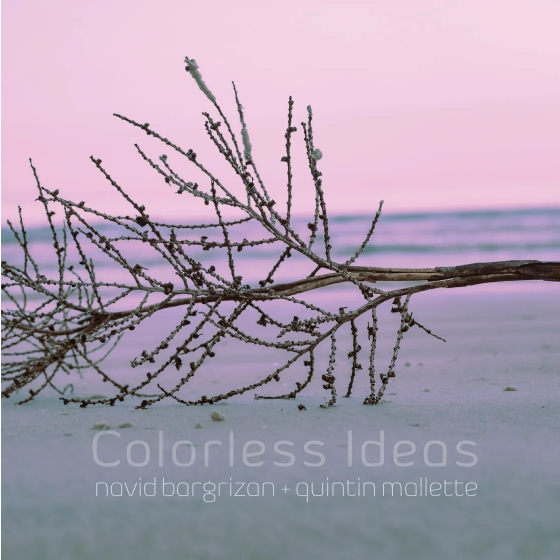
Colorless Ideas: Navid Bargrizan and Quintin Mallette compose in the space between meaning and noise
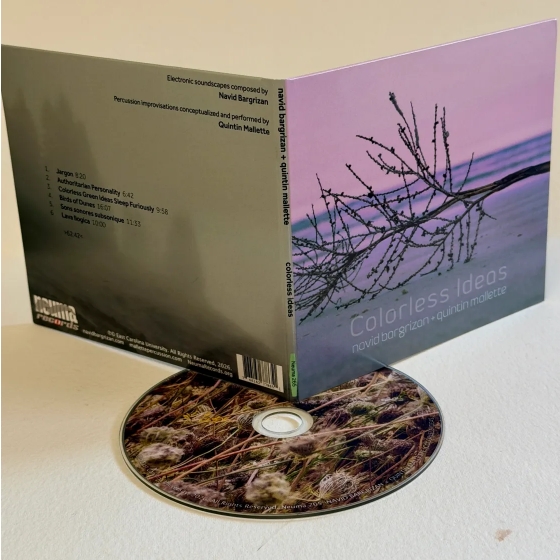
Colorless Ideas, the new Neuma Records release from composer Navid Bargrizan and percussionist Quintin Mallette, is a record about language losing its grip on meaning, memory dissolving at the edges, and structure surviving even after sense has drained out of it. And rather than simply talking about those ideas, the duo have found a way to make them audible, texture by texture, across six genuinely absorbing pieces.
The premise is elegant in its simplicity: Bargrizan’s electronic soundscapes, built from field recordings, acoustic keyboards, digital manipulation and layered samples, set against Mallette’s improvised acoustic percussion. On paper, that’s a fairly familiar electroacoustic pairing. In practice, what makes it work so well here is how genuinely dialogic the relationship feels: Bargrizan’s textures rise and settle like something half-remembered, and Mallette’s playing moves through them not as accompaniment but as an active, searching presence, tracing paths through fog that vanish the moment they’re drawn. Neither party dominates. The album’s real subject, in a sense, is the conversation between the two.
Both musicians bring serious credentials to that conversation. Bargrizan, an Assistant Professor of Musicology and Composition at East Carolina University, has spent over a decade exploring microtonality and tuning theory in works performed at festivals from the New York City Electroacoustic Music Festival to the Mikrotöne Symposia at Mozarteum Salzburg, alongside a parallel career as a scholar publishing on Harry Partch, Luigi Nono and Manfred Stahnke, among others. Mallette, his colleague at ECU, has built a reputation less on flash than on genuine advocacy, a percussionist and researcher who has commissioned dozens of new works from underrepresented composers and who serves on multiple committees within the Percussive Arts Society dedicated to exactly that mission. That combination of deep theoretical grounding and genuine curatorial generosity shows up throughout the album: this is exploratory music made by two people who have clearly spent careers thinking hard about what exploration should actually sound like.
Three of the album’s six pieces draw directly on linguistics and philosophy, and they form the record’s intellectual backbone. Opener “Jargon” takes its cue from one of the word’s own dictionary definitions, “a medley or babel of sounds”, and builds a genuinely playful sonic chaos from field recordings, keyboard textures and percussion collision, unintelligible in the best sense: less a message than the sensation of language before it resolves into words.
“Authoritarian Personality” turns considerably darker, drawing on both Bebe and Louis Barron’s pioneering electronic score for Forbidden Planet and the Adorno-led sociological study of the same name, with its famous warning that intolerance of ambiguity marks the authoritarian mind. Built from hours of MIDI-keyboard sketching later reshaped into a bending, refracting tapestry, with percussion circling and sharpening its edges, the piece turns that psychological warning into genuine sonic tension — a terrain of doubt and fracture that resists easy resolution almost as a matter of principle.
The title-referencing centrepiece, “Colorless Green Ideas Sleep Furiously,” takes its name from Noam Chomsky’s famous linguistic thought experiment, a sentence perfectly grammatical and entirely meaningless, designed to prove that syntax and semantics are separable. It’s a natural gift of a concept for a piece of instrumental music, and Bargrizan and Mallette run with it beautifully: processed textures shift beneath the surface like a murmured, half-understood language, while Mallette’s percussion, guided by a graphic score built from actual syntax-tree diagrams, engages in genuine call-and-response with the material rather than simply decorating it. At nearly ten minutes, it’s the album’s most structurally ambitious piece, and it earns every minute of its length.
The album’s second half widens the frame beyond language into memory and landscape, and the results are, if anything, even more affecting. “Birds of Dunes,” the longest piece on the record at over sixteen minutes, was built from two years of field recordings gathered along the same trails near Indiana Dunes National Park, mingled with percussion that echoes and reshapes the birds’ own calls rather than simply accompanying them. It plays like a genuine act of memory in real time, a sonic daydream that never forces its own structure onto material that’s naturally episodic and drifting, letting the piece breathe at the pace of an actual walk-through actual landscape.
“Sons sonores subsoniques” turns inward and downward, building a slow, subharmonic cloud from environmental traces and processed percussion that the composer has directly connected to the experience of dementia, thought thinning and dissolving at its edges, expanding and receding without ever quite settling into clarity. It’s a genuinely difficult subject to render musically without either over-explaining it or reducing it to mere atmosphere, and the piece navigates that tightrope with real sensitivity.
The album closes with “Lava Ilogica,” inspired by the well-documented losses of meaning in the first English translation of Wittgenstein’s Tractatus Logico-Philosophicus, recorded voices reciting fragments of the text, stretched and multiplied until they melt into a molten, half-legible flow, with Mallette’s percussion agitating the wreckage as it dissolves. It’s a fitting, turbulent close to an album that has spent its entire runtime asking what survives when structure and meaning come apart.
What ultimately makes Colorless Ideas such a satisfying listen is the paradox sitting right at its center: an album explicitly built around instability, fog and dissolving meaning that nonetheless holds together as a remarkably unified, purposeful statement from start to finish. Recorded at East Carolina University’s Fletcher Music Center and mastered by the celebrated electroacoustic composer Erdem Helvacıoğlu, the album sounds as considered and precise in its production as it is deliberately unsettled in its content, a genuine achievement of dynamic balance between thinking and simply letting go.
This is challenging, intellectually rich music, but it never becomes an academic exercise. Mallette’s percussion in particular keeps every piece grounded in something tactile and human, however abstract Bargrizan’s conceptual scaffolding gets. Colorless Ideas rewards close, patient listening with genuine emotional and intellectual payoff, and it stands as one of the more thoughtfully constructed electroacoustic releases to come out of Neuma’s consistently adventurous catalogue this year. A great, genuinely rewarding record.
Frankie Pfeiffer
Editor in chief – PARIS-MOVE
PARIS-MOVE, September 16th, 2026
Follow PARIS-MOVE on X
::::::::::::::::::::::::
Album to order on Neuma Records’ website
Tracklisting:
- Jargon 8:20
- Authoritarian Personality 6:42
- Colorless Green Ideas Sleep Furiously 9:58
- Birds of Dunes 16:07
- Sons sonores subsonique 11:33
- Lava Ilogica 10:00
Total: 62:42
Musicians:
Electronic soundscapes composed by Navid Bargrizan
Percussion improvisations conceptualized and performed by Quintin Mallette
Credits:
Producers: Navid Bargrizan, Quintin Mallette, Alex Davis
Recording and Mixing Engineer: Alex Davis
Mastering: Erdem Helvacıoğlu
Recorded: Summer 2025, East Carolina University, A. J. Fletcher Music Center Recital Hall and Electronic Music Studios
Photos: Morgan Rich
Design: Philip Blackburn
Thanks to: Morgan Rich, Jacquelyn Mallette, James Paul Sain, Don Jin Shin, Thomas Sisson, the East Carolina University College of Fine Arts and Communication