
| Contemporary music |

Cyanotypes: Patti Cudd develops five sonic blueprints into a stunning portrait of contemporary percussion
Before it was ever a music album, “cyanotype” meant something very specific: a camera-less photographic process, invented in the 1840s, in which objects or negatives are laid directly onto paper treated with a light-sensitive iron solution, exposed to sunlight, and washed to reveal a ghostly white image against a deep, unmistakable Prussian blue. It’s the technique behind the world’s first photographically illustrated book, and the process still used today for architectural blueprints and botanical prints. It’s also, as it turns out, the perfect metaphor for what percussionist Patti Cudd has built on her fantastic new album, a record where five composers each expose their own blueprint of what percussion can be, and Cudd develops every one of them into something vivid, fully realized, and genuinely essential.
The connection between the photographic process and the music isn’t just a clever album title, it’s baked directly into the record’s origin story. Cudd approached composer Elainie Lillios with what sounded like a near-impossible brief: write a piece that treats the vibraphone like a snare drum. Lillios found her way in only after encountering actual cyanotype prints, realizing she could use the drum’s “rhythmic and articulate characteristics” as a kind of imprint, exposed onto the vibraphone’s very different resonant surface the way light exposes an image onto treated paper. The resulting five-movement title track, each section named for a different shade of blue – Prussian, Midnight, Sapphire, Cobalt, Cetacean – is a genuinely ingenious opener, its energy swinging between sharp, percussive vibraphone strikes and passages of the instrument’s more familiar shimmering sustain, with a faint wash of electronics and murmured vocal fragments blurring the line between what’s struck and what’s processed.
That idea of imprint and exposure, an original gesture pressed onto an unfamiliar surface and revealed anew, turns out to be a remarkably useful lens for the whole album, even on the four pieces that don’t share the title’s direct conceptual link. Every composer here is essentially doing the same thing Lillios did: taking an idea, an object, a tradition or a memory, and exposing it onto Cudd’s astonishing instrumental and technical range to see what develops.
Kerry Hagan’s “This bottle has notions” takes the most literal object imaginable, a plain wine bottle, and runs it through live electronics until it develops a genuinely comic, almost theatrical sense of self-importance; a muttered “bottle, bottle, bottle” and a woozy fragment of the century-old pub song “Show Me the Way to Go Home” give the piece a wonderfully tipsy, shaggy-dog charm before it swells into something closer to a full drum kit workout. It’s proof that this album, for all its conceptual sophistication, never loses its sense of humour.
Tiffany Skidmore’s “Chime” strips things back to pure acoustic material, two snare drums and six crotales, and lets rotating pitch patterns and shifting rhythmic density do all the work. There’s something genuinely hypnotic about it, closer to watching light move across water than to a conventional percussion showcase. It’s the album’s most purely meditative stretch, and a reminder that restraint can be just as compelling as maximalism.
Heather Dea Jennings’ “The Meeting Place” is the record’s most ambitious cultural exposure, layering Brazilian alfaia drumming with live electronics and spoken Yoruba proverbs rendered in Yoruba, English and Portuguese, a piece composed in memory of the experimental sound artist Alvin Lucier and built, fittingly, around the idea of different traditions finding common rhythmic ground. It’s dense, sometimes deliberately unsettled, and genuinely absorbing as a piece of cross-cultural composition.
The album closes with its most epic development: Margaret Schedel’s nine-movement “Tattoo of a Gesture,” built around a single bendir frame drum and what amounts to a carry-on case of found percussion: bells, bowls, cymbals, cups, and wooden slats treated with moleskin, sandpaper and drilled holes. Across nearly thirty-five minutes, Schedel and Cudd trace an extended, deeply physical exploration of touch and gesture, and the sheer patience of its unfolding – movement titles like “Underhues” and “To Red to Music to Chaos” give some sense of its interior logic – makes it a fitting, substantial close to an album so preoccupied with the relationship between object, imprint and sound.
There’s another layer to Cyanotypes worth dwelling on: every one of its five commissioned composers is a woman. Cudd doesn’t make a show of that fact in the music itself, but the choice gives the album a quiet, structural significance beyond its considerable musical merits, and it’s entirely in keeping with a career built on genuine curiosity and collaboration rather than showmanship.
That career, it’s worth saying, is genuinely staggering in scope. A doctoral graduate of UC San Diego and Fulbright scholar at the Royal Danish Conservatory, Cudd has premiered more than two hundred new works and worked directly with figures like Pauline Oliveros, Morton Feldman, John Zorn and Christian Wolff, performing everywhere from the Bang on a Can Festival at Lincoln Center to festivals across Korea, Brazil and continental Europe. A member of the pioneering new-music ensemble Zeitgeist, she’s also, delightfully, a third-degree black sash in Chuan Lu Kung Fu, a detail that somehow makes perfect sense once you hear the physical, almost martial precision she brings to Schedel’s closing piece. That combination of academic rigor, restless curiosity and genuine physical command is all over this record.
Cyanotypes is a genuinely thrilling portrait of what contemporary percussion can sound like when it’s stripped of every stereotype about volume and aggression and rebuilt instead around imagination, subtlety and collaboration. Five composers, five completely different sonic worlds, one performer skilled and curious enough to make every single one of them fully convincing. It’s an album that rewards headphones and patience in equal measure, and it is one of Neuma Records’ most inventive and fully rewarding releases. A must.
Frankie Pfeiffer
Editor in chief – PARIS-MOVE
PARIS-MOVE, September 16th, 2026
Follow PARIS-MOVE on X
::::::::::::::::::::::::
Album on Neuma Records’ website
Musician:
Patti Cudd: percussion and electronics
Tracklisting:
1.Elainie Lillios: Cyanotypes 10:14
2.Kerry Hagan: This bottle has notions 07:11
3.Tiffany Skidmore: Chime 08:43
4.Heather Dea Jennings: The Meeting Place 12:27
5.Margaret Schedel: Tattoo of a Gesture 33:20
Total: 71:57
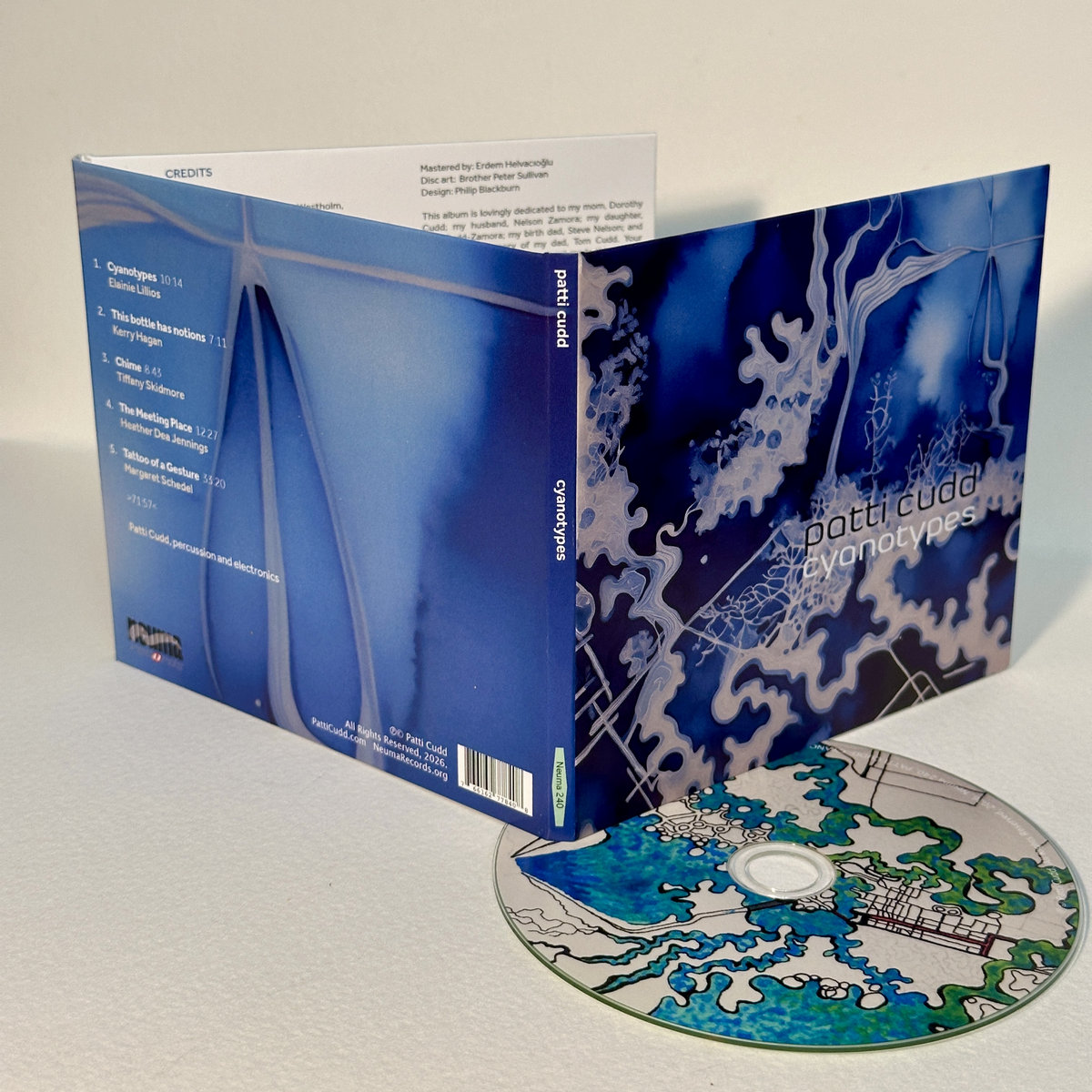
Credits:
1.Elainie Lillios: Cyanotypes
Recording and editing: Derek Westholm,
Mixing: Scott Miller
Recorded at Anderson Center Red Wing, MN (2025)
2.Kerry Hagan: This bottle has notions
Recording Engineer: Graham Duncan
Mixing: Kerry Hagan
Recorded at University of Illinois School of Music Recording Studio (2025)
3.Tiffany Skidmore: Chime
Recording: Christopher Jacobs, University at Buffalo
Editing and mixing: Connor Skidmore and Tiffany M. Skidmore
Recorded at: State University of New York at Buffalo (2025)
4.Heather Dea Jennings: The Meeting Place
Spoken voice recordings:
Yorubá – Adérónkẹ́ Babájídé
English – Christina Bogiages
Português – Vânia Maria
Recording Engineer (Resonance process): Alexandre Maiorino, Estúdio Ritornello, Escola de Música da UFRN, Natal, Brazil.
Recording Engineer (alfaia): Derek Westholm
Editing: Derek Westholm
Mixing: Scott Miller and Heather Dea Jennings
Recorded at: Escola de Música da UFRN, Natal, Brazil and Colfax, WI (2025)
5.Margaret Schedel: Tattoo of a Gesture
Recording: Derek Westholm, University of Wisconsin- River Falls
Editing and mixing: Christopher Howard
Recorded at: University of Wisconsin-River Falls (2023)
Album mastered by: Erdem Helvacıoğlu
Disc art: Brother Peter Sullivan
Design: Philip Blackburn