| Jazz |
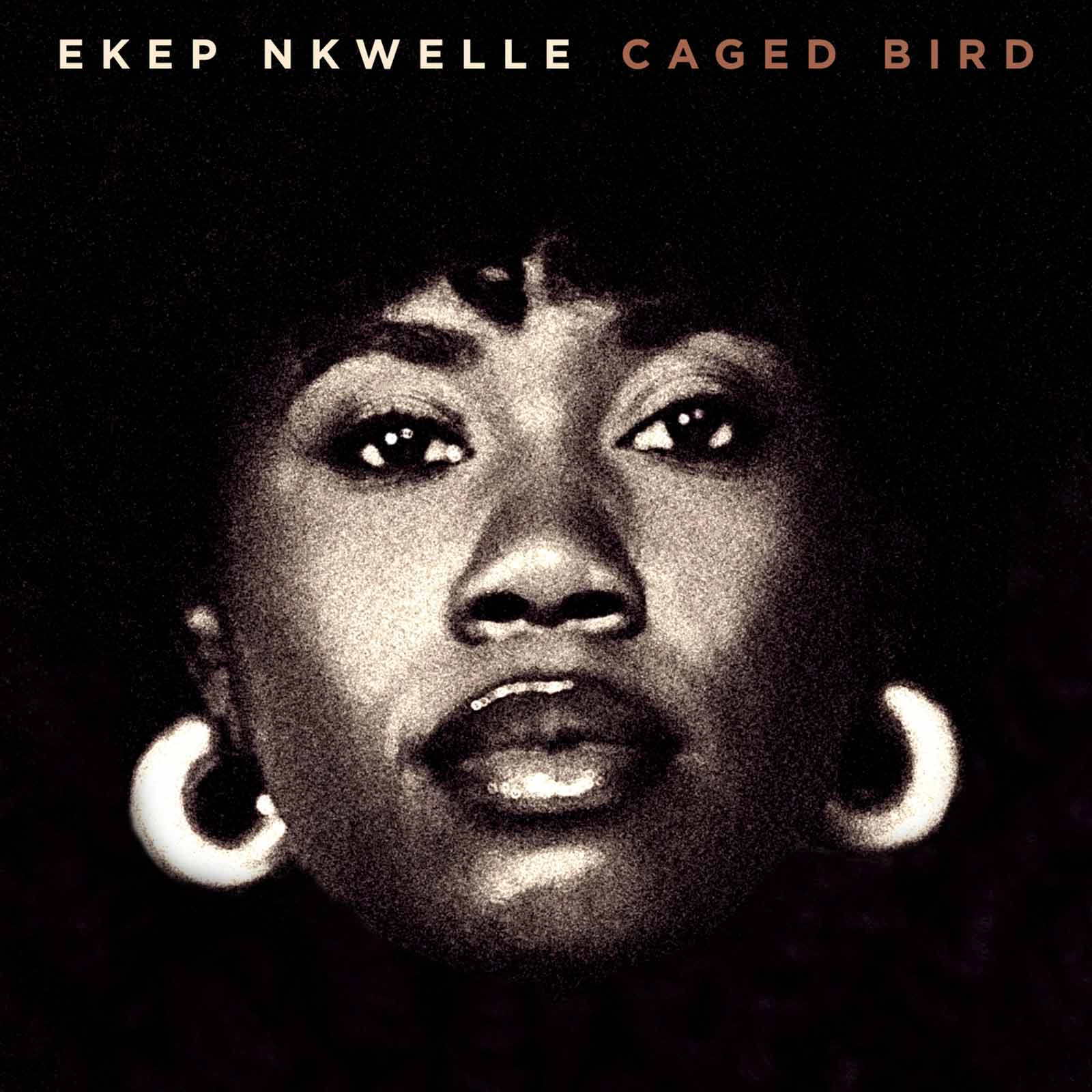
Summary: Ekep Nkwelle’s debut, Caged Bird, brings together jazz, blues and gospel with a commanding vocal presence, revealing a singer who already understands the value of nuance while leaving plenty of room for a more personal repertoire to come.
Ekep Nkwelle’s Caged Bird: A Bold New Voice in Vocal Jazz
When an artist earns the attention of musicians such as Wynton Marsalis, Kenny Barron, Dianne Reeves, the late Russell Malone, Dee Dee Bridgewater and Cyrus Chestnut, I naturally want to know what they heard. What was it that made these accomplished musicians stop and listen? With Ekep Nkwelle, I do not have to wait long for an answer. From the opening track of Caged Bird, her debut album, she commands attention with a voice that can expand dramatically without losing its intimacy. She can move from full-throated intensity to something much more contained, and she does so without making the contrast feel calculated. There is an assurance throughout the album that occasionally makes it hard to believe this is a first record. Caged Bird is remarkably self-possessed. My one significant reservation is the limited presence of original material. Aside from The Sad Ones, there is very little here that originates with Nkwelle herself. With a singer who already possesses such a distinct personality, I found myself wanting her to step further outside the familiar repertoire and give us a deeper look into her own musical imagination. Still, that reservation does little to diminish my enjoyment of the album. If anything, the pleasure comes from hearing familiar songs through an artist who clearly knows how to make them her own.
Nkwelle comes from a Cameroonian family, but she was born and raised in the United States, in the fertile musical environment of Washington, D.C., and the surrounding DMV. She has described Washington as one of the most soul-drenched places on the East Coast, and that background is important to understanding the singer we hear on Caged Bird. Her father was a musician who recorded with Cameroonian artist Prince Eyango, giving music a presence in the family from the beginning. But the story goes well beyond family influence. The powerful gospel tradition of the local Black community also played a central role in her development. Her earliest church performances gave her something that cannot easily be learned in a classroom: an instinct for the room, an understanding of how to communicate directly with an audience and an awareness of the emotional weight a singer carries when standing in front of people. That church tradition has been a starting point for countless Black American artists, and it remains a powerful training ground.
Her father, her family environment and gospel gave Nkwelle a way of experiencing music from the inside rather than simply studying it from the outside. Her relationship with jazz became more defined at Washington’s Duke Ellington School of the Arts, where she received classical vocal training. Then came a pivotal moment when she heard her classmates perform Sophisticated Lady. The big band, the swing and the collective force surrounding the melody opened another door. What began as discovery eventually became part of her own vocabulary. Less than a decade later, she would be leading a band herself. That trajectory tells me a great deal about the singer on Caged Bird. Nkwelle does not sound like a vocalist simply placed in front of an ensemble. She sounds like someone who understands what it means to work with musicians. There is a sense of interaction in her phrasing, an awareness of space and a willingness to let the arrangement breathe. Her church experience, classical training and immersion in jazz have given her a vocabulary in which gospel, blues and jazz coexist naturally. Nothing feels pasted together. The influences are distinct, but they speak to one another.
That becomes particularly clear in the way she approaches the album’s repertoire. What I appreciate most about Caged Bird is that Nkwelle does not seem interested in reproducing definitive versions of songs we already know. She approaches them as material to be interpreted rather than preserved. Her phrasing, timing and use of breath shift the center of gravity of each performance. At times, it feels almost like a form of vocal re-composition. The melody remains familiar, but the emotional perspective changes. Night Song, by Lee Adams and Charles Strouse, is a good example. Nkwelle resists the temptation to oversell it. She moves between intimacy and expansion with an ease that makes the performance feel almost conversational. Nothing sounds designed merely to showcase the voice, yet the voice remains impossible to ignore. That balance matters. There is a confidence in knowing when not to push, and Nkwelle already seems to possess it. This is the kind of interpretation that makes me want to hear a song again rather than simply move on to the next track. Early One Mornin’ is where she makes the strongest impression on me. This is the track that most clearly reveals what I value in a great jazz singer: rhythmic intelligence, patience and an understanding that a phrase does not have to arrive fully formed. Nkwelle allows the music to unfold. She plays with accents, breath and silence, but never sounds as if she is demonstrating technique for its own sake. The song may seem straightforward, yet it takes considerable control to make it this expressive without overworking it.
I found myself going back to certain passages simply to hear how she places the voice inside the groove, how she stretches a phrase or lets a silence carry part of the meaning. That is where the distinction becomes clear between a singer who has a beautiful instrument and an interpreter who has something to communicate. Nkwelle has the vocal power to dominate a performance if she chooses, but she also understands when to step back. In jazz, that ability is crucial. The singer has to listen as much as she sings. The voice must interact with the band rather than constantly compete with it. On Caged Bird, Nkwelle already seems to understand that principle. Her connection to the blues is equally important. There is considerable weight in her voice, but it never becomes overly polished or academic. There is grain, texture and emotional history in the sound. That may be what I find most compelling about her singing. Gospel is clearly part of her foundation, but it never overwhelms the jazz or blues. Instead, the three traditions seem to meet inside the voice itself. The result is not a stylistic collage but something much more organic.
The concept behind Caged Bird reinforces that sense of continuity. The album is built around ideas of suffering, survival and perseverance, with the title invoking the world of Maya Angelou and the image of a people who have endured profound hardship without losing the ability to sing. The repertoire moves between sacred and secular, older material and more contemporary selections. I find that balance particularly effective because it prevents the album from becoming a mere vocal showcase. These songs feel chosen for what they carry, not simply for what they allow a singer to do. His Eye Is on the Sparrow establishes that spiritual dimension immediately. This could easily have become a vehicle for vocal fireworks, but Nkwelle takes a more restrained approach. She gives the lyric and melody room to breathe, and that decision makes the performance more affecting. I will almost always take this kind of restraint over the singer who feels compelled to remind us every few measures of how much power she has. Nkwelle does not need to prove it. We already know. The Sad Ones becomes particularly revealing because it moves beyond interpretation and into authorship. The music comes from Roger Wendell “Buck” Hill, an important figure in the Washington scene, while Nkwelle provides the original lyrics. It also represents her first serious venture into vocalese. For me, this is the moment when the album opens a door onto what could become an even more interesting future. This is also where my main reservation about Caged Bird comes into focus. I wanted more. Not because the standards are lacking, but because The Sad Ones makes me curious about the music Nkwelle has yet to write. When she moves beyond the established repertoire and contributes something that is unmistakably hers, my attention sharpens. I begin to hear not simply a talented interpreter but an artist who may have a deeper body of work waiting to emerge. I would very much like to hear more of that Ekep Nkwelle on her next recordings.
The album continues through jazz, blues and gospel with The Creator Has a Master Plan, opening the music into a more expansive spiritual space. Again, what strikes me is her ability to resist filling every available space. She understands that restraint can be just as powerful as projection. That gives the album room to breathe and keeps its emotional arc from becoming one-dimensional. Then comes Ma Rainey’s See See Rider. This is familiar territory, and countless artists have left their mark on the song. Nkwelle approaches it with a voice deeply informed by the blues, and I like the way she lets that history speak without trying to turn the performance into a museum piece. There is something immediate about her reading. The song remains rooted in its blues identity, but the interpretation belongs to her. See See Rider is also an effective way to close the album because Nkwelle does not feel the need to deliver one last grand vocal statement. She lets the blues do the work. The voice carries the weight, the phrasing gives the song its character, and the performance gradually settles into its own atmosphere. I like endings that leave something behind rather than simply announcing themselves. This one does.
Caged Bird therefore becomes more than a collection of standards. Beneath the repertoire is the story of an artist bringing several worlds into the same room. Cameroon and Washington, D.C. The church and the conservatory. Gospel, blues and jazz. Classical vocal training and the instinctive language of the Black American musical tradition. All of these elements are present, but what matters most is the way Nkwelle is beginning to synthesize them rather than simply display them.
That is the voice I am left with after the album ends. Yes, it is powerful. But power is not the most interesting thing about it. What stays with me are the nuances, the rhythmic instincts, the ability to tell a story and, above all, the way Nkwelle maintains her identity while moving between different musical languages. That is what allows songs that have been performed countless times to sound fresh again. Caged Bird is, without question, a strong first statement. Ekep Nkwelle arrives with a distinctive instrument, a serious musical education and a stage experience that already exceeds what one might expect from a young artist making her debut. She is not attempting to reinvent vocal jazz, and I do not think she needs to. At this stage, what matters is that she already sounds as though she knows where she belongs.
My one lingering question is what happens when she begins to fill more of the repertoire with music of her own. The Sad Ones suggests that there is considerably more to discover. I would like to hear her take greater risks, write more, stretch the boundaries of the material and give us a fuller picture of the artist behind the interpreter. Caged Bird gives us the foundation. It is solid, assured and compelling. Now I am curious to hear what Ekep Nkwelle will build on it.
Thierry De Clemensat
Member at Jazz Journalists Association
USA correspondent for Paris-Move and ABS magazine
Editor in chief – Bayou Blue Radio, Bayou Blue News
PARIS-MOVE, September 16th, 2026
Follow PARIS-MOVE on X
::::::::::::::::::::::::
Musicians :
Ekep Nkwelle: Vocals (All)
Julius Rodriguez: Piano (3-9)
Russell Hall: Upright bass (2-9)
Brian Richburg Jr: Drums (2-9), Tambourine (6)
Luther Allison: Piano (1, 2), Percussion (6)
Producer: Ekep Nkwelle
Track Listing:
His Eye Is on the Sparrow 3:20 (Charles H. Gabriel, Civilla D. Martin)
Caged Bird 4:48 (Abbey Lincoln)
Night Song 4:40 (Lee Adams, Charles Strouse)
Amazon Farewell 4:57 (Djavan Caetano Viana, Mark Edward Vieha, Brock Patrick Walsh)
Good Morning, Heartache 5:43 (Dan Fisher, Ervin M. Drake, Irene Higginbotham)
Early One Mornin’ 4:57 (Henry Ballard)
The Sad Ones 8:33 (Roger Wendell Hill)
The Creator Has a Master Plan 6:38 (Ferrell Lee Sanders, Amos Leon Thomas)
See See Rider 4:39 (Ma Rainey)