
| Jazz |
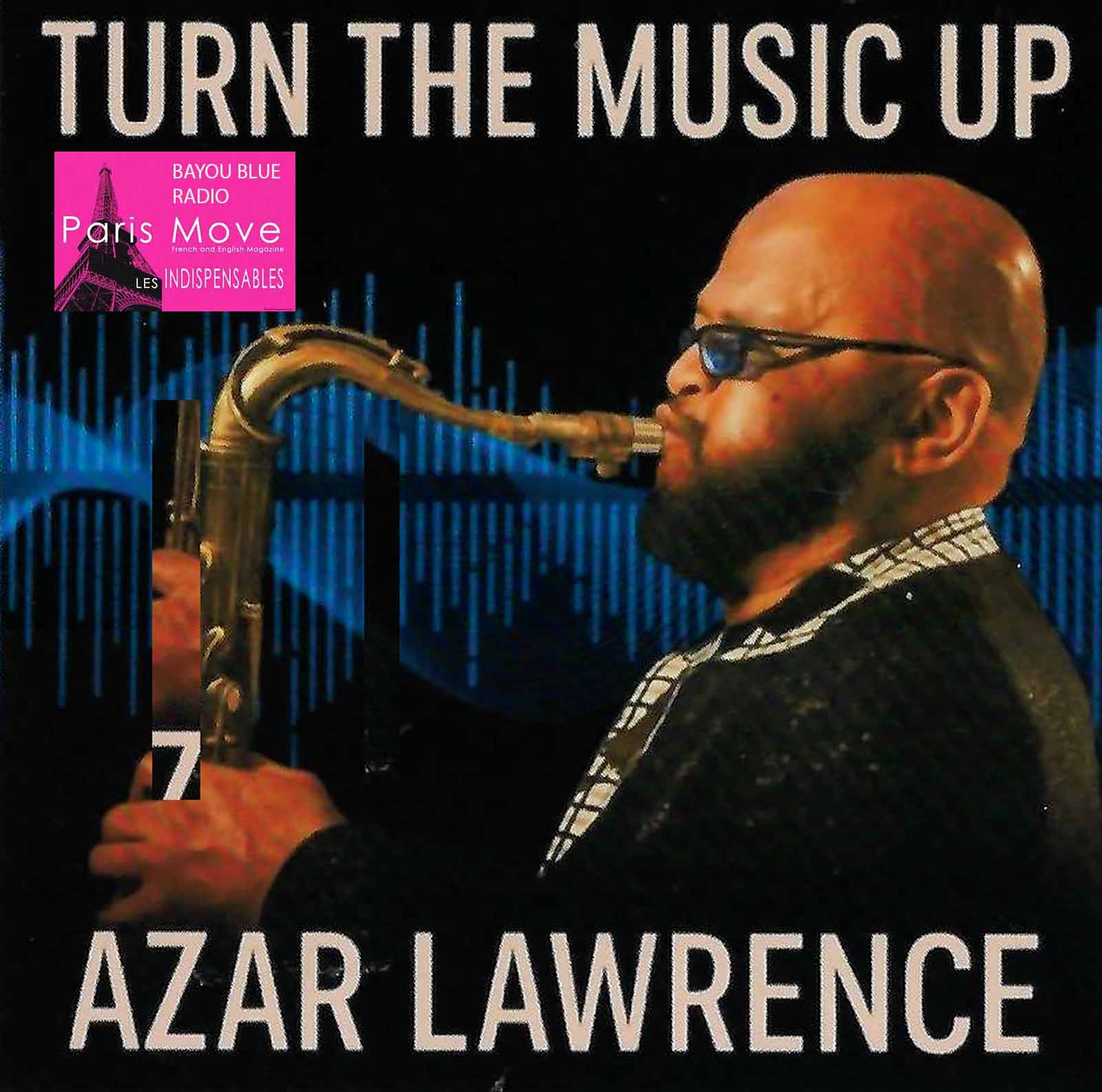
Summary: Azar Lawrence’s Turn the Music Up connects 1970s spiritual jazz with the present, exploring memory, Black musical history, improvisation and artistic freedom.
Azar Lawrence’s Turn the Music Up: Jazz, Memory and the Power to Keep Moving
On a sweltering September afternoon, under a sun bright enough to make the outside world seem almost bleached of color, I found myself doing what I often consider one of the best ways to escape the heat: closing the studio door and putting a new jazz record on the turntable. This time, it was “Turn the Music Up,” by Azar Lawrence. Within minutes, I realized it was not going to be background music. Lawrence’s tenor saxophone demands to be heard. The sound is warm, powerful and unmistakable, the kind of tone that identifies a musician before you have even glanced at the credits. But there is more behind that sound than a signature style. There is a history. And for Lawrence, memory is not nostalgia. It is something still alive.
“Turn the Music Up” moves between jazz, funk and hints of smooth jazz, but those labels tell only part of the story. What interests me more is the way Lawrence brings different eras into conversation. The album carries the imprint of the 1970s, in its groove, its modal language and the space it gives the soloists, but it never sounds like a recreation of that decade. Lawrence is not pretending to be a musician from the 1970s. He was there. He helped shape that music, and he still speaks its language, now with nearly five decades of experience added to the vocabulary.
At 73, Lawrence’s career is a useful reminder that jazz history is not simply the story of the great figures we later placed in museums and textbooks. He played with McCoy Tyner, Miles Davis, Woody Shaw and Elvin Jones. He worked with Marvin Gaye and Earth, Wind & Fire. He became a member of The Cookers. A résumé like that could easily become a marketing tool. Here, it feels like something more substantial: a body of experience, a musical memory that has not been reduced to a list of trophies. Lawrence’s past is not something he carries around for display. It is part of the language he still speaks.
That is where the musical story begins to intersect with the political one. Jazz is now institutionalized enough that it is easy to forget the circumstances that gave birth to it. A music created within Black communities confronting segregation, economic inequality and a society that denied them equal rights eventually became a form of global cultural heritage. That recognition is deserved. But it is not politically neutral. As jazz moved into conservatories, foundations, festivals and major cultural institutions, parts of its history were sometimes separated from the conflicts that gave the music its urgency. We celebrate the masterpieces and the geniuses. We talk less often about the power structures that determined who could record, who got paid, who received recognition and who was simply allowed to be heard.
The spiritual jazz of the 1960s and 1970s cannot be understood apart from its time. The civil rights movement, Black liberation struggles, protests against the Vietnam War and challenges to established social norms were reshaping American life. For Coltrane, Pharoah Sanders, Alice Coltrane, McCoy Tyner and the musicians around them, musical experimentation was also a search for freedom. The extended improvisations, open structures, spirituality, emphasis on collective playing and rejection of conventional harmonic rules were not merely matters of style. They were, in their different ways, expressions of a desire to move beyond an established order.
Lawrence belongs directly to that history. So when he returns to music connected to “Bridge Into the New Age,” released in 1974, and “Summer Solstice,” from 1975, he is not simply revisiting his youth. He is returning to a moment when jazz was still pushing against its boundaries, resisting some of the pressures of the commercial marketplace and looking for forms capable of carrying ideas beyond entertainment. The more interesting question now is what that music can still do. Lawrence is not asking us to go back to the 1970s. His playing asks what remains useful from that era and what we can still make of it.
That distinction matters. A living tradition is not one that carefully reproduces its origins. Jazz has always moved forward by refusing to accept fixed definitions: bebop, hard bop, free jazz, modal jazz, spiritual jazz, fusion. Every new direction produced resistance. The music survived because it changed. That is why I have always been wary of revivals that turn past decades into recognizable scenery. Nostalgia is an effective commodity. It allows us to sell an era after stripping away its contradictions. “Turn the Music Up” mostly avoids that trap. The past is everywhere in the record, but it is not worshiped.
Brian Swartz deserves particular attention because, from where I sit, this is a trumpeter we simply do not hear enough about. There are musicians whose names appear regularly in credits and band lineups but who never quite make it into the dominant story of jazz. Swartz is one of them. His sound is distinctive, his choices are thoughtful, and he brings a contemporary sensibility to the album without feeling the need to announce himself at every turn. That makes his partnership with Lawrence especially effective. Their approaches are different, but neither sounds trapped by history. Swartz has a quality that has become increasingly rare: He knows how to listen. In a music built on exchange, that is not a minor virtue. Jazz is not simply the expression of a soloist. It is an ongoing negotiation between the individual and the group. One musician offers an idea, another changes it, the rhythm pushes back, the form shifts. The music lives in that shared space. I would like to hear much more from Brian Swartz, and I continue to hope he records another album under his own name. Some musicians deserve more attention than the music industry’s machinery of visibility gives them. Swartz is one of those musicians.
Lynne Fiddmont brings another essential dimension to the record. Her voice allows Lawrence to move between jazz, funk and more accessible territory without making those transitions sound forced. It is another reminder of something that can get lost when jazz history is told through institutions: The boundaries between genres were never as rigid as the labels suggest. Gospel, blues, soul, rhythm and blues, funk and jazz have been borrowing from one another for generations. Lawrence’s work with Marvin Gaye and Earth, Wind & Fire makes that history difficult to ignore.
His reading of “Atlantis,” by McCoy Tyner, carries an added weight for that reason. Lawrence played on the original 1974 recording. When he returns to the composition now, he is not approaching a museum piece from the outside. He is revisiting part of his own musical life. The Latin touches give the performance a particular warmth, but what stays with me is the distance between the two recordings. The composition has survived. The musician has lived another half century.
Then comes “The Creator Has a Master Plan,” by Pharoah Sanders and Leon Thomas. Given the historical importance of the piece, it would have been easy to treat it with excessive reverence. Lawrence does the opposite. He lets it breathe. The long introduction remains, but the performance expands it and places it inside a contemporary sound. This is where “Turn the Music Up” is at its most persuasive: The 1970s and the present stop looking like opposing worlds and begin to sound like parts of the same musical continuum.
There are moments of real intensity, others that are less predictable, and a few that verge on excess. I welcome that. Jazz should still be allowed to surprise us. A music so concerned with protecting its heritage that it stops taking risks eventually becomes something else: respectable, controlled and, ultimately, dead. Lawrence talks about harmonic intensity, modal depth and the principles he absorbed from McCoy Tyner, Miles Davis and Elvin Jones in the years after the Coltrane era. But he is equally clear about the need to express those ideas in his own voice. “The sound moves forward.” The phrase could almost serve as the record’s thesis.
Because the central question of “Turn the Music Up” is not how to preserve the past. It is how to keep the past producing something new. Who decides what deserves to survive? Who gets to define “real” jazz? Which musicians become part of the official history, and which remain at its edges? Behind those questions are the economics of music, the systems that determine recognition, the representation of Black artists and the ability of an industry to turn a once radical culture into something that can be packaged, institutionalized and consumed.
Lawrence does not answer those questions in an essay. He answers them by playing.
That may be the most important thing about the record. He is not trying to prove that the past was better. He is not asking anyone to return to the 1970s. He takes what remains alive from that period and puts it through the pressure of the present. The arrangements provide enough structure to give the music direction, but enough room for the musicians to react, intervene and change course. The result feels less like a historical reenactment than a conversation.
That sense of collective movement matters. Jazz is a music of negotiation: between tradition and invention, between the individual and the group, between the marketplace and artistic freedom. Lawrence gives his musicians room because he understands that music does not belong entirely to the person whose name is on the cover. It moves. It changes in the hands of the people who play it.
That is also why the record’s nostalgia works. This is not nostalgia for nostalgia’s sake. It is memory that remains open to revision. For listeners who have followed Lawrence for years, “Turn the Music Up” offers familiar landmarks from a different point in the journey. For those discovering him now, it provides a direct connection to jazz history without turning Lawrence into its curator or guardian.
That is what I want from a record. I do not need a musician to tell me what I already know. I want him to remind me why something I thought I understood is still worth hearing. I am drawn to artists who know where they came from without allowing their roots to become chains, and to records that acknowledge their history without turning themselves into monuments.
Then comes “Summer Solstice,” almost inevitably, like one final blast of heat. In September, the title feels almost symbolic. Summer is beginning to loosen its grip, but the music is still burning. It is hard to imagine a better way to end the album.
I could not have asked for a better soundtrack to the end of summer.
“Turn the Music Up” is ultimately a record about memory, but more importantly, it is about refusing to let memory become a prison. Azar Lawrence looks back because he has an extraordinary musical history. He also looks ahead because he clearly has more to say. That is what lifts the album beyond a tribute to a particular era. It reminds us that jazz history is not finished, that it does not exist only in archives, reissues, museums and universities. It also lives in the bodies of the people who experienced it, and in their ability to pass it on without simply reproducing it.
After all these years, perhaps the best compliment I can give Azar Lawrence is that his music is still alive because he refuses to treat the past as something dead. He carries its warmth, its contradictions, its aspirations and its wounds, but he does not allow himself to be trapped by them. He keeps moving. And on that September afternoon, with the sun seemingly determined to leave nowhere to hide, I closed the studio door, turned up the volume and listened. It was not an escape into the past. If anything, it was a reminder that when the past is truly alive, it never asks us to go backward. It asks us to keep going.
Thierry De Clemensat
Member at Jazz Journalists Association
USA correspondent for Paris-Move and ABS magazine
Editor in chief – Bayou Blue Radio, Bayou Blue News
PARIS-MOVE, September 12h, 2026
Follow PARIS-MOVE on X
::::::::::::::::::::::::
To buy this album (September 25, 2026)
The Azar Lawrence Experience (TALE):
Azar Lawrence, tenor and soprano saxophones
Brian Swartz, trumpet
Taka Mori, guitar
Robert Turner, keyboards
Gerald Brown, bass
Yayo Morales, drums, percussion (#1, 3, 4, 7)
Lynne Fiddmont, vocals
Additional musicians:
Quinn Carson, trombone (#4, 7)
Munyungo Jackson, percussion (#2)
David Leach, percussion (#1, 3, 4, 7)
Adam Moseley, chimes (#5)
Track Listing:
- Highway (Amaury Tristão) 9:25
- Novo Ano (Amaury Tristão) 6:15
- Atlantis (McCoy Tyner) 7:06
- Lost Tribes of Lemuria (Azar Lawrence) 5:48
- The Creator Has a Master Plan (Pharoah Sanders-Leon Thomas) 8:28
- Fatisha (Azar Lawrence) 5:43
- Summer Solstice (Azar Lawrence) 6:47
Produced by Azar Lawrence, Tracy Hannah, and Adam Moseley
Arranged by Azar Lawrence and Tracy Hannah
Engineer, Adam Moseley
Recorded at Earthstar Creation Center Recording Studios, Venice, CA.
Mastered by Bernie Grundman at Bernie Grundman Mastering, Los Angeles, CA.
Artwork and design, Natalie Meyjes and Vincent Collier
DEDICATION
This album is lovingly dedicated to Vincent Collier, Azar’s beloved brother, whose spirit, wisdom, and rhythm continue to inspire the music and the message.
All songs performed by the Azar Lawrence Experience (TALE)
Produced under the creative direction of Trazar Records
Spiritual Jazz for the People—Turn the Music Up
Liner notes, Jeff Weber
Public Relations, Terri Hinte
Distribution—CrossCheck Media/Trazar Records