| Jazz |
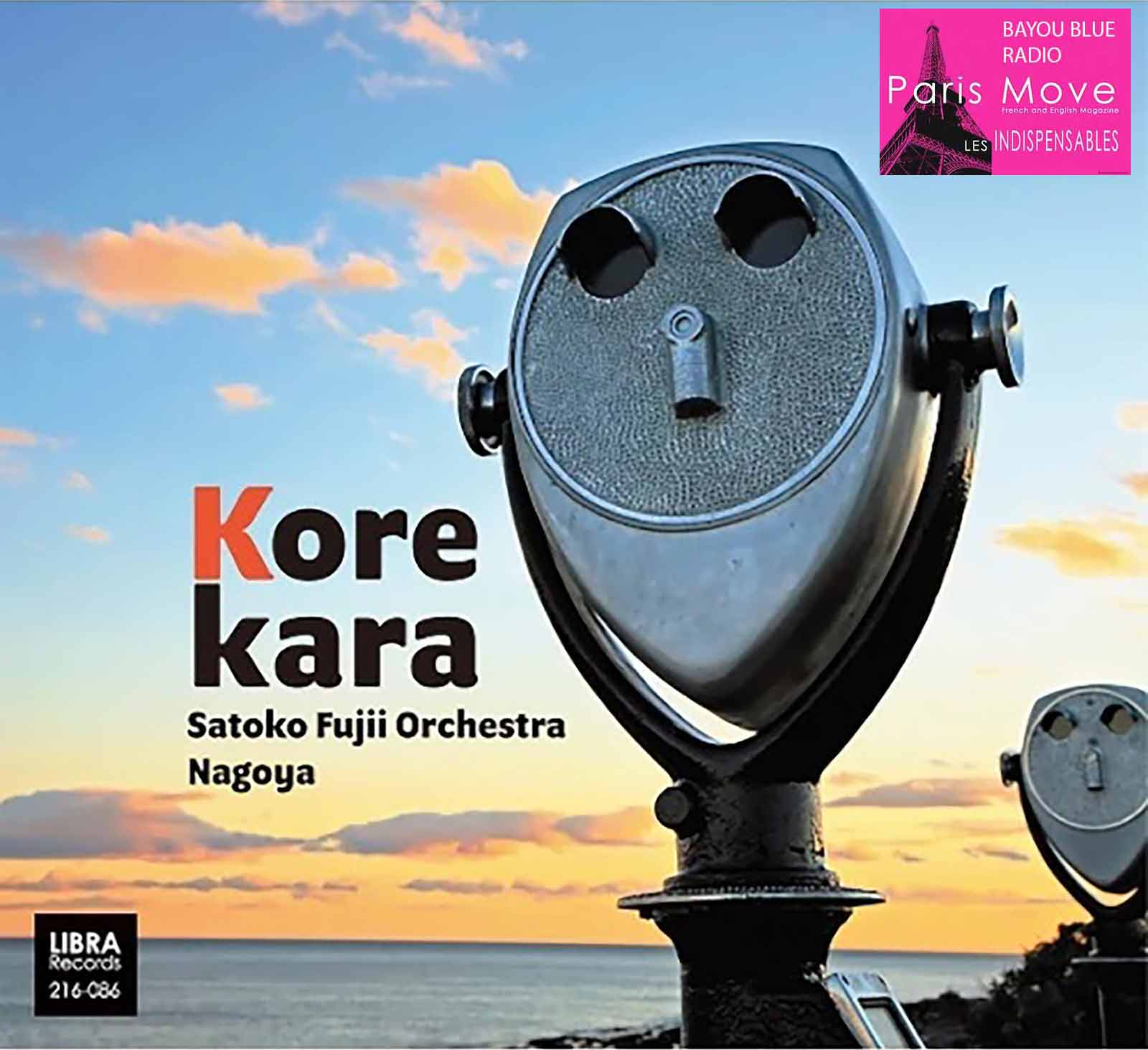
Summary : Satoko Fujii’s KoreKara with Orchestra Nagoya is an adventurous blend of jazz, improvisation and contemporary composition, driven by brass, cinematic atmospheres and a bold vision of the future.
Satoko Fujii Orchestra Nagoya: KoreKara and the Sound of the Future
Satoko Fujii’s albums keep arriving, one after another, yet they never really sound alike. Her voice as a composer is unmistakable, but recognition never becomes repetition. Each new release asks the listener to step into another sonic adventure, to take the time to listen, to accept the pleasure of discovery and, sometimes, rediscovery. Much depends on the moment, on the state of mind in which the music finds us. Fujii’s music rewards that openness.
With Orchestra Nagoya, the brass are placed firmly at the center. There is something of a fanfare here, but not one content simply to announce itself. This fanfare plays, speaks and tells a story. The music seems to build its own architecture, a strange and constantly shifting world that might bring to mind the fictional city of Samaris created by François Schuiten and Benoît Peeters. It is a kind of postmodern classicism, rooted in recognizable forms while looking toward an imagined future.
Fujii gives composition and musical expression an unusual sense of freedom. Written music and improvisation do not compete; they exist together, constantly pushing against one another. This is not necessarily music for everyone, and it asks for a certain openness to enter its immersive world. But that is also where its strength lies. Fujii does not make music designed to resolve itself immediately. She leaves room for mystery, for questions and for the listener’s imagination.
The small stories surrounding the music are important, too. They give this ambitious work a human dimension. Fujii recalls that Shingo Takeda, who plays alto in the orchestra, and his wife, Ririko Mio, ran a small café called Rojura no Matari near the station in Nagoya. Whenever Fujii and Natsuki played there, they would stop at the café before taking the train home. It was a warm, intimate place and a meeting point for many film lovers. The couple later moved the café to another neighborhood filled with restaurants, shops and vinyl record stores. Fujii still visits, although the new location is farther from the station.
They eventually asked her to write a piece for the café’s 20th anniversary. The concert took place in July 2021, when COVID-19 was still a very real threat and the musicians were tested before performing. The title of the resulting suite, KoreKara, means “from now on.” Fujii’s intention was simple but powerful: she wanted to write for their future, not their past.
That idea seems to extend far beyond the original commission. KoreKara feels like music emerging from an uncertain period, but refusing to remain imprisoned by it. During those strange years, when time seemed suspended and many artists found themselves creating under completely different conditions, Fujii chose to look forward. The result is an astonishing brass universe, inhabited by musicians who seem less interested in preserving what has been than in imagining what might come next.
KoreKara can sometimes feel like entering a David Lynch film without knowing exactly where the road is going. Questions appear, disappear and return in another form. Rock and folk colors move through a jazz language deeply connected to improvisation, while the orchestra creates atmospheres that can be both physical and cinematic. There is something here that belongs as much to contemporary art as it does to jazz. The music seems to occupy a visual space, creating shapes, distances, shadows and movement.
And this is where we rediscover Sakoto Fujii in all her complexity and demanding musical intelligence. Her work does not ask to be simplified. Yet complexity should never be confused with inaccessibility. KoreKara requires attention, but it also gives something back: the pleasure of hearing a large ensemble behave in ways that constantly escape the conventions of the traditional big band. Brass becomes color, architecture, gesture and narrative.
More than 50 minutes unfold across four tracks, four parts of a journey that feels larger than the recording itself. Fujii has now passed the remarkable milestone of 100 albums as a leader. No listener could reasonably know every record in such an immense discography, and perhaps that is part of the adventure. There is no need to begin at the beginning. Each album provides another possible entry point, allowing different generations of listeners to discover her music on their own terms.
Satoko Fujii Orchestra Nagoya’s KoreKara is not a synthesis of the composer’s career, nor does it attempt to summarize her many musical languages. It is one proposition among many, presented openly and without compromise. Fujii continues to move forward, refusing the comfort of repetition and using composition as a way to question what an ensemble can become.
Ultimately, that is what makes KoreKara so compelling. It is music looking toward the future without pretending to know what that future will sound like. The brass, the improvisations, the shifting narratives and the cinematic atmosphere create a world constantly in motion. For listeners willing to enter that world, the reward is substantial. KoreKara begins with the force of a fanfare, but it leads somewhere much more elusive: a place where jazz, contemporary composition, visual art and imagination become part of the same conversation.
Thierry De Clemensat
Member at Jazz Journalists Association
USA correspondent for Paris-Move and ABS magazine
Editor in chief – Bayou Blue Radio, Bayou Blue News
PARIS-MOVE, September 10th, 2026
Follow PARIS-MOVE on X
::::::::::::::::::::::::
To buy this album (October 2, 2026)
::::::::::::::::::::::::
To buy this album (October 2, 2026)
Musicians :
Conductor & Composition
Satoko Fujii – Composer, conductor
Saxophones
Shingo Takeda – Alto saxophone
Ryoko Ono – Alto saxophone
Takuya Matsumoto – Tenor saxophone
Yoshiyuki Hirao – Tenor saxophone
Daion Kobayashi – Baritone saxophone
Trumpets
Natsuki Tamura
Tsutomu Watanabe
Takahiro Tsujita
Misaki Ishiwata
Trombones
Toshinori Terukina
Tatsuki Nakamura
Toshihiro Furuike
Rhythm Section
Yasuhiro Usui – Guitar
Toru Kasai – Bass
Hisamine Kondo – Drums
Track Listing :
1. KorekaraPart 1
2. KorekaraPart 2
3. KorekaraPart 3
4. KorekaraPart 4
Recorded live on February 2, 2026
at Tokuzo, Nagoya by Satoru Kono
Mixed on June 21, 2026 by Naoto Sugahara,
Orpheus Studio, Tokyo
Mastered on June 22, 2026 by Naoto Sugahara,
Orpheus Studio, Tokyo