| Jazz |
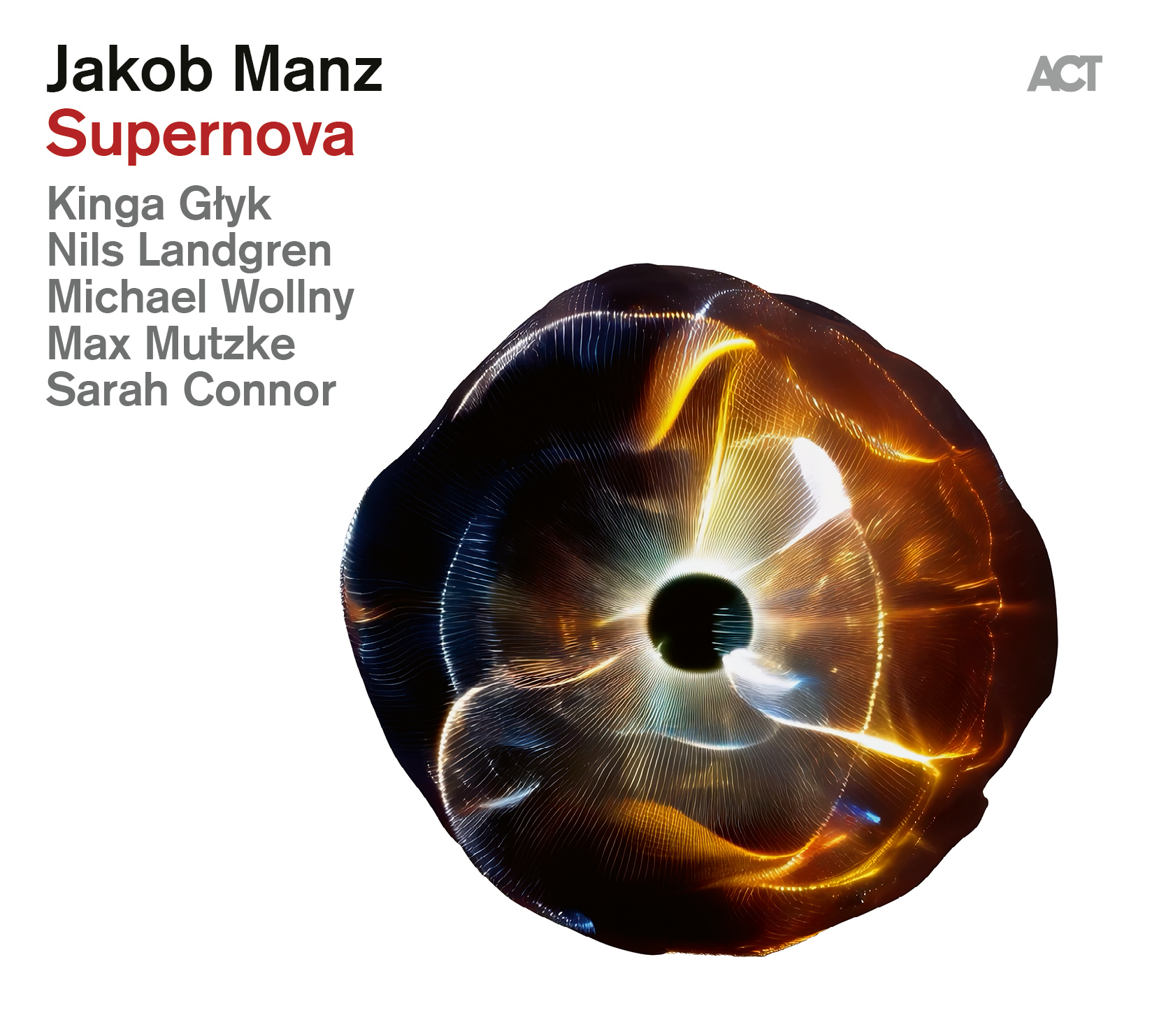
Summary: Jakob Manz’s Supernova showcases a young saxophonist blending jazz, funk, rock and pop with remarkable energy, creativity and an impressive international cast.
Jakob Manz’s Supernova: The New Energy of European Jazz
A new album from Jakob Manz, saxophonist and composer, is always excellent news for me. Like Nils Landgren, Manz moves freely between jazz, funk, rock and pop. What may initially sound accessible often hides surprisingly complex structures, clever arrangements and a sophisticated understanding of groove. This contrast is one of the things I particularly appreciate about his music. He does not need to make the complexity obvious. It is there beneath the surface.
The presence of Nils Landgren on this album is therefore particularly appropriate. Manz belongs to a generation of musicians who are not interested in putting jazz inside a narrow definition. He looks toward other musical worlds and other audiences, and I believe this openness is one of his greatest strengths.
The tone is set immediately with “Eyes of Crystals (Live).” At only twenty-five, Manz already possesses an impressive stage confidence. Recorded in front of 2,600 spectators at Frankfurt’s Alte Oper, the performance demonstrates something I find particularly encouraging: the current generation of jazz musicians can still produce artists capable of captivating a large audience without sacrificing musical substance.
That is not a small achievement. Too many young musicians can demonstrate extraordinary technique while leaving little emotional impression. With Manz, I hear something different. His playing is technically impressive, but technique is not the point. He already has an identifiable sound and, more importantly, an artistic personality.
I also understand why the audience responds so strongly. Manz writes music that communicates immediately. At certain moments, I even hear something cinematic in his compositions, as if some passages could belong to a film. There is movement, drama and atmosphere, but never at the expense of the music itself.
What holds this remarkably varied evening together is a genuine sense of openness and gratitude. Manz is celebrating the music and musicians who have influenced him, but he is also establishing a direct relationship with the audience. This is something I always listen for in a live recording. Some musicians can perform in front of thousands and still sound distant. Others have the ability to make a large concert hall feel surprisingly intimate. Manz belongs to the second group.
That quality is particularly evident when he performs with Michael Wollny. Their interpretation of Horace Silver’s “Peace” is one of the album’s great moments. I am very glad this performance was captured because it is poignant, beautiful and remarkably concentrated. The two musicians seem to listen to each other as much as they play. There is no need for unnecessary display. The music itself is enough.
The collaborations with bassist Kinga Głyk and Nils Landgren are equally revealing. What fascinates me is that these musicians do not simply share a stage. They challenge one another. Their improvisations become a musical conversation in which the original structures remain intact while still allowing room for risk and spontaneity.
One of the album’s most striking moments begins almost like the opening of a rock concert. Max Mutzke enters with German vocals and the atmosphere changes immediately. The energy rises and Manz once again demonstrates that he is completely comfortable outside the traditional jazz environment.
In this respect, I think of David Sanborn. Like Sanborn, Manz understands that the saxophone can become a bridge between jazz and a much larger musical universe. He seems genuinely interested in collaborating with artists from different backgrounds, and I believe this will become an important part of his career.
For listeners outside Europe, the German-language performances add another dimension to the album. Personally, I like that. They give the project a distinctly European character and remind us that European jazz does not need to imitate American jazz to be internationally relevant.
Ultimately, this is an album about pleasure, and I mean that as a compliment. I sometimes feel that contemporary jazz takes itself too seriously, as though complexity were more important than communication. Manz takes a different approach. His music can be sophisticated and still be enjoyable. It can be complex and still make you want to move.
Everything here seems designed to keep the listener engaged: the grooves, the melodies, the changes of atmosphere and the impressive list of collaborators. The audience is invited into the music rather than being asked to understand it before enjoying it. For me, that is one of Manz’s greatest strengths.
His career already reflects this openness. He has performed with major figures such as Randy Brecker, Nils Landgren and Thomas Quasthoff, as well as with the WDR and SWR big bands. He also regularly appears on some of Germany’s largest stages as a special guest with Sarah Connor’s band. These experiences demonstrate how comfortably he moves between very different musical environments.
At twenty-five, Jakob Manz is already an important name on the German jazz scene. I would go further and say that he is becoming an increasingly important figure in European jazz. He has the technical ability, but he also has something much harder to teach: instinct. Instinct for the stage, instinct for the audience and instinct for knowing when the music needs to move in another direction.
For anyone interested in international artists and the future of European jazz, this album is almost a catalogue of the different musical worlds in which Manz is already operating. Each collaboration reveals another side of him, while the live setting gives the entire project a genuine sense of energy and occasion.
What excites me most, however, is that he does not sound finished. At twenty-five, he is still experimenting, still meeting new musicians and still expanding his musical vocabulary. I would much rather listen to an artist who is still searching than one who believes he has already found all the answers.
Jakob Manz is not simply a young saxophonist demonstrating that he can play. He is becoming an artist with something to say. This album makes that increasingly difficult to ignore. We need more musicians like him: artists who respect jazz history without becoming prisoners of it, who can be sophisticated without becoming inaccessible, and who understand that an audience is not the enemy of serious music but an essential part of it.
For me, “Supernova” is therefore more than a very good live album. It is a snapshot of an artist already taking his place on the European stage while still leaving us wondering how far he can go. At twenty-five, that may be the most exciting thing about Jakob Manz. This sounds impressive, but it does not sound finished. It sounds like the beginning of something much bigger.
Thierry De Clemensat
Member at Jazz Journalists Association
USA correspondent for Paris-Move and ABS magazine
Editor in chief – Bayou Blue Radio, Bayou Blue News
PARIS-MOVE, September 10th, 2026
Follow PARIS-MOVE on X
::::::::::::::::::::::::
The Jakob Manz Supernova Band:
Niko Zeidler, tenor sax, flute
Maximilian Seibert, trumpet
Jonathan Böbel, trombone
Ferdinand Schwartz, keys, musical director
Bruno Müller, guitar
Thomas Stieger, bass
Roland Peil, percussion
Felix Lehrmann, drums
Special Guests:
Kinga Głyk, bass
Max Mutzke, vocals
Michael Wollny, piano
Nils Landgren, trombone
Sarah Connor, vocals
01 Eyes of Crystals (Manz) 4:32
02 Island (Głyk, League & Williams) 6:07 feat. Kinga Głyk
03 Polygon (Wollny) 5:33 feat. Kinga Głyk, Michael Wollny, Nils Landgren
04 Peace (Silver) 5:17 feat. Michael Wollny
05 Mr. M (Landgren) 6:59 feat. Kinga Głyk, Michael Wollny, Nils Landgren
06 Welt hinter Glas * 5:48 feat. Max Mutzke
07 Forgotten World (Manz) 6:46
08 Ich wünsch dir (Connor, Kuhn & Schwizler) 5:34 feat. Sarah Connor
Recorded live on 27 January 2026 at the Alte Oper Frankfurt as part of Jakob Manz’s Jazz Residency
Recorded by Dominik Arnold
Mixed and mastered by Emanuel Uch
Musical director & live arrangements: Ferdinand Schwartz
Horn arrangements of Forgotten World & Island: Jakob Manz
Cover Art: Champagne Supernova (2025) by Jinjoon Lee. © Jinjoon Lee. Courtesy of Jinjoon Lee Studio