

Elias Haslanger’s interview
by Thierry De Clemensat
Member at Jazz Journalists Association
USA correspondent for Paris-Move and ABS magazine
Editor in chief – Bayou Blue Radio
September 10th, 2026
Follow PARIS-MOVE on X
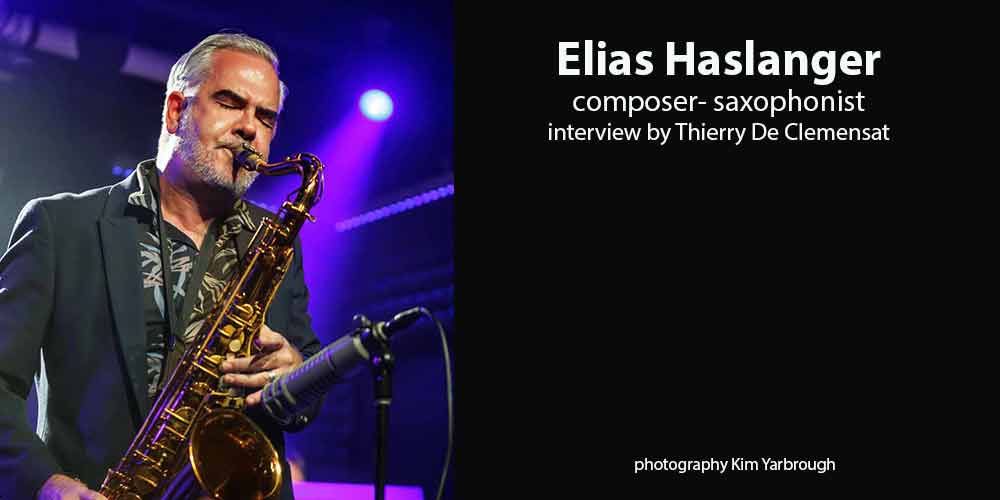
Elias Haslanger: The People, Places and Music That Became a Legacy
An intimate conversation with the Austin saxophonist about the musicians who shaped him, the friendships that became music, the city that became home, and the stories behind his new album, Legacy.
There are musicians who spend their careers chasing a sound. And then there are musicians who spend their lives collecting people, places and experiences, until all of those things eventually become part of the sound. For Elias Haslanger, the story runs through teachers and mentors, legendary bandleaders, late nights, Austin clubs, friendships, touring, family and decades of listening. His career has moved comfortably between jazz and the wider musical world, without ever losing sight of where the music came from.
His new album, Legacy, brings that history into focus. But the story of the record really begins much earlier.
The beginning
Thierry De Clemensat: Elias, before the albums, before the tours and before Austin became such an important part of your life, do you remember the first moment when music became something more than something you simply enjoyed?
Elias Haslanger: It was probably when I was 12 and picked up the saxophone. I was in 6th grade and started taking lessons from a local (Austin) pro sax player. I enjoyed the learning process, and I also was competitive, so I wanted to be better than my peers. I was immersed in music as a kid, so I was listening to a lot of music, even as a young man.
Thierry De Clemensat: You discovered Charlie Parker at a very young age. Do you remember what you felt the first time you really heard him? What was it about Parker that made you want to pick up the saxophone and find out what he was doing?
Elias Haslanger: My mom bought me my first Charlie Parker record, and it was a Dial compilation called Cool Blues. I had never heard anything like it before, so it intrigued me. The raw, visceral sound was compelling, and the technical virtuosity was mind-blowing. I didn’t understand it at first, so I listened to the recording repeatedly to try and grasp the sound and the music. I had a mentor named LaFalco “Corky” Robinson who was the first to give me transcriptions of his solos which I started learning – that was probably 8th grade. I then started to learn everything I could about bebop and tried to copy his playing.
Thierry De Clemensat: When you were young, did you already imagine yourself becoming a professional musician, or did that dream develop slowly as you met the right people?
Elias Haslanger: I never imagined being a professional musician, it just happened naturally over the course of time. When it came time to decide where to go to college, I had other interests, but I landed on music at The University of Texas because of the saxophone professor there, Harvey Pittel. He was instrumental in getting me focused on a practice routine and the discipline it required to get better. As I improved, I started being called to play gigs and I found I really enjoyed playing for people. It was an organic process.
The people who shaped you
Thierry De Clemensat: You have been fortunate to work with some remarkable teachers and mentors. When you think about people such as Harvey Pittel, Dick Oatts and Ellis Marsalis, what comes back first: something they told you, something they played, or simply the way they carried themselves as musicians?
Elias Haslanger: Each had different influences on me. By far, the most influential on me as a saxophone player was Harvey Pittel. He taught me everything there is to know about the horn, how to produce a good sound, how to practice and how to be musical. He was a huge influence. I only studied with Dick for 1 semester, but he really gave me an honest and practical view of what it takes to be a working musician. Keep the overhead low, try to play music you like with people you like, always be learning, etc. Ellis never said much but when he did talk, it was very poignant. I respected how serious he was about the music and that he was a dedicated family man who lived his life in service to the music.
Thierry De Clemensat: Ellis Marsalis was a remarkable musician, but he was also a remarkable teacher. What was it like to have someone like Ellis listen to you when you were still developing your voice?
Elias Haslanger: I was 23 when I met Ellis and I was introduced to Ellis by Martin Banks, the trumpet player who played with Dexter Gordon, Duke Ellington, Count Basie, the house band at The Apollo and countless other bands. I met him toward the end of his career and life, and he was an amazing person to be around. Ellis came to play in Austin at the Clarksville Jazz Festival and Martin, and he was friends from their time together in the Ray Charles orchestra. Ellis asked me to sit in based on Martin’s recommendation. I then sat in with him two more times over the course of his stay in Austin. As I mentioned, he didn’t say much but he did offer a compliment after my last time playing with him and said that I “sounded good”. Of course, that made me feel good, but I didn’t think much else would come from it. The record company I was associated with at the time, Heart Music, and the owner, Tab Bartling, was the one who suggested the collaboration. Much to my surprise, Ellis said yes and we planned a full day in the studio. I was a bit intimidated, but we did the full day in Houston, and he was quite gracious and took the session quite seriously. We ended up using 2 tracks from the session on my recording Kicks are for Kids. During our studio session together, I learned a lot from just listening to him play and then we had some conversation about Duke Ellington, Charlie Parker and other jazz greats. He was encouraging and had no tips on my playing other than to keep doing it. Most of the elders (people like James Polk and Martin Banks and others) had very little to say about tone or technique or the “how” of playing the music. Rather, it was a feeling and a dedication to the music that was understood. This was a lifelong journey, and you must submit yourself completely to the process and to the music. It was certainly a high point of my musical life to be able to play and record with him.
Thierry De Clemensat: Is there something Ellis said to you that has stayed with you all these years, perhaps something that only became meaningful much later?
Elias Haslanger: “If it were easy, everyone would be doing it”
Thierry De Clemensat: You eventually joined Maynard Ferguson’s band. You were suddenly on the road, playing night after night with extraordinary musicians. Was there a particular night or moment when you realized, “This is my life now”?
Elias Haslanger: When I got the call to join the band, the first night was at the Mirage in Las Vegas. We were there for 3 nights and all the old-school jazz musicians who lived in Vegas who he knew were in attendance. I was already nervous, but my flight was delayed and I didn’t get to rehearse with the band before the show, so I had to read the book live on the gig. It was definitely nerve wracking but I did well and Maynard, the band and the old school guys were all super great and supportive.
Thierry De Clemensat: Maynard Ferguson had such a powerful personality and such a distinctive sound. How do you learn from a musician like that without losing your own identity?
Elias Haslanger: There was no one like Maynard. A truly unique individual in the history of music. He encouraged everyone to be their own player. He was another elder who was super supportive – he shook my hand and thanked me on stage after every solo I took every night! He couldn’t sleep on the bus and neither could I so I was up many nights with him talking about legends like Charlie Parker, Miles Davis and others. He told me that I held the same chair in his band as Wayne Shorter! That was crazy and hard to imagine but it is true. The biggest thing I learned from Maynard was his dedication to the music and to the audience. He welcomed everyone to the music and was the ultimate showman. He has fans that span from elementary school age to folks in their 80s and all ages in between. He signed every autograph after every show and loved performing for people.
Thierry De Clemensat: Looking back at all the musicians you have worked with, is there someone who taught you something about music that you only understood years later?
Elias Haslanger: As I get older, the climb up the mountain continues. Every elder that I played with and learned from knew that it was a never-ending journey and that there is always room at the top for anyone willing to put in the work.
The life of a working musician
Thierry De Clemensat: There is a romantic idea of the jazz life: the clubs, the late nights, the travel, the improvisation. After all these years, what does that romantic picture get completely wrong?
Elias Haslanger: It is a lot of hard work. The pay is low and the travel is difficult and the clubs are facing real financial pressures. Most of your time is spent on logistics like booking the band, managing finances, waiting around for the gig – lots of waiting around. The fun part is playing the music and interacting with the crowd.
Thierry De Clemensat: When you were starting out, what did you imagine professional musicianship would be like? And what turned out to be completely different?
Elias Haslanger: I’m not sure I had a picture in my head of what being a professional musician would be. I didn’t actively think or dream about becoming a professional musician, my life just naturally moved in that direction. So I didn’t have any preconceptions. I did receive some good, practical advice from my mentor Dick Oatts and that was to keep my overhead low so that I could play the music I wanted to play.
Thierry De Clemensat: You spent time in New York and eventually built your life in Austin. What did New York teach you about being a musician, and what did returning to Texas teach you about who you were?
Elias Haslanger: New York is an amazing city and when I was there, I toured with Maynard Ferguson which was an incredible experience. Maynard was the ultimate showman and invited everyone into the music – he was truly a special performer and person. I don’t think living there taught me anything about music other than you must work hard. There are a lot of world class musicians there, so I enjoyed access to them and to be able to hear the music executed at a very high level regularly. Returning to Texas was important to my wife and I because we wanted to start our family and be closer to our loved ones. Fortunately for us, we had two beautiful daughters and were able to balance family with music in Austin.
Thierry De Clemensat: You have watched Austin’s music scene change over several decades. What do you think the city has managed to preserve, and what do you worry it might lose? Austin has evolved from a small college town to one of the biggest cities in the US so yes, lots has changed but I tell people that if you present music your honestly and with integrity, there will always be people who respond to it, regardless of style or genre. Austin is known for its music and its musicians and that reputation continues to expand, bringing high-quality musicians from all over the world. The main concern I have about Austin is affordability for the musicians because the cost of living is far outpacing the rate of pay for the creative class.
Church on Monday
Thierry De Clemensat: Church on Monday has become such an important part of your musical life. Do you remember the first night clearly? At the time, could you possibly have imagined that it would become such a lasting part of your career?
Elias Haslanger: I do remember the first night clearly. I wanted to play in that room for many years as a leader, but the right opportunity never presented itself until I created this band. The group started as a recording project for my 5th album, and I wanted to work with Dr. Polk who was a friend and mentor. He was known in Austin as a pianist, but I knew that he played organ with Ray Charles and so I wanted people to hear him play that instrument again. From our first night at The Gallery, I knew we had something special and here we are 15 years and 3 recordings later, still playing every Monday.
Thierry De Clemensat: There is something very different about playing regularly for the same audience. You begin to know the people in the room, and they begin to know you. What does the Church on Monday audience understand about your music that someone seeing you for the first time might not?
Elias Haslanger: I think the special thing about Church on Monday is whether it’s your first time hearing us our your 300th time hearing us, there’s a feeling of community and joy that is part of that room and the music that is instantly felt. That’s why people keep coming back.
Thierry De Clemensat: Has playing a regular residency changed the way you think about improvisation? When you know you will be back next week, does it give you more freedom to take risks?
Elias Haslanger: Not really. I do think that playing regularly with the same group of players helps because music is about the band and the compositions, not the soloist. The soloist is simply an extension of the song so if the band is playing together regularly, they can better interpret the song and help the soloist.
Thierry De Clemensat: One of the interesting things about your career is that you have never seemed particularly interested in keeping jazz in a box. You have worked with musicians from rock, blues, soul, country and other traditions. What happens to Elias Haslanger when you step outside the traditional jazz world?
Elias Haslanger: I think Duke Ellington said, “there are two kinds of music: good and bad”. I subscribe to the same philosophy. If the music is good, I like to listen to it and play it.
The people behind the music
Thierry De Clemensat: You have worked with an extraordinary range of artists. Is there one particular session, concert or tour that still makes you smile when you think about it?
Elias Haslanger: Legacy is my way of paying respect to the mentors in my life who influenced me and helped me become the musician I am today. From playing and recording with Ellis Marsalis to touring with Maynard Ferguson to standing next to Dr. James Polk weekly for over 10 years at The Gallery, I am fortunate to be able to draw upon many years of shared experiences with these great musicians and many others.
Thierry De Clemensat: There is a difference between respecting a musician and genuinely connecting with someone as a person. Have some of your most important musical relationships also become some of your most important friendships?
Elias Haslanger: Yes I like to create music with people who are my friends. It’s part of the joy of playing music.
Thierry De Clemensat: Mike Sailors has been an important musical partner for many years. What happens when you play with someone who knows your musical instincts almost as well as you do?
Elias Haslanger: Mike and I have listened to a lot of the same music and we have similar interests and goals in life. It’s easy to play with him because we share a similar music perspective. It’s always a joy to play with Mike – he’s a fantastic musician and a dear friend.
Thierry De Clemensat: After so many years of playing together, can Mike still surprise you? And can you still surprise him?
Elias Haslanger: Music is a lifelong journey filled with listening, practicing and performing as well as writing, recording and collaborating. If we don’t surprise each other then something is wrong.
Thierry De Clemensat: You have also worked with musicians from very different generations and musical backgrounds. What have younger musicians taught you that you did not expect to learn at this point in your career?
Elias Haslanger: I’m always trying to listen and learn and that never stops. I have no age bias.
The musician behind the saxophone
Thierry De Clemensat: After decades of playing, what does practice mean to you now? Do you still approach the saxophone the way you did when you were twenty, or has your relationship with the instrument changed completely?
Elias Haslanger: The only thing that has changed is the time I have to practice and the experience that comes with age. I wish I had more time to practice but now that I’m older, I’m more efficient with my practice time.
Thierry De Clemensat: Has your definition of a great saxophone solo changed over the years? When you were younger, what did you think made a player great, and what do you listen for now? I’ve always loved listening to all kinds of players from every era.
Elias Haslanger: Ben Webster is still a thrill and so is Michael Brecker. The context in which they are playing is most important – it’s about the band and the composition, not the soloist. The soloist is simply an extension of the composition.
Thierry De Clemensat: At this stage of your life, are you more interested in playing more notes, or finding the right note?
Elias Haslanger: Again, I am not concerned about how many notes if they serve the composition and the music the band is playing in the moment.
Legacy
Thierry De Clemensat: The title of your new album is Legacy. That is a powerful word. It can almost sound like a word you use when looking backward, yet you are still very much in the middle of your creative life. Why did that title feel right to you now?
Elias Haslanger: I have been playing, composing and recording for over 30 years so it reflects my experiences to date. Living in NYC, touring, returning to Austin, starting a family, raising kids… my legacy. But it is also an acknowledgement of the influences and mentors I’ve had along the way and paying respect to their legacy. This music is rooted in the tradition but reflects the attitudes and ideas of today.
Thierry De Clemensat: The album is connected to the people who shaped you. When you began writing the music, did you consciously think about your mentors, or did those memories naturally find their way into the compositions?
Elias Haslanger: I don’t set out to write songs about things or people. I start with a rhythm and a feeling, and it evolves.
Thierry De Clemensat: Some of the titles on the album are deeply personal: “Going Home,” “Faith in Family,” “Reflection,” “Gentle Giant,” “Sweet Relief” and “A View of the City.” When you look at those titles together, do you see pieces of your own life in them?
Elias Haslanger: Yes, this is a collection of my original music and the titles reflect my history and life experiences.
Thierry De Clemensat: There is an interesting idea behind the word “legacy.” We inherit music from the people who came before us, and eventually we become part of that history ourselves. Do you think about what you are leaving behind, or are you still too busy making music to think about that?
Elias Haslanger: It is both – a tribute to my mentors and a documentation of my life. That was intentional.
Thierry De Clemensat: Finally, Elias, imagine that twenty years from now a young saxophonist discovers Legacy without knowing anything about you. They hear the record, they hear the musicians, they hear the stories in the compositions. What would you hope that young musician understands about the life behind that music?
Elias Haslanger: Hopefully, it inspires them to be a positive force for good in the universe.