| Jazz |
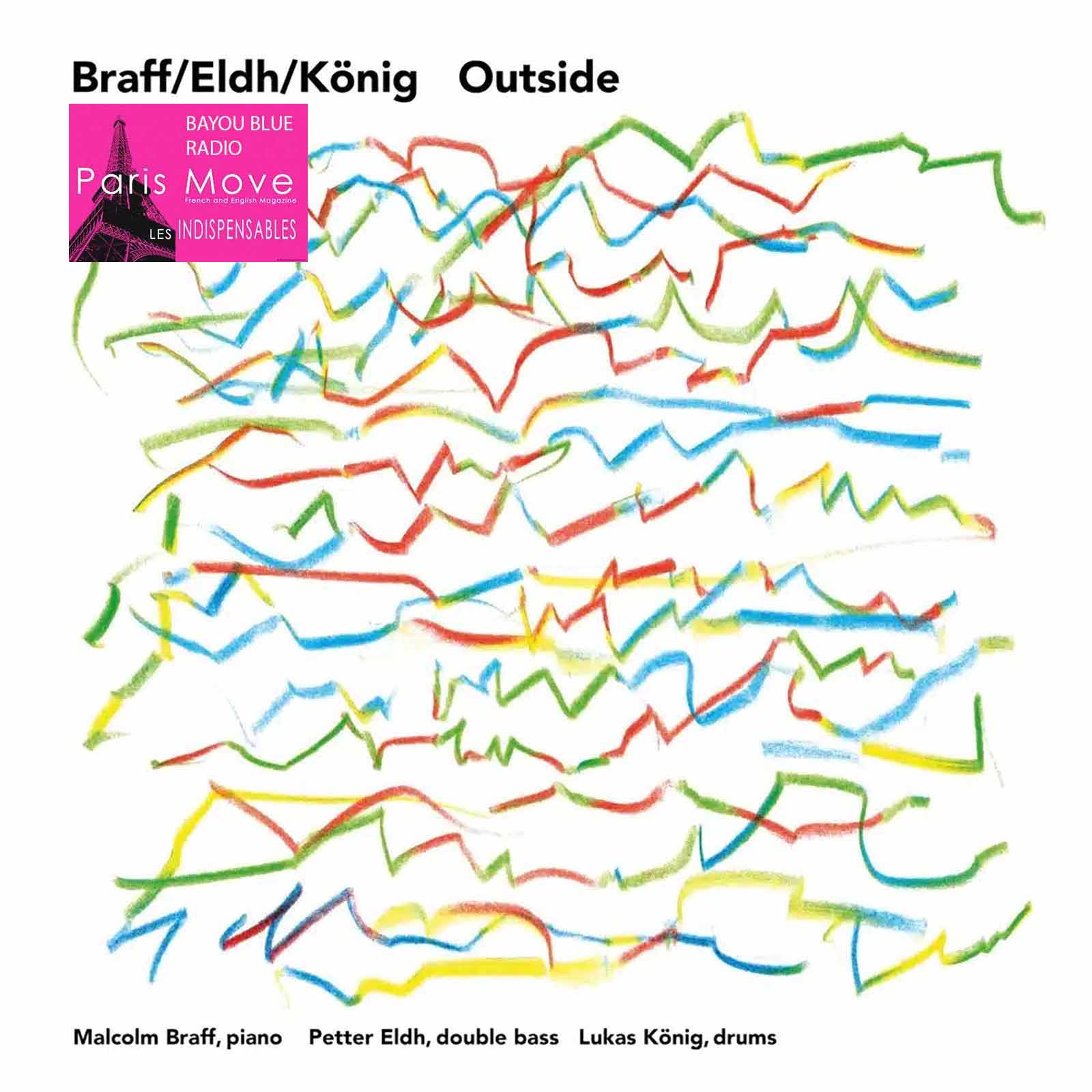
Summary : Outside, the new jazz trio album by Malcolm Braff, Petter Eldh and Lukas König, blends contemporary jazz, inventive rhythms and dynamic improvisation in a compelling exploration of musical time, interaction and freedom.
Outside: Three Musicians, One Restless Conversation
The coffee was still steaming on my desk when I pressed play. It was one of those autumn mornings when daylight seems to arrive reluctantly, as if the season itself were quietly reconsidering whether the day was worth beginning. Outside, the trees were starting their annual surrender, the afternoons growing shorter, the light thinning almost imperceptibly. I was not looking for a record to analyze. I wanted music in the room while the morning slowly found its shape. Instead, Outside, the new trio recording by Malcolm Braff, Petter Eldh and Lukas König, made me stop what I was doing and listen.
There are albums that announce themselves immediately, with a melody that stays in your head or a groove that settles into the body before you have had time to think about it. Outside is more elusive. It does not rush toward the listener. It creates a certain kind of curiosity, the feeling that something is happening just beyond the obvious surface of the music. Within minutes, I found myself listening differently, paying attention not only to what the musicians were playing but to the spaces between their decisions, to the small shifts in rhythm and texture that seemed to alter the direction of the music without ever announcing themselves.
The first thing that caught me was Lukas König’s snare drum. I kept wondering how he had managed to get that particular sound, because it seemed to have a physical presence all its own. The attack is precise without being sterile, dry without being lifeless, intimate without losing its force. The snare does not simply mark the beat; it seems to comment on it, to question it, occasionally to challenge it. König has the rare ability to make percussion feel like a form of thought. You hear the drummer not merely keeping time but deciding, moment by moment, what time is supposed to mean.
Then Malcolm Braff enters on piano, and the technical question disappears. His phrases have an unusual poetic quality, as though they were arriving from somewhere slightly outside the immediate logic of the music. A line begins, bends unexpectedly, and seems to disappear just as you think you have understood where it is going. Listening to Braff can feel a little like watching birds cross a pale morning sky. You know they are moving toward somewhere, but you have no access to the instinct that tells them exactly where to go. Their direction is obvious, their destination is not.
That sense of movement is fundamental to Outside. Braff, Eldh and König are, technically speaking, a piano trio, but the conventional description does not really capture what is happening here. They do not sound like three musicians occupying three clearly defined roles. They sound like three personalities engaged in a continuous negotiation, constructing the music in the space between them. Each musician is immediately recognizable, yet none seems particularly interested in dominating the conversation. The music belongs to the relationship.
That is harder to accomplish than it sounds. There is a particular kind of contemporary jazz in which extraordinary technical ability can become almost a burden. Everyone can play, everyone knows the vocabulary, everyone is capable of navigating difficult rhythmic structures and sophisticated harmonic material. The result can be impressive while remaining strangely distant. You admire the musicians, perhaps even marvel at them, but you are left wondering whether the music itself ever became more important than the evidence of its construction.
Outside avoids that trap. The technique is there, often in abundance, but it remains subordinate to expression. The musicians never seem to be playing difficult passages simply because they can. Complexity has a purpose. Rhythm has personality. Virtuosity is allowed to disappear into the larger musical conversation, which is precisely what virtuosity should do when it is functioning at its highest level.
Malcolm Braff’s career helps explain some of this sensibility. For more than two decades, he has explored rhythm, musical time and the possibilities that emerge when conventional ideas about pulse are subjected to pressure. His work has moved comfortably between jazz and contemporary classical music, while his collaborations have also drawn on African and Indian rhythmic traditions. Yet Outside does not feel like a catalogue of influences. Braff is not presenting his musical education for inspection. The traditions are simply part of his vocabulary, absorbed deeply enough that they no longer need to be identified.
What interests him is not merely rhythm but the perception of rhythm. Where does the pulse actually begin? How much of a beat has to be stated before the listener recognizes it? What happens when the musician places the emphasis somewhere the listener was not expecting it? How much information can be removed before the sense of movement disappears? These are old questions, but great musicians have a way of making old questions feel newly dangerous. Braff is particularly good at creating that sensation. He does not destroy the listener’s sense of time. He makes that sense of time slightly unreliable.
Petter Eldh is the perfect partner for such an approach because his bass playing is itself a study in instability. There is tremendous physicality in his sound. One moment the bass feels broad and rounded, almost architectural, and the next it becomes percussive, restless and sharply articulated. His rhythmic imagination is formidable, but what makes his contribution so convincing is that rhythm is never separated from melody. His lines have shape and direction. They seem to know where they are going even when the music around them is deliberately refusing to provide a conventional map.
That distinction is increasingly important in contemporary jazz. We live in an era of remarkable instrumental ability, when musicians can execute rhythmic and harmonic ideas that would have seemed almost unimaginable to earlier generations. But the ability to play something difficult is not, by itself, a reason to play it. Eldh understands that instinctively. He never sounds as though he is trying to prove that he can play the bass. He sounds as though he is trying to make the bass necessary to what is happening.
The same principle governs König’s drumming. He does not function simply as the rhythmic foundation beneath Braff and Eldh. He listens, reacts, anticipates and provokes. His playing can become forceful without becoming heavy-handed and intricate without sounding calculated. The drum kit becomes a palette of textures, colors and accents rather than a machine designed to keep everyone obediently in line. A snare hit can change the emotional temperature of a passage. A cymbal can become punctuation. A slight displacement of an accent can make an otherwise familiar rhythmic figure suddenly feel unstable.
There is something particularly conversational about König’s approach. He can suggest a change before it happens, interrupt a phrase without breaking its momentum, or create tension with what sounds like the smallest possible gesture. The remarkable thing is that he remains constantly present without constantly demanding attention. That quality is rare. Many drummers want you to notice what they are doing. König seems more interested in making sure that you notice what is happening.
Eldh works in much the same way. His bass gives the trio gravity, but it is an unstable kind of gravity. It bends, accelerates and shifts. Sometimes he seems to anchor the music; at other moments he sounds like the musician quietly encouraging Braff and König to move further into uncertainty. The bass becomes both foundation and invitation, something that holds the music together while simultaneously encouraging it to escape the obvious.
That is where the chemistry of the trio becomes so compelling. They trust one another, and trust is one of the least discussed but most important qualities in improvisation. It is easy to play loudly. It is easy to fill every silence. It is considerably more difficult to leave space for another musician to speak and then listen carefully enough to respond to what has actually been said. Outside is built on that kind of attention. The musicians do not seem afraid of empty space because they understand that silence can be part of the conversation rather than an absence of it.
This brings to mind an idea often associated with Wynton Marsalis, that musicians ultimately make music for an audience rather than simply for other musicians. The thought may sound almost old-fashioned in some corners of contemporary jazz, where complexity can occasionally become a form of prestige and where the ability to understand a piece can become almost as important as the pleasure of hearing it. But the distinction remains essential. Complexity is not communication. Virtuosity is not emotion. Difficulty is not automatically depth.
Outside understands the difference. You do not need to know Braff’s ideas about rhythm to feel the instability he creates. You do not need to understand the mechanics of Eldh’s bass lines to sense the direction and weight they give the music. You do not need to analyze König’s rhythmic vocabulary to understand that he is constantly listening and responding. The body gets there before the intellect. That is one of the oldest and most powerful truths about jazz.
The record also benefits from the freedom and vulnerability of the trio format itself. There is nowhere to hide. There is no large ensemble to absorb an uncertain decision, no wall of sound behind which a musician can disappear. Every note matters. Every hesitation can become audible. Every silence carries weight. The three musicians are exposed, and that exposure gives the music a particular tension. You feel that something could change at any moment because there is nothing between the musicians and the listener to prevent it.
This is perhaps why the title Outside feels so appropriate. The word suggests territory beyond the familiar, a place where the usual rules have been loosened but not abandoned. The musicians are not rejecting jazz tradition, nor are they trying to escape it for the sake of appearing original. They know the tradition well enough to move through it without becoming imprisoned by it. The piano trio is one of the most established formats in jazz, carrying with it an almost intimidating history, but Braff, Eldh and König do not sound burdened by that history. They acknowledge it and then continue their conversation.
That confidence is one of the album’s greatest pleasures. Contemporary jazz often finds itself caught between two impulses, one looking backward toward tradition and the other desperate to demonstrate that it has moved beyond it. Outside has little interest in either argument. It knows where it comes from, but it is much more interested in where the music might go next. Its European sensibility, its openness to contemporary classical ideas, its rhythmic curiosity and its jazz vocabulary are not competing identities. They are simply different parts of the same musical language.
The more I listened, the more I realized that the album’s sophistication is almost beside the point. What matters is that it remains alive. The rhythms can be complex without becoming intellectual exercises. The music can be highly structured without sounding predetermined. The improvisation can be adventurous without becoming self-conscious. Most importantly, there is always a sense that the musicians might surprise themselves.
That possibility is what keeps bringing me back to Outside. The album rewards close listening, but it does not punish casual listening. You can allow it to play in the background and enjoy the movement, the pulse and the atmosphere. Return to it with more attention, however, and another record begins to reveal itself underneath the surface. Suddenly a rhythmic figure that seemed incidental becomes structural. A piano phrase begins to sound like an answer to something the bass said earlier. A drum accent that initially passed unnoticed turns out to have changed the direction of an entire passage.
Eventually, you stop hearing three separate instrumentalists and begin hearing a single organism constantly changing shape. That is one of the most difficult achievements in a trio. Individuality must remain intact while the boundaries between the musicians become porous. Outside manages that balance remarkably well. Braff still sounds like Braff, Eldh still sounds like Eldh and König still sounds like König, but the identities become less important than the space they create together.
By the time the album ended, the coffee on my desk had gone cold. The morning had fully arrived, the light had changed, and the strange half-darkness of autumn had given way to another ordinary day. Yet something from the record remained in the room. I was still thinking about König’s snare drum, about the way Eldh seemed to bend the center of gravity, about Braff’s ability to make rhythm feel less like a grid than a question.
That, for me, is when a record becomes more than an accomplished recording. Not when you can explain every part of it, but when something inexplicable remains after the music has stopped. Outside leaves that kind of residue. It makes you more conscious of time without lecturing you about time. It makes silence feel active. It reminds you that rhythm is not merely the thing underneath music but one of the ways music thinks.
There are many excellent jazz trios working today. There are far fewer that can make the listener feel that a musical language is being discovered rather than merely performed. Braff, Eldh and König occasionally reach that territory, and when they do, Outside becomes something more than a sophisticated exercise in contemporary improvisation. It becomes a genuine conversation, unpredictable enough to remain exciting and disciplined enough to remain coherent.
That may ultimately be the record’s greatest strength. It is cerebral without becoming cold, adventurous without turning experimentation into a badge of honor, and deeply rooted in jazz without allowing the history of jazz to dictate what the music must be. It respects the listener enough to offer complexity but trusts the listener enough not to explain every decision.
And perhaps that is why the record feels so generous. Outside does not demand that you understand it before you are allowed to enjoy it. It simply asks you to listen. Listen again, and you may begin to hear the architecture. Listen again after that, and the architecture may disappear into something more mysterious. The music changes because your attention changes, and that is one of the most satisfying things a record can do.
Those fortunate enough to hear this trio onstage will probably discover yet another version of the music. Outside does not feel like a finished object that exists primarily to be reproduced. It feels like a set of possibilities. The recording captures one moment in an ongoing conversation, but the conversation itself seems capable of continuing indefinitely, because the musicians have built their language around listening rather than certainty.
Three musicians enter the same musical space with different histories, different instincts and different ways of hearing time. They do not erase those differences. They use them. They listen closely enough to one another that the music begins to move somewhere none of them could have reached alone. That is where Outside becomes most convincing, not as a demonstration of how advanced contemporary jazz has become, but as a reminder of what improvisation can still accomplish when musicians are willing to leave enough room for one another.
For my money, that makes Outside one of the most compelling trio recordings I have heard in recent years. Its originality does not come from trying to sound unprecedented. It comes from the much harder task of making familiar musical materials feel newly alive. By the end, you may not be able to tell exactly where the composition stops and the improvisation begins, or where one musician’s idea ends and another musician’s response begins. But perhaps that uncertainty is precisely the point. The record does not ask us to choose between structure and freedom, tradition and invention, intellect and instinct. It lives in the tension between them. And that is where this trio has found its voice.
Thierry De Clemensat
Member at Jazz Journalists Association
USA correspondent for Paris-Move and ABS magazine
Editor in chief – Bayou Blue Radio, Bayou Blue News

PARIS-MOVE, September 6th, 2026
Follow PARIS-MOVE on X
::::::::::::::::::::::::
Musicians:
Malcolm Braff | Upright Piano
Petter Eldh | Double Bass
Lukas König | Drums
Trackinglist:
Vienese Grøt à la Berlinaise
3TOES
Cycle
Crémines
Malcolm Braff’s website
Petter Eldh’s website
Lukas König’s swebsite