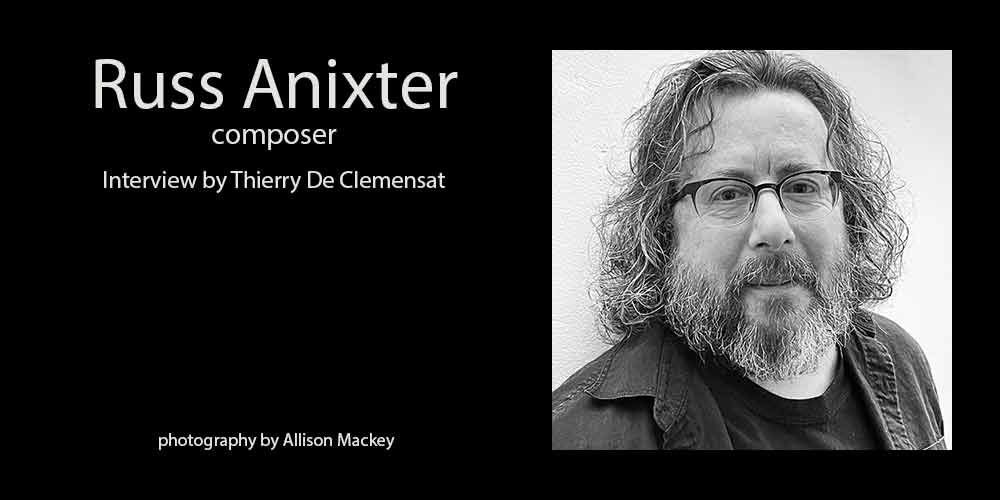
Russ Anixter’s Interview
by Thierry De Clemensat
Member at Jazz Journalists Association
USA correspondent for Paris-Move and ABS magazine
Editor in chief – Bayou Blue Radio
September 5th, 2026
Follow PARIS-MOVE on X
Russ Anixter: Finding His Voice Between Rock, Jazz and New York
An intimate conversation with the arranger, orchestrator and founder of Russ Anixter’s Hippie Big Band.
There is an interesting tension at the heart of Russ Anixter’s musical life.
For more than three decades, he has worked behind the scenes of the New York music world, preparing scores for Broadway, theater productions, concerts, recording sessions and large ensembles. It is a profession that demands extraordinary precision, but it is not usually the person holding the microphone who receives the attention.
At the same time, Anixter has carried another musical identity with him since his teenage years.
Growing up in San Francisco during the 1960s, he was drawn to the Grateful Dead, Santana and the strange freedom of rock musicians who were willing to let a song wander. At the same time, he was discovering jazz and big band music. Years later, after studying jazz composition and arranging at Manhattan School of Music with Manny Albam and Rich DeRosa, those seemingly different musical worlds began to converge.
The result is the Hippie Big Band, an eleven-piece ensemble that refuses to fit neatly into a category. It can play rock, jazz, funk, ballads and free improvisation, sometimes inside the same arrangement. Anixter describes the project as a way of finally bringing together the different sides of his musical life.
His latest album, What Next?, recorded at The Bunker Studio in Brooklyn in February 2026, continues that journey, with the Hippie Big Band joined by special guests Danny Louis on organ and Erica von Kleist on piccolo.
Thierry De Clemensat: You grew up in San Francisco in the 1960s, at a moment when music seemed to be changing almost every week. When you think back to those years, what is the first sound you remember that made you think, “I want to be part of this”?
Russ Anixter: I can’t say that back then I knew there was anything like this to be a part of. My family was fairly conservative, and we only sparingly listened to music in the house. I was very drawn to music I heard on TV and on Children’s records in the 1960s. Turns out the arrangers were people like Billy May, Nelson Riddle, Oliver Nelson, and other great jazz writers. I never knew that being involved in music as a career was even possible until midway through college. Even then, I was discouraged by my family to pursue music beyond a hobby.
Thierry De Clemensat: You were listening to the Grateful Dead and Santana while also becoming interested in jazz and big bands. Those worlds can seem very far apart on paper. What did you hear in them that made them belong together in your mind?
Russ Anixter: In San Francisco in the 1960s it was hard to escape the music of the time, and especially the now famous local bands. I wasn’t allowed to go to concerts, but I heard Santana and Grateful Dead records at my friend’s homes. I can still remember when I heard Sgt Peppers for the first time at someones house.
In high school I started playing trombone in pep band and in the school musicals. In college I started playing in the jazz ensemble, and started to discover jazz. I took some arranging lessons, and discovered great arrangers, was introduced to the whole jazz cannon. I’d always been an avid record collector, and my library had equal parts rock music and jazz music, as well as classical music.
After college I started to go to hear music in person more frequently. Caught the Grateful Dead several times. Sun Ra more than several times. I’d go hear the SF Symphony, and any good big jazz band that came through the city.
All of these musics were separate in my mind until i discovered Frank Zappa while in college. Zappa changed the way I heard music, and I started to break down barriers. Seeing concerts by jam bands like Gov’t Mule and Phish play covers, and even some jazz tunes, in their own voices made me realize I could really mix the genres. Arrange rock tunes with a jazz point of view, and take the music to new places while still staying true to the original material. Long answer, sorry.
Thierry De Clemensat: You have said that, at the time, you did not really understand improvisation, but you knew that you liked something about it. Do you remember when improvisation finally began to make sense to you?
Russ Anixter: Improvisation started to make sense once I started listening to Charlie Parker and John Coltrane. Later Mingus, Dolphy and Sun Ra. Not that I could play that way by any means, but I was able to analyze and understand what they were doing. I also realized then what improvising rock players were doing from a theoretical point of view, especially Jerry Garcia.
Thierry De Clemensat: You started playing trombone and eventually found your way into big bands. What did the trombone give you as a musician that perhaps another instrument would not have?
Russ Anixter: Many great arrangers and composers were/are trombone players. We sit in the middle of the ensemble sonically, and I think that gives us a great vantage point to hear what is going on around us and how the pieces fit together. I played a lot of bass trombone and tuba, and I could feel the rest of the band floating on tope of me.
Thierry De Clemensat: Later you moved from California to New York and studied jazz composition and arranging at Manhattan School of Music. What was it like arriving in New York as a young musician with all those influences in your head?
Russ Anixter: I was already 31 years-old when I got to New York for graduate school. I’d spent 8 years in SF playing in as many big bands as I could to get the experience. I’d wanted to study arranging and orchestration to write commercially, and I suspected that having a diverse appreciation for different types of music be helpful. There was also such diversity in the music scene in NY that I found that anything was possible.
Thierry De Clemensat: You studied with Manny Albam, who was an important figure in big band writing. Was there a particular lesson from him that stayed with you, even years later?
Russ Anixter: Not particularly one lesson. I learned something every time I was in Manny’s presence. After graduate school I took some lessons at his house, and we’d listen to his recordings while we’d eat lunch. The comments he tossed out about his music while we were eating were priceless. I was his copyist for a few years after his guy retired. I learned even more copying his charts.
Thierry De Clemensat: At some point, you arranged Jimi Hendrix for big band almost on a whim. What happened when you first heard that music transformed into an ensemble arrangement? Did you immediately feel that you had found something?
Russ Anixter: Absolutely! I called some professional musicians in NYC to read some of my compositions. I think it was a 12 piece ensemble I was trying. Actually very similar to the HBB. I think I had about 7 compositions, and an arrangement of Manic Depression my Jimi Hendrix. Manic Depression was definitely the best thing from that rehearsal. It showed me that I had the ability and aptitude for orchestration.
Thierry De Clemensat: You went on to arrange Hendrix and Led Zeppelin, but then your career as a music copyist became increasingly demanding. Was there a moment when you realized that your own composing had been pushed into the background?
Russ Anixter: I devoted a few years to the Hendrix and Zeppelin tunes. I had the 14 piece New York Fusion Ensemble led by my friend, Bill Warfield, at my disposal to play the material. We had a regular once-a-month thing in a club going on for a year or so.
When I was freelancing as a copyist I would have the inevitable lulls in work , and would be able to find the time to compose or arrange. Once I established Anixter Rice Music Service, with Don Rice, I was running a copying business full time. Composing definitely took a backseat. I’d still arrange some things, but nothing serious. Also about this time, my two kids were born.
After copying parts for shows every day, It was especially difficult to find the time and energy to compose, and really develop thematic material the way one has to do in a long form composition. I could knock out easy arrangements while watching TV, but serious composing was not happening. I did find some time around 2007/2008 to write an 11 minute symphonic composition that I am proud of, but it took an extraordinary level of time management.
Thierry De Clemensat: There is something fascinating about spending decades preparing other people’s music while quietly developing your own musical language. Did being a copyist ever make you feel closer to music, or further away from it?
Russ Anixter: When we still did the work with pen and ink, I was right on top of the music and inside the scores. Once we transitioned to Finale in the early 90’s we still had to enter the music from hand written scores, and I also felt part of the music. Now most of what we get from orchestrators comes from music notation data files, and it’s become more of an editing job, and a couple steps further away from the music itself.
Thierry De Clemensat: You have described studying other arrangers’ scores as a kind of education you were actually being paid to receive. What did you learn from looking at other people’s work that you could never have learned in a classroom?
Russ Anixter: This is the big question. I’ve lost track of how many projects I’ve worked on, but in thirty five years I’m constantly looking at scores. I’ve seen so many tricks and devices. You get a feeling for what will work, what will be mediocre, and what won’t work. Especially when you’ve had the chance to be at the rehearsals and hear what you’ve prepared.
The biggest thing I’ve learned on the job is a result of shrinking orchestras. What used to be 24 piece pit bands are now 18 players at the most. Maybe averaging 12 to 14 players. The great writers know how to make the small band sound bigger. Addition by subtraction, woodwind players doubling on many instruments, combinations of instruments, etc.
Thierry De Clemensat: Music copying is almost invisible to an audience. People see the musicians onstage, but rarely think about what had to happen before the first note was played. What do you wish musicians and audiences understood about that part of the job?
Russ Anixter: That it is tedious, time consuming, and owning notation software doesn’t make up for knowledge and experience.
Thierry De Clemensat: You also lived through the transition from traditional music preparation to computer notation. What did technology make easier, and what did it change about the human side of preparing music?
Russ Anixter: It’s become less of a craft and more of a service. People expect the music prepared faster, which may be possible as the methodology is probably better. However, and a big however, proofreading hasn’t gotten faster, and it’s importance is often overlooked. And as I said before, owning software doesn’t make someone an expert.
Thierry De Clemensat: After so many years working on Broadway, recordings and large musical productions, what did those experiences teach you about orchestration that you eventually brought into the Hippie Big Band?
Russ Anixter: Woodwind doubling definitely. Broadway shows have woodwind players 3 to 5 different instruments in a given show. In my band I’ve tried to limit my writing to 3 instruments per player in ways that make sense and give me the most marginal utility. Sometimes I’ll use more like I did on this album where I’ve added bassoon. Giving wind players the necessary rest they need to get through an arrangement or a show. I’ve been told that my years of working in the theater have given me a sense of drama in my arrangements, but that’s not for me so say.
Thierry De Clemensat: You often talk about learning how to “get more from less.” Is that partly the result of watching orchestras and ensembles become smaller, and discovering that a small group can still create an enormous sound?
Russ Anixter: Absolutely! I see some orchestrators have the whole ensemble playing all of the time. Trying to make a small ensemble something it’s not. To me that makes an already small ensemble sound smaller. In this case subtraction can be a form of addition, and variety of colors becomes more important.
Thierry De Clemensat: The Hippie Big Band is deliberately somewhere between a traditional big band and a small combo. Why did that particular musical size feel right to you?
Russ Anixter: The snarky answer is I didn’t want to make 18 phone calls (or more.) Really I wanted to give myself some challenges. Getting more from less, and creating my own sound was important to me. It’s about the choice of instruments than the size of the ensemble. For instance, I realized I could get more by having a Trumpet and French Horn rather than two Trumpets. Having a Bass Trombone rather than a Tuba gives more flexibility. It’s about the infinite possibilities of combinations I’ve given my self.
The Marty Paich Dectet, Gil Evans’ later groups, The Birth of the Cool, The Mancini Combo album, Art Pepper Plus 11 (Marty Paich charts) all influenced me. Plus the logistics of a full size big band doesn’t interest me at this point.
Thierry De Clemensat: You have said that the band finally allowed you to combine the different musical experiences you had carried with you since you were young. Was creating the Hippie Big Band, in some sense, a way of bringing the different versions of yourself into the same room?
Russ Anixter: It just happened that way. I started really writing for the band in 2019 with no expectations. I was already 60 years old, and I just wrote what I wanted to write. This is what came out. It may be the sum of my parts rather than a deliberate attempt to consolidate the parts.
Thierry De Clemensat: You write specifically for the musicians in the band. How well do you have to know a player before you can write something that really sounds like them?
Russ Anixter: Chicken or the egg. I’ve learned what they can do from how they approach what I write. Eventually I started looking for things that feature the strengths of each player. Fortunately all of the musicians in the band are very versatile, but to answer your question I trust them be themselves. I also realize that when I bring in a sub I will get something different, and I’m Ok with that.
Thierry De Clemensat: There is a fascinating contradiction in arranging. You can spend hours controlling every detail on the page, and then you hand the music to musicians whose improvisation may take it somewhere you never expected. Do you enjoy losing control at that point?
Russ Anixter: My friend, Steven Bernstein, refers to it as controlled chaos. I’m still learning that aspect. It’s my hope that I am giving them a vehicle to take the music somewhere new and exciting. They are experienced enough to realize when they have to play the ink, and when they can experiment. Nothing is more thrilling at a show when the rhythm section reacts in an unexpected way to a soloist.
Thierry De Clemensat: When you take a song that people already know, how do you decide what has to remain recognizable and what can be completely reinvented?
Russ Anixter: I’m still learning how to do that. The further I go along the more I look for different ways to bend the material without breaking it as opposed to just coloring it. I love it when the listener realizes what the song is. It could be instantly or halfway through the arrangement. Ultimately I want the listener to be able to latch on to a melody at some point. More importantly, I don’t want to make the material something it’s not like forcing a rock tune to be a swing tune.
Thierry De Clemensat: Is there a song you have arranged that surprised you because, once you pulled it apart and rebuilt it, you discovered something in the original that you had never noticed before?
Russ Anixter: A couple things come to mind that happen to be mashups. On What Is?, Joni Mitchell’s A Free Man in Paris had a Freedom Jazz Dance vibe to me so I married the tunes. Same with Led Zeppelin’s No Quarter. I’d been feeling an electric Miles vibe in that a tune. Hence No Quarter into Bitches Brew on the album.
Thierry De Clemensat: Your repertoire moves from Miles Davis and Weather Report to the Grateful Dead, Little Feat, Led Zeppelin and Jimi Hendrix. What connects all of those artists for you?
Russ Anixter: I feel all of those artists influenced each other one way or another. The other connection to all those artists may be me.
Thierry De Clemensat: Do you think rock music and jazz have spent too much time being treated as separate musical languages when, in reality, they have been borrowing from each other for decades?
Russ Anixter: Yes, but their vocabularies are different. You usually don’t hear jazz harmonic concepts in a rock tune, and you don’t always get the rock energy or intent when a jazz band plays a rock tune. The more successful groups that borrow seem to try and be truthful to both types of music.
Thierry De Clemensat: The name “Hippie Big Band” sounds deliberately playful. Was the name there from the beginning, or did the music eventually force you to give the project that identity?
Russ Anixter: The name of the band came quickly from a couple places. About 20 years ago I taught myself how to play electric bass, and I joined a Grateful Dead cover band. I’d practice at home to recordings, and my son, who was about 5 at the time, asked why we had to listen to hippie music all the time. At the second rehearsal the drummer we had that day, after playing a Dead tune, a Jimi Hendrix tune, a Led Zeppelin tune and a Little Feat tune said, “This is fun. It’s like hippie music for big band. Hence the name and sort of the direction for choice of material.
Thierry De Clemensat: The first album was called What Is? It feels almost like the beginning of a philosophical conversation. What did you discover about yourself and the band while making that record?
Russ Anixter: I really surprised myself with What Is? I’d started the band with no expectations. I’d been to hundreds of recording sessions, but as a copyist. This was my first attempt at recording and producing my own music (at the age of 65.) It really summed up all off my music experiences to that point.
Thierry De Clemensat: And now comes What Next?. The title sounds like both a question and a challenge. When did you realize that What Next? was the right name for the new album?
Russ Anixter: Exactly! It was a challenge to see if we can take what we did with What Is?, and move forward as a band.
Thierry De Clemensat: You recorded What Next? over two days in February 2026 at The Bunker Studio in Brooklyn. What do you remember most vividly about those sessions? Was there a moment when the band suddenly sounded exactly the way you had imagined it?
Russ Anixter: Not exactly sounding how I imagined it sounding because I am pretty inexperienced using that little box that gives you a headphone mix. It was during the mixes that I was realizing the sounds becoming what I’d expected, if not more so. At the session I really was feeling the fire and groove of the band. When we were done the second day we all felt the love and connection as a band.
Thierry De Clemensat: This album brings in Danny Louis on organ and Erica von Kleist on piccolo. What did each of those musicians bring to the music that you could not have achieved with the core band alone?
Russ Anixter: For What Next? I wanted to make sure to bring in guests that play instruments that we don’t have in our band. I have no keyboard player in the band so with Danny Louis we got a wonderful B-3 Organ on Freddie’s Dead. Danny is a real pro, and a super nice guy to work with and get to know. Danny also brought in my connection and appreciation of Gov’t Mule’s approach to covering tunes.
I’ve been wanting to collaborate musically with Erica von Kleist for a while now. I’d done some copy work for her, and she did the graphic design on both CDs. Erica’s a superb Alto Sax player and woodwind doubler. She just recorded and released a jazz Piccolo album called “Picc Pocket” where I was the co-producer. So it was a natural choice to bring Erica in to play on Bird Song … Her Piccolo put the Bird in the arrangement.
Thierry De Clemensat: There was even a last minute twist during the recording, with engineer John Kilgore having to supervise remotely after getting COVID and Alex Conroy stepping in to engineer the session. Did that kind of unexpected disruption affect the atmosphere of the recording?
Russ Anixter: John Kilgore’s engineering and mixing has become an important part of the band sound. John texted me the morning of the first day of the session with a picture of a positive Covid test. Alex Conroy has worked extensively with John as an assistant, and Alex knows how John likes to do things. Plus Alex has experience engineering on his own. I was pretty confident it would go smoothy, and it did. Alex did a super job at the date, and John was able to mix accordingly.
Thierry De Clemensat: When you listen to What Next? now, with some distance from the recording sessions, what do you hear differently? Is there something on the album that even you did not expect?
Russ Anixter: It makes me realize just how far this band has grown as a band. I’m very proud of What Is? In the 18 months in between recordings we’ve gotten even tighter. The band was already pretty fantastic, and I didn’t realize how much better it could get.
Thierry De Clemensat: Finally, let’s take the title seriously. What Next? What is next for Russ Anixter? After spending so much of your life learning from other people’s music and then building the Hippie Big Band as a place for your own voice, what is the musical question you still want
Russ Anixter: I keep joking the title of the next album will be What For? Like why do we do this? It’s certainly not about the money so it must be for the sake of creativity and expression. Creating a vehicle for my friends to have fun, and to grow. The band sure seems to be having fun. Hopefully it can be felt in the recordings. Maybe next time we push the envelope a little further and see how far we can bend these tunes without breaking them. I’d love to have the band play some festivals, and have more people feel the fun in the music.