| Jazz |
Summary: Discover Thelonious Monk’s legendary 1967 Paris performances, his revolutionary approach to jazz, and why his music still sounds remarkably modern today.
Thelonious Monk in Paris: The Jazz Genius Who Was Ahead of His Time
Thelonious Monk, affectionately known simply as “Monk,” has continued, decade after decade, to fascinate jazz listeners and musicians alike. There is a simple reason for that enduring fascination: Monk was unquestionably one of the most influential composers of his generation, an artist whose music seemed to arrive from somewhere slightly ahead of its own time. Listening today to Volumes 1 and 2 of these remarkable Paris recordings, it is difficult not to be struck by how modern they still sound. More than half a century later, Monk’s music has lost none of its ability to surprise, unsettle and, above all, make us listen more carefully.
To understand what these recordings represent, however, we have to return to France in the 1950s, 1960s and 1970s, when jazz occupied a remarkable place in the country’s cultural life. Paris was not simply another stop on the international touring circuit. It had become one of the great European homes of American jazz, a city where musicians were listened to with extraordinary attention and where audiences were often prepared to embrace music that challenged established ideas about what music was supposed to be. Miles Davis had already become part of the mythology of postwar Paris, and virtually every major American jazz musician eventually found a stage there. Jazz was not regarded simply as entertainment. It was increasingly understood as an important artistic language, capable of reflecting the enormous cultural and social changes taking place on both sides of the Atlantic.
That makes Monk’s appearance at the Salle Pleyel particularly significant. At the time, the venue remained strongly associated with the European classical tradition, and seeing an African American jazz musician such as Monk perform there represented something larger than a prestigious concert booking. It was a meeting between two musical worlds. Monk arrived with a language that had developed largely outside the traditional institutions of European high culture, yet he was now standing on one of Paris’s most respected concert stages in front of an audience that understood that something important was taking place. For Monk, it was a recognition of the stature of his music. For the Parisian audience, it was an opportunity to witness an artist who had already begun to redefine the possibilities of modern jazz.
The recordings themselves are remarkable historical documents. Originally recorded by the French broadcasting organization ORTF, they remained for years either unreleased or available only through unofficial circulation. Their restoration has finally allowed this extraordinary material to be heard in a form worthy of the performances themselves. The work associated with the legendary Rudy Van Gelder at Van Gelder Recording Studio in Englewood Cliffs, New Jersey, brings a new level of clarity and presence to the recordings while preserving the character of the original performances. With Monk, that matters enormously, because so much of his musical personality is contained in details that can easily disappear in poor recordings: the precise attack of a chord, the weight of a pause, the sudden change of rhythm, the space between notes and the extraordinary way in which he could make a familiar melody sound completely unfamiliar.
The French reception of Monk was itself a fascinating chapter in the history of jazz. Critics and musicians were drawn to him because he seemed to embody a different idea of modernity. His music was rooted in jazz tradition, yet it refused to behave according to conventional expectations. His compositions could be deceptively simple on the page and astonishingly complex in performance. His melodies were memorable without being predictable, his harmonies could sound playful and disorienting at the same time, and his approach to the piano often seemed to challenge the very idea of what a pianist should sound like. The more closely one listened, the clearer it became that what might initially appear eccentric was in fact the product of an extraordinarily disciplined musical intelligence.
That tension is particularly powerful on Volume 1. For me, the performance of “Evidence,” released on the first volume, is one of the most compelling moments of the entire collection. Listening to it, it becomes almost impossible to determine where the composition ends and improvisation begins. The musicians seem to search for one another, to challenge one another and to push one another toward the furthest possible limits of the music. They are not simply reproducing a composition that everyone already knows. They are discovering what it can become in that particular room, on that particular night, with those particular musicians.
The result is exhilarating because it never feels predetermined. Every musician seems fully committed, giving everything to the performance and feeding off an audience that is completely engaged. Yet despite the intensity, the music never collapses into chaos. This is one of the great mysteries of Monk’s art. He understood that improvisation was not the absence of structure but the ability to enter a structure so deeply that it could be stretched, questioned and transformed without losing its identity. “Evidence” is therefore much more than an impressive performance. It is an illustration of the extraordinary territory that exists between composition and improvisation, between what has been written and what can still be discovered.
When the applause finally arrives and the musicians move into “We See,” the feeling becomes even more powerful. Listening today, it is easy to forget just how radical this music could have sounded to an audience in 1967. We have spent decades absorbing the musical ideas that Monk and his contemporaries helped introduce. What once sounded unfamiliar has become part of the vocabulary of modern music. Yet when heard in its original context, the freshness remains astonishing. Monk was not simply playing the music of his time. In many ways, he was already pointing toward music that had not yet arrived.
For me, these recordings also carry a deeply personal dimension. When this concert took place in France, I was seven years old. Television was still a very different experience. There were only two channels, both in black and white, and seeing major American musicians on television was a rare event. Louis Armstrong, Ella Fitzgerald, Ray Charles and other great performers could occasionally appear, but most of the time the radio was the real window onto the wider musical world. I would listen to late-night broadcasts, sometimes secretly, waiting for those extraordinary sounds that seemed to come from somewhere far beyond the ordinary world around me. Monk was inevitably one of my heroes.
Perhaps that memory also explains why these recordings feel so powerful today. In the 1960s, music was something you had to discover gradually. You could not simply open a computer or a phone and call up almost any performance ever recorded. You waited for the radio to play something interesting. You searched record shops. You borrowed albums from friends. You heard a name and tried to find out what that musician sounded like. Discovery required patience, and that patience created a different relationship with music. When Monk appeared through a radio speaker late at night, he did not feel like a historical figure. He sounded like someone arriving from the future.
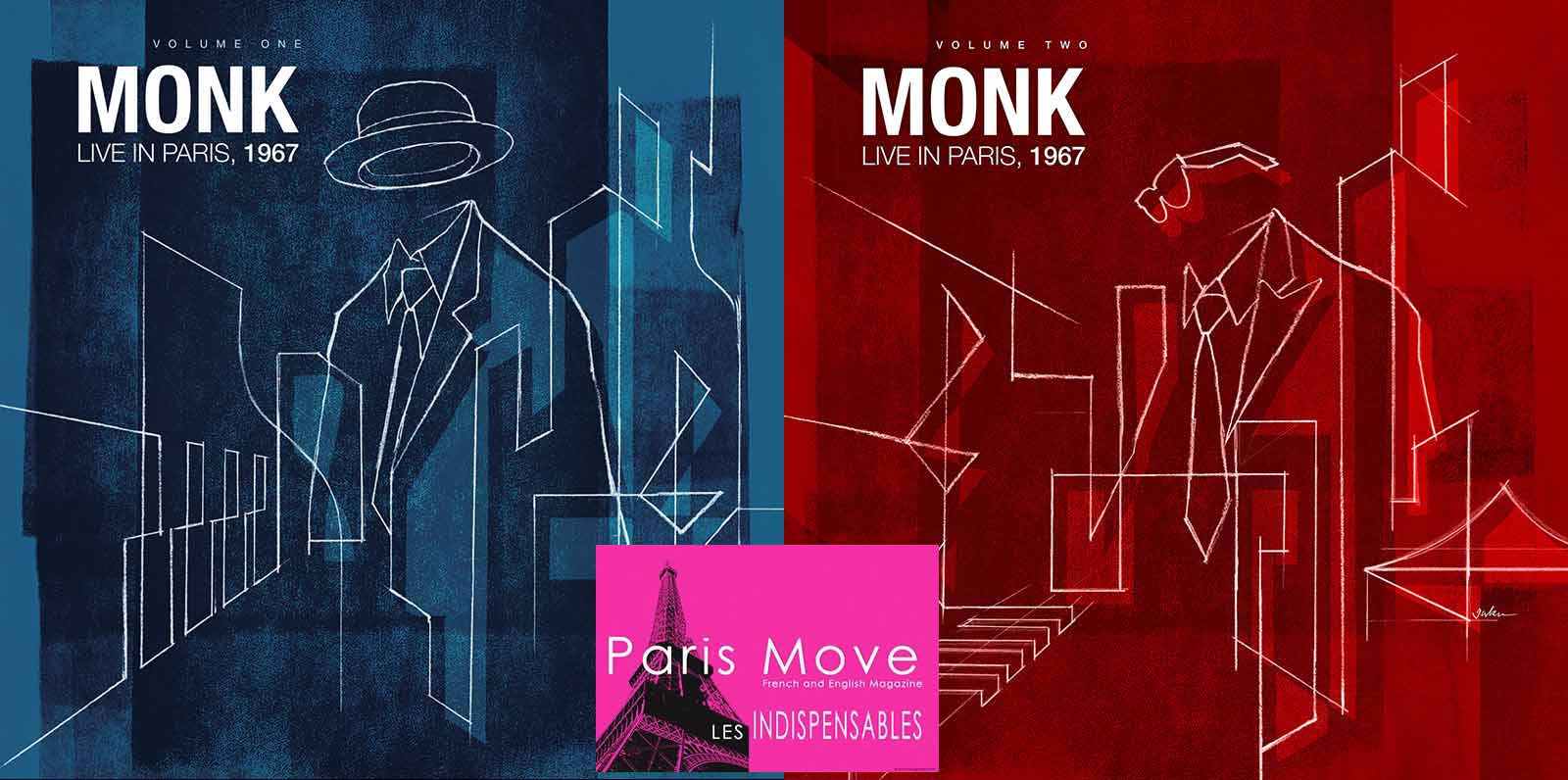
Volume 2 continues the story and is inseparable from the first volume, while developing its own atmosphere. The introduction is long, the presenter takes time to announce the program, and the audience responds with another tremendous burst of applause. You can almost picture the Salle Pleyel: the musicians under the powerful stage lights, working in the heat of the room, concentrating intensely on one another while the audience waits for the next musical encounter. Despite the physical demands of the performance, there is an unmistakable sense of happiness in the room. The musicians are not merely fulfilling an engagement. They are enjoying the privilege of being together and sharing their music with an audience that is completely receptive.
“Blue Monk” opens this part of the concert, and once again Monk demonstrates why his compositions have survived so powerfully. The piece is familiar, but familiarity never makes it static. Monk treats his own composition as a living structure rather than a fixed object. The melody remains recognizable, but the musicians are free to explore it, reshape it and challenge its expectations. That quality is at the heart of Monk’s enduring influence. His compositions have become standards not because they are closed musical statements, but because they remain open to interpretation. Other musicians can enter them and find something new.
The final moments of Volume 2 bring us to “Oska-T,” and there is something deeply moving about hearing the concert arrive at that point. It feels like the closing page of a chapter in musical history, although the music itself refuses to sound historical. That is one of Monk’s greatest achievements. He belongs unmistakably to his era, yet he never seems trapped by it. His music continues to speak because it was never entirely about the moment in which it was created.
Almost everything has been written about Monk. He has been described as a genius, a modernist, a revolutionary, an eccentric, a pioneer of bebop and one of the great composers of twentieth century American music. All of these descriptions contain some truth, but they can also become a problem. Jazz criticism sometimes becomes so determined to explain an artist that it forgets the simplest and most important thing: the music itself. Monk does not require an elaborate theory before he can be appreciated. You can simply listen and feel the music working on you.
That is particularly important when considering Monk’s place in France. During the decades after the Second World War, music was moving alongside society. The world was changing rapidly, and jazz became one of the places where that transformation could be heard. In Paris, musicians such as Monk represented a form of modernity that was difficult to ignore. They brought sounds that did not fit comfortably into the existing cultural order, and they offered audiences another way of thinking about individuality, creativity and freedom.
This freedom remains at the heart of jazz. But freedom in jazz has never meant the absence of rules. It means understanding the structure deeply enough to challenge it without destroying it. It means allowing tradition to become a starting point rather than a prison. Monk understood that perhaps better than almost anyone. He could return to the same compositions throughout his career without ever making them feel completely settled. He could repeat himself and still surprise us because repetition, in his hands, was never simply repetition.
That is why these Paris recordings deserve to be heard not merely as historical documents but as living performances. They allow us to hear Monk in the room, surrounded by musicians responding to him, pushing him and being pushed in return. We hear the audience reacting. We hear the physical effort of the players. We hear moments of tension and moments of release. Most importantly, we hear music being created rather than simply preserved.
The last known broadcast of this Paris material on France Musique was presented in 2014 on “France Musique la nuit… Quel Méli-Mélo, dis !” The program remains available as a podcast and provides another opportunity to hear this remarkable document, although the sound quality naturally cannot compare with the restored recordings presented on these two albums. You can listen to the original France Musique broadcast here.
Listening to Monk again today, it becomes increasingly difficult to think of him simply as a musician from the past. His music does not behave like history. It continues to ask questions. Where does composition end and improvisation begin? How much can a melody be transformed before it becomes something else? Can repetition become a form of freedom? Can a musician remain completely faithful to his own identity while continuing to surprise his audience?
More than half a century after that evening at the Salle Pleyel, we are still trying to answer those questions. Perhaps we always will. And perhaps that is the most fitting tribute to Thelonious Monk. He did not leave us music that provides all the answers. He left us music that refuses to stop asking questions, music that still sounds alive, still sounds restless and, remarkably, still sounds as though it has arrived a little earlier than the rest of us.
Thierry De Clemensat
Member at Jazz Journalists Association
USA correspondent for Paris-Move and ABS magazine
Editor in chief – Bayou Blue Radio, Bayou Blue News

PARIS-MOVE, August 29th, 2026
Follow PARIS-MOVE on X
::::::::::::::::::::::::
To buy Vol.1 – 180gr LP (Blue Vinyl)
Vol. 2 -> Available October 9, 2026, (digital & LP)
Musicians on Thelonious Monk – Live in Paris 1967, Vol. 2
Thelonious Monk — piano
Clark Terry — trumpet (“Blue Monk,” “Epistrophy Theme”)
Ray Copeland — trumpet
Phil Woods — alto saxophone
Johnny Griffin — tenor saxophone
Charlie Rouse — tenor saxophone
Jimmy Cleveland — trombone
Larry Gales — bass
Ben Riley — drums
Digital remastering by Rudy Van Gelder at Van Gelder Recording Studio, Englewood Cliffs, New Jersey, in 2002. Originally produced by Thelonious Monk Productions, Incorporated for Thelonious Records, Incorporated.
Tracklisting
- Artist Introduction — 2:00
- Blue Monk — 5:10
- Epistrophy Theme — 1:20
- Oska-T — 15:10
Musicians on Thelonious Monk – Live in Paris 1967, Vol. 1
Ray Copland, trumpet
Phil Woods, alto saxophone
Johnny Griffin, tenor saxophone
Charlie Rousse, tenor saxophone
Jimmy Cliveland, trombone
Thelonious Monk, piano
Larry Gales bass
Ben Riley, drums
Tracklisting
1 Intro
2 Epistrophy
3 Evidence
4 Ruby My Dear
5 We See