| Latin Jazz |
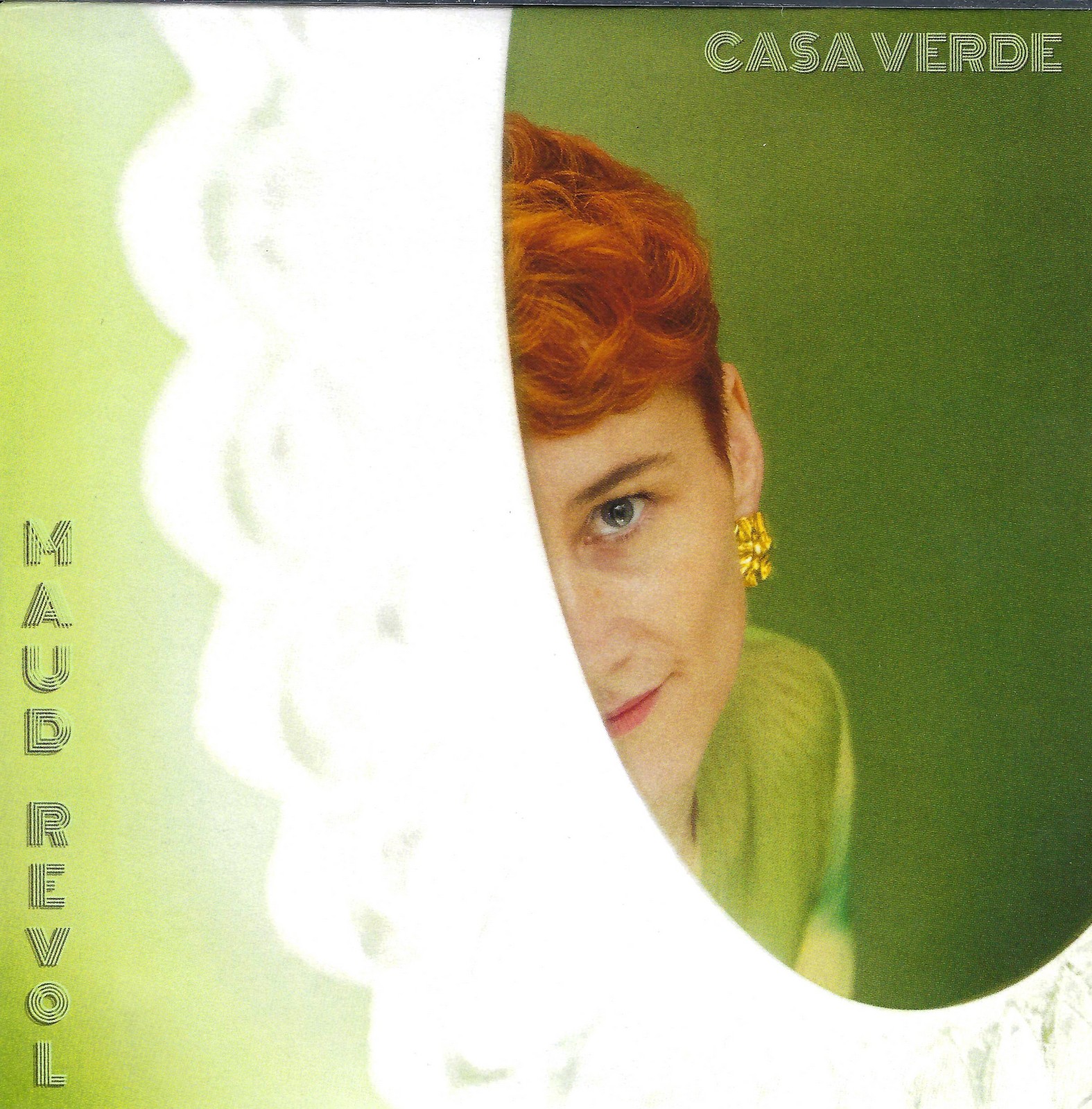
Casa Verde: Maud Revol turns a house in Recife into a musical home
Some artists take years to find their voice not because the voice isn’t there, but because it needs a place to settle into. For Marseille-based jazz vocalist Maud Revol, that place turned out to be a small green house in a favela south of Recife, Brazil, where she lived for a month and a half in late 2019. Casa Verde, her debut EP, is named directly after that house, and across its four tracks it plays like a travel journal set to music, one that moves fluently between French and Portuguese, between the Mediterranean and the Atlantic, between jazz, bossa nova, and chanson, without ever losing its own clear, unifying voice.
Maud has spent roughly a decade as a working jazz vocalist before turning to her own compositions, and that history matters to how Casa Verde sounds. Raised on scat singing and her mother’s samba-jazz records, she was already scatting by age fifteen, and her subsequent training reads like a genuine crash course in musical hybridity: choral singing from childhood, jam sessions in Montpellier as a teenager, classical vocal studies at the Chambéry conservatory (Poulenc, Ravel, Fauré), a year of volunteer work in Moldova that exposed her to Romica Puceanu’s gypsy melancholy and Russian romances, and, after settling in Marseille in 2013, years spent building duos, trios, and quartets around bossa nova, jazz standards, and instrumental jazz. Further study at Marseille’s IMFP and the Pierre Barbizet conservatory led to her Balacobaco project, selected for a showcase stage at the Marseille Jazz des Cinq Continents festival, and then, just before the pandemic, to three formative months in Brazil’s Nordeste region, where she deepened her Portuguese and formed a lasting friendship with guitarist Thiago Righi.
That trip is the clear hinge point of Maud Revol’s artistic identity, and it eventually led to Atlantica, a trio built around the idea of treating Fauré and Poulenc almost like jazz standards, blended with early-twentieth-century Brazilian repertoire. Casa Verde, released in May 2026, is the first proper distillation of everything that followed: an intimate, sun-warmed brand of jazz woven between the shores of the Nordeste and Mediterranean light, first previewed by the single “Première étoile” in February 2024, which already revealed a clear, affecting timbre and a compositional style deeply marked by both instrumental and Brazilian jazz.
The EP opens with “Malmousque”, named for a small fishing quarter of Marseille that Maud describes as a place of respite when the city grows too chaotic and overwhelming. Structured as a lyrical, contemplative jazz waltz, it’s a tribute to the Mediterranean Sea and the sun that tans skin and warms hearts, an unhurried, breathing opener that sets the EP’s unhurried emotional pace from the first bar.
The title track, “Casa Verde”, takes its name from that green-walled house in the Bode community outside Recife where Maud lived during her Brazilian stay, and it’s built to hold genuinely contrasting moods within a single song, an attempt to capture both the richness of the people she met there and the intensity of everything she felt during that stretch of time. It’s the EP’s emotional centre of gravity, and its shifting textures make the strongest case for why this particular house gave the whole project its name.
“Vanités” turns toward more difficult territory: a song built on refusal, naming directly what often goes unsaid, that violence dressed up as love is not love at all, and a firm decision to stop paying that particular price. Carried by a jazz-inflected milonga rhythm, it functions as an act of dignity as much as a love song, and it’s arguably the EP’s most quietly courageous track, trading warmth for something closer to resolve.
The closer, “Lila Blanc”, began life as a poem drawn from a short prose text tracing the stages of a romantic relationship before becoming a song. Inspired by a Debussy melody, it unfolds as a mysterious, elegant bossa nova, closing the EP on a note that’s genuinely poetic rather than simply pretty, a fitting end to a record that treats poetry and melody as inseparable throughout.
Maud Revol surrounds herself on Casa Verde with musicians whose own backgrounds mirror the EP’s cross-cultural instincts. Guitarist Luke Darlison, English-born and Marseille-based, trained in Leeds and at the Pierre Barbizet conservatory, brings fifteen years of experience spanning jazz and contemporary classical music. Pianist Yann Delaunay, born in New Caledonia and a winner of Sydney’s Sarah Waugh Prize, holds dual training in classical and jazz. Double bassist Willy Quiko, of Guadeloupean and Sicilian heritage, has performed with the London Symphony Orchestra alongside various Latin jazz and jazz-flamenco ensembles. And drummer Jérémi Martinez, also trained at Pierre Barbizet, has played across the French jazz circuit, including famous Paris jazz places like Baiser Salé and Sunset/Sunside, as well as stages in Finland, Belgium, and Scotland. It’s a genuinely well-travelled band, and that range shows up in how comfortably the EP moves between its various idioms without any single influence overwhelming the others.
Casa Verde is a genuinely appealing introduction to Maud Revol’s musical world: intimate, polyglot, unmistakably shaped by two very specific places she’s called home. What it captures most successfully is the emotional range her Brazilian sojourn opened up in her: joy and melancholy walking hand in hand, exactly as her own team has described the project.
There’s just one honest reservation, and it comes down to simple arithmetic rather than anything about the songwriting itself: four tracks, however well-crafted, is a short visit to a musical world this rich. “Casa Verde” and “Vanités” in particular suggest a songwriter with considerably more to say, and by the time “Lila Blanc” fades out, the EP ends just as it’s finding its full stride. It’s a shame, in the best sense, the kind of shame that comes only from genuinely wanting more, not less. With the depth of experience Revol has clearly built, both in Brazil and across a decade of French jazz stages, a full album of nine or ten tracks feels less like a hope than an inevitability, and on the strength of Casa Verde, it’s one very much worth waiting for.
Frankie Pfeiffer
Editor in chief – PARIS-MOVE
PARIS-MOVE, August 26th, 2026
Follow PARIS-MOVE on X
::::::::::::::::::::::::
Tracklisting:
01.Malmousque (5’49)
02.Casa Verde (4’57)
03.Vanités (5’36)
04.Lila Blanc (6’03)
Musiciens:
Maud Revol : chant
Yann Delaunay : piano
Luke Darlison : guitare
Willy Quiko : contrebasse
Jérémi Martinez : drums