| Jazz |
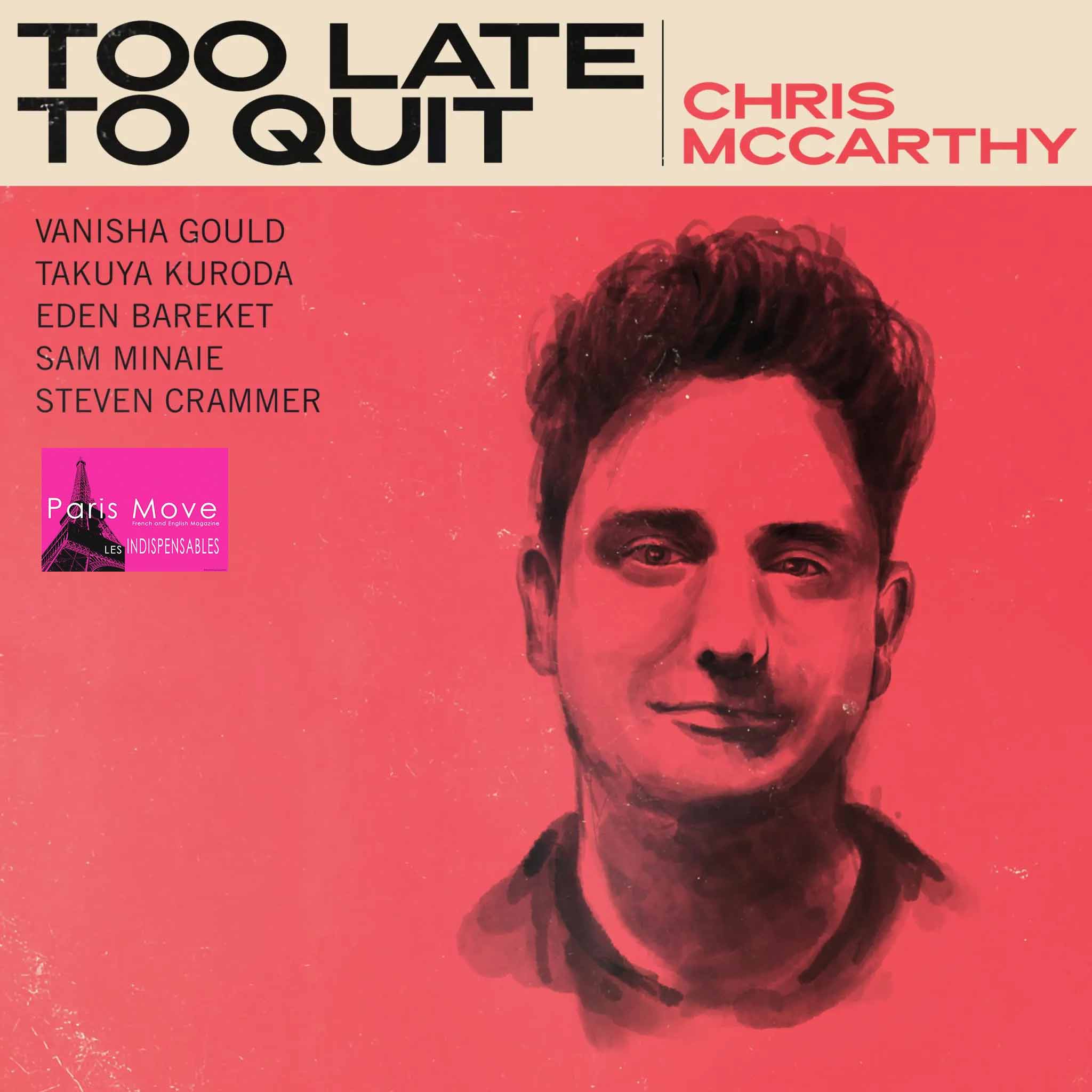
Summary: Chris McCarthy’s Too Late to Quit blends modern jazz, Great American Songbook traditions and New York experience, featuring the remarkable voice of Vanisha Gould in an elegant, deeply personal album.
Chris McCarthy’s Too Late to Quit Featuring Vanisha Gould: A New Jazz Standard
There are albums that seem to ask for a particular kind of attention. They are not necessarily difficult records, nor are they records that announce their importance from the first few seconds. Instead, they gradually establish a relationship with the listener, revealing small details with each return. Before long, the album has become part of a private routine, something heard at a particular hour, in a particular room, perhaps with headphones on and the rest of the world temporarily pushed aside. Chris McCarthy’s Too Late to Quit belongs to that increasingly rare category of records that can make listening feel personal again. It is the kind of album that initially makes you want to keep your discovery to yourself, even as you realize that keeping quiet would be a disservice to the musicians who made it.
The temptation, particularly for anyone already familiar with Vanisha Gould, would be to begin with her. That would be understandable. Gould has become one of the most distinctive young voices in contemporary jazz, a singer whose phrasing combines intelligence, warmth and an almost effortless sense of dramatic timing. Her presence on Too Late to Quit is therefore one of the album’s great attractions, especially for listeners who have been waiting for her next project. Yet McCarthy’s achievement is not simply that he has brought Gould into the studio. The deeper accomplishment is that he has created music that seems to understand exactly how her voice should inhabit a composition. She does not sit on top of these songs as a featured attraction. She is woven into them
That distinction matters because Too Late to Quit is ultimately a statement about Chris McCarthy himself, not merely a showcase for his collaborators. Over the past decade, he has become the kind of pianist who can move comfortably between the roles of leader, accompanist, composer and collaborator, a musician whose value is increasingly apparent precisely because he does not need to announce it. His playing has a natural sense of proportion, but his compositional voice is perhaps even more revealing. There is a delicacy to his writing, but it is never precious. There is sophistication, but very little self-consciousness. Most importantly, there is an obvious affection for the song itself, for melody and for the idea that a well-constructed tune can remain emotionally powerful without needing to disguise its craft
That affection for the song is at the center of Too Late to Quit. The album arrives as McCarthy marks ten years since moving to New York, and the record feels less like a conventional anniversary statement than an attempt to understand what those ten years have actually meant. New York has a way of turning ambition into endurance. Musicians arrive with enormous expectations, convinced that talent, persistence and a little luck will quickly lead them to the right stages and the right people. The reality is usually much less cinematic. There are countless late nights, long subway journeys, uncertain engagements and years spent building relationships one performance at a time. McCarthy’s album understands that reality, and its title captures the strange point at which persistence ceases to be a decision and becomes part of who you are.
The title also carries a sly connection to his earlier album Still Time to Quit. What might initially sound like a simple reversal becomes something much more personal. Ten years after arriving in New York, the question is no longer whether McCarthy should stay. He has already built a musical life there. The more interesting question is what he can do with everything he has learned. That is where the album’s relationship with the Great American Songbook becomes particularly compelling. McCarthy originally considered recording an album made entirely from standards, but eventually asked himself why he could not attempt to write standards of his own. It is the sort of question that sounds almost innocent until you consider the enormous tradition standing behind it.
The answer is heard throughout the record. McCarthy does not attempt to reproduce the past as a museum piece. Instead, he takes the language he has spent years studying and performing and uses it as a foundation for something contemporary. The melodies often have an immediately recognizable logic; the kind of shape that makes you wonder whether you have heard them somewhere before. Yet they remain unmistakably modern because the experiences behind them belong to McCarthy’s own life. The past is not being copied. It is being continued.
This is particularly effective on “Curtain Call” and “As If,” two songs that draw heavily on the spirit of the Great American Songbook while dealing with intensely personal material. McCarthy has described the songs as emerging from a period of romantic upheaval, and that emotional history gives them an unusual weight. What could easily have become autobiographical confession is instead transformed into songwriting. The melodies are clear, the forms are disciplined and the lyrics allow the emotional material to breathe without overwhelming the music. There is something very old fashioned about that restraint, and yet the result feels entirely contemporary.
Vanisha Gould is especially effective in this environment because she understands how much emotional information can exist inside a single phrase. Her relationship with McCarthy is not new, and that familiarity becomes one of the album’s quiet advantages. They have worked together extensively, recording several projects and developing the kind of musical understanding that cannot be created simply by bringing two talented people into a studio. McCarthy has spent more hours playing with Gould than with anyone else, and he wrote these songs with her voice in his imagination. His ambition was to create pieces that might sound like forgotten songs from the Great American Songbook, while allowing Gould’s particular musical personality to shape the writing from the beginning. That is a difficult balance, but the record makes it sound remarkably natural.
There is also a larger sense of trust running through the album. McCarthy’s quintet has been playing together regularly since 2023, and the difference between a collection of excellent musicians and a functioning ensemble is audible. The arrangements are carefully constructed, but they never seem to prevent spontaneous interaction. Trumpeter Takuya Kuroda, baritone saxophonist Eden Bareket, bassist Sam Minaie and drummer Steven Crammer sound less like hired specialists than members of an established musical conversation. Their familiarity allows McCarthy to write arrangements with enough detail to reward repeated listening while leaving enough space for the musicians to respond to one another in real time.
“Overnight Excess” makes that point particularly well. The piece begins with angular harmonic material and restless rhythms beneath a melody that initially seems smoother than the underlying structure would suggest. From there, the music begins to open up, giving Kuroda, Bareket and McCarthy room to push into more energetic improvisations. The composition carries an obvious New York reference, but it avoids the usual clichés. Rather than romanticizing the city, McCarthy captures the peculiar mixture of hope and exhaustion that comes with trying to establish a career there. The title itself suggests the joke: everyone arrives expecting overnight success, only to discover that the real New York education may involve an excess of overnight work. If “Overnight Excess” captures the hustle of the city, “Insomnia Waltz” reveals another dimension of McCarthy’s musical life. His continuing work with the Mark Morris Dance Group has required him to develop an extensive vocabulary of pieces in three quarter time, capable of accompanying movement while remaining sufficiently open to improvisation. That experience becomes the starting point for a composition that feels both practical and imaginative. The rhythm suggests physical movement throughout, and it is not difficult to imagine dancers responding to the music even when no choreography is present.
That quality of movement is one of the reasons Too Late to Quit feels larger than a collection of individual songs. There is a dramatic arc running through the album, even when the compositions are not explicitly connected by narrative. The record moves between memory, romance, frustration, humor and ambition, and the recurring sense of physical motion gives the whole project a theatrical quality. It is tempting to imagine what might happen if these compositions were eventually developed into something larger, perhaps a stage work or a contemporary musical built around the emotional and musical world McCarthy has created here. The idea may sound ambitious, but the foundations are already present. The music has characters, moods, conflict and a sense of progression.
“MTA (Much Too Angry)” may be the clearest expression of the album’s contemporary side. McCarthy takes one of the most universal experiences of New York life, the particular irritation of being underground and surrounded by the city’s machinery, and turns it into something dryly humorous and musically adventurous. The piece does not attempt to reproduce the city literally. Instead, it captures its emotional rhythm, the impatience, absurdity and constant movement that become part of daily life when you spend enough time there. It is one of the album’s most immediate compositions precisely because the emotion behind it is so recognizable. “Tuck and Draw” goes further back, returning to the funk and soul sounds that first attracted McCarthy to the Wurlitzer electric piano. The story behind the piece may be one of the most revealing details on the album. When McCarthy first moved to New York, he was willing to drag a heavy keyboard through the subway because he was obsessed with a particular Wurlitzer sound. That image of a young musician hauling equipment through the city in pursuit of a sound he could already hear in his head says more about the beginning of a musical career than any conventional biography could. The piece becomes a tribute not only to an instrument, but to the twenty-two-year-old musician who had not yet figured out where the city would take him.
The album’s closing piece, “Sonder,” completes that circle. McCarthy returns to the opening theme of the first project he released after arriving in New York, effectively allowing the musician of ten years ago to meet the musician he has become. It is a simple structural idea, but it carries emotional weight because the record has spent so much time examining the distance between those two versions of the same person. The closing gesture does not suggest that the journey is finished. If anything, it suggests that the first decade was only the opening chapter. That may be the most persuasive way to understand Too Late to Quit. It is not a nostalgic record about looking backward, and it is not a declaration that tradition must be abandoned in order for contemporary jazz to move forward. It is a record about inheritance. McCarthy has spent much of his life learning the language of the Great American Songbook, and now he is trying to speak that language with his own accent. The ambition is not to sound like the past. It is to create music that might eventually make the past larger.
For listeners, the best way to approach this album may therefore be to resist treating it as background music. Give it the kind of attention that the writing deserves. Listen first for the melodies, then return to the record and listen to the arrangements. Spend time with Gould’s phrasing and notice how differently a melody can feel when she changes the weight of a single word. Listen to the rhythm section beneath the horns, where much of the ensemble’s character is revealed. Then return to “Insomnia Waltz,” “MTA (Much Too Angry)” and “Overnight Excess” and listen specifically for the moments when the carefully designed compositions suddenly become open spaces for improvisation. The album becomes more rewarding when approached that way because its real pleasures are cumulative. The first listen gives you the songs. The second begins to reveal the architecture. Subsequent listens expose the small decisions that make the record feel so carefully considered without ever sounding overworked. That is where McCarthy’s greatest strength may lie. He knows that elegance in jazz does not require simplicity, and complexity does not require confusion.
There is also something reassuring about an artist choosing this particular moment in his career to ask whether he can write his own standards. The question is ambitious, but it is not arrogant. McCarthy has spent ten years listening, accompanying, performing, collaborating and learning how musicians build lives in a city that rarely makes the process easy. Too Late to Quit is what happens when all of that experience is allowed to become composition. And perhaps that is why the album is so difficult to leave alone. Each return seems to uncover another detail, another rhythmic turn, another harmonic color or another moment in which Gould and the quintet find exactly the right amount of space. What begins as an attractive collection of sophisticated jazz compositions gradually becomes something more intimate, a portrait of a musician trying to understand what he has built and what might come next.
By the end, it becomes clear that the title is more than a clever reference to an earlier album. Too Late to Quit is a statement about commitment, about staying with the music long enough for the music to change you. Chris McCarthy has spent a decade finding his place in New York, and he has emerged from that experience with something more valuable than a résumé. He has a musical language of his own, a group of musicians who understand that language, and a vocalist whose voice gives the songs an emotional dimension that could hardly be imagined without her. That combination is rare enough to deserve attention. More importantly, it deserves time. In a musical culture increasingly built around instant reactions, Too Late to Quit makes a quieter argument for patience. Listen once and you will hear a beautifully constructed jazz album. Listen again and you may begin to hear the decade behind it. Listen carefully enough, and you might even hear the beginning of whatever comes next.
Thierry De Clemensat
Member at Jazz Journalists Association
USA correspondent for Paris-Move and ABS magazine
Editor in chief – Bayou Blue Radio, Bayou Blue News

PARIS-MOVE, August 25th, 2026
Follow PARIS-MOVE on X
::::::::::::::::::::::::
Musicians:
Vanisha Gould, vocals (1.2.4.6.7)
Takia Kuroda, trumpet
Eden Bareket, baritone saxophone
Chris McCarty (piano, Wurlitzer (5)
Sam Minaie, bass
Steven Crammer, drums
Track Listing :
Curtain Call (Featuring Vanisha Gould)
As If (Featuring Vanisha Gould)
Overnight Excess (Featuring Takuya Kuroda & Eden Bareket)
Insomnia Waltz (Featuring Vanisha Gould)
Tuck and Draw (Featuring Takuya Kuroda & Eden Bareket)
MTA (Much Too Angry) (Featuring Vanisha Gould)
After All (Featuring Vanisha Gould)
Sonder (Featuring Takuya Kuroda & Eden Bareket)
All music and Lyrics by Chris McCarthy