| Jazz |
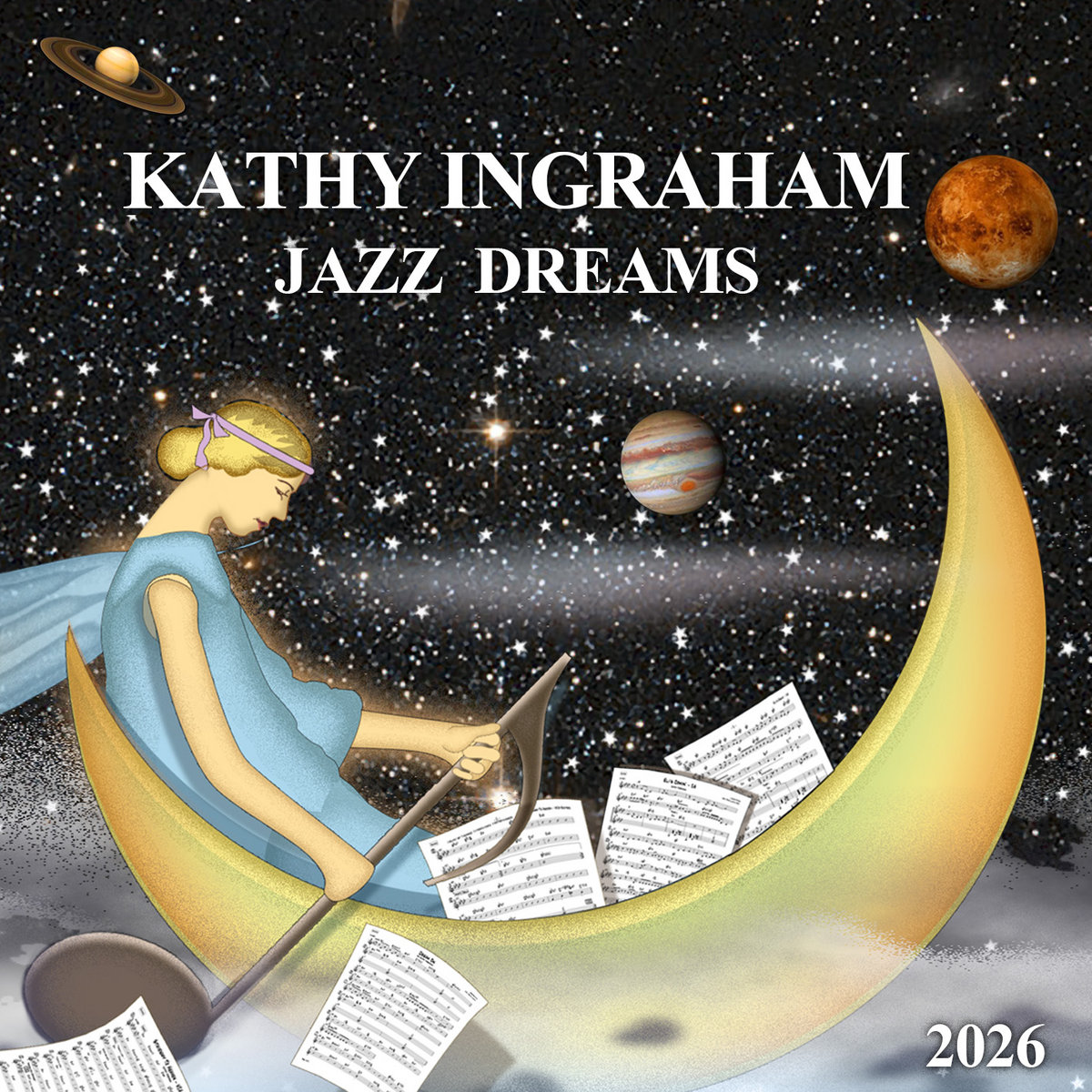
Kathy Ingraham – Jazz Dreams: When Rock Classics Enter a New Jazz Dimension
What happens when some of the most recognizable songs in rock history are invited into the world of jazz? If the answer is Jazz Dreams, the result is not a conventional crossover album, nor a collection of predictable rearrangements. Instead, Kathy Ingraham has created something much more intriguing: a record where familiar melodies are taken apart, reimagined and allowed to reveal personalities that may have been hiding inside them all along.
Released in March 2026, Jazz Dreams is perhaps Ingraham’s most adventurous statement yet. Across seven tracks, she applies a jazz sensibility to songs associated with Aerosmith, Led Zeppelin, The Rolling Stones, Laura Nyro and the traditional repertoire, while also revisiting one of her own compositions. The fascinating part is not simply hearing these songs played differently, it is discovering how naturally they can inhabit an entirely new musical environment.
The album’s origins are wonderfully unexpected. Ingraham traces the initial idea back to the 1943 Oscar-winning short film Heavenly Music, whose story imagines great classical composers being challenged to recognize the possibilities of jazz. The film’s underlying proposition, that a great melody can transcend the genre in which it was originally created, became the philosophical starting point for Jazz Dreams.
Then came a second spark. Watching a performance of Aerosmith’s Dream On by Steven Tyler at Howard Stern’s birthday celebration, Ingraham heard a brief jazz-inflected vocal passage in the middle of the song. Those few measures were enough to trigger an idea: what if contemporary songs could be treated as jazz material? The seven tracks on Jazz Dreams are the answer. And what an answer it is.
The album opens with Dream On, and it is an inspired choice. Rather than attempting to reproduce the dramatic rock intensity of Aerosmith’s original, Ingraham searches for the song’s underlying emotional architecture. The familiar melody becomes more spacious, more intimate and more vulnerable. This is one of the album’s great strengths: Ingraham does not try to make rock songs sound like jazz simply by adding jazz musicians. She searches for the jazz already contained within them.
That approach becomes particularly fascinating on House Of The Rising Sun. A song with an extraordinarily long and complicated history, subsequently immortalized for a new generation by Eric Burdon & The Animals, is given an interpretation that emphasizes its darker, more contemplative character. Evan Christopher’s clarinet is a perfect addition, bringing with it a connection to the expressive tradition of New Orleans while giving the performance a distinctly individual colour. Christopher is not simply a guest appearance. His clarinet becomes part of the storytelling, responding to Ingraham’s voice and helping transform the song into something closer to an intimate nocturnal meditation.
Then comes Little Things Redux, a particularly meaningful inclusion because the song is Ingraham’s own. Originally released as a retro-styled pop song and subsequently featured in the 2019 Johnny Depp film The Professor, it is here brought into the musical language that has become central to her recent work. The transformation demonstrates that Ingraham is not only interested in borrowing from other songwriters, but she is also equally willing to reconsider her own material, hearing it from another angle and giving it a new life.
Melusina takes the journey in a more personal direction. The song is connected to Ingraham’s own ancestry, and that autobiographical dimension gives the track a special place within the album. It is a reminder that Jazz Dreams is ultimately about more than genre. Behind the experiments with familiar songs is a musician exploring memory, identity and the emotional associations that music carries.
The Rolling Stones’ Ruby Tuesday is another inspired choice. Its melancholy, graceful melody lends itself remarkably well to jazz, and Ingraham finds the space inside the composition rather than forcing it into a predetermined arrangement. Elliott Randall’s guitar adds another layer of colour, helping create an interpretation that feels simultaneously familiar and newly discovered.
Then comes Laura Nyro’s Eli’s Comin’, one of the album’s most striking transformations. Nyro’s music has always occupied an interesting territory between pop, soul, jazz and sophisticated songwriting, making her an especially natural candidate for Ingraham’s project. Here, the song’s melodic identity remains recognizable while the arrangement opens it toward a more exploratory sonic world.
The album concludes with the formidable challenge of Stairway To Heaven. Few songs in popular music are as heavily associated with their original recording as Led Zeppelin’s epic. Yet Ingraham does not attempt to compete with it. Instead, she strips away expectations and approaches the composition as a piece of songwriting. The resulting performance is an excellent illustration of the album’s entire philosophy. Once the original rock setting is removed, the melody begins to reveal different possibilities. William Galison’s harmonica adds an especially distinctive colour, while Elliott Randall’s guitar contributes another important link between the original song and its new incarnation. Across the album, the musicians deserve enormous credit for making these transformations sound organic.
The arrangements, credited to Kathy Ingraham and Pete Levin, provide enough structure to make the songs recognizable while leaving room for the musicians to breathe. Levin’s contribution is particularly important. A sophisticated keyboardist and composer whose career has included a long association with the Gil Evans Orchestra as well as work with an extraordinary range of artists, he brings an understanding of both orchestral colour and jazz improvisation to the project.
The rest of the ensemble is equally impressive: Randy Brecker needs little introduction: a seven-time Grammy Award winner and one of the most influential trumpet and flugelhorn players of modern jazz, he has spent decades moving between jazz, rock, R&B and other musical territories. His presence on Dream On gives the album an immediate connection to the highest levels of contemporary jazz musicianship.
Joel Rosenblatt’s drumming provides another essential ingredient. Known especially for his work with Spyro Gyra and for collaborations across jazz, fusion and contemporary music, he brings rhythmic flexibility without overwhelming the songs.
And then there is Elliott Randall. Best known to many listeners for the unforgettable guitar work on Steely Dan’s Reelin’ in the Years, Randall has had an extraordinarily varied career, working with artists ranging from The Doobie Brothers and Carly Simon to Laura Nyro and the Blues Brothers. His participation here is particularly appropriate because his playing has always existed comfortably between rock, jazz and sophisticated popular music.
British guitarist Matt Wensor adds another generation to this musical dialogue, while Evan Christopher brings the unmistakable expressive possibilities of the New Orleans clarinet tradition. William Galison’s harmonica, meanwhile, provides some of the album’s most unusual tonal colours. Lily Del Rosso’s backing vocals complete the ensemble with an additional layer of warmth. The result is a fantastic record populated by top-class musicians, and listening is perhaps the key word for understanding Jazz Dreams.
Kathy Ingraham describes jazz as a conversation: musicians give, receive, listen and respond. That philosophy is audible throughout the album. There are space and love between the notes. There is room for the all the musicians to say something and nothing feels excessively crowded or mechanically arranged. Here, the jazz language is not an ornament added to rock songs. It is the mechanism through which Ingraham discovers new meanings in them.
Her own background helps explain this instinct. Originally from a small coastal town in Maine and now based in New York, Ingraham grew up surrounded by music and began singing jazz professionally as a teenager, performing during cocktail hours at a restaurant on the Portland waterfront. Her later albums have continued to explore the meeting point between original songwriting, jazz and popular music. But there is something particularly attractive about the way she describes her creative process as she does not present songwriting as an entirely intellectual exercise. Inspiration can arrive while driving, walking, shopping, doing household chores or simply living an ordinary day. When the unexpected idea appears, she follows it. That spirit of openness is everywhere on Jazz Dreams. It feels like an artist following her curiosity and inviting us along for the journey.
You do not need to be a jazz specialist to enjoy this beautiful album as you do not need to know the history (and music) of Led Zeppelin, Aerosmith or The Rolling Stones and you do not need to have heard the original versions. If you know them, however, there is an additional enormous pleasure: recognition becomes part of the listening experience. A melody suddenly appears from somewhere unexpected, and you realize that the song you thought you knew has acquired another personality. That is the real magic of this album. Kathy Ingraham has not simply transformed famous songs. She has demonstrated that musical identity is never as fixed as we imagine. A great melody can survive a change of rhythm, instrumentation, genre, atmosphere and generation. It can cross borders and emerge on the other side with its essential character intact.
Jazz Dreams is therefore both a celebration of songwriting and an argument for musical freedom. It is adventurous without being obscure, sophisticated without becoming distant, and deeply rooted in jazz without being imprisoned by jazz conventions. Most importantly, it is GREAT fun. There is pleasure in hearing songs reinvented, and there is genuine excitement in the musicians’ willingness to explore them. For listeners discovering Kathy Ingraham for the first time, Jazz Dreams is an excellent introduction to an artist whose musical imagination refuses to stay in one place. For those already familiar with her previous work, it represents a fascinating new chapter. And for anyone who believes that jazz and rock belong to separate worlds, this album offers a gentle and very convincing counterargument. Sometimes all it takes is a great song, an open mind, and a group of musicians willing to dream differently. Highly recommended. A must!
Frankie Pfeiffer
Editor in chief – PARIS-MOVE
PARIS-MOVE, August 23rd, 2026
Follow PARIS-MOVE on X
::::::::::::::::::::::::
Website
Tracklisting:
- Dream On (Feat. Randy Brecker & Elliott Randall) 05:20
- House Of The Rising Sun (Feat. Evan Christopher) 05:48
- Little Things Redux 04:30
- Melusina (Feat. Elliott Randall & Matt Wensor) 03:19
- Ruby Tuesday (Feat. Elliott Randall) 04:58
- Eli’s Comin’ 05:14
- Stairway To Heaven (Feat. William Galison & Elliott Randall) 08:02
Musicians:
Pete Levin, Piano, Strings & Bass
Randy Brecker, Flugelhorn
Joel Rosenblatt, Drums
Elliott Randall, Guitar
Matt Wensor, Guitar
Evan Christopher, Clarinet
William Galison, Harmonica
Lily Del Rosso, backing vocals
Engineer: Kathy Ingraham
Producer: Kathy Ingraham
Artwork: Richard Del Rosso
Album Title “Jazz Dreams” Nancy Richards-Stower, Esq.