| World Jazz |
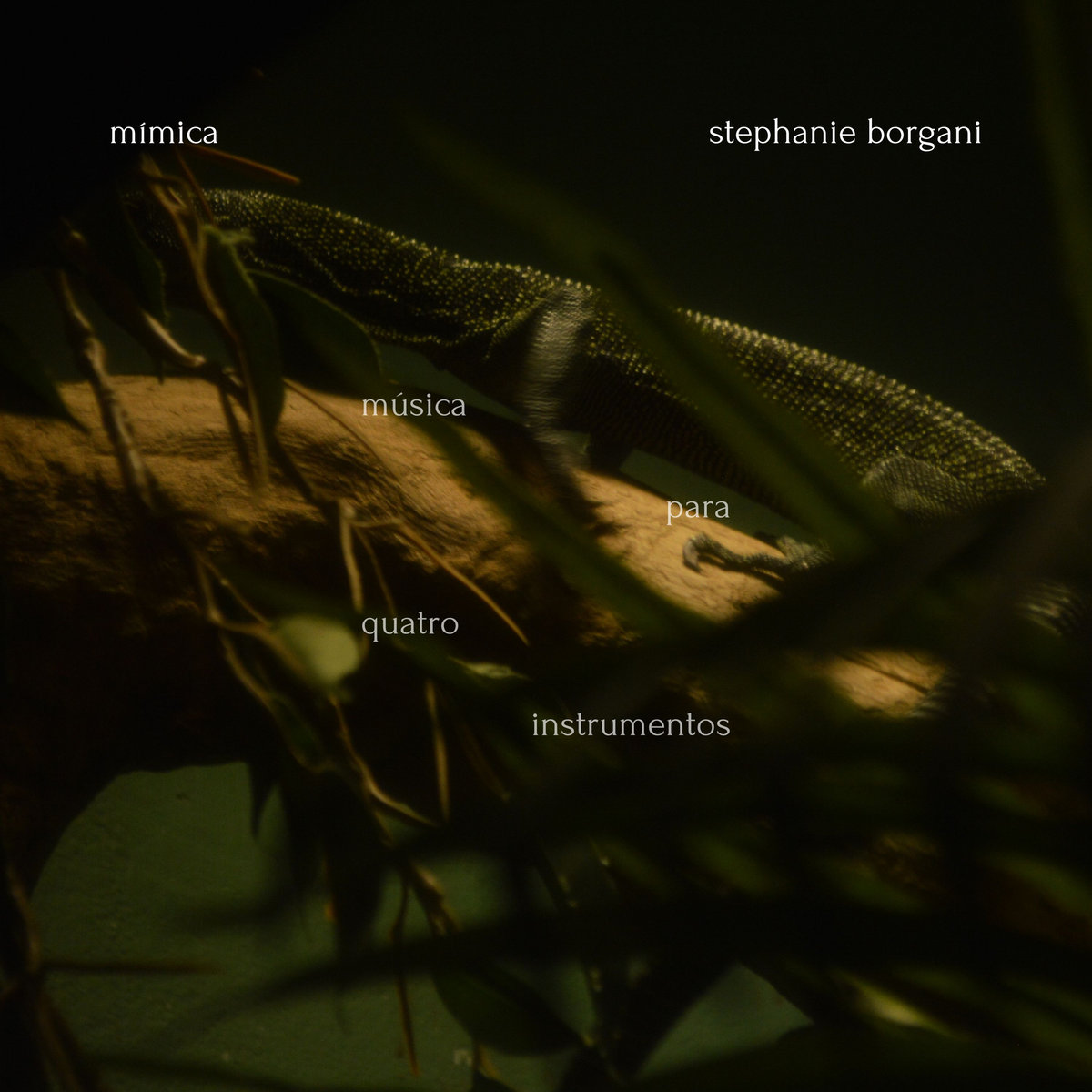
Mímica – Música para quatro instrumentos: When Voices Become Instruments
Built around an extraordinary combination of two wordless voices and two saxophones, the Mímica – Música para quatro instrumentos debut album by the São Paulo-based Mímica Quarteto creates a musical language that is at once intimate, playful, sophisticated and surprisingly accessible. Led by vocalist and composer Stephanie Borgani, with Marina Marchi on voice and Lucas Sales and Marlon Cordeiro on alto and tenor saxophones, Mímica explores what happens when the human voice stops carrying words and becomes, instead, another instrumental colour. The result is lovely to listen to, and much more adventurous than the apparent simplicity of its four-instrument format might suggest.
The album grew out of a 2024 commissioned performance at São Paulo’s Centro da Terra, where Borgani developed the idea of investigating the similarities between the human voice and wind instruments. The concept is beautifully summed up by the group’s name: Mímica, or “mimicry”. In nature, different species can evolve to resemble one another, and here, voices and saxophones imitate, camouflage and eventually merge with each other. The result is a fascinating sonic game in which it can sometimes become difficult to tell which sounds come from flesh and which from metal. This is not merely a clever conceptual exercise. The music works because the concept is transformed into something genuinely expressive. It is both astonishing and captivating!
Borgani’s compositions draw on several musical traditions (Brazilian instrumental music, contemporary classical music, jazz and free improvisation) but Música para quatro instrumentos never sounds like a stylistic collage. Instead, these influences have been absorbed into a remarkably coherent personal language. Originality can sometimes, or even often, surprise, but here, not only does it surprise, it draws us in, bewitches us, and and takes us over.
The opening Montagem immediately establishes the quartet’s distinctive identity. Rather than presenting voice and saxophone as separate sections of an ensemble, Borgani treats the four musicians almost as a single organism. Phrases are passed from one performer to another, timbres overlap, and melodic fragments appear to emerge simultaneously from several sources. It is this constant ambiguity that makes the album so fascinating.
On Brincadeira, the playful character suggested by the title becomes particularly evident. Yet there is considerable compositional sophistication beneath the apparent spontaneity. The voices use articulation, breath, pitch and timbre as musical materials. The saxophones answer, imitate and sometimes almost disguise themselves as human voices.
The two interludes are especially revealing. Primeiro Interlúdio – Interlúdio Saxofones temporarily places the saxophones in the foreground, while Segundo Interlúdio – Interlúdio Vozes reverses the perspective. These pieces make the listener suddenly aware of how much the quartet depends upon the fascinating similarity between the two families of sound. The effect is almost theatrical, even when nothing is being “acted out”. One instrument seems to speak, another responds, a vocal gesture becomes a saxophone phrase, a breath becomes rhythm, a sustained tone acquires an almost physical presence. This is precisely where Stephanie Borgani’s work as a vocalist and composer becomes so compelling.
Stephanie Borgani has made the wordless voice a central element of her artistic identity, working at the intersection of Brazilian instrumental music and contemporary jazz while exploring new possibilities for the voice. Her background includes studies at Columbia University and the New England Conservatory, as well as collaborations with musicians including Maria Schneider and Antonio Sánchez. Her work has also been recognized through awards including the 2025 Eduardo Álvares Composition Award. But Mímica is not a project designed simply to demonstrate vocal technique. Borgani’s voice is deliberately integrated into the ensemble. She does not constantly demand attention, instead, she listens, responds and blends. That sense of collective musicianship is one of the album’s greatest strengths.
She is beautifully matched by Marina Marchi, whose own experience with instrumental voice, Brazilian music, jazz and improvisation makes her an ideal partner for Borgani. Marchi has worked extensively as a vocalist, guitarist, composer and educator, and has been part of projects that deliberately explore the voice without words. She has also collaborated with musicians such as Eric Clapton and Daniel Santiago. The two voices therefore do much more than sing together.They create a surprising and essential additional instrumental section.
The same is true of Lucas Sales and Marlon Cordeiro. Lucas brings a particularly broad experience of Brazilian instrumental music and jazz to the quartet. A graduate of EMESP Tom Jobim, he has performed with artists including Monica Salmaso, Nailor Proveta, Ted Nash, Vanessa Moreno, Zélia Duncan and Leila Pinheiro. His alto saxophone provides an extraordinary range of colours, from crystalline and delicate to warm and almost vocal. Marlon’s tenor provides the complementary darker register, giving the quartet additional depth and body. Together, the two saxophones create an extraordinarily flexible pair of voices, capable of sounding like a miniature horn section one moment and like two human singers the next.
The music becomes particularly captivating on Trave, where the quartet’s carefully balanced textures demonstrate just how much can be achieved without drums, bass, piano or any other conventional harmonic instrument. This absence is important. There is no conventional rhythm section to tell the listener where the music “should” go. Instead, rhythm emerges from breathing, articulation, repetition, silence and interaction. Harmony is suggested through the overlapping of four melodic lines. The music breathes rather than marches.
Colorida offers another delightful example of this approach, with its changing colours and constantly shifting relationships between the four performers. Meanwhile, Coro brings the voices and saxophones together in an especially convincing ensemble texture. And then comes Quieto, Por Favor (Coda), a wonderfully suggestive title for the album’s final statement. After all the movement, interplay and sonic camouflage of the preceding tracks, the coda leaves the listener with the feeling that the four musicians have gradually taught us how to hear them differently.
The recording itself reinforces the intimacy of the project. Recorded in a single room at Estúdio Arsis in São Paulo, the album captures the quartet as a genuine chamber ensemble. There is an appealing sense of physical proximity: breaths, attacks, resonances and subtle changes of timbre all remain part of the musical experience. That chamber-music quality is perhaps the most important key to Música para quatro instrumentos. Although the album draws energy from jazz and improvisation, it is fundamentally about listening. Each musician has to respond to the others constantly. There is no place to hide, and the resulting performances feel alert, spontaneous and alive.
What makes this album especially successful is that its experimental nature never becomes intimidating. Listeners who love contemporary classical music will find fascinating compositional ideas. Jazz listeners will appreciate the freedom, interaction and improvisational spirit. Admirers of Brazilian music will recognize an unmistakable connection with its instrumental traditions. Fans of vocal music will be fascinated by the extraordinary possibilities of the wordless voice. And listeners who do not normally listen to any of these genres may be the ones who are most pleasantly surprised. Because Mímica – Música para quatro instrumentos is, above all, beautiful music.
It is curious without being pretentious, experimental without being inaccessible, sophisticated without losing its warmth. The quartet has created something that can be appreciated intellectually, but which never requires the listener to understand the concept before enjoying the sound.
The idea of “mimicry” becomes increasingly powerful as the album progresses. At first, we hear voices and saxophones. Then we begin to notice similarities between them. Eventually, the distinction becomes less important. What matters is the collective sound: four musicians breathing, articulating, imitating and transforming one another. That is an impressive achievement for a debut album.
Stephanie Borgani has also demonstrated something particularly exciting as a composer: she understands that originality does not necessarily require abandoning tradition. Instead, she takes familiar materials, the human voice, the saxophone, Brazilian musical language, jazz improvisation, chamber music, and puts them into a new relationship. Música para quatro instrumentos is therefore an album about connection: between voice and instrument, composition and improvisation, Brazilian musical heritage and contemporary experimentation, human breath and metallic resonance. Most importantly, it is an album that invites repeated listening. Every return reveals another exchange between the four musicians, another timbral resemblance, another beautifully constructed transition.
What did Billie Holiday once say? “I don’t feel like I’m singing. I feel like I am playing a horn”. That is exactly what Stephanie might say.
Mímica’s debut album is original, intelligent, playful and genuinely enchanting. It introduces a quartet with a distinctive identity and announces Stephanie Borgani as a composer with a remarkably clear artistic vision. For anyone curious about what contemporary music can sound like when the boundaries between singer and instrumentalist begin to disappear, this is an album not to miss. Listen to the voices, listen to the saxophones, then listen again and see if you can still tell which is which.
Frankie Pfeiffer
Editor in chief – PARIS-MOVE
PARIS-MOVE, August 22nd, 2026
Follow PARIS-MOVE on X
::::::::::::::::::::::::
Tracklisting:
- Montagem 05:56
- Brincadeira 04:48
- Primeiro Interlúdio – Interlúdio Saxofones 04:50
- Trave 03:105.
- (Meditacao) De Se Esperar/ Segundo Interlúdio – Interlúdio Vozes 06:19
- Coro 02:51
- Colorida 05:27
- Quieto, Por Favor (Coda) 04:10
All compositions by Stephanie Borgani
Personnel:
Voice 1: Stephanie Borgani
Voice 2: Marina Marchi
Alto Sax: Lucas Sales
Tenor Sax: Marlon Cordeiro
Mixed and mastered by Adonias Souza, Jr
Recorded at Estúdio Arsis in São Paulo on January 18, 2026
Produced by Stephanie Borgani
Band photos by Camilla Loreta/Filme d’Água
Album art and design by Stephanie Borgani