| Jazz |
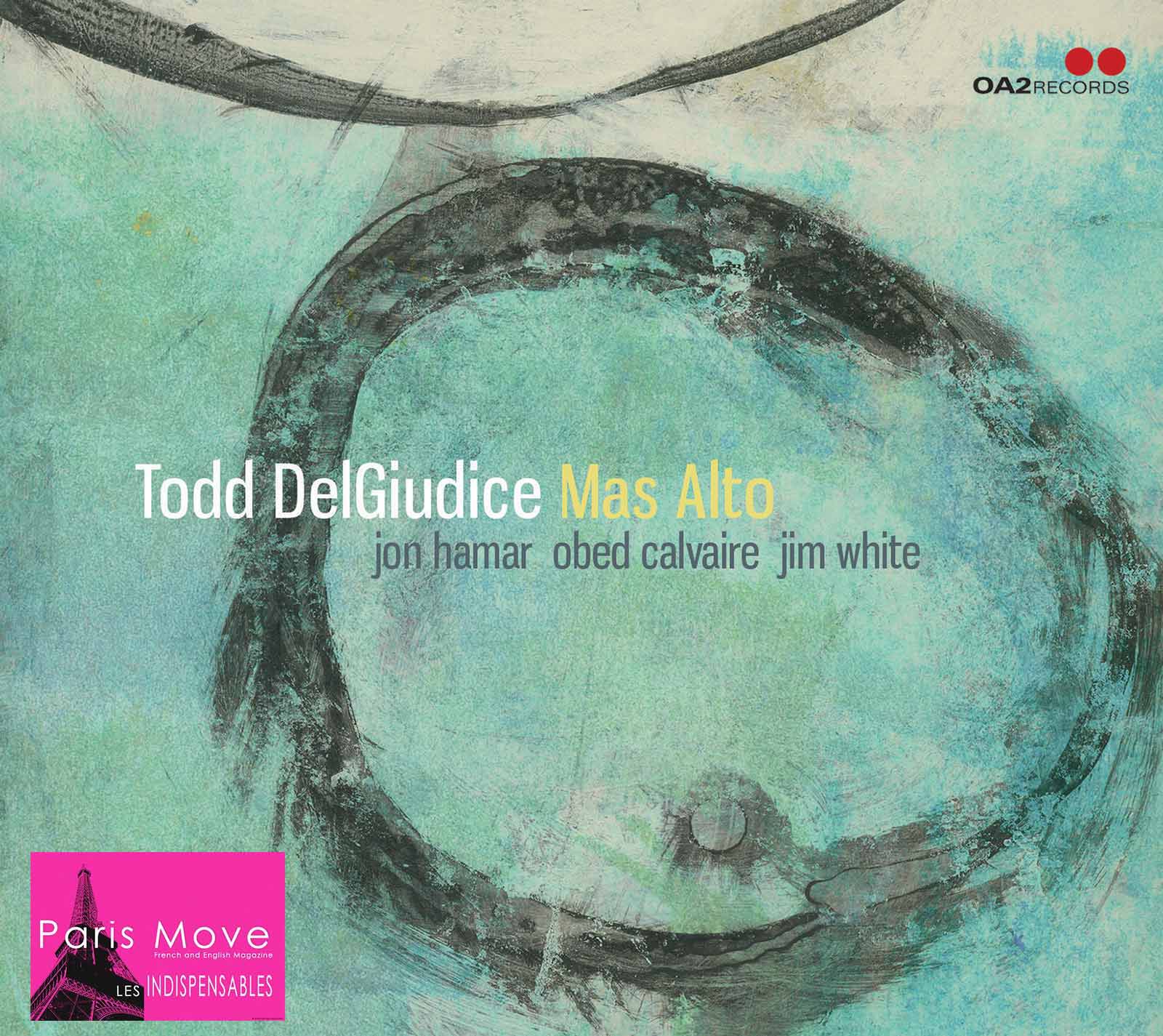
Summary: Todd DelGiudice’s Mas Alto brings alto saxophone, bass and drums together in a deeply interactive acoustic jazz album built on improvisation, rhythm and musical discovery.
Todd DelGiudice’s Mas Alto: An Alto Saxophone Trio That Rewards Deep Listening
By late afternoon, the heat has become almost physical, the kind of heat that settles over the city and seems determined to stay there. Inside the studio, the fans are working overtime, pushing around air that is only marginally cooler, while bottles of water become part of the recording equipment. It is not exactly the ideal setting for critical listening, but then Todd DelGiudice’s Mas Alto begins, and somehow the heat becomes less important. The album opens with DelGiudice alone, without a grand entrance or any attempt to announce the arrival of a major statement. There is simply the alto saxophone, exposed and remarkably economical, establishing a language before anyone else enters the conversation. When Jon Hamar’s bass arrives, its sound is round, precise and beautifully grounded, giving the music a new center of gravity, and when Jim White joins them, what might have been a conventional trio begins to feel much more like a conversation between three musicians who are listening as carefully as they are playing.
That distinction matters because Mas Alto is not particularly interested in demonstrating how much these musicians can play, even though they clearly have the technique to do so. What interests them is what can happen when technique is placed at the service of an idea. The rhythms often arrive before the melodies, and at times melody seems almost incidental, a theme offered as a starting point rather than a destination. A phrase appears, the musicians examine it, turn it over, stretch it and sometimes leave it behind altogether. The music is not moving toward a predetermined conclusion so much as discovering its own direction as it goes, which gives the performances an appealing sense of risk without ever allowing them to lose their structural discipline.
Two pieces have already gone by, far too quickly for my taste, and yet “Ablution” and “P.O.I.” have taken up roughly twelve minutes of listening, although they seem to have lasted considerably less. That is usually a good sign, because there are records that make you conscious of time and others that make you forget it, and Mas Alto belongs firmly to the second category. There is plenty here to listen to, but there is also plenty to question. What is the melody doing at a particular moment? Why does the rhythm suddenly become the dominant voice? Why does a phrase that initially sounds almost familiar become something different after a few measures? Those questions are not obstacles to enjoying the album. They are part of the pleasure, particularly for listeners who enjoy music that continues to reveal itself after the first impression has passed.
I have always been drawn to musicians who put substance before appearance, artists who do not seem particularly concerned with making the work look important because they are too busy making it meaningful. DelGiudice belongs to that category. His music does not come with a flashing sign telling you where the interesting part begins, and there is no obvious attempt to seduce the listener through easy gestures. Instead, the music develops almost quietly, with ideas being tested, expanded and reconsidered until their purpose becomes clearer. The more closely you listen, the more apparent the architecture becomes, and that architecture is never imposed at the expense of spontaneity.
The title Mas Alto contains a particularly appropriate ambiguity. In Spanish, it means “higher,” suggesting movement, aspiration and the continuing search for artistic development, but it can also be heard as “more alto,” an almost mischievous celebration of the instrument itself. In a musical world where the tenor saxophone has often occupied the center of the jazz conversation, DelGiudice puts the alto firmly in the foreground and gives it room to speak in its own voice. The result is not a nostalgic return to an earlier sound, even though the album clearly understands the history from which it emerges. Instead, the title describes both an instrument and an artistic attitude, a desire to push the music upward while remaining deeply conscious of what came before.
That connection to jazz history is certainly present, and listeners familiar with post bop will recognize some of the vocabulary, but calling Mas Alto a post bop record and leaving it there would miss much of what makes it interesting. The history is present, but DelGiudice does not appear to be standing inside it. He is using it as material, taking elements that have already been explored by generations of musicians and asking what can still be said with them. The music therefore feels informed by tradition without becoming dependent on it, and that distinction becomes increasingly important as the album unfolds.
Much of that confidence comes from the people with whom DelGiudice has chosen to work, particularly Jon Hamar. The dialogue between the saxophonist and bassist is one of the album’s most compelling features, and their musical relationship has developed over years. It shows in the way they seem to know when to leave space, when to challenge one another and when a musical idea has reached the point where it needs to be abandoned. There is familiarity between them, but not complacency, and that difference gives their exchanges a sense of alertness that is easy to hear.
Jim White is equally important because he does not simply provide a rhythmic foundation. He gives the other musicians somewhere to go, pushing a phrase forward, interrupting an expected resolution or subtly altering the balance of a passage without making the intervention feel like an interruption. There is an element of playfulness in his drumming that keeps the music from becoming overly cerebral, and his ability to respond rather than simply accompany allows the trio to sound less like three musicians taking turns and more like three people involved in the same thought.
DelGiudice’s background helps explain the discipline behind this approach. A woodwind instrumentalist, composer and educator, he grew up in South Florida and studied clarinet with Richard Hancock of the Florida Philharmonic and saxophone with Gary Keller at the University of Miami. At Miami, he earned both his Bachelor of Music and Master of Music, studying saxophone with Keller and Gary Campbell and clarinet with William Klinger and Margaret Donahue. That education gave him an unusually broad technical foundation, but formal training alone does not explain the character of his playing, because the more important question is what an artist does after the lessons are over.
DelGiudice went on to perform with an extraordinary range of musicians, including Maria Schneider, John Fedchock, Ingrid Jensen, Donny McCaslin, Rich Perry, Rick Margitza and Jon Gordon. Those collaborations matter because they represent very different approaches to rhythm, composition, improvisation and ensemble playing, and an artist who spends years moving through that many musical environments inevitably absorbs some of their contradictions. The interesting musicians are the ones who eventually turn those contradictions into a language of their own, and DelGiudice appears to be doing exactly that.
His work also stretches beyond the usual boundaries of a jazz career. He has maintained a relationship with classical music while continuing to work as a performer, composer and educator, and his playing can be heard in a variety of settings, including projects associated with Steve Owen, Jon Hamar and the Free Range Saxophone Quartet. The result is a musical identity that does not depend on a single genre, which may also explain why Mas Alto feels particularly convincing as an acoustic recording. There is nowhere to hide in this setting, because there is no electronic surface to distract from the interaction and no production trick capable of disguising a weak idea. The musicians have to listen to one another, and the record makes clear that listening is one of the central elements of DelGiudice’s approach.
I suspect that Mas Alto may be even more revealing live, because watching these musicians interact with an audience capable of listening closely would add another dimension to the experience. There is something increasingly rare about a concert in which nobody feels compelled to ask whether the music is “really jazz,” because the question seems beside the point here. The music is doing what good jazz has always done: taking what exists, questioning it and seeing what might happen next, without requiring the listener to settle the matter with a label.
That is also where the relationship with OA2 becomes particularly interesting. The label has provided a recurring home for DelGiudice’s work, and the aesthetic connection feels natural because OA2 has long been associated with musicians who value composition, improvisation and individual voice over easy categorization. In that environment, DelGiudice does not sound like an artist trying to fit into a label identity. He sounds like an artist whose approach already belongs there, which makes the label feel less like a marketing vehicle and more like a place where this particular kind of musical investigation can continue.
There is something reassuring about that, not because Mas Alto is conservative, because it is not, but because it demonstrates that acoustic jazz still has enormous room for experimentation when musicians are willing to treat tradition as material rather than as a set of rules. DelGiudice is not trying to destroy the past, and he is certainly not trying to imitate it. He is using it, taking the vocabulary handed down by generations of musicians and asking what can still be said with it.
Sometimes the answer is found in the rhythm, sometimes in the texture of the alto and sometimes in the dialogue between saxophone and bass, while at other moments it emerges simply from the way three musicians listen to one another long enough for something unexpected to happen. That may be the album’s greatest strength, because the music does not depend on a single spectacular gesture. Its character comes from accumulation, interaction and the gradual transformation of ideas.
For that reason, I would resist describing Mas Alto simply as post bop. The label is convenient, but convenience is precisely what this music seems to resist. There is too much curiosity here and too much movement beneath the surface. DelGiudice has clearly absorbed the language of acoustic jazz, but he is not content to reproduce its familiar vocabulary. He is interested in what happens when that vocabulary is placed in the hands of musicians who are willing to question it.
This is an album for listeners who are willing to stay with a piece long enough for its internal logic to reveal itself. It is for people who enjoy discovering rather than being immediately convinced, and for those who do not need a melody to arrive fully formed because they are perfectly happy to hear a theme become a question and then watch the musicians spend several minutes trying to answer it. In an era when music is increasingly consumed in fragments, Mas Alto asks for something almost unfashionable: attention.
Give it that attention and the album opens gradually, not with a dramatic revelation but through accumulation, with a rhythmic shift here, a change in tone there, a conversation between saxophone and bass that suddenly seems more important than the theme that brought them together, and a drummer who refuses to behave like a metronome. Small details begin to connect, and eventually it becomes clear that the record has been doing something rather clever all along: asking you to listen to the musicians rather than to the category.
Todd DelGiudice does not seem particularly interested in telling us what kind of jazz he is playing. He is more interested in finding out what his music can become, and that is a much more interesting question. Mas Alto is therefore not simply a showcase for an accomplished alto saxophonist, nor is it merely another exercise in the continuing revival of the acoustic jazz trio. It is a record built around interaction, curiosity and the belief that music becomes more compelling when the musicians leave enough room for one another to surprise themselves. For listeners willing to take that journey, there is more than enough here to hear, reconsider and return to, which is perhaps the best compliment one can pay an album that takes its music seriously without ever taking itself too seriously.
Thierry De Clemensat
Member at Jazz Journalists Association
USA correspondent for Paris-Move and ABS magazine
Editor in chief – Bayou Blue Radio, Bayou Blue News
PARIS-MOVE, August 21st, 2026
Follow PARIS-MOVE on X
::::::::::::::::::::::::
To purchase Todd DelGiudice’s discography on OA2 records
Musicians :
Todd DelGiudice – alto sax
Jon Hamar – bass
Obed Calvaire – drums (2, 4, 5, 7, 8, 9)
Jim White – drums (1, 3, 6, 10)
Track Listing:
1 Ablution 5:08 Lennie Tristano
2 P.O.I. 8:48 Jon Hamar
3 Falling Grace 5:22 Steve Swallow
4 Horses for Courses 5:19 DelGiudice
5 Darn That Dream 6:25 Jimmy Van Heusen
6 Around Now 5:50 DelGiudice
7 Mas Alto 8:30 DelGiudice
8 Small Feats 8:19 Ron Miller
9 Momentos 7:26 DelGiudice
10 Stratigraphy 3:42 DelGiudice
Produced by Todd DelGiudice
Recorded by Chris Sulit at Trading 8s Studio, Paramus, NJ (2,4,5,7,8,9)
Recorded by Socrates Garcia at UNC Recording Studio, Greeley, CO (1,3,6,10)
Recorded on December 16, 2025 & May 23, 2026
Mixed & mastered by Chris Sulit at Trading 8s Studio, Paramus NJ
Cover design & layout by John Bishop