| Contemporary music |
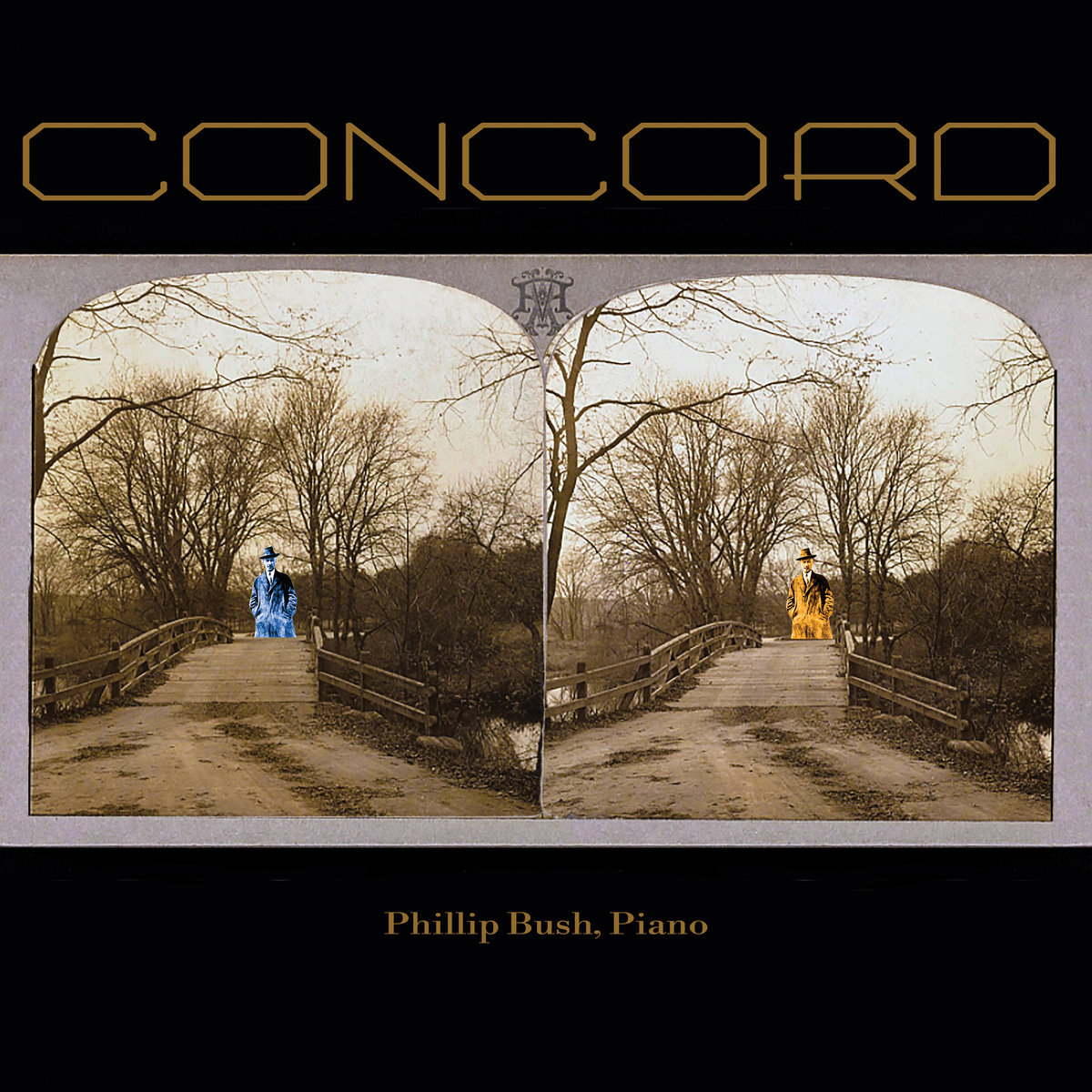
Concord: Phillip Bush Makes the Case for American Music’s Most Contradictory Masterpiece
A century ago, one critic dismissed Charles Ives’ Concord Sonata as little more than meaningless noise scrawled across white paper. A decade later, another heard in the same piece the full terror and splendour of human destiny. That whiplash of reception has never really settled, and it doesn’t need to, the Concord Sonata was built to resist a final verdict. What Concord, pianist Phillip Bush’s new recording on Neuma Records, offers instead is something more valuable than a verdict: three decades of lived familiarity with the score, distilled into a performance of remarkable clarity and conviction.
Phillip Bush has been playing Ives’ Second Piano Sonata for so long that it has become, in his own words, something of a lifestyle rather than simply a piece in his repertoire. That kind of sustained relationship shows in every bar of this recording. Where the Concord can sound, in less committed hands, like an unruly pile of competing ideas, dense chromatic clusters colliding with hymn tunes, quotations from Beethoven’s Fifth flickering in and out of the texture, Bush plays it like a work he has fully internalized, finding the architecture beneath the density rather than merely surviving its technical demands.
That architecture matters, because the Concord Sonata isn’t really about Concord, Massachusetts, at all, not directly. Ives wrote it as a tribute to the writers and thinkers who gathered in that town between 1840 and 1860: Emerson, Hawthorne, the Alcott family, Thoreau. It’s a portrait of a portrait, music inspired by writers who were themselves inspired by the spiritual power of the natural world. Bush has described the piece’s central paradox himself: for all its unsettling modernism, at heart the Concord is a profoundly Romantic work, and that’s precisely the tension his performance holds onto rather than resolving.
The sonata’s four movements, each named for one of those Concord figures, give Bush ample room to draw out distinct emotional characters. “Emerson,” the sprawling opening movement and by far the longest at over sixteen minutes, is full of searching, improvisatory-sounding gestures. Ives described Emerson’s prose itself as having this quality, and Bush’s playing captures that sense of thought unfolding in real time rather than arriving pre-formed. “Hawthorne” that follows is the sonata’s most volatile stretch, its restless, sometimes spectral energy handled with a real sense of danger. The brief “The Alcotts”, by contrast, is the sonata’s warm emotional centre, built around a simple hymn-like theme that Bush lets breathe with unforced tenderness after the storms that precede it. And “Thoreau”, the closing movement, brings a flute, played here by Jennifer Parker-Harley, drifting in near the end like a distant birdcall across Walden Pond, closing the piece on a note of quiet, unresolved reverie rather than triumphant resolution.
One of the smartest decisions on Concord is the pairing that follows it: Marion Bauer’s Six Preludes for Piano, Op.15. Bush is known for exactly this kind of programming in recital, framing the Concord alongside its contemporaries, composers like Arthur Foote, Henry Cowell, Amy Beach, and Ruth Crawford Seeger, to help listeners hear Ives’ radicalism in context. Bauer is a particularly rewarding choice for a recorded pairing. The first American composer to study in Paris with Nadia Boulanger, she represents a different, more conservative strand of early twentieth-century American music, one closer to French Impressionist harmony than to Ives’ quotation-laden maximalism. Heard back to back with the Concord, her six brief, elegantly turned Preludes, including a delicate opening piece written for the left hand alone, don’t diminish Ives’ achievement so much as throw it into sharper relief, giving listeners a genuine sense of just how far outside his era’s mainstream Ives was writing.
Phillip Bush has spent decades as one of contemporary music’s most trusted collaborators, touring with the Philip Glass Ensemble and Steve Reich and Musicians, working directly with composers from John Adams to Charles Wuorinen, and performing everywhere from Carnegie Hall to the Sydney Opera House, and much of that work has, by nature, kept him in a supporting role rather than the spotlight. Concord changes that equation entirely. This is a record built around Bush’s own voice as an interpreter, and it makes an unambiguous case that his voice deserves to be heard on its own terms, not just in service of other composers’ ensembles.
The result is a genuinely significant addition to the Concord Sonata’s discography: a performance shaped by thirty years of intimacy with one of American music’s thorniest, most rewarding scores, paired thoughtfully with a composer whose own contribution to that era deserves far wider recognition. Concord doesn’t just make Ives’ masterpiece more accessible, it makes an eloquent case for why it still demands to be heard.
Frankie Pfeiffer
Editor in chief – PARIS-MOVE
PARIS-MOVE, August 20th, 2026
Follow PARIS-MOVE on X
::::::::::::::::::::::::
Order the album on the Bandcamp
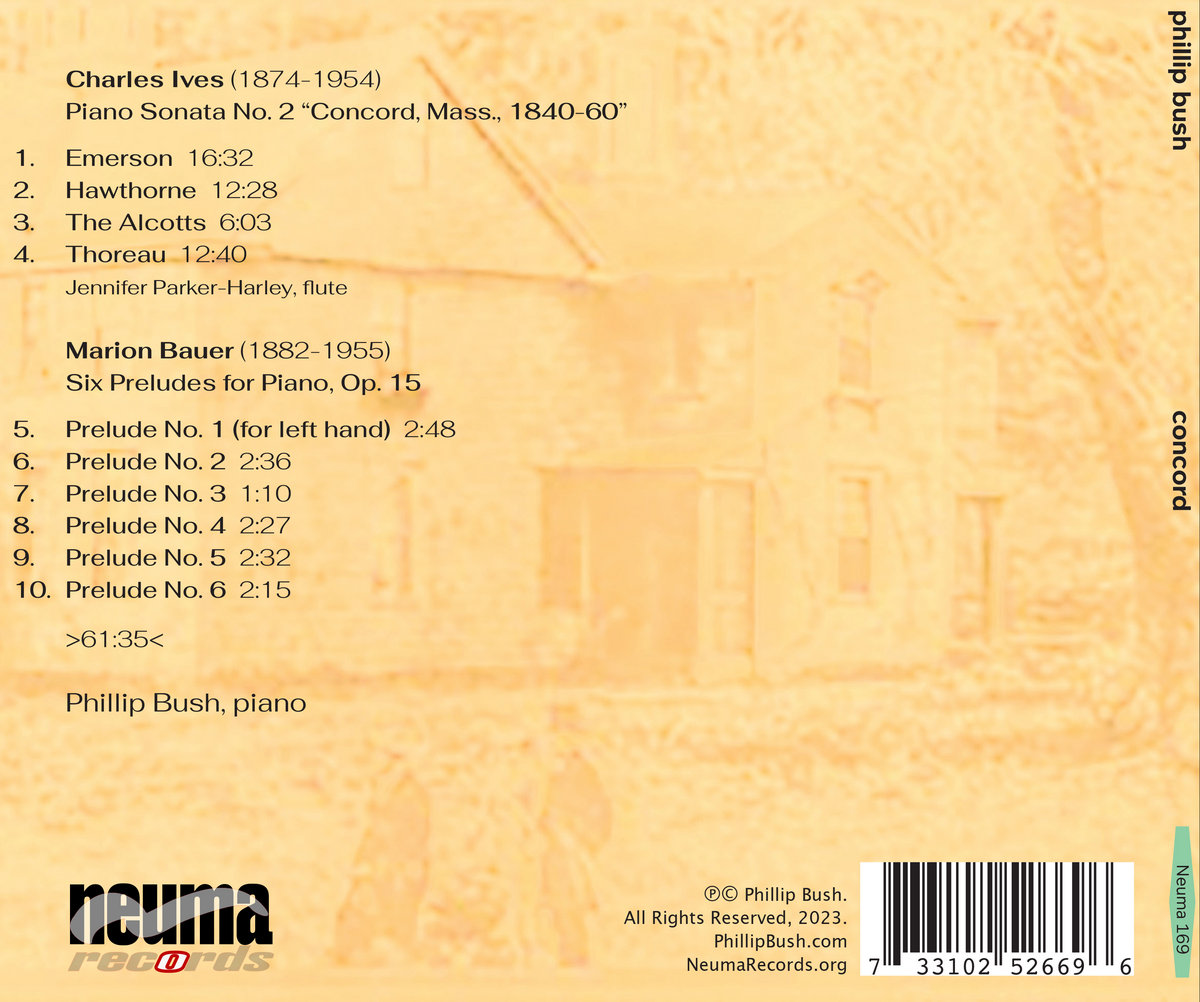
Tracklisting – second presentation:
Charles Ives (1874-1954)
Piano Sonata No. 2 “Concord, Mass., 1840-60”
- Emerson 16:32
- Hawthorne 12:28
- The Alcotts 6:03
- Thoreau 12:40
Marion Bauer (1882-1955)
Six Preludes for Piano, Op. 15
- Prelude No. 1 (for left hand) 2:48
- Prelude No. 2 2:36
- Prelude No. 3 1:10
- Prelude No. 4 2:27
- Prelude No. 5 2:32
- Prelude No. 6 2:15
Musician:
Phillip Bush – piano
Special guest:
Jennifer Parker-Harley: flute on track 4, Thoreau