| Jazz |
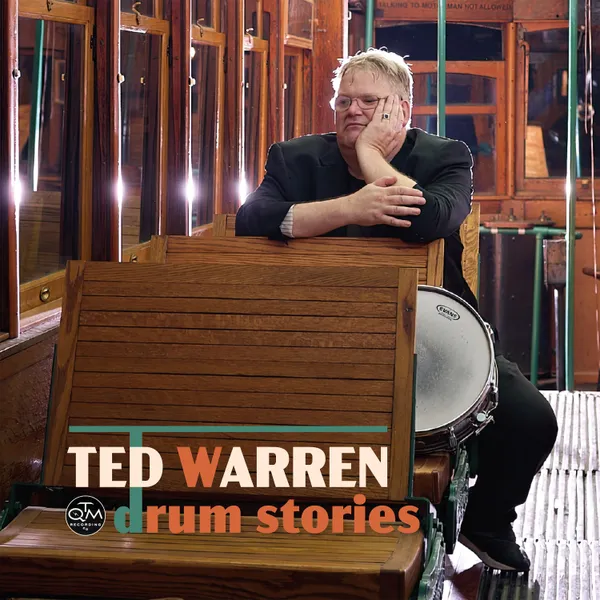
Ted Warren – Drum Stories: When the Drum Set Becomes the Whole Story
There is something wonderfully audacious about a drummer making an entire album with nothing but drums. No bass, no piano, no horns, no guitar, no electronics to expand the sonic palette, no ensemble to provide harmonic context or rhythmic support. Just Ted Warren, one day, his drum set, and seventeen improvised pieces. Yet Drum Stories does not feel like a technical demonstration, an extended drum solo, or an exercise designed to impress other drummers. That distinction is crucial. Warren’s ambition is considerably more interesting: he wants the drum set to become a complete musical instrument, capable of telling stories on its own. And he succeeds.
Across these 17 pieces, Ted Warren explores the drum set as a world of voices, colours, textures, rhythms and resonances. The result is an adventurous, highly personal and surprisingly intimate album that continually challenges our assumptions about what a drum set can do when it is liberated from its traditional role inside an ensemble. The album’s own description captures its essential idea beautifully: it moves between “delicacy and force, pulse and freedom”, while simultaneously respecting tradition and pushing beyond it.
The title Drum Stories is important. Warren himself explains that he went into Mark Mariash’s studio and improvised every piece in a single day of recording, deliberately looking for variety in tempo, dynamics and texture. But he also makes an important distinction: despite all the techniques involved, he wants listeners to hear the stories, rather than simply concentrating on “drum stuff.”
That is exactly the key to appreciating this album. The 17 tracks are not presented as demonstrations of what Ted Warren can do with a drum set. They are miniature narratives. Some are fleeting, some are expansive, some seem to emerge almost before we have had time to prepare for them and others develop patiently, accumulating tension, movement and texture. The shortest piece, “Fanfare”, lasts just 36 seconds, and at the other extreme, “Drumatic” stretches to 8:42. Between those poles, Warren constantly changes the scale of his musical storytelling and that variety is one of the album’s great strengths. There is always another door to open.
Also, the most remarkable thing about Drum Stories is that Warren’s approach makes the distinction between drummer, improviser and composer increasingly difficult to maintain. He is, of course, an extraordinarily experienced drummer. His career has taken him through orchestral, jazz and contemporary settings and into collaborations with major figures including Kenny Wheeler, Mike Murley, Sheila Jordan, Slide Hampton, Jeff Healey and Chuck Mangione. He was also a member of the legendary Boss Brass and has appeared on numerous recordings as both sideman and leader. But Drum Stories reveals something else. Ted does not merely play rhythms. He organizes the sound. He thinks in terms of development, contrast, density, silence, register, timbre and pacing. A cymbal can become a sustained sound rather than simply a timekeeper. A drum can become a voice rather than merely a rhythmic punctuation mark. A repeated figure can acquire the function of a motif. And silences can become parts of the architecture. This is composition through improvisation.
And the fact that all 17 pieces were created spontaneously in one recording day (!) makes the accomplishment even more impressive. Warren had no written score to fall back on and no other musicians with whom to share the responsibility of maintaining musical momentum. He had to “create” the form as he played it. This requires an extraordinary combination of listening skills, memory, instinct, and technique, and with this album, Ted demonstrates, with great humility, that he possesses all these abilities, and even more.
For me, the project also takes on an almost philosophical dimension. For decades, the drum set has generally been understood through its relationship with other instruments. In jazz, the drummer interacts mainly with the bassist or the pianist. In rock, the drums reinforce the guitar and bass. In countless other musical contexts, the drum set provides pulse, colour, accents and propulsion within a larger structure. Now, set aside everybody who isn’t a drummer, and the question becomes fascinating: what remains? Ted’s answer is: almost everything. The drum set contains far more melodic and expressive potential than we sometimes give it credit for. The cymbals have pitch, sustain and colour. The toms offer different registers. The snare can whisper, crack, buzz, roll or sing. The bass drum can function as punctuation, resonance or a deep heartbeat.
Warren’s stated creative research is precisely about this question. He describes Drum Stories as an exploration of the drum set as a “fully expressive solo instrument”, investigating the different voices of drums and cymbals through textures, dynamics and contrasting musical approaches.
The album therefore isn’t simply about playing drums alone. It is about discovering what the drums can become when they are allowed to carry the entire musical narrative. The track titles themselves suggest Warren’s sense of humour and imagination. “Fanfare” opens the album almost like an announcement: here we are, entering a different kind of musical space. Then comes “Dialogue”, an immediately suggestive title for a solo performance. With no second musician present, the “dialogue” has to happen within the drum kit itself.
“Revenge Of the Onion Goggles”, “The Drum Also Train Beats”, “Tremolo Pies”, “Brush Breathing”, “Always Sunny”, “Palette Cleanser” and “Mallody” continue this fascinating sequence of ideas. There is humour here, but also curiosity. Warren clearly enjoys the absurdity and freedom of creating music without having to explain every title and every sound in conventional terms.
And then there are pieces such as “Dreams of Mr Blackwell”, “The Gathering”, “Suspension”, “Jacks Win” and “Lonely Metal”. The titles don’t need to tell us exactly what to hear, they give us invitations. And that is appropriate for improvised music: the listener is encouraged to participate in the act of discovering meaning.
Warren’s musical imagination is clearly rooted in a broad tradition. When asked about his influences, he names Wayne Shorter, Thelonious Monk, Tony Williams, John Bonham, Ringo Starr and the Beatles, Max Roach and Howlin’ Wolf. That is an extraordinarily revealing list as there are jazz composers and drummers, of course, but there is also rock, blues and popular music. And this breadth helps explain why Drum Stories does not sound trapped inside a narrow definition of “solo jazz drums.”
Tony Williams and Max Roach suggest the extraordinary rhythmic and textural possibilities of jazz drumming. Bonham brings physical power and enormous sonic weight. Ringo represents economy, character and the ability to make a drum part instantly recognizable. Monk and Shorter point towards a deeper compositional principle: every sound can have identity and meaning. Even Howlin’ Wolf makes sense in this context, as Blues is storytelling. And that is precisely what Warren says he wants to achieve. The drums are not merely performing techniques, they are telling stories.
There is a particularly revealing detail in Warren’s advice to younger drummers. He argues that many players do not examine playing the ride cymbal deeply enough and recommends spending considerable time listening to and practising this fundamental art. Listening again to Drum Stories after reading Ted’s comment gives the ride cymbal an entirely different significance. In a solo context, its sound becomes one of the fundamental elements through which Warren creates continuity, atmosphere and movement. It can shimmer, articulate, sustain, interrupt and colour. Its sound occupies space.
This is one of the album’s most rewarding aspects for listeners who are willing to listen closely: Warren makes you hear the drum set differently. After spending time with this record, the instruments seem to have acquired additional dimensions.
To tell you just how important this album is, I will simply say: Four decades of experience, distilled into one day. There is something fascinating about the contrast between the album’s spontaneous creation and Warren’s enormous experience. He brings more than four decades of work as a drummer, composer, bandleader and educator to the project. At Wilfrid Laurier University, where he serves on the jazz faculty, he brings that experience directly into his teaching and mentorship. That matters because Drum Stories may sound spontaneous, but it doesn’t sound inexperienced at all. Improvisation is not the absence of knowledge. Quite the opposite. And the freedom heard here is the product of decades spent learning how rhythm works, how musicians communicate, how dynamics shape attention, how a sound acquires character, and how a musical idea can be developed.
In the context of solo drum recordings, Drum Stories is especially compelling because it approaches the challenge from a distinctly personal angle. The history of solo drumming contains many musicians who have demonstrated that the drum set can become an entire musical universe. What makes Ted Warren’s contribution so satisfying is that he does not appear interested in proving a point through sheer virtuosity. He wants to communicate. The technical ability is obviously there. But technique is the vocabulary, not the story. Warren is using that vocabulary to create characters, atmospheres, contrasts and journeys. And perhaps the best compliment one can give the album is that after listening, one does not simply think “What an incredible drummer”, but ” What an incredible musician!” And one who deserves a standing ovation!
Drum Stories is… 17 improvised pieces, one drummer, one drum set, one day, but an astonishing variety of musical worlds. The fact that he created all 17 pieces spontaneously in a single day makes the album’s coherence even more impressive. There is no sense of an artist desperately trying to fill the space left by an absent band or obsessed with demonstrating that he possesses every possible technique, right down to his fingertips and drumsticks. Instead, Ted seems completely at ease in this solitary space, alone with himself and his drum kit. Drum Stories is not an album missing other instruments. It is an album that proves they were not necessary.
For anyone interested in jazz drumming, improvisation, contemporary solo performance, or simply in hearing a great musician push a familiar instrument into unfamiliar territory, this is a record that deserves serious attention. Ted Warren has turned his drum set into a storyteller. And these are 17 stories very much worth hearing.
Frankie Pfeiffer
Editor in chief – PARIS-MOVE
PARIS-MOVE, August 18th, 2026
Follow PARIS-MOVE on X
::::::::::::::::::::::::
Musician:
Ted Warren – Drums
Tracklisting
1 Fanfare 0:36
2 Dialogue 2:25
3 Revenge Of the Onion Goggles 2:11
4 The Drum Also Train Beats 4:37
5 Tremolo Pies 2:21
6 Brush Breathing 4:59
7 Always Sunny 2:53
8 Palette Cleanser 1:39
9 Mallody 4:03
10 Dreams of Mr Blackwell 3:04
11 The Gathering 1:49
12 Suspension 4:35
13 A Jo J Ones App 5:15
14 Drumatic 8:42
15 Heather’s Groove 3:45
16 Jacks Win 3:36
17 Lonely Metal 6:21
Produced By: Ted Warren
Recorded at The Dome
Recorded By: Mark Mariash and Ron Skinner
Mixed and Mastered By: Ron Skinner
Photography By: Neal Burstyn
Design By: Sue Passmore
Ted Warren on the Wilfrid Laurier University’s website