| Jazz |
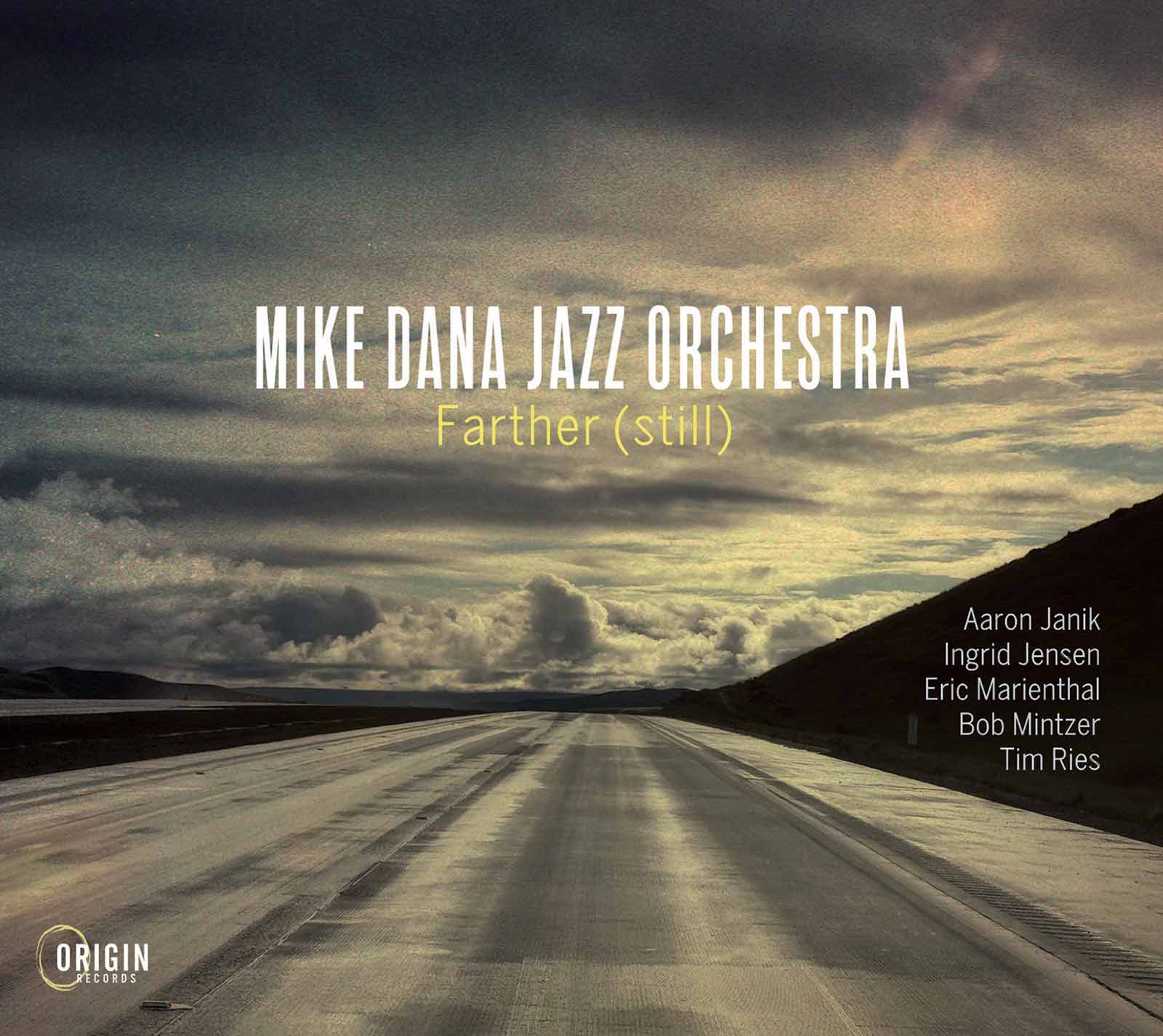
Summary: Mike Dana’s Farther (Still) is a sophisticated modern jazz orchestra album featuring Eric Marienthal, Bob Mintzer and Tim Ries, blending big band tradition, post bop influences, memorable melodies and inspired improvisation.
Mike Dana’s Farther (Still): Taking the Jazz Orchestra Further
I came to Mike Dana’s Farther (Still) through two familiar names, Eric Marienthal and Bob Mintzer. I have followed Marienthal’s work for years, particularly his smooth jazz recordings, while Mintzer’s extensive work with the WDR Big Band has made his name almost inseparable from the possibilities of the modern jazz orchestra. Those two musicians were enough to make me curious about a recording by an artist I did not yet know well. The deeper I listened, however, the clearer it became that this was not simply a project built around distinguished guests. It was Mike Dana’s record, and very much his musical statement.
Dana is a guitarist, composer, arranger and educator whose career has taken him through a remarkably broad range of jazz experiences. His writing for instrumental and vocal ensembles is performed internationally, and his work as an educator has placed him in contact with generations of musicians. He has also shared the stage with artists including Cannonball Adderley, Wayne Bergeron, Gary Burton, Ingrid Jensen, Eric Marienthal, Bob Mintzer, Bobby Shew, Clark Terry and Ernie Watts. That history matters, because Farther (Still) sounds like the work of someone who has spent a great deal of time listening to what a jazz orchestra can do, and then asking what else might be possible.
The answer begins with “Mi Respuesta.” From the opening moments, Dana establishes a sound that is expansive without becoming cumbersome. The orchestra has weight, but it also has room to breathe. Brass, reeds and rhythm section are not simply arranged in layers; they interact, answer one another and create movement within the compositions. There is a clear appreciation for the great tradition of big band writing, but Dana is not interested in turning that tradition into a museum piece.
That distinction is important. Farther (Still) contains seven original compositions alongside new arrangements of two standards, yet the album never feels as though it is checking boxes on a list of big band conventions. Dana uses the orchestra as a living instrument. Sometimes the writing is dense and harmonically sophisticated. At other moments, the arrangements open up and allow the individual musicians to step forward. The effect is less about demonstrating how complicated the music can be than about finding the right amount of complexity for each moment. That may be why the album is easier to enter than its arrangements might initially suggest.
There is plenty here for musicians to study. The voicings, sectional writing, harmonic movement and orchestral dynamics reward close attention. But the listener does not need to understand any of that to enjoy the record. The melodies remain accessible, the ensemble has a strong sense of direction, and the improvisations feel integrated into the compositions rather than attached to them as separate events.
This is where Dana’s experience as both composer and performer becomes especially apparent. A large ensemble can easily become overly formal. The musicians can sound as though they are executing a blueprint rather than participating in a conversation. Dana avoids that problem. Even when the arrangements are carefully constructed, there is a sense of movement underneath them, as though the score is providing a framework rather than a set of restrictions. The guest musicians play an important role in creating that feeling.
Eric Marienthal brings an unmistakable melodic and harmonic voice to the project, and his presence adds another layer of sophistication without distracting from Dana’s writing. Bob Mintzer brings a different kind of energy, reinforcing the rhythmic authority of the brass and reed sections and adding the experience of someone who has spent decades exploring the possibilities of large ensemble jazz.
Tim Ries, moving between tenor and soprano saxophone, provides another valuable connection between the various musical personalities. His role helps keep the record moving between ensemble writing and improvisation without making those transitions feel artificial. The choices feel carefully considered rather than decorative. Listeners familiar with the WDR Big Band may occasionally recognize a similar appetite for precision, scale and orchestral color, particularly in the way Dana allows individual sections to interact with the soloists. But this is not an attempt to reproduce the WDR sound. If anything, the comparison helps illustrate how much Dana has absorbed from the modern big band tradition while maintaining a musical identity of his own. That identity is perhaps most apparent in the way he handles atmosphere.
There are moments on Farther (Still) when the music becomes almost cinematic. Not cinematic in the sense of sounding like a conventional movie score, but in the way it creates a place in the listener’s imagination. The music can suggest a city at night, a conversation taking place somewhere just beyond the frame, the feeling of walking through unfamiliar streets while knowing that a jazz club is waiting around the next corner. For me, that is where the post bop influence becomes particularly intriguing.
There is a certain atmosphere that recalls the era without attempting to imitate it. I found myself thinking of Humphrey Bogart walking through the streets of San Francisco, perhaps not because the music literally evokes a particular film, but because Dana understands something that great film composers and great jazz composers have in common. Both know how to suggest a story without explaining it.
The orchestra becomes a kind of camera. It changes perspective. It moves closer, then pulls away. A brass passage can suddenly widen the frame, while a saxophone solo brings the listener back into something more intimate. The rhythm section keeps the whole thing moving, but never seems desperate to announce where it is going. That quality also helps explain the title, Farther (Still). The phrase feels almost like a description of Dana’s approach to music. There is no sense here of arriving at a final definition of what a jazz orchestra should be. Instead, the music seems interested in the next possibility, the next arrangement, the next combination of voices.
Dana’s career as an educator makes that philosophy particularly interesting. His arrangements and compositions have been performed by jazz ensembles around the world, and his work has appeared through publishers including Kendor, Alfred, Jazzlines, UNC Jazz Press and Lorenz. His commissions have included projects connected with the Jazz Education Network, the Taipei Jazz Orchestra, Azusa Pacific University and numerous school ensembles. Several of his works have also received recognition through J. W. Pepper’s Editor’s Choice selections.
Those credentials are impressive, but they become more meaningful when you hear the music. What they reveal is not simply a composer who knows how to write for a large ensemble. They suggest someone who understands musicians and understands the practical reality of bringing complicated music to life. That experience can be heard throughout Farther (Still). The arrangements are ambitious, but they remain playable, expressive and, most importantly, musical.
Dana’s history as a guitarist adds another dimension. A guitarist who has worked alongside musicians such as Cannonball Adderley, Gary Burton, Clark Terry and Ernie Watts has spent a considerable amount of time around distinctive musical personalities. That kind of experience inevitably changes the way a musician thinks about an ensemble. You learn when to step forward, when to leave space, when to support another voice and when a single well placed note can be more effective than an entire section of music.
That sense of restraint is one of the album’s quieter virtues. Farther (Still) does not need to prove its sophistication every few seconds. It trusts the compositions. It trusts the musicians. And it trusts the listener. That makes the album unusually versatile. You can listen closely and find an impressive amount of detail in the writing, or you can put it on in the background and discover that the music changes the atmosphere of the room without demanding your complete attention. Ideally, of course, you do both.
I would actually suggest listening to the album twice. The first time, simply let it unfold. Do not worry about identifying every arrangement technique or following every harmonic turn. Let the orchestra establish its own world. On the second listen, pay attention to what happens behind the soloists, to the way the sections answer each other, to the shifts in density and to the moments when Dana suddenly gives the music more space.
That second listen is where the architecture becomes visible. And yet the architecture never overwhelms the pleasure. That balance is perhaps the album’s greatest achievement. Big band jazz can sometimes become caught between virtuosity and accessibility, as though a record has to choose whether it wants to impress musicians or invite ordinary listeners inside. Dana refuses that choice. The music is sophisticated enough to reward close examination, but open enough to be enjoyed simply because it sounds good.
Eventually, the technical discussion becomes less important than the experience of listening. There is a moment on almost every successful jazz recording when something unexpected happens, perhaps a change in harmony, a brass figure appearing behind a soloist, a rhythmic shift or simply a phrase played with such conviction that you instinctively listen more closely. Farther (Still) has several of those moments. And when they arrive, I suspect many listeners will have the same reaction: turning to whoever happens to be in the room and asking, “Did you hear that?”
That may be the best way to describe what Mike Dana has accomplished here. He has made an album that can be appreciated for its craft without being reduced to its craft, an album that respects the history of the jazz orchestra while refusing to remain trapped inside it. It can be listened to deeply, or it can simply become part of the atmosphere of an evening. Either way, the music keeps finding another place to go. Farther, still.
Thierry De Clemensat
Member at Jazz Journalists Association
USA correspondent for Paris-Move and ABS magazine
Editor in chief – Bayou Blue Radio, Bayou Blue News
PARIS-MOVE, August 17th, 2026
Follow PARIS-MOVE on X
::::::::::::::::::::::::
Musicians :
David Becker – alto sax, tenor sax, flute, clarinet
Ron McCarley – alto sax, tenor sax, flute, clarinet
Michael Mull – baritone sax, clarinet, bass clarinet
Jessica Hoffman – oboe
Lisa Nauful – bassoon
Wayne Bergeron – trumpet
Daniel Rosenboom – trumpet
Alex Iles – trombone
Alan Ferber – trombone
Joe Turgeon – bass trombone
Mike Dana – guitar
George Stone – piano, keyboard
Ron Suffredini – basses
Dave Tull – drums
Brian Kilgore – percussion
SPECIAL GUEST ARTISTS:
Aaron Janik – trumpet (1, 5, 7)
Ingrid Jensen – trumpet (2, 8)
Eric Marienthal – alto sax (5, 9)
Bob Mintzer – tenor sax (3, 5, 6)
Tim Ries – soprano sax (4), tenor sax (8)
Track Listing :
Mi Respuesta 7:18
Elysian Shore 6:07
The Truth Is 7:16
Farther (still) 4:51
The More I See You 6:30
It’s Just a Phase 6:29
You Don’t Know What Love Is 7:52
December 7:04
Confluential 8:04
All music composed & arranged by Mike Dana, except:
(5) comp. Mack Gordon & Harry Warren
(7) comp. Gene De Paul & Don Raye
Produced by George Stone & Mike Dana
Recorded by George Stone at Central Coast Studio Works, Cambria, CA in August 2025
Mixed, edited & assembled by George Stone
Mastered by Will Borza at Seismic Mastering Studio, Los Angeles, CA
Additional recording from March-November, 2025 by: Brian Kilgore at Ancient Pathways Recording (CA); Aaron Janik at ARJ Studios (CA); Dan Rosenboom at BoomHill Studio (CA); Bob Mintzer at Canyon Cove Studio (CA); Dan Rorke at Charles Myers Recording Studio, Manhattan School of Music (NY); Wayne Bergeron at Gault Street Sound (CA); Laura de Rover at LDR Studio, NYC; Alan Ferber at Sanctuary Studio (NY)
Cover photo by Julie Dana
Cover design & layout by John Bisho