
| Jazz |
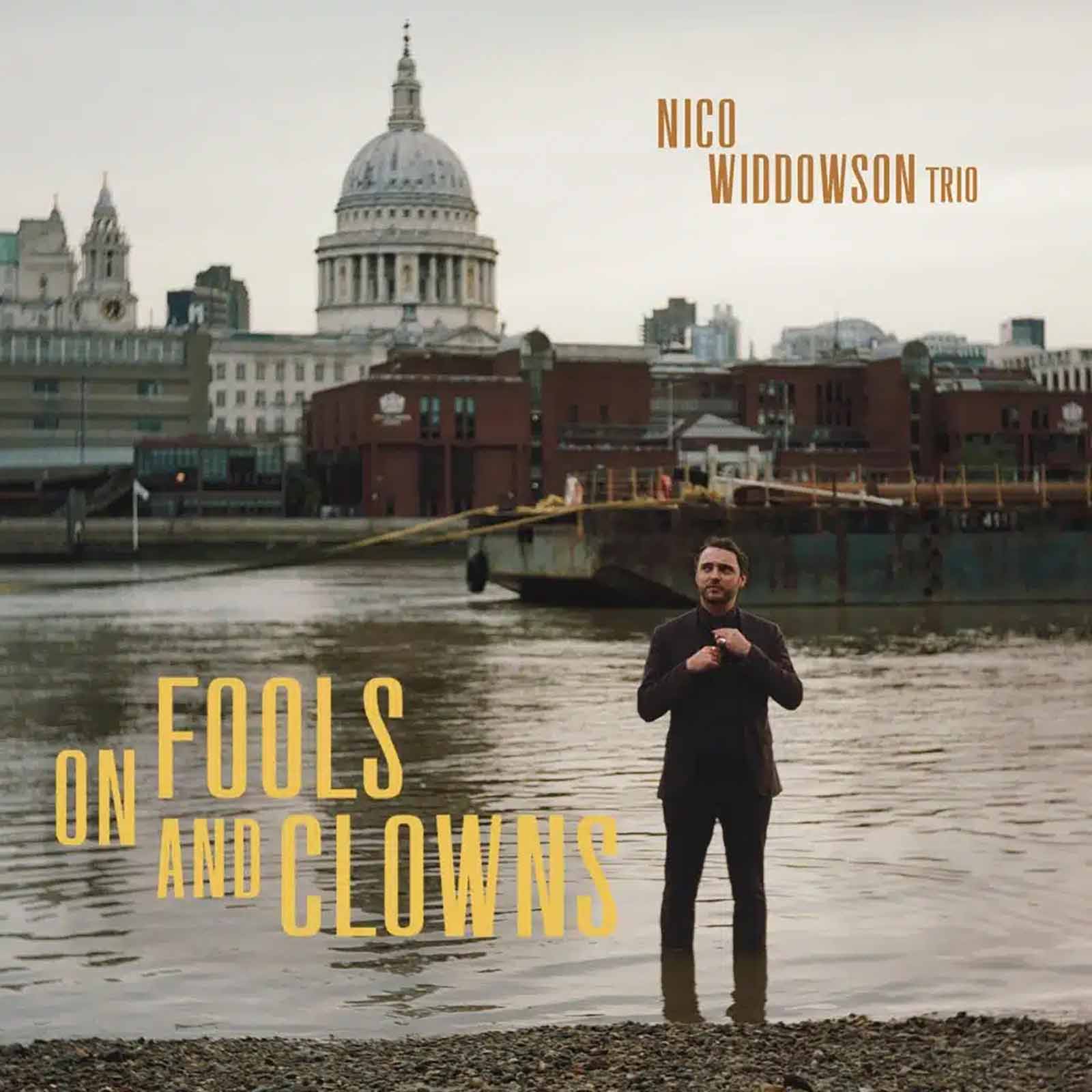
Summary: Nico Widdowson Trio’s On Fools and Clowns blends stride piano, free improvisation, blues and contemporary London life into a personal, unpredictable jazz debut shaped by humor, uncertainty and musical history.
The Jazz of Ordinary Troubles: Nico Widdowson and the Sound of London
By the middle of August, summer has begun to change its colors, almost imperceptibly, in the way a season announces its departure long before it is actually gone. The butterflies are still moving lazily from flower to flower, and the squirrel that has become a regular visitor continues to appear at the doorstep often enough for me to greet him as though we had established some informal neighborhood agreement. It was during one of those quiet mornings, with the next season beginning to make itself felt while summer was still very much present, that I found myself with a copy of Nico Widdowson Trio: On Fools and Clowns in front of me. I put the CD into the player, pressed start, and within the first moments of the opening track, “Angela Scott,” another image came to mind, or perhaps something closer to a memory of an idea, and that idea was Charlie Chaplin.
The connection is not that Widdowson sounds like Chaplin, because he does not, and there would be little value in pretending otherwise. It is instead a question of sensibility, of the strange territory where humor, melancholy, absurdity and music can occupy the same emotional space. Chaplin never needed to explain the human condition in order to make an audience recognize it, and although he was not primarily known as a jazz musician, his relationship with music was fundamental to his films, including the music he composed for A Day’s Pleasure in 1919. What returned to me while listening to “Angela Scott” was that same understanding that amusement can contain sadness, that nostalgia does not necessarily require sentimentality and that ordinary life, with all its small frustrations and unexpected pleasures, can become an artistic language when someone knows how to listen to it.
Nico Widdowson approaches that territory from another century and another city, with a piano rather than a film camera, but there is a similar desire to turn the everyday into something larger without losing its imperfections. On Fools and Clowns is an ambitious first album because it does not present itself merely as a demonstration of what a young pianist can do. It brings together stride piano, free improvisation, blues and a highly personal form of storytelling, while allowing the music to reflect a period of uncertainty that followed Widdowson’s move from Leeds to London. The record grew out of several years spent trying to establish an artistic life in a city where ambition can be exhilarating but where the cost of simply remaining there can become an almost constant source of pressure.
That pressure is present throughout the album, although rarely in the form of a direct statement. It emerges through the subjects that have shaped Widdowson’s daily life, including difficult landlords, professional frustrations, family relationships, friendships and the complicated experience of working as a freelance musician. There is nothing particularly glamorous about those subjects, which is precisely why they are useful. Instead of turning them into declarations, Widdowson allows them to become musical material. The album consequently feels like a diary that has been translated into sound, but it is not a diary in the confessional sense. It is closer to a collection of memories in which the details have been transformed by rhythm, harmony and improvisation.
There is an unmistakably European quality to the music, and anyone who has spent enough time in English pubs, particularly those places where a piano may sit quietly in a corner for most of the day before becoming active when musicians arrive in the evening, will recognize part of its atmosphere. There is a particular kind of English musical culture that exists outside concert halls and formal institutions, in rooms where musicians can appear almost by accident and where a song may begin without anyone being entirely certain where it will finish. Widdowson’s trio seems to emerge naturally from that environment, yet it does not remain confined by it. Beneath the familiarity there is a restless energy that continually pushes the music toward something less predictable.
Widdowson has found his way into stride piano through a particularly modern route. His fascination with the style was intensified after seeing Joe Webb perform at the Love Supreme Festival, an experience that opened a door into a musical history that stretches from Harlem stride through Duke Ellington and beyond. What initially appears to be an old fashioned piano language reveals itself to be something much more aggressive when played with the physical force it demands. Stride can sound elegant from a distance, but close listening reveals its muscularity, its rhythmic violence and its remarkable freedom. It is not difficult to understand why Widdowson has compared its spirit to punk music, because beneath the historical clothing there is an attitude that remains rebellious.
That history is essential to understanding the album, but Widdowson does not treat it as an inheritance that must be preserved behind glass. Willie “The Lion” Smith, Duke Ellington, Thelonious Monk, Sun Ra and Jaki Byard form part of the musical family tree, but the purpose of that lineage is not to reproduce the past. It is to find out what happens when the past is placed inside the present. Widdowson’s music suggests that tradition becomes most useful when it is allowed to become uncomfortable, when it is questioned and pushed into situations where it has not necessarily been before.
The turning point for me comes with “Duke’s Blues,” the third track, because this is where the pianist appears to stop demonstrating his technique and begins to reveal his personality more directly. The distinction is important. Widdowson is technically capable, but the most interesting thing about his playing is not the speed of his hands or the complexity of his vocabulary. It is the sense that the technique is being placed in service of something more elusive. At this point the record begins to sound like a soundtrack, not necessarily to a particular film, but to the life of a musician trying to make sense of a city, a profession and a personal history.
That is where the Chaplin comparison returns, although again it is a comparison of spirit rather than sound. Chaplin understood that the most effective comedy often emerges from vulnerability, and that the smallest problems can reveal the largest truths. A man losing his balance, struggling with a door or being chased through a street could become funny precisely because the audience recognized the seriousness with which the character experienced his own predicament. Widdowson’s material is different, but the principle is surprisingly close. The landlord, the uncertain freelance career, the pressure of London, the family relationship or the awkwardness of friendship may seem insignificant from the outside, yet they become meaningful once they are transformed into music.
The album is strongest when it allows those contradictions to remain visible. Widdowson does not seem interested in making every passage beautiful, and that decision gives the record a welcome degree of tension. There are moments when the musicians appear to push a piece further than necessary, almost as though they are testing how much pressure an arrangement can absorb before it changes character. Instead of treating that excess as a mistake, the trio uses it as a source of energy. The music can become rough around the edges, but it rarely becomes careless.
This is also where the importance of improvisation becomes clear. Widdowson has developed an attitude toward performance in which mistakes are not necessarily enemies. He has spoken about the importance of accepting weakness and failure, and about the need to create an environment in which musicians can take risks without being paralysed by the fear of making the wrong choice. That philosophy is audible because the trio does not always sound as though it knows exactly what will happen next. There is a certain danger in the performances, and danger is one of the qualities that can disappear very quickly when jazz is over rehearsed.
Joe MacLaren on double bass plays an important role in maintaining that sense of conversation, while the presence of Jordan Hadfield and Charlie Hutchinson on different tracks gives the recording two distinct rhythmic personalities. The drums do not simply provide a neutral platform beneath the piano. They become part of the argument. At times the rhythm section seems to pull the pianist forward, while at other moments it appears to resist him, creating the kind of tension that makes a trio sound like three independent musicians rather than a single instrument divided into three parts.
That interaction had already been developing through performances in Soho, where the trio could test new material in front of audiences and modify it according to what happened in the room. The process matters because it meant the compositions were not finished objects when they reached the recording studio. They had already lived in public, had already changed through performance and had already acquired a history of their own. When the time came to record, the musicians wanted to preserve that sense of movement rather than reconstruct the music piece by piece.
The recording itself was therefore approached as a performance rather than an assembly process. The work began on a boat on the Thames, and the musicians recorded complete sets, allowing the order of the songs and the arrangements to evolve as the sessions developed. Ideas could appear unexpectedly and remain in the music rather than being discarded simply because they had not been planned. The result is a record that retains something of the uncertainty of live performance, when the musicians have to listen to one another continuously because there is no possibility of stopping the clock and starting again.
That willingness to accept uncertainty is particularly significant in an age when recording technology can make almost anything appear perfect. A musician can replace a passage, correct a mistake and construct a performance from dozens of fragments until every imperfection has disappeared. There is nothing inherently wrong with that process, but it can also remove the element of risk that makes improvisation meaningful. Widdowson’s trio has chosen to preserve some of that vulnerability, and the album is better for it.
There is also a distinctly English humor running through the record, and it is one of the reasons the album never becomes weighed down by its darker subjects. Widdowson is serious about music, but he does not appear to believe that seriousness requires solemnity. His musical influences include artists who understood that intellectual ambition and humor could coexist, from Ellington and Monk to Sun Ra, Alice Coltrane, Ornette Coleman and Charlie Parker. The lesson is not that jazz should become a comedy, but that music loses something when it becomes afraid of being playful.
The title On Fools and Clowns therefore carries more weight than it initially suggests. The fool and the clown occupy an unusual position in Western culture because they are allowed to expose contradictions that more respectable figures must hide. They can be ridiculous and wise, vulnerable and aggressive, amusing and deeply sad. They remind us that human beings spend much of their lives trying to appear more coherent than they actually are. Widdowson’s album is at its best when it accepts that contradiction rather than attempting to resolve it.
The music also reflects a broader reality about being a young artist in contemporary London. The city remains one of Europe’s great centers for musicians, but the romantic idea of the struggling artist has become increasingly difficult to sustain when the struggle includes housing costs, unstable employment and the basic economics of everyday survival. There is a particular irony in a city that can offer enormous artistic opportunities while making it increasingly difficult for artists to afford the time and space required to take advantage of them. What Widdowson is describing may be rooted in London, but the underlying experience is shared by musicians throughout Europe, where freelance cultural work often carries a degree of insecurity that is rarely visible from the outside.
The album does not need to become a political manifesto to make that reality visible. Its strength lies precisely in refusing to turn every frustration into an argument. Instead, the problems enter through rhythm, mood, humor and memory. The result is more convincing because the listener is allowed to experience the circumstances rather than being instructed how to interpret them.
That is perhaps why the record feels European without becoming geographically limited. There is something English in its humor and its nostalgia, something continental in its relationship with history and something distinctly American in its engagement with the great jazz traditions that shaped its language. The music crosses those boundaries naturally because jazz has always been a conversation between places, generations and personalities.
“Angela Scott” opens the door gently, establishing an atmosphere that feels almost cinematic, while “Duke’s Blues” brings the personality of the composer into sharper focus. Elsewhere, the album becomes increasingly willing to disturb its own balance, with pieces such as “Are You There Lion?” reaching backward toward the stride tradition, while “Nicotine Fingers” and “Who Shot Pinetop?” reveal a more unruly side of the pianist’s imagination. “To Those I Love” introduces another emotional dimension, and “Maple Leaf Rag” brings the journey back toward one of the historical forms that continues to sit beneath Widdowson’s contemporary vocabulary.
Taken together, the tracks create something larger than a collection of compositions. They form a musical chronology in which influences, friendships, frustrations and personal memories are continually colliding with one another. The album is not polished into a single emotional color, and that is one of its strengths. It can be affectionate without becoming sentimental, technically sophisticated without becoming academic, and funny without losing its sense of seriousness.
For the listener, I would suggest resisting the temptation to judge the album from a single pass. It rewards repeated listening because the first impression tends to emphasize the energy and the virtuosity, while later encounters reveal the architecture underneath. The relationships between the tracks become clearer, the recurring influences become easier to recognize and the moments of apparent excess begin to feel less like decoration and more like deliberate attempts to keep the music alive.
There is an important question underneath all of this, particularly for a musician at the beginning of a career. How much of a tradition should one preserve, and how much should one be willing to disturb? Widdowson appears to have understood that the answer cannot be found by choosing one side. He needs the past precisely because he wants to move beyond it, and the freedom of improvisation matters because it allows him to test whether those historical materials can still speak in a contemporary voice.
That process is not finished, and it should not be. The strongest quality of On Fools and Clowns may be the feeling that its author has not yet arrived at a final definition of himself. There is already a recognizable personality, a substantial musical vocabulary and a clear sense of direction, but the material is still in motion. The trio has the foundations of a strong identity, although those foundations have not yet hardened into a formula.
That leaves considerable room for the future. The challenge will be to develop without becoming predictable, to preserve spontaneity without turning spontaneity into a mannerism, and to continue taking risks without confusing risk with mere disorder. If Widdowson and his collaborators can maintain the openness that shaped this first album while allowing their individual voices to become more distinct, the next records could be considerably more surprising than this one.
Perhaps that is why I kept returning to Chaplin while listening to the album that August morning. The connection is not a question of style but of artistic instinct. Chaplin understood that comedy could contain loneliness, that absurdity could reveal social reality and that the smallest troubles of ordinary existence could become meaningful once an artist found the right language for them. Widdowson is working in a different time, with a different instrument and inside a different tradition, yet his music is animated by a comparable curiosity about what happens when ordinary life is taken seriously without being treated solemnly.
The butterflies are still outside, the squirrel will probably return to the doorstep, and summer has not quite finished with us yet. Somewhere between one season and the next, however, Nico Widdowson and his trio have produced a first album that captures something more valuable than a simple demonstration of talent. They have captured a moment in which history, economic uncertainty, friendship, frustration, humor and musical ambition are all still in motion. The material is there; the chemistry is there and the appetite for discovery is unmistakable. What remains to be seen is how far they are willing to push it, and that may be the most interesting question this record leaves behind.
Thierry De Clemensat
Member at Jazz Journalists Association
USA correspondent for Paris-Move and ABS magazine
Editor in chief – Bayou Blue Radio, Bayou Blue News

PARIS-MOVE, August 17th, 2026
Follow PARIS-MOVE on X
::::::::::::::::::::::::
Musicians :
Nico Widdowson | Piano
Joe MacLaren | Double Bass
Jordan Hadfield | Drums (Tracks 1, 3 & 7)
Charlie Hutchinson | Drums (Tracks 4, 5, 8, 9 & 11)
Track Listing :
Angela Scott
Are You There Lion?
Duke’s Blues
Nicotine Fingers
¿Who Shot Pinetop?
And Also Her Mother
Today I’ve Been Feelin’ Blue
You Can Fire Me In The Morning
On Fools and Clowns
To Those I Love
Maple Leaf Rag