| Jazz moderne |
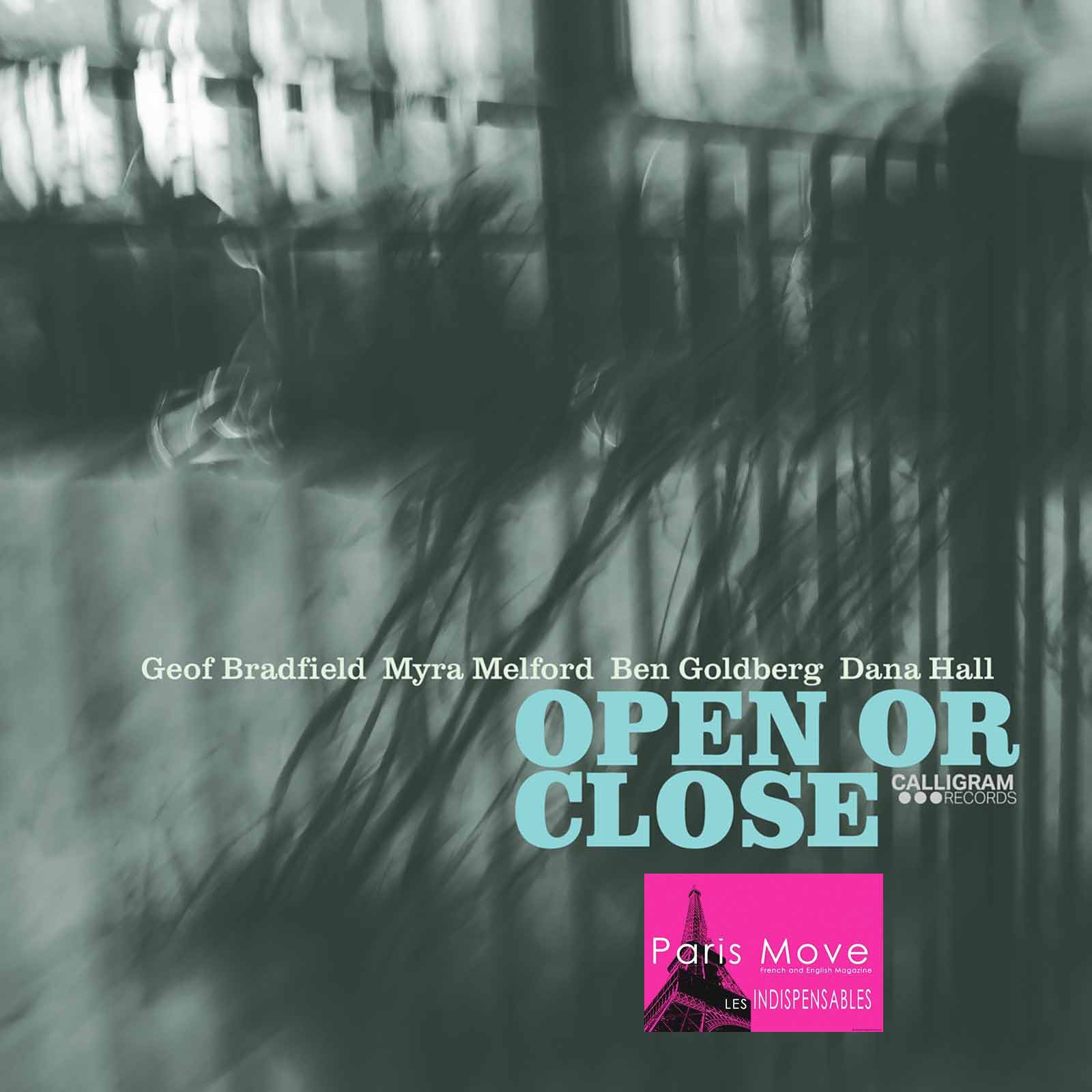
Summary: Geof Bradfield’s Open Or Close brings together four adventurous musicians in a live recording where jazz, improvisation, blues and global influences meet in a constantly evolving conversation.
Geof Bradfield’s Open Or Close: Jazz, Improvisation and the Art of Listening
There is a moment on Open Or Close when the music seems to lose its balance, only to find another one a few seconds later, as a clarinet phrase hangs in the air, the piano answers, the drums begin to shift underneath them, and what initially sounded like a carefully constructed composition suddenly becomes something far more unpredictable. Nothing feels out of control, yet nothing feels entirely predetermined either, and it is precisely this tension between structure and discovery that gives Geof Bradfield’s new album much of its appeal.
Recorded live at Chicago’s Green Mill on Nov. 26, 2025, Open Or Close brings together Bradfield, Ben Goldberg, Myra Melford and Dana Hall, four musicians who have spent years developing highly personal relationships with improvisation and who seem to understand that attentive listening is not an abstract principle but an essential part of making music together. The audience, the room and the musicians all become part of the same moment, and because the performance is happening in real time, every decision carries a small element of risk that a studio recording can often conceal.
The story goes back to 2020 and General Semantics, when Bradfield, Goldberg and Hall were working as a trio built around two woodwinds and drums, an unusual combination that attracted attention from DownBeat and NPR’s Fresh Air. Six years later, the trio has become a quartet with the addition of pianist Myra Melford, but the significance of her arrival goes well beyond the presence of another instrument. The more interesting question is what happens when these four musicians, each with such a distinctive artistic identity, begin listening to one another, and on Open Or Close the answer is that the music becomes considerably harder to predict while remaining remarkably coherent.
The opening track, “Open Or Close,” is Dana Hall’s arrangement of Ornette Coleman’s composition, first recorded in 1979 by Old and New Dreams. The melody arrives with an appealing looseness, but the quartet does not remain together for long, moving naturally between full ensemble passages and smaller combinations in which the musicians form trios, duos and solos before returning to the quartet. The transitions are so carefully judged that the listener rarely becomes conscious of the underlying structure, and what might have sounded like a formal device instead becomes part of the natural movement of the performance.
This is one of the album’s defining qualities, because the music is highly organized without ever sounding over organized, while the compositions function less as fixed sets of instructions than as points of departure from which the musicians can explore. Listening to it, I kept thinking about Satoko Fujii, not because Bradfield’s quartet sounds like Fujii’s music, because it does not, but because there is a similar willingness to follow an idea simply because it is interesting and to see where it might lead rather than forcing it toward the most obvious destination. In that sense, the journey itself becomes part of the composition.
The fact that the album was recorded live at the Green Mill makes this approach even more compelling, because there is a sense that the musicians are taking small risks throughout the performance, testing an idea, waiting for a response and deciding what to do next. The communication between them is audible in the smallest details, and there are moments when the interaction is so immediate that you can almost imagine the musicians looking at one another before deciding where the music should go.
That feeling becomes particularly strong as the album moves through its different musical worlds, each of which brings another piece of the quartet’s history and personality into the conversation. Bradfield’s “Lonely Flowers,” his arrangement of a composition by South African bassist Johnny Dyani, brings another musical tradition into the room, drawing on Bradfield’s longstanding interest in African musical traditions without turning that connection into a simple exercise in historical reference. Ben Goldberg plays the bass function on contra alto clarinet, an unusual choice that changes the expected relationship between the instruments and gives the piece a darker, unusually physical sound.
Then comes “No Brand,” a tribute to Abdullah Ibrahim, another major figure in South African jazz, in which Myra Melford and Bradfield weave their lines around a syncopated groove that feels grounded without ever becoming predictable. The music carries a sense of history, but the musicians are not attempting to recreate the past or present it as something untouchable; they are taking elements from that history and allowing them to become part of their own musical language, which is an important distinction throughout Open Or Close. The quartet knows the history of jazz well enough to draw from it without becoming trapped by it.
By the third track, I found myself thinking about Boris Vian and the particular freedom he associated with jazz, because Vian understood improvisation not simply as a musical technique but as a way of escaping rules that had accumulated around music over time. He was also a trumpeter and jazz singer, which makes the connection feel less fanciful than it might initially appear, and while listening to these four musicians I found myself wondering what he would have made of their willingness to treat musical form as something flexible rather than fixed. I suspect that he would have recognized the pleasure of the experiment, particularly because the music manages to be intellectually curious without losing the sense of play that makes improvisation so compelling.
“Study of the Blues” provides a particularly good example of that balance. The title suggests something familiar, but the music quickly moves beyond the conventional idea of a blues performance, with Goldberg and Bradfield beginning with a sparse conversation that encourages the listener to pay attention to every sound and to the spaces between them. The clarinets do not simply carry a melody; they seem to examine what can happen around the melody, stretching the familiar language of the blues without abandoning its emotional center.
This is also where Open Or Close begins to demand something from the listener, because there are albums that can accompany an afternoon, a drive or a conversation without asking very much in return, while this is not one of them. Listening to this quartet is closer to watching a contemporary play in which the audience has to remain attentive because the meaning can change from one moment to the next, requiring the listener to follow the melody when it appears while also accepting repetition, silence, texture and sudden changes of direction.
The reward is that the music begins to create images of its own, and at certain moments the clarinets sound almost like birds speaking to one another somewhere in the distance, before the piano begins to insist, the drums move closer and the atmosphere changes as though a storm were approaching. These images are not programmed into the music and certainly do not need to be shared by every listener; they are simply what the sounds can suggest when you allow yourself to listen without immediately searching for an explanation.
Myra Melford is particularly important to that experience because her presence gives the quartet another dimension without simply filling the harmonic space that a pianist might traditionally be expected to occupy. On “A Line With a Mind of Its Own,” her composition takes its inspiration from the visual arts and from Cy Twombly, whose work famously treated the line as something capable of developing a life of its own, and that idea feels remarkably appropriate to Melford’s playing. Her piano lines do not always seem to travel from one predetermined point to another; they can appear, hesitate, change direction and disappear, leaving the other musicians to decide what happens next.
That quality reminded me, unexpectedly, of Salvador Dalí, particularly because the music can create the same curious sensation of seeing familiar elements placed into relationships that make them unfamiliar again. When I visited the Dalí exhibition at the Centre Pompidou in Paris in the early 1980s, I remember being struck by that sensation, and “Study of the Blues” brought something of it back to me. The comparison is not about style or musical resemblance, but about the pleasure of having expectations rearranged and of discovering that things we thought we understood can look very different when placed in another context.
There is plenty of humor here as well, something that can easily disappear from discussions of experimental jazz, where complexity is sometimes mistaken for seriousness. Dana Hall’s “The Kitchen” begins with a powerful drum solo before opening into a series of improvisations, while “Aargh,” which closes the album, turns toward the street rhythms of New Orleans and brings a different kind of energy to the conclusion. After all the concentration and exploration that come before it, the ending feels almost as though the musicians are reminding us that serious musicians are allowed to have fun, and there is little doubt that these four musicians are enjoying themselves.
Bradfield’s bass clarinet brings warmth and weight to the ensemble, while Goldberg can make the clarinet sound intimate one moment and almost unruly the next. Melford has the ability to change the emotional temperature of a piece with only a few notes, while Hall knows when to push the music forward and when to leave enough room for another musician to take it somewhere unexpected. What is impressive is that none of them appears to need to dominate the performance, because these are four strong personalities who have somehow managed to create an album that never becomes a competition between them.
Instead, they give one another room, interrupt one another when the music calls for it and pick up ideas that another player has left hanging in the air, creating the kind of communication that is difficult to fake, particularly on a live recording. The result is not simply four accomplished musicians demonstrating what they can do, but four artists making the audience aware of the pleasure of listening closely to another person and responding to what that person has just played.
That may be the quality that makes Open Or Close an album worth returning to, because the first listen can be demanding precisely because the quartet refuses to tell you exactly how you should hear the music. With each subsequent listen, however, certain details begin to emerge, with a phrase that went unnoticed the first time suddenly becoming important or a rhythmic gesture that initially seemed incidental revealing itself as part of something that will happen several minutes later. The album grows as the listener becomes more familiar with its language, but it never becomes entirely predictable, which is an increasingly rare quality in recorded music.
There are, of course, plenty of musicians capable of playing complicated music, and complexity by itself is not particularly interesting anymore. What is considerably harder to find is music that can be complex without becoming cold, experimental without becoming self important, and intellectually serious without forgetting the simple pleasure of making a sound and hearing another musician answer it. Open Or Close succeeds because Bradfield, Goldberg, Melford and Hall seem to understand that difference, choosing to trust the listener rather than asking the listener to admire the difficulty of what they are doing.
Perhaps this is also why the audience captured at the Green Mill matters so much. You can sense that people are not merely waiting for the musicians to finish their ideas, because they are following them, listening for the next turn, the next exchange and the next moment when the music might suddenly become something none of the four players could have predicted a few seconds earlier. That is what improvisation can still do when it is taken seriously without being treated solemnly: it can make a room full of people pay attention to the same thing at the same time, and in a world that rarely asks us to do that anymore, there is something quietly radical about the experience.
Open Or Close is not an easy album, and there is no reason it should be, because its purpose is not to make everything immediately accessible or to resolve every musical question before the listener has had time to consider it. Instead, it invites us to listen more carefully, to accept that music can take a few unexpected turns and still arrive somewhere worthwhile, and perhaps even to remember that not every artistic experience needs to be understood immediately in order to be meaningful.
In the end, the title feels like more than the name of a composition, because Open Or Close can also be heard as a question addressed directly to the listener: are we willing to open ourselves to music when it takes us somewhere unfamiliar, or do we instinctively close the door when it refuses to follow the path we expected? Bradfield, Goldberg, Melford and Hall leave that choice with us, which may be the most generous thing they could do, because sometimes the most rewarding way to listen is simply to open the door and allow the music to show us where it wants to go.
Thierry De Clemensat
Member at Jazz Journalists Association
USA correspondent for Paris-Move and ABS magazine
Editor in chief – Bayou Blue Radio, Bayou Blue News
PARIS-MOVE, August 15th, 2026
Follow PARIS-MOVE on X
::::::::::::::::::::::::
Track Listing :
Open or Close
A Line With a Mind of Its Own
No Brand
Study of the Blues
Three Ingredients
Lonely Flowers
The Kitchen
Aargh
Recorded by Ken Christianson at the Green Mill, Chicago, November 26, 2025.
Mixed and mastered by Ken Christianson at Pro Musica Audio, Chicago.
Produced by Geof Bradfield.
Photography, layout, and design by Chad McCullough