| Jazz |
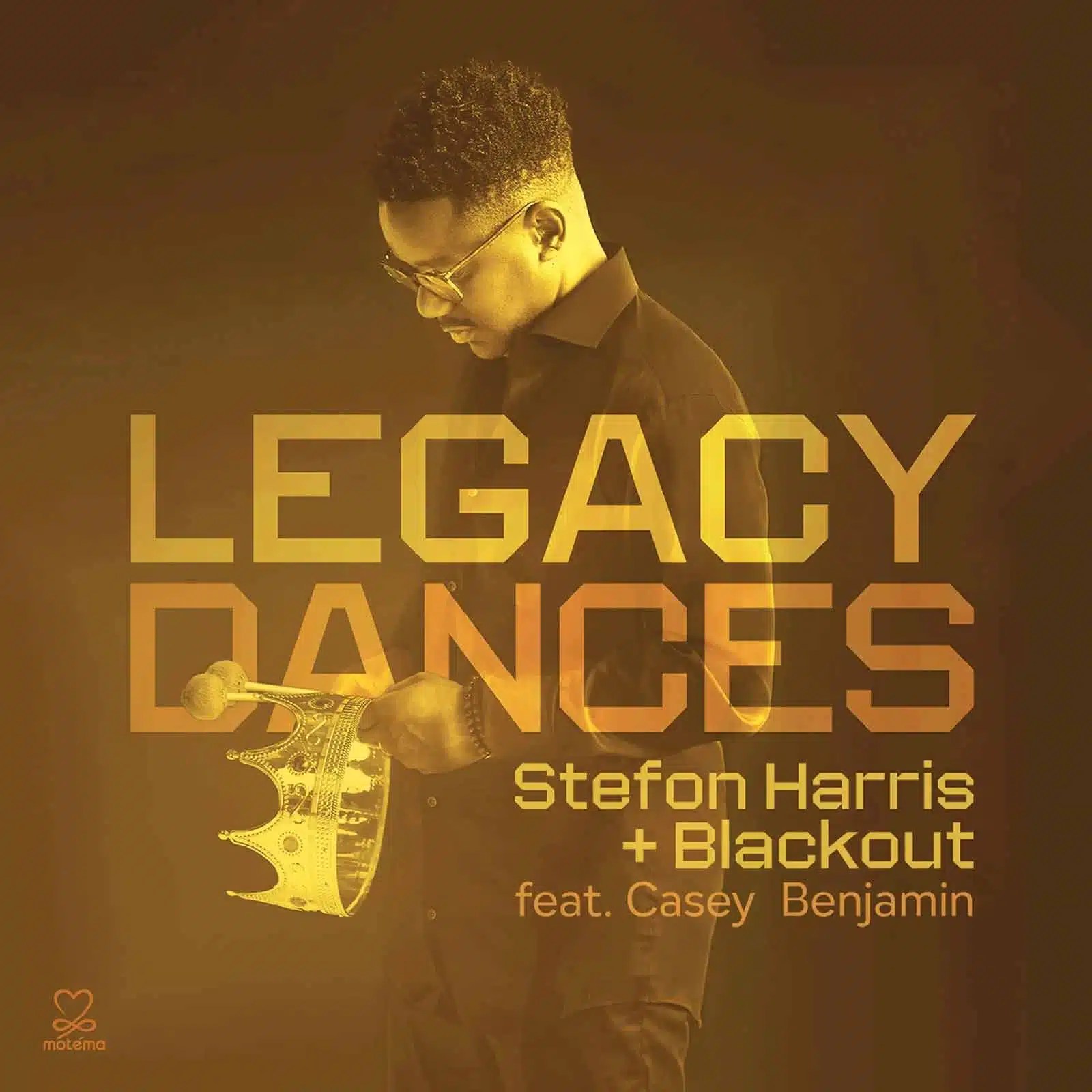
Summary: Stefon Harris’s Legacy Dances is a deeply personal jazz album honoring Casey Benjamin while exploring friendship, loss, musical innovation and the enduring evolution of jazz.
Stefon Harris, Casey Benjamin and the Music That Remains
When Casey Benjamin died suddenly in 2024, Stefon Harris lost far more than a musical collaborator. He lost a close friend, a creative partner and a musician whose presence had become deeply intertwined with his own artistic life. Benjamin’s death came at a particularly painful moment, interrupting plans to mark the twentieth anniversary of Blackout, the group they had helped build and whose music reflected their shared interest in the possibilities of contemporary jazz.
Legacy Dances, Harris’s new album, carries the weight of that loss without becoming a conventional memorial. Its subject is memory, but its musical language is firmly directed toward the present. The recording reflects Harris’s conviction that jazz remains a living art form, one that must continue to evolve if it is to remain meaningful. For him, that evolution does not mean abandoning tradition. It means understanding where tradition comes from, questioning what it has become and finding new ways to make it speak to the present.
That approach gives the album a bittersweet character. Benjamin is no longer here to participate in the conversations that shaped the music, yet his presence is unmistakable. His playing remains part of the album’s musical architecture, while his influence can be felt in the way Harris approaches sound, technology, improvisation and collaboration. The result is not an attempt to reconstruct the past. It is closer to a continuation of a conversation that was interrupted.
Harris has long approached the vibraphone as more than a vehicle for preserving a particular jazz tradition. His work draws on composition, percussion, improvisation and a broad understanding of rhythm, while maintaining a strong interest in the relationship between individual musicians and the larger ensemble. On Legacy Dances, those interests become particularly revealing because the music is inseparable from the history shared by its players.
The album does not always make an immediate attempt to win over the listener. Its arrangements can be intricate, and its ideas are allowed to develop rather than being reduced to easily digestible statements. Harris appears more interested in creating space for musicians to respond to one another than in smoothing out the music for the sake of accessibility.
That quality is important because contemporary jazz often finds itself caught between two expectations. It is expected to respect a formidable history while simultaneously demonstrating that it has something new to say. Harris does not resolve that tension by choosing one side. Instead, he works inside it.
His collaboration with Benjamin offers one of the clearest examples. The relationship between Harris’s vibraphone and Benjamin’s saxophone gives the music much of its distinctive character. Their instruments occupy very different sonic spaces, yet the contrast allows them to interact in ways that are both rhythmic and melodic. The vibraphone can create an almost orchestral field of sound, while Benjamin’s saxophone brings a more direct human voice into the arrangement. At their best, the two instruments seem less concerned with taking turns than with reshaping the music around one another.
Their interpretation of “What a Wonderful World” illustrates that approach. The song is so familiar that any new version inevitably has to confront the expectations attached to it. Harris and Benjamin do not treat the composition as something that must be protected from reinterpretation. Instead, they use its familiarity as a starting point, allowing the musicians room to explore its melodic and rhythmic possibilities. That freedom is central to the album.
The performance does not depend simply on the recognition of a well known melody. It asks what can still be discovered inside music that audiences believe they already know. The answer comes through changes in texture, phrasing and interaction, as the musicians move away from a straightforward reading and toward something more exploratory.
For Benjamin, that kind of movement between musical worlds had become a defining part of his career. It would be easy to describe him primarily through his versatility. He played alto, tenor and soprano saxophones and worked with keyboards, vocoder and aerophone. He was also a composer, arranger, producer and DJ. But the list of instruments and professional roles does not fully explain what made him distinctive.
His real strength was his ability to connect ideas that were often treated as separate. He understood electronic technology not as a replacement for musical expression but as another means of extending it. He could move between acoustic instruments and electronic textures without allowing technology to become the central attraction. The technology served the music. That instinct helped define his work with Blackout and became part of a broader approach to contemporary jazz in which improvisation could coexist naturally with electronic production.
Benjamin also possessed a particularly strong melodic sensibility. His technical abilities were considerable, but technique was never the entire point. What distinguished his playing was the way he used those abilities to construct musical ideas, often finding connections between melody, rhythm and texture that gave the music a sense of movement even when its arrangements were complex.
His absence therefore changes the meaning of Legacy Dances. The album documents a musical relationship that can no longer continue in the same form, but it also demonstrates how creative relationships can survive through recordings, compositions and the musicians who carry those ideas forward. That question of inheritance has always been central to jazz.
The music depends on memory, but it also depends on the willingness to alter what has been inherited. Musicians learn from earlier generations, absorb their vocabulary and then change it through their own experiences. A jazz tradition that could only be repeated would eventually become static. Its history remains alive because every generation is allowed to challenge it.
Harris’s own biography reflects that process. He initially imagined pursuing his musical ambitions within the classical world, including the possibility of performing with the New York Philharmonic. His discovery of Charlie Parker altered that trajectory. Parker offered Harris another conception of musical freedom, one in which technical discipline did not disappear but became the foundation for improvisation and personal expression.
That transition from the classical tradition to jazz is more significant than it might first appear. Classical training can provide musicians with an intense understanding of harmony, rhythm, ensemble playing and structure. Jazz introduces another possibility: the ability to respond to those structures in real time, to make decisions in the moment and to allow individual personality to become part of the composition itself.
For Harris, those two worlds were never necessarily opposites. The discipline of classical music and the freedom of jazz can coexist. In fact, the tension between them can become productive. A musician who understands structure deeply can take greater risks when departing from it because the underlying architecture remains present.
That idea also helps explain Harris’s connection with Benjamin. Their music was experimental, but it was not careless. Beneath the freedom was a strong awareness of composition, arrangement and musical form. Their willingness to incorporate technology and different genres did not eliminate the traditions from which they came. It expanded the vocabulary available to them.
Legacy Dances moves through those possibilities without insisting on a single definition of contemporary jazz. At different moments, the music can suggest a larger symphonic conception, then retreat into more intimate exchanges between individual players. Rhythm can become the organizing principle in one passage, while melody or texture takes over in another.
That variety gives the album its sense of movement. It also makes the recording more demanding than a conventional tribute. Harris does not appear interested in creating a comforting portrait of the past. Instead, the music recognizes that remembrance can be complicated. It can contain affection, grief, gratitude and unfinished conversations at the same time. Benjamin’s death inevitably gives the album a darker emotional dimension, but Legacy Dances does not allow that sadness to become its only story. The music continues to move. It experiments, changes direction and leaves room for uncertainty.
That may be the most appropriate way to remember a musician like Benjamin. His contribution was never simply about reproducing an established sound. It was about finding connections between different musical languages and making those connections feel natural. A tribute that merely repeated what he had already done would therefore miss something essential about his artistic personality. Harris instead uses the recording to keep that spirit of exploration alive.
The album also raises a broader question about the role of technology in jazz. Electronic instruments, digital production and new forms of musical manipulation have become increasingly common, but their presence does not automatically make a recording innovative. What matters is whether technology changes the musical possibilities available to the performers.
Benjamin understood that distinction. His work demonstrated that electronic tools could become part of the vocabulary of jazz without erasing the qualities that make the music distinctive: interaction, improvisation, rhythmic awareness and the unmistakable presence of individual musicians. That remains one of the most interesting aspects of Legacy Dances.
The album is rooted in a long history, but it does not behave like an archival document. Its references to the past are constantly being filtered through the experiences of musicians living in the present. Harris’s vibraphone, Benjamin’s saxophone and the album’s broader sonic palette create a space where tradition and experimentation are not competing ideas. They are part of the same conversation.
For listeners who approach Legacy Dances expecting a conventional tribute record, that distinction may take some time to reveal itself. The album does not always provide an obvious emotional shortcut. Some of its ideas require attention, particularly as the arrangements become denser and the musicians move between composed material and improvisation. But that patience is part of the experience. The record ultimately works because Harris does not treat Casey Benjamin’s legacy as something finished. He treats it as something that can still influence the way music is made.
That is also what gives the album its human dimension. Behind the technical discussion of instruments, arrangements and technology is a much simpler story about two musicians who spent years listening to one another, challenging one another and developing a shared understanding of music. One of them is no longer here. The other has chosen not to close the conversation.
With Legacy Dances, Stefon Harris places that friendship within the larger history of jazz, where musicians have always depended on the voices of those who came before them while searching for their own. The album acknowledges loss without allowing loss to define the music. It remembers Casey Benjamin, but it also gives his ideas somewhere to go.
For Harris, that may be the most honest way to approach both friendship and legacy. The past deserves to be remembered, but music only remains alive when someone is willing to take what has been inherited and make something new from it.
Thierry De Clemensat
Member at Jazz Journalists Association
USA correspondent for Paris-Move and ABS magazine
Editor in chief – Bayou Blue Radio, Bayou Blue News

PARIS-MOVE, August 14th, 2026
Follow PARIS-MOVE on X
::::::::::::::::::::::::
Musicians:
Stefon Harris (vibraphone, marimba)
Christian Sands (piano & keyboards)
Dezron Douglas (bass)
Terreon Gully (drums)
Casey Benjamin (sax, aerophone, vocoder)
Special guests:
Braimah “Weedie” Morris – djembe (1,4,9,10)
Anne Drummond – flute (3,6,8,11)
Oran Etkin – clarinets (3,6,8,11)
Eric Eaton – cello (3,11)
Dwayne Clark – spoken word (10)
Orchestrations for tracks 3, 6, 8 & 11 by Scott Arcangel
Track Listing:
Legacy Dances
Wonderful World (Intro)
What a Wonderful World
Echoes of the Lion
West End Blues
I Know Love
Ell’s Boogie
A Radical’s Love
Libation
We Are an African People
I Know Love [Extended Version]
On Tour :
Sep (18-21 – Date Tbc) – Jazz By The River, PA
Oct 5, 6 – Blue Note, NY, NY
Oct 13,14 – Jazz Alley, Seattle, WA
Oct 23-25 (Date Tbc) – Exit Zero Jazz Fest, Cape May, NJ