| Contemporary music |
Stephanie Lamprea and Alistair MacDonald Explore Voice, Technology and Transcendence
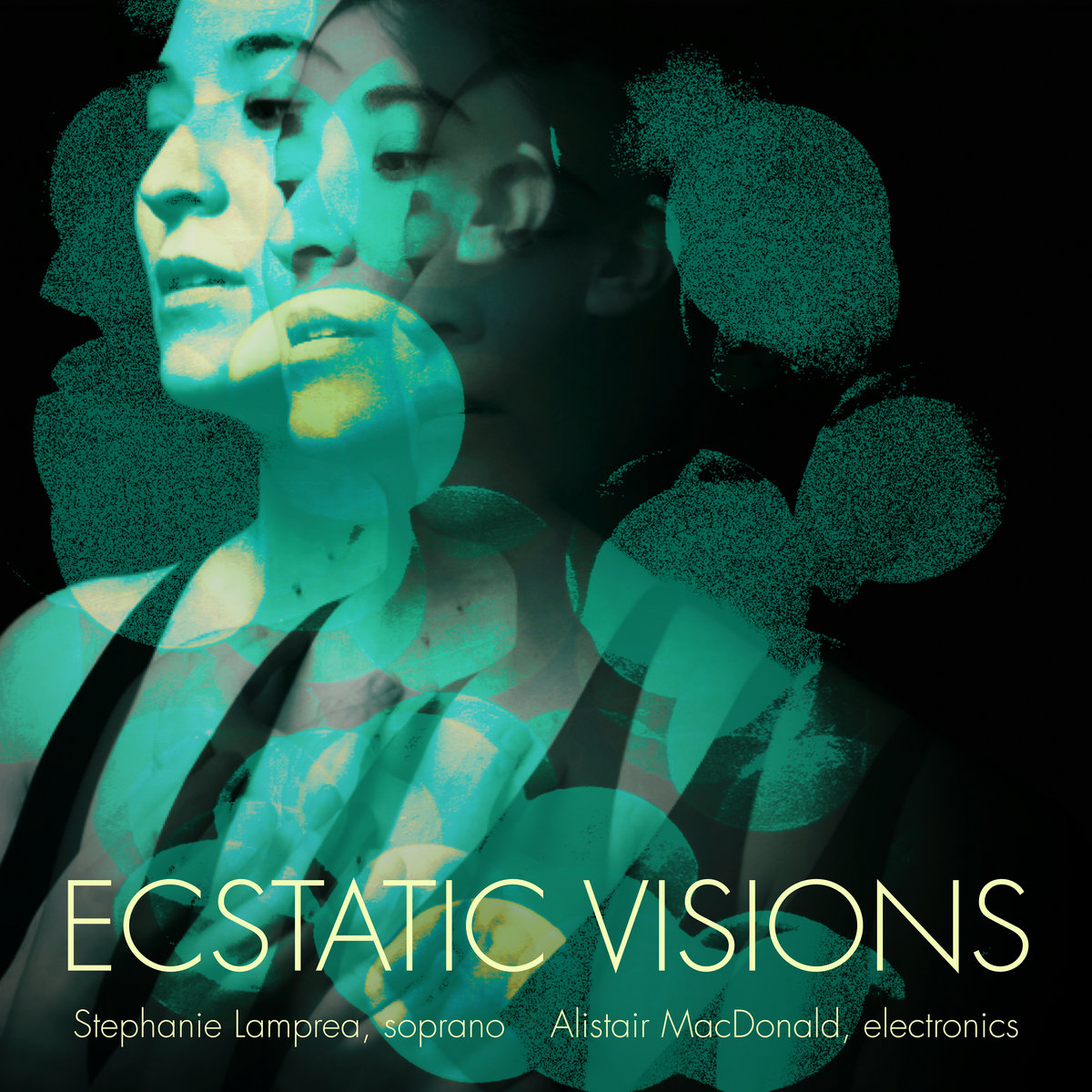
In today’s world which sometimes seems to be overtaken by the future and in which the relationship between technology and artistic expression is constantly being questioned, Ecstatic Visions arrives as one of the most thought-provoking and imaginative releases in contemporary vocal music. Created by soprano Stephanie Lamprea and composer-electronic musician Alistair MacDonald, this album is far more than a collection of modern works: it is a meditation on voice, identity, spirituality, and the evolving dialogue between human creativity and technology.
Bringing together music by five composers from different generations and aesthetic backgrounds, Ecstatic Visions explores the voice as both a physical presence and a transformative force. Across its seventy-plus minutes (!), listeners travel through medieval visions, feminist poetry, lunar symbolism, confessional literature, and speculative AI-generated mythologies. The result is challenging at times, but consistently rewarding.
From the opening moments of Angélica Negrón’s Letras para cantar, the album establishes its dreamlike atmosphere. Inspired by the poetry of the seventeenth-century Mexican writer and nun Juana Inés de la Cruz, the work unfolds as a delicate tapestry of layered voices and electronic textures. Lamprea’s performance captures both intimacy and mystery, floating effortlessly between earthly sensuality and spiritual contemplation.
The album’s centrepiece is undoubtedly MacDonald’s six-part title work, Ecstatic Visions. Drawing inspiration from the writings of Hildegard von Bingen, the twelfth-century mystic, composer, and visionary, the cycle merges ancient texts with contemporary electronic soundscapes. The inclusion of the great bell of Glasgow Cathedral gives the work a remarkable sense of space and resonance. Rather than treating electronics as accompaniment, MacDonald uses them as an extension of the voice itself, blurring the boundaries between the human body and the acoustic environment. The individual movements reveal different facets of Hildegard’s visionary world. Sacred chants emerge and dissolve into shimmering electronic clouds, while pieces such as O splendidissima gemma and Hoc Verbum effabricavit create a fascinating dialogue between medieval spirituality and twenty-first-century technology. Throughout the cycle, Lamprea demonstrates extraordinary control, navigating demanding vocal lines with apparent ease while preserving a strong emotional core.
A different kind of ritual unfolds in Wende Bartley’s Ellipsis. Structured around the phases of the moon and corresponding feminine archetypes, the work explores vocal colour and resonance in striking ways. The piece demands an impressive range of extended techniques, all delivered with remarkable conviction by Lamprea. There is something primal and deeply human in this music, even as it ventures into highly experimental territory.
Eric Chasalow’s The Fury of Beautiful Bones provides one of the album’s most emotionally immediate moments. Setting Anne Sexton’s poetry, the work compresses an astonishing amount of intensity into just a few minutes. Here, electronic manipulation serves to amplify the poem’s themes of mortality, memory, and physical existence. Lamprea’s interpretation is powerful without becoming theatrical, allowing the raw emotional force of Sexton’s words to emerge naturally.
The closing work, Robert Laidlow’s Post-Singularity Songs, may prove to be the album’s most discussed contribution. Built around texts generated through collaborations with artificial intelligence alongside references to poets such as Emily Dickinson and John Donne, the six-movement cycle imagines a post-human universe shaped by digital consciousness. What makes Post-Singularity Songs so compelling is its refusal to offer simple answers. The electronic sound world alternates between unsettling mechanistic gestures and moments of surprising lyricism, while Lamprea’s voice remains the emotional anchor. The contrast between machine-generated language and human expression becomes one of the album’s most fascinating tensions.
Throughout the recording, Stephanie Lamprea proves herself to be an exceptional advocate for contemporary vocal music. Her technical command is extraordinary, but what impresses even more is her ability to inhabit vastly different musical worlds while maintaining a strong artistic identity. Whether interpreting medieval mysticism, feminist poetry, she brings an unwavering sense of commitment and authenticity.
Alistair MacDonald’s contribution is equally significant. His electronic work never feels decorative or merely experimental. Instead, it functions as a living, breathing extension of the musical narrative, expanding the expressive possibilities of the voice while continually questioning where the human ends and technology begins.
Ecstatic Visions is not an album designed for passive listening. It asks for concentration, curiosity, and openness. Yet those willing to engage with its ambitious vision will discover a richly imaginative work that bridges centuries of thought and artistic practice. By placing Hildegard von Bingen, Juana Inés de la Cruz, Anne Sexton, and artificial intelligence within the same creative universe, Lamprea and MacDonald create a compelling reflection on how humanity continues to invent new ways of telling its oldest stories. A really GREAT album.
Frankie Pfeiffer
Editor in chief – PARIS-MOVE
PARIS-MOVE, August 12th, 2026
Follow PARIS-MOVE on X
::::::::::::::::::::::::
To buy the album on Stephanie Lamprea’s Bandcamp
To buy the album on NEUMA Records’ website
Artists/musicians:
Stephanie Lamprea: soprano
Alistair MacDonald: electronics
Tracklisting:
1.Angélica Negrón (b. 1981): Letras para cantar (2019) 11:08
2.Alistair MacDonald (b. 1962): Ecstatic Visions (2023-25): The fiery life – 04:16
3.Alistair MacDonald/Hildegard von Bingen: Ecstatic Visions – O splendidissima gemma – 02:40
4.Alistair MacDonald: Ecstatic Visions – The brightness of the stars – 02:57
5.Alistair MacDonald/Hildegard von Bingen: Ecstatic Visions – O choruscans lux stellarum – 04:05
6.Alistair MacDonald: Ecstatic Visions – Fire and moisture – 03:14
7.Alistair MacDonald/Hildegard von Bingen: Ecstatic Visions – Hoc Verbum effabricavit – 03:40
8.Wende Bartley (b. 1951): Ellipsis (1988) 14:28
9.Eric Chasalow (b. 1955): “The Fury of Beautiful Bones” from The Furies (1984) 04:07
10.Robert Laidlow (b. 1994): Post-Singularity Songs (2023-24) – Creation Myth 1: In The Beginning – 06:05
11.Robert Laidlow: Post-Singularity Songs – Creation Myth 2: The Kingdom of Dust and Decay – 04:14
12.Robert Laidlow: Post-Singularity Songs – Love – 04:26
13.Robert Laidlow: Post-Singularity Songs – Creation Myth 3: Pyron’s Return – 02:43
14.Robert Laidlow: Post-Singularity Songs – Gift – 04:42
15.Robert Laidlow: Post-Singularity Songs – Storyteller Unpearls – 01:54