| Jazz |
Nicki Adams & Michael Eaton feat. Francisco Mela – Arrival: Where Jazz Tradition Meets Fearless Reinvention
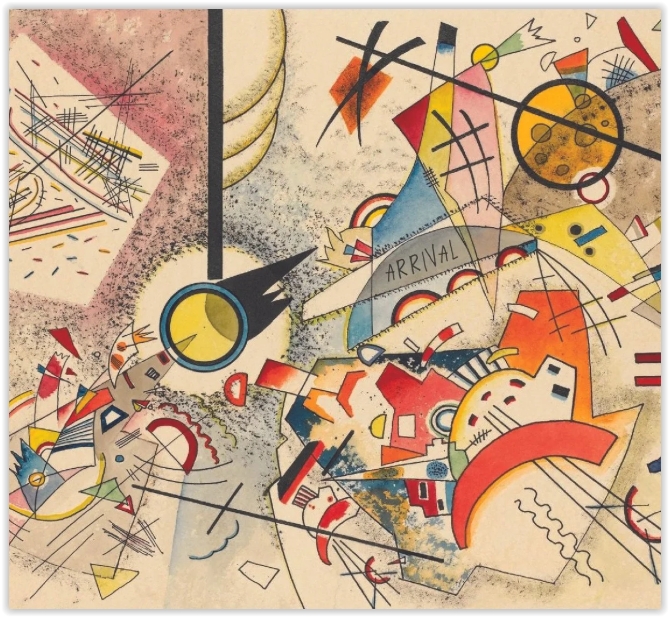
The choice of cover art for a jazz album is rarely incidental, and whoever selected Wassily Kandinsky’s Ohne Titel (“No Title,” 1923) for this record understood something important about what was inside it. Kandinsky believed that abstract form carries its own “inner sound”, that pure colour, shape and line could evoke emotion the way music does, bypassing rational explanation and speaking directly to something deeper. He was searching, in his own words, for “a universal law of harmony” at the core of every creation. It is a strikingly apt frame for Arrival, an album that operates on exactly that principle: sophisticated in its architecture, immediate in its emotional impact, and possessed of a visual-sonic logic that feels entirely its own.
The trio at the heart of this record is not a new formation so much as a natural evolution. Pianist Nicki Adams and saxophonist Michael Eaton have been building their musical conversation across acclaimed duo albums Paraphrase (Steeplechase, 2022) and The Transcendental (2024), and the rapport they have developed over that time is palpable throughout Arrival. With the addition of Cuban drummer Francisco Mela, that conversation opens up dramatically, gaining new rhythmic colour, depth and expressive range. The result is a trio with a genuinely distinctive voice, and an album that feels, in every sense, like the arrival it promises to be.
The first track of the album, the title track, sets the tone immediately and does so without hesitation. Eaton’s tenor saxophone enters with a stormy, exploratory energy, Adams’ piano drives forward with rhythmic authority, his left hand frequently conjuring bass lines that make the absence of a bassist feel not like a limitation but a deliberate aesthetic choice, recalling the self-sufficient pianistic approach of Lennie Tristano, and Mela’s drums punctuate and propel with the imaginative freedom of someone who has played with McCoy Tyner and Joe Lovano and absorbed every lesson. From the first minute, it is clear that this trio has found something worth pursuing.
Andrew Hill’s Black Sabbath follows, and the trio attacks it with high-energy drive and complete conviction. Hill’s angular, harmonically knotty writing suits them perfectly. There is the same restless intelligence at work, the same refusal to settle for the obvious. It is one of the album’s most exhilarating moments.
Daily Battles, Thom Yorke’s deceptively simple song arranged by Eaton, is a revelation. In the trio’s hands it becomes lyrical and melancholic in equal measure, Eaton’s tenor finding a vocal, almost keening quality that transforms the original into something unmistakably jazz without losing any of its emotional directness. That a piece by the Radiohead frontman should sit so naturally alongside Hill and Shorter says something important about the breadth of this trio’s musical imagination.
Cole Porter’s It’s Alright With Me, arranged by Adams, is given a fresh and inventive reading that honours the standard’s elegance while finding new angles within it. Eaton’s Discursive Regime is angular and propulsive, all sharp edges and rhythmic surprise, a showcase for the trio’s ability to navigate complex compositional terrain with spontaneous ease.
Homage, Adams’ own composition, is a highlight of a different kind, spacious and freely inspired, built around a stride piano approach that is expansive rather than nostalgic, less a backward glance than a deep bow to tradition before moving on. Eaton’s Solarity is the album’s most buoyant and swinging moment, irresistible in its forward momentum.
The centrepiece of the second half of this great album is Eaton’s Kupka Disks, the album’s longest (10:16) and most ambitious track, an episodic, extended piece that unfolds through several distinct sections and moods, its title referencing the Czech abstract painter František Kupka, another early pioneer of non-representational art. The connection to Kandinsky is not accidental: both painters, and the music here, share a belief in abstraction as a vehicle for profound emotional experience rather than mere formal experiment. Mela is especially magnificent throughout this track, his drumming by turns thunderous, delicate and perpetually inventive.
The album closes with Wayne Shorter’s ESP, arranged by Adams. A fitting conclusion, Shorter’s enigmatic, open-ended writing providing the perfect final statement for a record that has consistently privileged exploration over resolution.
Michael Eaton, Brooklyn-based and broadly curious, brings to every track a sound rooted in the jazz tradition but reaching consistently beyond it. His tenor playing has the kind of distinctive personal voice that takes years to develop, immediately recognisable in its blend of lyricism, angularity and improvisational daring. His soprano appearance adds further colour.
Nicki Adams is a complete musician in the fullest sense: pianist, composer, arranger, film scorer, producer, and on Arrival he demonstrates all of those skills simultaneously, his playing commanding, harmonically rich and rhythmically authoritative throughout.
Francisco Mela, who has shared bandstands with Kenny Barron, Esperanza Spalding, Chucho Valdés and many (many) others, brings exceptional musicianship and an almost telepathic responsiveness to the other two voices, his drumming adding momentum and colour without ever crowding the space.
Kandinsky wrote that “form itself, even if completely abstract, has its own inner sound”. Listening to Arrival, one is struck by how precisely that idea describes what Adams, Eaton and Mela are doing together: building forms (melodic, rhythmic and harmonic) that carry their own inner sound, their own emotional logic, their own quiet insistence on being heard on their own terms. The Kandinsky cover is not a decoration. It is a statement of intent. And the music inside it lives up to every word.
Arrival is sophisticated, adventurous, deeply rooted and entirely alive, a GREAT album. A milestone for all three musicians, and one of the most compelling jazz albums of 2026.
Frankie Pfeiffer
Editor in chief – PARIS-MOVE
PARIS-MOVE, August 3rd, 2026
Follow PARIS-MOVE on X
::::::::::::::::::::::::
Musicians:
Michael Eaton – Tenor and Soprano Saxophone
Nicki Adams – Piano
Francisco Mela – Drums
Nicki Adams’ website https://nickiadams.com/
Michael Eaton’s website https://michaeleatonmusic.com/home
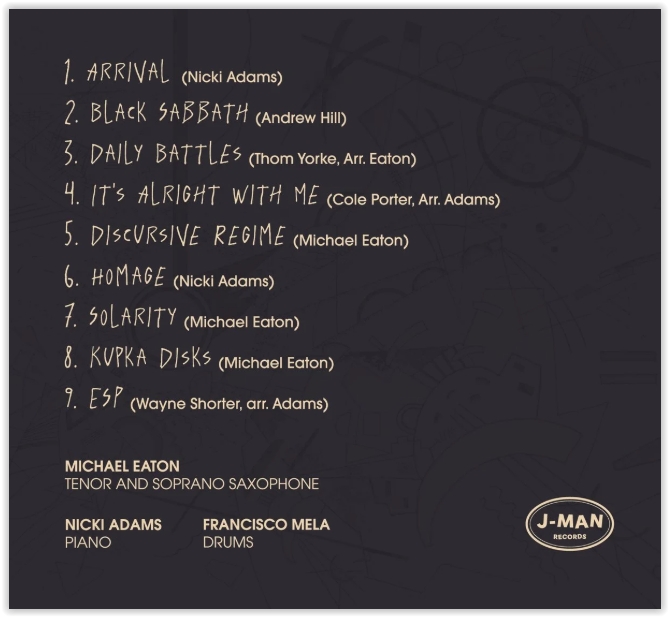
Tracklisting:
- Arrival by Nicki Adams (7:12)
- Black Sabbath by Andrew Hill (4:25)
- Daily Battles by Thom Yorke (arranged by Michael Eaton) (7:20)
- It’s Alright With Me by Cole Porter (arranged by Nicki Adams) (5:20)
- Discursive Regime by Michael Eaton (4:35)
- Homage by Nicki Adams (5:35)
- Solarity by Michael Eaton (3:56)
- Kupka Disks by Michael Eaton (10:16)
- ESP by Wayne Shorter (arranged by Nicki Adams) (5:02)
Total Album Length: 53:42
Mixed/Mastered by:Dave Darlington
Album Cover art: “Ohne Titel” by Wassily Kandinsky (1923)
Designer: Ozar Studios, Paul Razo
Recorded by: Nolan Thies at The Bunker Studio
Photo Credits: Nolan Thies