
| Jazz |
Summary: Mike Jones’s Mike Jones With Strings revisits the golden era of jazz piano trios with elegance, energy and a modern perspective. Through interpretations of Gershwin, Oscar Peterson and classic standards, Jones celebrates the legacy of Nat King Cole and the Great American Songbook while bringing this timeless music to a new generation.
Mike Jones and the Art of Making Yesterday’s Jazz Feel Alive Today
Imagine a pianist sitting at the center of a small ensemble, surrounded by musicians who understand that every note carries a memory. The challenge before them is not simply to play songs written decades ago. The real challenge is much more demanding: how do you make music from another era feel alive, immediate and meaningful for listeners who were not there when it was first created?
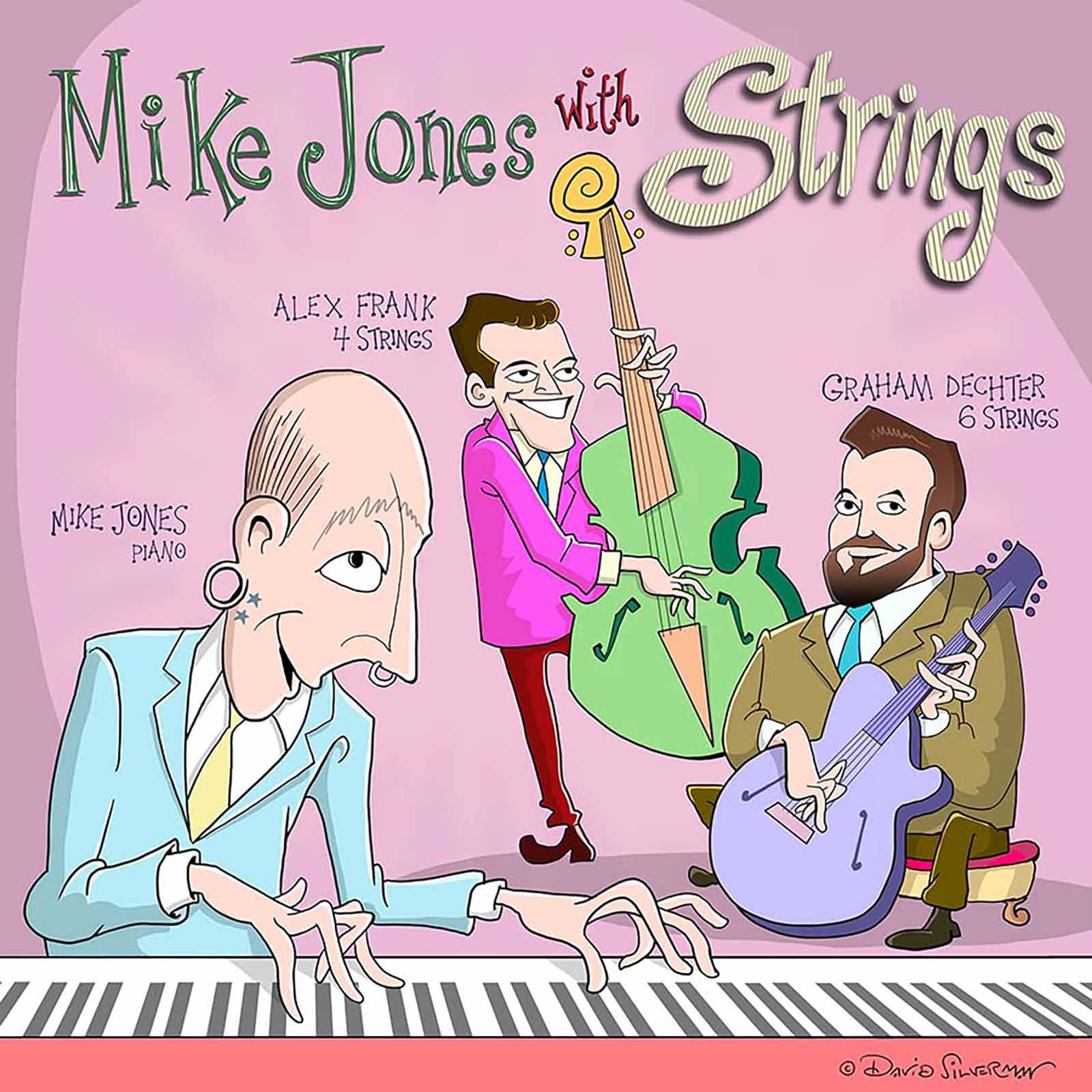
That is the artistic territory explored by Mike Jones on Mike Jones With Strings, an album that looks backward without ever becoming trapped by nostalgia. From the moment the cover appears, the listener is invited into a world that feels almost like a musical comic book, colorful, imaginative and full of personality. The artwork suggests movement and humor, preparing us for a recording built around joy, elegance and a deep affection for jazz history.
But beneath the playful surface lies a serious artistic question. In an era when jazz has often moved toward experimentation, electronic influences and new forms of expression, what does it mean for a musician to return to the language of the classic piano trios of the 1940s and 1950s? For Mike Jones, the answer is not to recreate the past. It is to start a conversation with it.
The album opens with “Lady Be Good,” the celebrated composition by George and Ira Gershwin that helped define the Great American Songbook. The choice is revealing. This is not simply a familiar standard chosen for recognition. It is a statement of purpose. Jones approaches these compositions as living material, allowing them to retain their original elegance while giving them renewed energy and personality.
Throughout Mike Jones With Strings, listeners encounter pieces connected to some of the great names of jazz history, including Oscar Peterson and other composers whose melodies have become part of the shared vocabulary of American music. Yet this project is not an exercise in imitation. Mike Jones is not attempting to become another musician from another generation. He is asking a more interesting question: what can these songs tell us when they are seen through the eyes of a contemporary artist? The answer lies in the atmosphere he creates.
The album recalls the great piano trios of the mid twentieth century, a period when small ensembles developed one of jazz’s most intimate forms of communication. There was a special chemistry between piano, bass and rhythm instruments, a balance between structure and spontaneity that allowed musicians to respond to one another almost instinctively.
There are elements here that recall gypsy jazz traditions, particularly in the rhythmic approach and the influence of guitar based techniques. The double bass provides a foundation that feels both grounded and flexible, while the piano rises above it, drawing melodic lines with clarity and warmth.
For longtime jazz listeners, the connection is immediate. The music evokes a world of late night clubs, small rooms and musicians creating something unique in the moment. But the achievement of Mike Jones is that he does not present this tradition as a historical artifact. He treats it as a language that can still communicate. That distinction is essential.
The danger of revisiting a golden era is that perfection can become a limitation. When musicians return to a highly developed tradition, they risk reproducing the surface elements without capturing the emotional tension that made the original performances so powerful.
Jazz has never been only about technical accuracy. Its greatest moments often come from uncertainty, from the subtle interaction between musicians, from the small imperfections that reveal human presence. This is why the studio recording and the concert experience can feel so different.
On a recording, the discipline of this style can sometimes create an almost academic impression. The guitar technique known as “la pompe,” with its precise rhythmic structure, is a remarkable musical achievement, but its strict nature can occasionally make the performance feel carefully controlled.
Live, however, something changes. The musicians breathe together. They react to each other. A phrase can stretch, a rhythm can shift slightly, and suddenly the music becomes less about recreating a style and more about experiencing a moment.
This is where the legacy of Nat King Cole becomes especially important. When many listeners think of Nat King Cole, they first remember the extraordinary singer, the elegant voice and the effortless sophistication. But before becoming one of America’s most beloved vocal artists, Cole was a groundbreaking pianist and the leader of one of the most influential trios in jazz history.
What made Nat King Cole revolutionary was not the absence of tension, but the way he controlled it. His trio performances contained a fascinating illusion of instability. Everything seemed perfectly balanced, yet there was always a sense that something unexpected could happen. His rhythmic intelligence created a unique conversation between the musicians, a feeling that the entire performance was moving naturally, almost without effort.
A song such as “Come To Baby Do” reveals that magic. It demonstrates the extraordinary groove that existed at the center of Cole’s playing, a combination of relaxation, precision and imagination that few musicians have ever achieved. The remarkable thing about Nat King Cole was that his complexity was hidden behind simplicity. That quality is one of the hardest things to reproduce.
Oscar Peterson represented another side of this tradition. His extraordinary technique, his speed and his ability to transform melodies into powerful musical narratives made him one of the most admired pianists of the twentieth century. But beyond the virtuosity was a deep understanding of swing and communication. Mike Jones’s project exists within this conversation. It acknowledges these giants while refusing to become overwhelmed by their presence.
That confidence has been part of Jones’s career from the beginning. His first album, Oh! Look At Me Now! released in 1994, became the best selling recording by a new artist in the history of Chiaroscuro Records. His following album, Runnin’ Wild, released in 1996, received widespread critical acclaim. Over the years, Jones continued to build his reputation through successful recordings, including a 2005 live album captured at Chicago’s legendary Green Mill, a venue where he has regularly performed in trio settings since his first appearances there in 2002.
Those achievements help explain why Mike Jones With Strings feels like a natural extension of his artistic journey. This is not a musician discovering a forgotten style. It is a musician returning to a musical language he has spent decades understanding. There is also a broader cultural meaning behind this kind of project.
At a time when much contemporary music is often shaped by technology, speed and constant transformation, there is something powerful about musicians who return to human interaction as the central element. The piano trio represents conversation. It represents listening. It represents three artists creating something together rather than simply delivering a finished product.
That may be the true importance of Mike Jones’s work. He reminds us that tradition is not the opposite of innovation. A tradition survives because each generation finds a new way to interpret it. The greatest challenge for any artist working with historical material is avoiding the temptation to preserve the past like a museum object. Music was never meant to be frozen. It was created to move, change and continue speaking. Mike Jones With Strings succeeds because it understands that yesterday’s music can still belong to today. The recording captures the architecture of this tradition. The stage reveals its heartbeat.
For anyone interested in understanding the full spirit of this project, the recommendation is simple: experience these musicians live. That is where the true conversation happens, where history becomes the present again, and where jazz proves once more that it is not a memory. It is a living language.
Thierry De Clemensat
Member at Jazz Journalists Association
USA correspondent for Paris-Move and ABS magazine
Editor in chief – Bayou Blue Radio, Bayou Blue News

PARIS-MOVE, August 2nd, 2026
Follow PARIS-MOVE on X
::::::::::::::::::::::::
Musicians :
Mike Jones, piano
Alex Frank, bass
Graham Dechter, guitar
Track Listing :
Lady Be Good
Gone With The Wind
Autumn Leaves
Kelly’s Blues
Destination Moon
Deed I Do
The Very Thought Of You
Exactly Like You