| Latin Jazz |
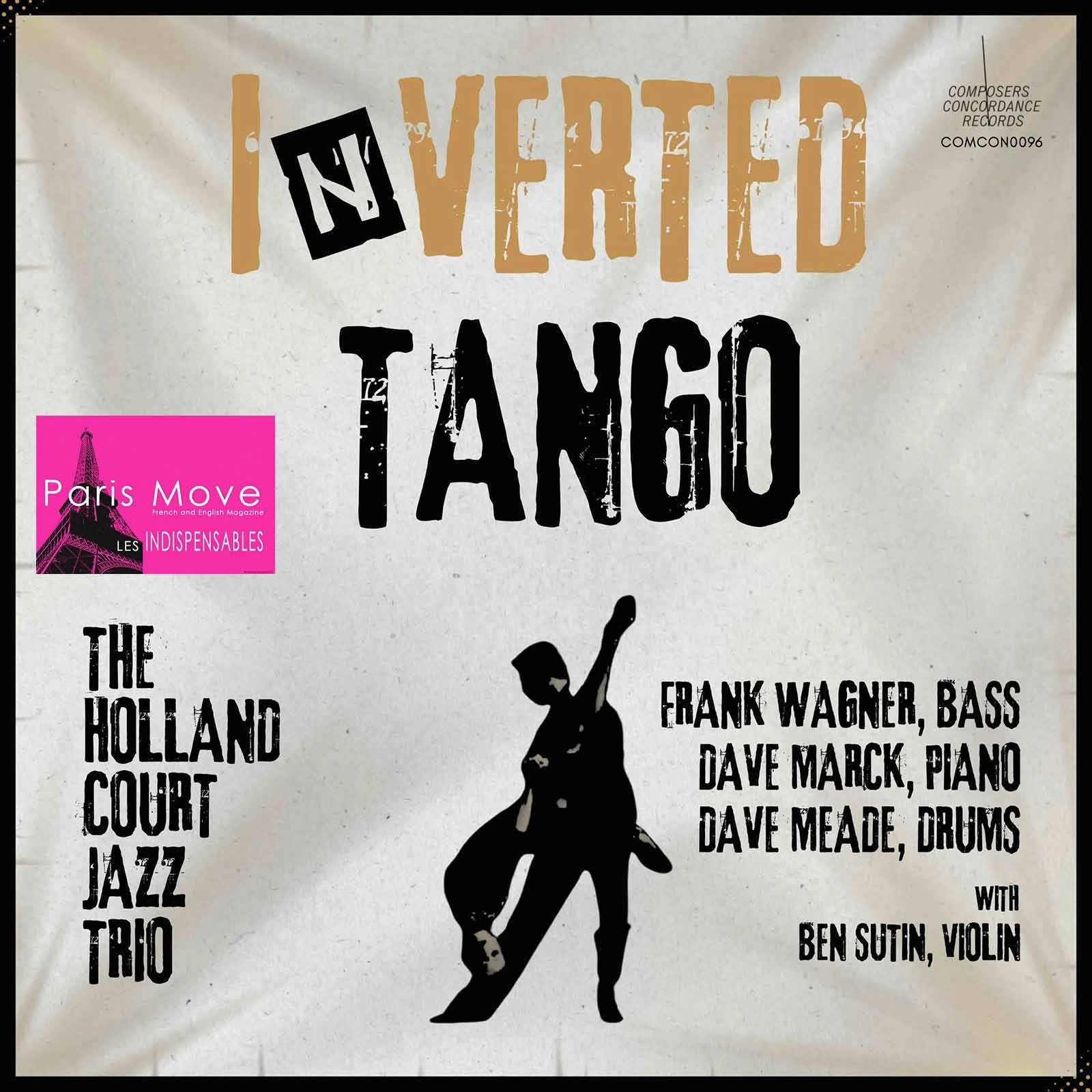
Summary: Inverted Tango by The Holland Trio is a remarkable fusion of tango, contemporary jazz, and classical influences. Led by bassist Frank Wagner, the quartet delivers an intellectually rich and emotionally compelling recording that pays tribute to Astor Piazzolla while forging its own artistic identity. More than a jazz album, Inverted Tango is a profound exploration of memory, cultural dialogue, and musical humanism.
Memory, Tango, and the Unexpected Return of Emotion
There are certain mornings when memory seems to awaken before consciousness itself. Nothing extraordinary has happened. The room is quiet, the coffee has barely begun to cool, yet an unexpected voice rises from somewhere deep within the mind. On mornings like these, it is Roberto Goyeneche who returns first. His unmistakable phrasing, suspended somewhere between speech and song, carries with it the emotional weight of an entire culture. Then comes Astor Piazzolla, whose restless imagination forever altered the vocabulary of tango without ever severing its roots. Neither presence announces itself. They simply arrive, as though they had never truly left.
Perhaps there is always a reason for such moments, even when we fail to recognize it immediately. In this case, the explanation was sitting quietly on my desk. The previous day had brought the arrival of Inverted Tango, the latest recording by The Holland Trio. I could not have anticipated that inserting the compact disc into the player would awaken not only memories of Argentine music, but an entire emotional landscape that had remained dormant for years, patiently waiting for the right artistic encounter to bring it back to life.
The finest recordings possess that rare ability. They do not merely ask us to listen. They invite us to remember. They remind us that music inhabits a curious space between memory and imagination, where personal experience and collective history become impossible to separate. One hears a melody, yet what resonates is something far greater than the succession of notes. Music becomes biography. It becomes geography. It becomes the invisible thread connecting generations of musicians who continue speaking to one another long after they have disappeared.
That realization accompanied my first encounter with Inverted Tango. Almost immediately another question emerged. Was I entering familiar territory shaped by the ghosts of Buenos Aires, or was I about to discover a musical language entirely its own? The answer proved to be both.
Frank Wagner demonstrates from the opening moments that he possesses an exceptionally deep understanding of tango, not simply as a recognizable style but as a sophisticated artistic philosophy. This distinction matters. Too many contemporary musicians approach tango as though it consisted merely of rhythmic formulas, melancholic melodies, and nostalgic gestures. Wagner understands something far more essential. Tango has always been an evolving conversation between memory and innovation, between European tradition, African rhythms, immigrant experience, and the changing cultural identity of Argentina itself. To play tango honestly is therefore to accept its complexity rather than simplify it.
From the album’s opening composition, appropriately titled Inverted Tango, Wagner makes his intentions unmistakably clear. Every phrase reflects respect for the tradition while refusing to become imprisoned by it. The familiar vocabulary of tango gradually opens itself toward another musical horizon. Without abrupt transitions or calculated effects, contemporary jazz slowly emerges from within the composition as though it had always existed there, hidden beneath the surface. The transformation feels inevitable rather than experimental.
This is perhaps the album’s greatest accomplishment. It never seeks novelty for its own sake. Instead, it demonstrates that the distance separating tango and modern jazz may have been smaller than we imagined all along.
Such artistic confidence cannot be manufactured. It comes only from musicians who have reached a level of maturity where technical mastery becomes almost invisible. Listening to Wagner, one is rarely tempted to admire virtuosity as an end in itself. The attention remains focused upon something much more elusive: intention. Every note appears necessary. Every silence carries meaning. Every change of direction feels motivated not by the desire to impress but by the desire to tell a story.
That quality has become increasingly rare within contemporary jazz. We live in an age where astonishing technical ability often overshadows emotional communication. Complexity sometimes becomes a substitute for imagination. Speed occasionally replaces reflection. Inverted Tango quietly rejects such tendencies. It demonstrates that sophistication need not announce itself through excess. True refinement often lies in restraint.
What becomes immediately apparent is that Frank Wagner does not treat the double bass merely as a rhythmic foundation. Throughout the recording, the instrument acquires an almost narrative function. At times it speaks with the authority of a storyteller. Elsewhere it becomes contemplative, almost philosophical, allowing silence and resonance to shape the emotional architecture as much as the notes themselves. Wagner understands that the double bass occupies a unique position within jazz and tango alike. It is capable of grounding harmony while simultaneously carrying melody, rhythm, and emotion. Few musicians exploit all these dimensions with such natural authority.
One could even argue that Wagner approaches composition less as a bassist than as an architect. Rather than constructing isolated pieces, he designs spaces in which conversations become possible. Jazz emerges naturally from tango. Classical echoes coexist comfortably beside Latin rhythmic traditions. Improvisation never threatens the structural integrity of the compositions because every departure ultimately serves the larger narrative.
Listening carefully, one realizes that this is not fusion in the commercial sense of the word. Nothing here feels manufactured to satisfy contemporary tastes for genre crossing. The musical dialogue arises organically because the traditions themselves possess common roots. Both jazz and tango were born from cities transformed by immigration. Both emerged from communities negotiating questions of identity, displacement, and cultural memory. Both have always balanced discipline with improvisation, structure with spontaneity, intellect with emotion.
Perhaps that explains why Inverted Tango never sounds forced. The album uncovers relationships that have always existed rather than inventing artificial connections.
As the opening composition unfolds, another impression gradually takes hold. The spirits of Astor Piazzolla and Roberto Goyeneche seem quietly present throughout the recording. Their influence is unmistakable, yet never imitated. Wagner understands the difference between homage and imitation. The greatest tribute an artist can offer predecessors is not reproduction but continuation. Piazzolla himself transformed tango because he refused to believe tradition required repetition. Wagner adopts precisely that same philosophy. His respect for history becomes the foundation upon which new ideas are allowed to flourish.
For listeners familiar with the great recordings of Argentine tango, these echoes create moments of profound emotional recognition. Yet the album remains entirely accessible to those discovering this musical world for the first time. Indeed, that may be one of its quiet triumphs. It neither excludes newcomers through excessive reverence for tradition nor alienates experienced listeners through superficial modernization. Instead, it invites both audiences into the same conversation.
The result is music that feels remarkably generous.
Rather than asking listeners to admire its intelligence from a distance, Inverted Tango welcomes them into its emotional universe with unusual warmth. One senses throughout the recording a profound confidence that genuine artistic complexity never requires elitism. The most sophisticated works often remain the most deeply human.
That humanity may ultimately prove to be the album’s defining characteristic. Beneath its elegant arrangements and remarkable musicianship lies something increasingly uncommon in contemporary artistic production: genuine generosity toward the listener. Wagner and his collaborators never perform at their audience. They perform with them, inviting participation through curiosity rather than demanding admiration through display.
Long before the final notes of the opening pieces have faded, one realizes that Inverted Tango is not simply another jazz recording inspired by Argentine traditions. It is something considerably more ambitious. It is an exploration of memory itself, examining how cultures continue speaking across time through music, and how each new generation inherits not only melodies but ways of understanding the world.
The journey, however, has only begun. If Frank Wagner establishes the philosophical foundations of the album, it is through the remarkable interplay of the entire ensemble that those ideas acquire their full expressive power.
Where Tango Meets Contemporary Jazz
If the opening pages of Inverted Tango establish its philosophical landscape, the album’s heart reveals itself through conversation. Not conversation in the ordinary sense, but the kind that exists only between musicians who have learned to trust one another so completely that listening becomes more important than speaking. Every composition on this recording unfolds less like a succession of solos than as an exchange of ideas, each voice responding, questioning, and occasionally challenging the others with remarkable subtlety.
That sense of dialogue becomes immediately apparent with the second composition, Hi Ya. At first encounter, one is tempted to focus on the rhythmic sophistication of the piece. Yet repeated listening reveals something far richer. Rhythm is not simply the engine driving the music forward. It is the language through which the ensemble defines its collective identity.
Jazz and tango have always shared an intimate relationship with rhythm, although they express it differently. Tango cultivates tension, elegance, and restraint. Jazz embraces elasticity, surprise, and perpetual reinvention. In Wagner’s hands these contrasting traditions cease to oppose one another. Instead, they begin to breathe together.
The melodic architecture constructed by pianist Dave Marck illustrates this beautifully. His phrases carry unmistakable Latin inflections without ever becoming predictable. At moments they seem to glance toward Buenos Aires before turning unexpectedly toward Bill Evans, Keith Jarrett, or the harmonic openness of European contemporary jazz. These influences are never quoted directly. Rather, they are absorbed into a musical vocabulary that belongs entirely to the quartet.
Marck’s arrival within the ensemble deserves particular attention. Every established group eventually faces a decisive moment when a new musician joins its ranks. Such changes often disrupt carefully balanced chemistry. Here the opposite occurs. Marck expands the ensemble’s expressive possibilities while preserving its identity. His touch combines exceptional refinement with remarkable imagination. He understands that silence possesses as much expressive value as sound itself. His lyrical sensibility softens the sharper rhythmic contours without ever diminishing their energy.
Perhaps his greatest quality lies in his refusal to dominate the music. In an era where pianists are frequently encouraged to display technical brilliance at every opportunity, Marck consistently chooses conversation over demonstration. His improvisations emerge naturally from the surrounding musical landscape, enriching the narrative rather than interrupting it.
Equally indispensable is drummer Dave Meade, whose contribution extends far beyond timekeeping. To describe him merely as the ensemble’s drummer would underestimate both his role and his artistry. Throughout the recording he functions simultaneously as percussionist, colorist, and dramatic architect. Every brushstroke, cymbal accent, and rhythmic displacement appears carefully considered without ever sounding calculated.
Listening closely, one cannot help admiring the extraordinary balance between precision and spontaneity that characterizes his playing. There is something almost architectural about his rhythmic imagination, yet it never loses its human warmth. Like the finest craftsmen, he conceals immense technical sophistication beneath apparent simplicity.
One is reminded of the old observation that the greatest drummers are often those whom listeners notice last, not because they lack personality but because their musical intelligence permeates the entire performance. Meade belongs firmly within that tradition. He shapes the emotional climate of each composition while allowing the music itself to remain at the center.
The remarkable cohesion between Wagner, Marck, and Meade creates the foundation upon which the album’s most distinctive voice ultimately emerges. That voice belongs to violinist Ben Sutin. His presence fundamentally transforms the recording’s musical identity. The violin has occasionally occupied a place within jazz history, from Stéphane Grappelli to Jean Luc Ponty and beyond, yet it remains a comparatively rare instrument within contemporary jazz ensembles. Here it performs an even more significant role. Rather than functioning as decorative color, Sutin’s violin becomes the emotional bridge linking several musical civilizations.
Its timbre naturally recalls the lyrical melancholy of Argentine tango while simultaneously evoking European chamber music and the freedom of modern improvisation. The result is an extraordinary sense of continuity. Musical traditions that might appear distant on paper suddenly reveal their shared emotional vocabulary.
Sutin’s playing never seeks theatrical effect. Instead, he allows the instrument to sing with remarkable restraint. His lines often appear suspended between longing and serenity, carrying emotional weight without descending into sentimentality. This balance proves essential to the album’s overall character. Excessive romanticism would have reduced the music to nostalgia. Excessive abstraction might have sacrificed its emotional accessibility. Sutin consistently finds the delicate equilibrium between these extremes.
Nowhere does the ensemble’s collective imagination become more evident than in Wagner’s remarkable arrangement of Jimi Hendrix’s Manic Depression. Reinterpreting such an iconic work always involves considerable artistic risk. Too often these exercises become little more than respectful reproductions or unnecessarily radical deconstructions. Wagner wisely avoids both extremes. Instead, he approaches Hendrix not as a monument to be preserved but as a composer whose restless creative spirit remains profoundly compatible with the adventurous language of contemporary jazz. The result is startling.
Rather than disguising the composition beneath layers of sophistication, the quartet uncovers dimensions already latent within the original. Harmonic tension, rhythmic instability, and emotional urgency acquire entirely new forms without sacrificing the rebellious energy that made Hendrix’s music so compelling in the first place.
Here once again Dave Meade proves extraordinary. His performance demonstrates not simply technical versatility but genuine stylistic empathy. He understands that changing genres requires more than changing rhythms. It demands inhabiting a different emotional landscape. His playing captures the raw energy of Hendrix while integrating it seamlessly into the quartet’s broader musical language.
Yet perhaps the emotional summit of the album arrives with Phrygian Natural Six. The composition opens with Frank Wagner alone. What follows is among the most memorable moments on the entire recording. The double bass, played first with extraordinary restraint before Wagner introduces the bow, ceases to function as accompaniment. It becomes voice. It becomes memory. One hears echoes not only of classical string literature but of Argentine milongas, forgotten dances, and centuries of musical migration stretching across continents. This opening possesses an almost liturgical quality. Time appears suspended. Silence becomes as expressive as resonance.
When the remaining musicians finally enter, they do so with remarkable patience, allowing Wagner’s meditation to continue unfolding rather than interrupting it. The ensemble understands that profound musical moments cannot be hurried. They must be allowed to breathe according to their own internal logic.
It is here that one most clearly senses the invisible presence of Astor Piazzolla. Not because Wagner imitates his predecessor, but because both musicians share the same conviction that tango can absorb influences without losing its soul. Piazzolla expanded tango by refusing to protect it from change. Wagner extends that tradition through equally fearless curiosity.
Repeated listening also reveals another essential quality of Inverted Tango. Its arrangements reward attention. This is not music that exhausts itself after a single hearing. On the contrary, every return uncovers details that initially escaped notice. A subtle rhythmic displacement. An unexpected harmonic color. A brief dialogue between piano and violin. A silence whose dramatic significance only becomes apparent in retrospect.
Such richness distinguishes enduring works from merely impressive ones. Great recordings reveal themselves gradually because they trust the intelligence of their audience. Inverted Tango belongs confidently within that tradition.
By the conclusion of these central compositions, one begins to understand that Wagner and his collaborators have achieved something far more ambitious than a successful meeting of jazz and tango. They have created a musical language where tradition becomes movement rather than monument, where every influence serves creation instead of imitation, and where virtuosity always remains subordinate to expression.
The final question, however, extends beyond music itself. Why does such artistic dialogue matter today? Why do these encounters between cultures continue to move us so profoundly? To answer that question, one must leave the recording studio for a moment and accompany a young French philosopher walking into Harlem in the winter of 1947, where she would discover something about jazz that continues to illuminate our understanding of music nearly eighty years later.
Jazz, Humanism, and the Echo of Simone de Beauvoir
There are moments when a work of art transcends the limits of its own medium. A novel becomes a meditation on history. A painting becomes an inquiry into memory. A film becomes a philosophical reflection on time itself. The finest jazz recordings occasionally achieve something similar. They cease to be collections of compositions and instead become conversations about civilization, identity, and the endlessly evolving dialogue between cultures. Inverted Tango belongs to that rare category.
Its achievement lies not merely in the extraordinary musicianship displayed by Frank Wagner and his collaborators, impressive though that may be. Its deeper accomplishment is that it quietly reminds us why music has always occupied a unique place within human culture. Unlike language, music crosses borders without requiring translation. Unlike ideology, it does not seek agreement before inviting participation. It asks only that we listen. Perhaps this explains why the album continually evokes reflections that reach beyond the recording itself.
While listening, I found myself returning to the pages of Simone de Beauvoir’s remarkable travel journal America Day by Day. Arriving in the United States shortly after the Second World War, she encountered a nation both exhilarating and contradictory. Yet among her most enduring memories was an evening spent in Harlem, at the legendary Savoy Ballroom in February 1947.
There she experienced something that forever transformed her understanding of jazz. She later observed that nowhere could jazz discover its truth more completely than in dance itself. That sentence has often been interpreted simply as an observation about rhythm. It deserves a far deeper reading.
For Beauvoir, jazz represented freedom not because it rejected structure, but because it transformed structure into possibility. Improvisation did not abolish discipline. It liberated it. Individual expression became meaningful precisely because it emerged within a shared language understood by every musician participating in the conversation.
Listening to Inverted Tango, one cannot help recognizing that same principle at work. Every member of the ensemble enjoys complete artistic freedom. Yet none performs in isolation. Each phrase gains meaning because another musician answers it. Every silence invites a response. Every improvisation becomes an act of collective trust. In that sense, Wagner’s quartet embodies one of jazz’s oldest and most enduring ideals. Freedom is never solitary. It is relational. The same could be said of tango itself.
Popular imagination has often reduced tango to melancholy, nostalgia, or sensuality. Those qualities undoubtedly exist, yet they reveal only part of its identity. Tango emerged from one of history’s great cultural crossroads. Buenos Aires absorbed influences arriving from Italy, Spain, Eastern Europe, Africa, and countless other traditions. Languages mixed. Musical vocabularies overlapped. New identities gradually emerged. Jazz followed a remarkably similar path.
Born from African American experience while embracing European harmony, Caribbean rhythm, blues, gospel, and countless regional traditions, jazz became one of history’s most powerful demonstrations that artistic greatness often emerges where cultures meet rather than where they remain isolated. Perhaps this explains why the encounter between jazz and tango within Inverted Tango feels so completely natural.
The album does not manufacture dialogue. It simply allows two neighboring histories finally to recognize one another. Frank Wagner appears fully aware of this historical continuity. Throughout the recording he resists every temptation toward easy nostalgia. The past is never treated as sacred territory requiring preservation behind museum glass. Instead, history functions as living material, something capable of growth, reinterpretation, and renewal. That distinction is essential.
Tradition survives not because artists repeat it faithfully, but because they possess the courage to continue it creatively. Astor Piazzolla understood this. His innovations were initially criticized by those who believed tango should remain untouched. History eventually demonstrated the opposite. Today his music represents not the destruction of tradition but one of its greatest renewals. One suspects that Wagner shares precisely the same confidence. Rather than asking permission from the past, he enters into dialogue with it. The result never sounds revolutionary for the sake of revolution. Instead, it sounds inevitable. As though these musical conversations had always been waiting to occur.
There is also something profoundly humane about this recording. Not human merely in the emotional sense, although emotion certainly permeates every composition. Rather, human in the philosophical sense. One hears musicians listening before speaking. One hears restraint replacing vanity. One hears curiosity triumphing over certainty. These qualities have become surprisingly uncommon, not only within music but within contemporary public life itself. Perhaps this explains why the album feels quietly hopeful.
Its optimism does not arise from naïve celebration. It emerges from the simple demonstration that meaningful dialogue remains possible. Cultures need not erase one another in order to coexist. Traditions need not compete in order to flourish. Originality need not reject inheritance.
The finest moments of Inverted Tango remind us that creativity rarely begins with isolation. It begins with listening. This lesson extends well beyond jazz. One might even argue that the recording offers a subtle response to our increasingly fragmented cultural landscape.
Too often contemporary debate presents identity as something fixed, exclusive, and permanently divided into opposing camps. Music has always proposed another possibility. Every significant musical tradition is itself the product of encounter. Classical music absorbed folk melodies. Jazz transformed blues, gospel, European harmony, and African rhythm. Tango united continents within a single city. Rock borrowed from rhythm and blues, country, and jazz. Every tradition worthy of preservation once began as an act of cultural exchange.
Inverted Tango quietly reminds us of that historical truth. Its greatest achievement may therefore lie not in its remarkable performances, nor even in its sophisticated arrangements, but in its generosity of vision. The album trusts its audience. It assumes that listeners remain capable of patience, curiosity, and intellectual engagement. Such confidence deserves admiration.
There was a time when serious listening formed part of our broader cultural education. Albums were experienced from beginning to end. Silence between movements possessed meaning. Repeated listening revealed hidden architecture. One left the music changed. Inverted Tango invites precisely that kind of encounter. It rewards attention rather than distraction. It asks us to slow down in an age increasingly devoted to speed. It encourages contemplation rather than consumption. That alone makes it an unusual artistic statement.
By the final notes, one realizes that this recording has never been concerned merely with combining tango and jazz. Its true subject is continuity. The continuity of memory. The continuity of artistic curiosity. The continuity of cultures speaking to one another across generations. Listening becomes an act of remembrance as much as discovery.
The voices of Roberto Goyeneche and Astor Piazzolla, present only as distant echoes at the beginning of this journey, have never disappeared. Neither have Duke Ellington, Charles Mingus, Bill Evans, nor the countless anonymous musicians who carried their traditions forward without expecting recognition. Their presence survives because each generation chooses not simply to preserve what it inherited, but to enlarge it. Frank Wagner, Dave Marck, Dave Meade, and Ben Sutin have accomplished precisely that. They have not attempted to recreate yesterday’s music. They have written tomorrow’s conversation using yesterday’s language. That is a far more demanding achievement. It is also a far more enduring one.
Great recordings entertain. Exceptional recordings illuminate. The rarest recordings transform the way we hear everything that follows. Inverted Tango belongs confidently among them. It reminds us that music reaches its highest purpose not when it confirms what we already know, but when it gently persuades us that the world is larger, richer, and infinitely more interconnected than we had imagined.
In an age increasingly tempted by certainty, this quartet offers something infinitely more valuable. It offers curiosity. And curiosity, as every great jazz musician understands, has always been the beginning of freedom.
Thierry De Clemensat
Member at Jazz Journalists Association
USA correspondent for Paris-Move and ABS magazine
Editor in chief – Bayou Blue Radio, Bayou Blue News
PARIS-MOVE, August 1st, 2026
Follow PARIS-MOVE on X
::::::::::::::::::::::::
Musicians :
Frank Wagner – Bass
Dave Marck – Piano
Dave Meade – Drums
Featuring:
Ben Sutin – Violin (1, 3, 6-8)
Track Listing :
Inverted Tango
Hi-Ya
Phrygian Natural Six
A Flower is a Lovesome Thing
Invisible Enemy
Domenica Canta
Quiet Room
Manic Depression