
| Jazz, Swing |

A masterclass in contemporary swing, melodic invention and collective artistry
What exactly is swing? It is one of the most frequently used, and perhaps least adequately defined, words in jazz. Swing is not simply a rhythmic pattern or a style inherited from the great bands of the 1930s and 1940s. It is a feeling, an irresistible forward momentum, a living pulse created collectively by musicians who listen as much as they play. Swing is conversation. It is movement. It is freedom within structure. And above all, swing cannot be manufactured. It either happens, or it doesn’t.
On En équilibre, the eighth album by the French quartet Mystère Trio 4tet, it happens from the very first note.
After more than twenty-five years of musical collaboration, guitarist Cyril Salvagnac and drummer Laurent Meyer, joined by long-time collaborator Fabrice Camboulive on double bass and newcomer Tom Bernus on guitar, deliver an album that perfectly illustrates how contemporary swing can evolve without ever losing its soul.
This is not music imprisoned by tradition. It honours the legacy of Django Reinhardt, Count Basie and Duke Ellington, while opening wide the doors to Latin rhythms, Afro-jazz, Mediterranean colours, Balkan influences and modern jazz harmony. Rather than juxtaposing styles, Mystère Trio 4tet blends them naturally into a musical language that belongs entirely to the group.
The title En équilibre (“In Balance”) could hardly be more appropriate. Every aspect of the quartet seems perfectly balanced: virtuosity and lyricism, rhythmic energy and melodic elegance, individual expression and collective dialogue. Few ensembles manage to achieve such equilibrium.
One of the album’s greatest achievements lies in its understanding of what swing truly means. Swing is not simply about playing “long-short” eighth notes. It is the subtle elasticity of the beat. It is the groove that makes listeners unconsciously tap their feet before they even realise why. Most importantly, swing emerges through interaction. Throughout En équilibre, every musician constantly listens, reacts and responds. A phrase introduced by one guitar is immediately answered by the other. The double bass reshapes the harmonic direction. The drums colour the conversation with perfectly judged accents, brushes and percussive textures. Nothing feels predetermined. The music breathes naturally, and that organic sense of movement gives the entire album an infectious vitality.
The arrival of Tom Bernus marks a fascinating new chapter in the group’s history. Rather than competing, Bernus and Cyril Salvagnac complement each other beautifully. Their guitars weave around one another with remarkable elegance. Sometimes they perform intricate harmonised melodies, sometimes they engage in joyful musical conversations where ideas bounce effortlessly from one instrument to the other. Their electric guitar sound is warm, transparent and remarkably expressive. There is virtuosity throughout the album, but never virtuosity for its own sake. Every solo tells a story, every melodic line serves the composition. The result recalls the finest traditions of guitar dialogue while sounding unmistakably contemporary.
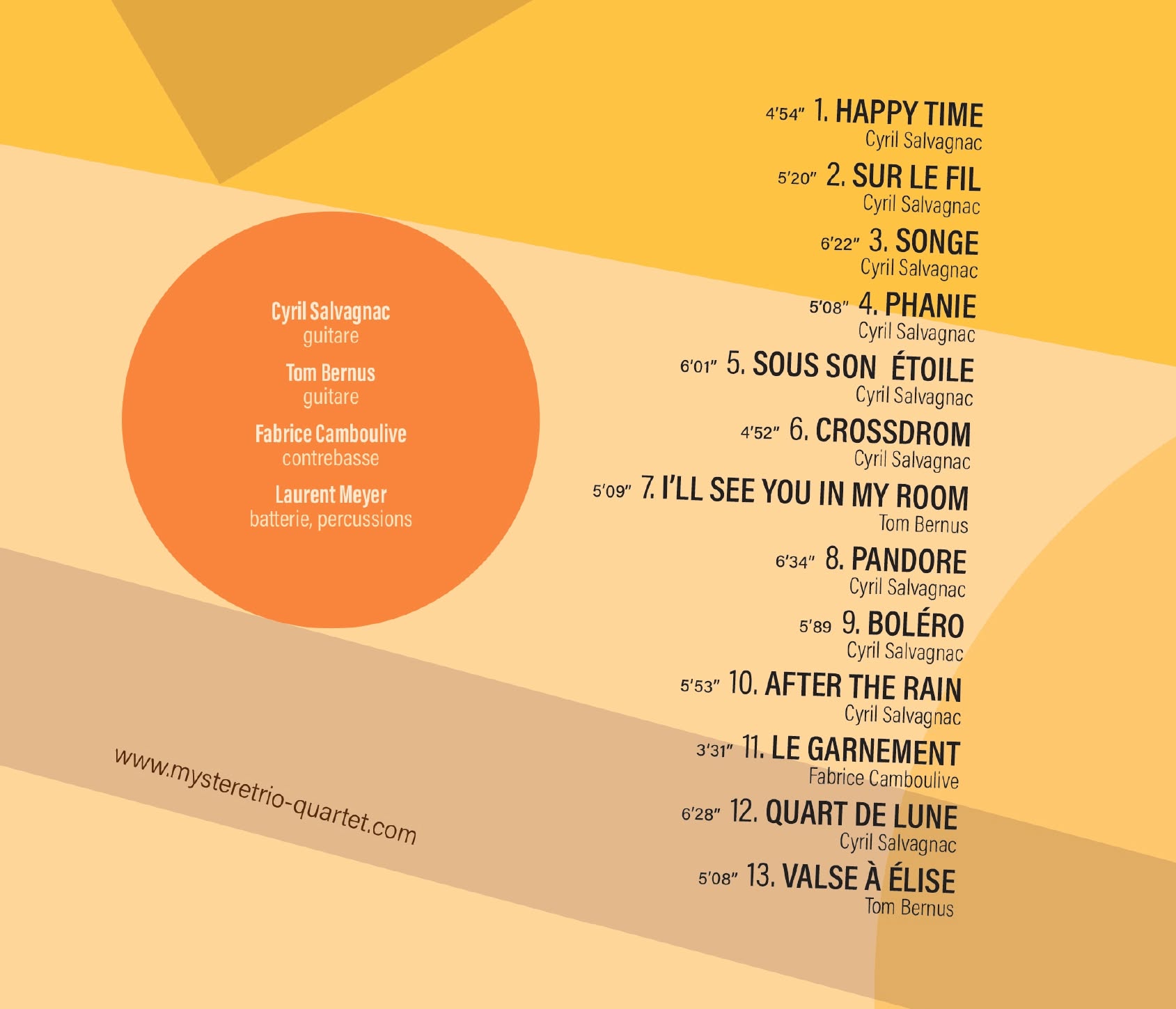
One of the album’s greatest strengths is the quality of its writing. The thirteen original compositions avoid predictable structures while remaining immediately accessible. Ten pieces come from the pen of Cyril Salvagnac, whose gift for memorable melodies and sophisticated harmonic movement shines throughout the recording. His compositions possess an effortless sense of flow, balancing lyrical themes with open spaces for improvisation.
The two compositions by Tom Bernus reveal another aspect of the quartet’s musical personality, bringing fresh harmonic colours and rhythmic ideas while integrating seamlessly into the album’s overall aesthetic. The contribution by bassist Fabrice Camboulive adds yet another dimension, confirming that composition is very much a collective strength within the group.
Although every track has its own character, the album unfolds like a single musical journey, with each composition naturally leading into the next.
Behind the elegance of the guitars lies one of the album’s greatest assets: its rhythm section. Fabrice Camboulive is much more than an accompanist. His double bass sings. Whether laying down irresistible walking bass lines, introducing lyrical countermelodies or subtly steering the harmonic direction, he provides the quartet with both its foundation and its heartbeat.
Alongside Fabrice, Laurent Meyer delivers a masterclass in modern jazz drumming. His brushwork is exquisite. His ride cymbal generates an effortless swing. His command of dynamics allows every composition to breathe. Equally comfortable behind a traditional drum kit or adding colours through percussion, Meyer understands one of jazz’s greatest secrets: sometimes the most powerful notes are the ones left unplayed.
Together, Camboulive and Meyer create the kind of rhythmic elasticity that defines great jazz. The groove never disappears. It simply changes shape.
Many contemporary jazz recordings celebrate technical brilliance. En équilibre reminds us that melody remains the true language of great music. The quartet never overwhelms the listener with unnecessary complexity. This remarkable sense of restraint gives the album enormous emotional depth. Repeated listening continually reveals new details: subtle harmonic colours, delicate rhythmic conversations and beautifully crafted interactions between the four musicians.
Trying to classify En équilibre quickly becomes impossible.
Is it Gypsy jazz? Contemporary swing? World jazz? Latin jazz? Modern European jazz?
The answer is all of these, and none of them. Mystère Trio 4tet has gradually developed a musical identity that transcends categories. Their music is rooted in jazz tradition but refuses to be confined by it. Instead, it celebrates openness, curiosity and the joy of musical exploration. Every influence becomes another colour on an already rich artistic palette.
Perhaps what makes En équilibre so convincing is the extraordinary history behind it. Since its formation in Toulouse in 1998, Mystère Trio has performed well over a thousand concerts and released a succession of increasingly ambitious albums. Such longevity cannot be manufactured. It creates the intuitive understanding that only years of playing together can produce. Even with the arrival of Tom Bernus, the quartet sounds remarkably cohesive. The new guitarist brings fresh energy while fully embracing the group’s collective identity. That balance between continuity and renewal mirrors the album’s title perfectly.
At a time when many ensembles either imitate the past or reject tradition altogether, Mystère Trio 4tet chooses a far more interesting path. Their music honours jazz history while speaking entirely in the present tense. This is swing for the twenty-first century. Elegant but adventurous. Accessible yet sophisticated. Deeply rooted yet constantly evolving.
Listening to En équilibre quickly becomes an uplifting experience. The album radiates joy, generosity and musical intelligence. Its melodies linger in the memory. Its grooves invite movement. Its improvisations continually surprise. Most importantly, it reminds us why swing has survived for over a century: because it remains one of the most direct and joyful ways musicians can communicate with one another, and with their audience.
With En équilibre, Mystère Trio 4tet has produced not only one of its finest recordings to date, but also one of the most engaging contemporary swing jazz albums of recent years. It is an album rich in melody, elegance, virtuosity and humanity.
Above all, it is music that smiles. And that may be the greatest compliment one can pay to any jazz recording.
Frankie Pfeiffer
Editor in chief – PARIS-MOVE
PARIS-MOVE, July 27th, 2026
Follow PARIS-MOVE on X
::::::::::::::::::::::::
.
Musicians:
Cyril SALVAGNAC: guitar
Tom BERNUS: guitar
Fabrice CAMBOULIVE: double bass
Laurent MEYER: drums, percussions