| Jazz |
There are moments in jazz history when a musician’s passing leaves more than an empty chair on the bandstand. It creates a silence that can only be answered by those artists who possess both the artistic maturity and the humility to revisit an extraordinary legacy without attempting to replace it. Sonny Rollins was one of those rare figures. His towering body of work remains a cornerstone of modern jazz, not because it belongs to the past, but because it continues to challenge every generation of musicians willing to engage with its brilliance.
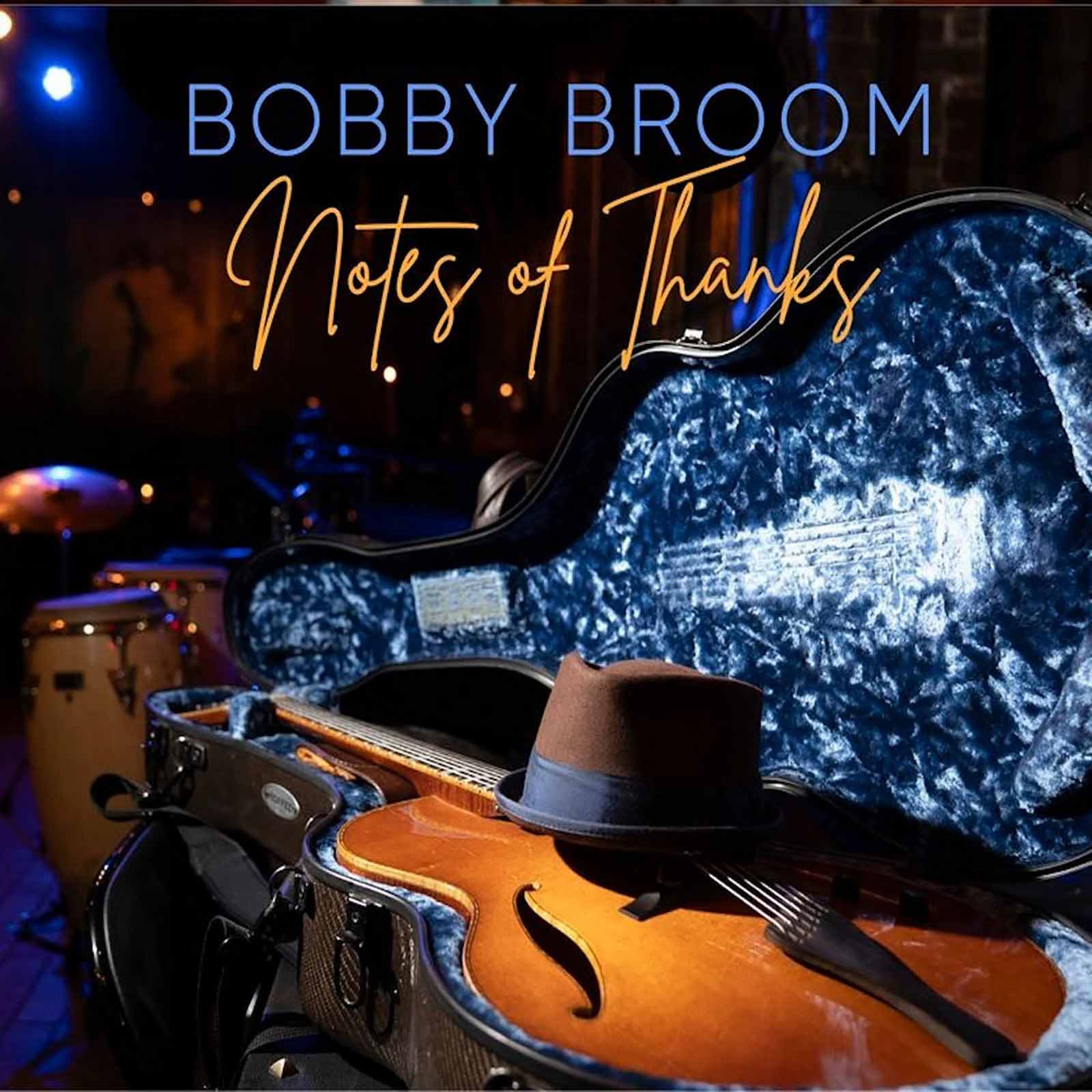
Rather than treating Rollins’ music as sacred museum pieces, guitarist Bobby Broom approaches it as living, breathing art. Notes of Thanks is neither a tribute album in the traditional sense nor an exercise in nostalgia. Instead, it is a deeply personal conversation between one master improviser and another, separated by instruments but united by a shared commitment to melody, rhythm and fearless musical exploration.
Translating Rollins’ unmistakable tenor saxophone vocabulary to the guitar is no small undertaking. Rollins built his reputation on an astonishing command of phrasing, harmonic invention and rhythmic freedom, qualities that naturally belong to the human voice and the saxophone’s expressive range. Reimagining those ideas on six strings demands much more than technical proficiency. It requires imagination, restraint and the confidence to let the music evolve rather than simply imitate its original form.
Broom succeeds precisely because imitation is never his objective. Throughout Notes of Thanks, he honors Rollins’ spirit while allowing his own artistic identity to guide every phrase. The result is a recording that feels remarkably fresh, offering familiar compositions through a completely different emotional lens.
For listeners who may only know Bobby Broom by reputation, his career has quietly become one of the most distinguished in modern jazz. Over several decades he has worked alongside an extraordinary list of musical giants, including organ master Charles Earland, jazz icon Miles Davis, tenor saxophone legend Stanley Turrentine, trumpet revolutionary Dizzy Gillespie and New Orleans musical visionary Dr. John, whose band Broom served from 1994 through 1999.
Those collaborations reveal a musician who has never confined himself to stylistic boundaries. Gospel, bebop, blues, soul, funk and straight ahead jazz all coexist naturally in his playing. That breadth of experience explains why Notes of Thanks never feels like an academic exercise. Tradition is respected, certainly, but it is never allowed to become static.
One of the album’s greatest strengths lies in the trio itself. Bassist Dennis Carroll and drummer Kobie Watkins are not simply accompanying Bobby Broom. They are equal partners in an ongoing musical dialogue, constantly shaping the direction of each performance through subtle interaction and shared intuition.
Carroll’s contribution deserves particular attention. His bass occupies an unusually prominent position in the recording’s sonic landscape, a production choice that may initially surprise listeners accustomed to guitar-led trio recordings. Yet after only a few tracks, the decision reveals its brilliance. Rather than functioning as harmonic support alone, the bass becomes a second melodic voice, constantly interacting with Broom’s guitar while grounding the ensemble with remarkable warmth.
Carroll’s résumé is every bit as impressive as one would expect from such a confident performer. He has collaborated with Ron Blake, Ira Sullivan and Russ Long while maintaining long-standing musical relationships with Bobby Broom, Pharez Whitted, Ron Perrillo, Pat Mallinger and John Wojciechowski. His extensive discography on Origin Records further illustrates the depth of his artistry.
For readers wishing to explore more of Dennis Carroll’s work, his recordings can be found HERE.
Drummer Kobie Watkins completes the trio with exceptional taste and intelligence. Many jazz listeners will immediately recognize his name through his long association with vocalist Kurt Elling, yet his career extends far beyond that celebrated collaboration. Watkins possesses the rare ability to make technically demanding performances sound entirely effortless, balancing precision with remarkable musical sensitivity.
His own recordings and numerous appearances on Origin Records showcase a drummer equally comfortable driving hard swinging passages or coloring quieter moments with extraordinary subtlety. One particularly rewarding introduction to his work is the album Involved, which highlights both his versatility and his compositional voice.
More information is available HERE.
The chemistry among these three musicians quickly becomes the album’s defining characteristic. Every solo feels less like an individual statement than a collective conversation. Ideas emerge, evolve and disappear almost organically, each player responding instinctively to the others without ever upsetting the delicate balance that defines outstanding trio performance.
Broom’s guitar tone deserves special mention. Warm without becoming overly polished, articulate without sacrificing emotion, his sound recalls the great mainstream jazz guitar tradition while remaining unmistakably contemporary. His phrasing often mirrors the elasticity of a horn player rather than relying on guitar-specific vocabulary. Notes are allowed to breathe. Silences become expressive. Dynamics replace unnecessary virtuosity.
That approach proves particularly effective on “Alfie’s Theme.” Rather than chasing the dramatic intensity associated with Rollins’ celebrated interpretation, Broom emphasizes the composition’s lyrical elegance. His guitar sings with quiet confidence, allowing the melody to unfold naturally while Carroll and Watkins provide an understated rhythmic cushion that never distracts from the central narrative.
“The Freedom Suite” represents a far greater challenge. Originally conceived by Rollins as one of the most ambitious artistic statements of his career, the work carries immense historical and emotional weight. Broom wisely avoids trying to recreate its monumental scale. Instead, the trio extracts its essential spirit: freedom through interaction. The musicians stretch phrases, reshape rhythms and allow the composition to breathe in ways that feel entirely spontaneous. It is less a recreation than a thoughtful reimagining, one that respects the original while speaking clearly in today’s musical language.
If there is a composition inseparable from Sonny Rollins, it is surely “Doxy.” The tune has become a jazz standard precisely because of its irresistible melodic simplicity and endless improvisational possibilities. Here, Broom approaches it with infectious joy. Carroll’s bass lines dance beneath the melody, Watkins propels the rhythm with crisp precision, and Broom effortlessly alternates between playful blues inflections and sophisticated harmonic detours. The performance never loses sight of the tune’s infectious swing, yet it constantly rewards attentive listening with subtle details hidden beneath its apparent ease.
The mood shifts with “Allison,” perhaps one of the album’s most intimate moments. Here the trio embraces space rather than density. Every note carries emotional weight, and Broom’s melodic restraint becomes one of his greatest expressive tools. His guitar almost whispers, supported by Carroll’s resonant bass and Watkins’ delicate cymbal work. It is a reminder that technical brilliance often reveals itself most clearly through simplicity.
That same sense of lyrical elegance continues with “Kim,” where melody takes precedence over display. Broom’s phrasing demonstrates an extraordinary vocal quality, each line unfolding as though sung rather than played. Carroll responds with beautifully shaped counter melodies, while Watkins constantly adjusts the rhythmic texture with remarkable sensitivity. Together they transform what could have been a straightforward interpretation into a richly layered conversation that continues revealing new details with every listen.
By the midpoint of Notes of Thanks, one truth has become impossible to ignore. This is not simply Bobby Broom paying homage to Sonny Rollins. It is three master musicians exploring timeless compositions through the lens of decades of shared experience, mutual respect and uncompromising artistry. The deeper one listens, the more this recording reveals itself not as a retrospective, but as a living continuation of one of jazz’s greatest musical conversations.
The Art of Conversation, Reinvention and Gratitude
By the time Notes of Thanks reaches its second half, the album has settled into an effortless confidence. Bobby Broom, Dennis Carroll and Kobie Watkins are no longer introducing themselves to the listener. Instead, they invite us into an increasingly intimate conversation where every phrase carries the weight of mutual trust and decades of experience. There is no sense of musicians competing for attention. Each performance unfolds as an act of collective storytelling, one in which the compositions themselves remain the true protagonists.
This quality has long distinguished the finest piano, guitar and saxophone trios in jazz history. Great ensembles understand that virtuosity is never an end in itself. The highest achievement lies in making complexity appear inevitable rather than difficult, allowing listeners to experience sophistication without ever feeling excluded.
That philosophy permeates every remaining track on the album.
“Me Time” offers one of the recording’s most relaxed performances. The title itself suggests reflection, and the trio embraces that spirit without slipping into sentimentality. Broom allows the melody to unfold patiently, resisting the temptation to fill every available space. His phrasing is conversational, almost as if he were speaking directly to the audience through the instrument.
Carroll responds with lines that are both supportive and unexpectedly lyrical. His bass rarely confines itself to marking harmony. Instead, it becomes another melodic voice, gently steering the direction of the improvisation while maintaining the rhythmic pulse. Watkins, meanwhile, demonstrates why tasteful drummers often leave the deepest impression. His touch is astonishingly refined, shaping the music through texture and color rather than volume.
The performance illustrates one of the album’s defining virtues: restraint. Modern jazz can sometimes mistake density for sophistication, but Notes of Thanks repeatedly demonstrates that emotional depth often emerges from simplicity.
The atmosphere shifts once again with “Paul’s Pal.” Here the trio embraces a brighter, more playful energy. Broom’s lines sparkle with wit, constantly referencing the blues while weaving effortlessly through more intricate harmonic ideas. His articulation remains exceptionally clear, every note carefully shaped without sounding calculated.
What makes this performance particularly engaging is the rhythm section’s ability to anticipate every twist in Broom’s improvisation. Carroll and Watkins seem almost telepathic, reacting instantaneously to subtle rhythmic changes and dynamic shifts. This level of communication cannot be rehearsed into existence. It is the product of years spent listening as carefully as playing.
One of the album’s hidden gems arrives with “Strode Road.” Less immediately recognizable than some of Rollins’ better-known compositions, it provides the trio with an opportunity to explore a broader emotional palette. The arrangement feels spacious, almost cinematic at times, allowing each musician to construct long musical sentences rather than isolated bursts of improvisation.
Broom’s guitar tone proves especially captivating here. Throughout the album he avoids excessive effects or unnecessary embellishment, relying instead on the natural warmth of the instrument. The result is a sound that recalls the great lineage of jazz guitar—from Kenny Burrell to Jim Hall—while remaining unmistakably Bobby Broom. There is a vocal quality to his phrasing that frequently makes listeners forget they are hearing a guitar rather than a horn.
This is perhaps the album’s greatest technical achievement. Rollins’ language was built upon breath, phrasing and physical movement through the saxophone. Broom somehow translates those qualities onto six strings without ever forcing the comparison. Rather than asking, “How would Sonny Rollins have played this?” he asks a far more interesting question: “How can these melodies continue to evolve?”. That distinction transforms the project from tribute into genuine artistic creation.
The emotional and technical summit of Notes of Thanks arrives with “Pent Up House.” For decades the composition has served as a proving ground for improvisers, its harmonic architecture demanding precision while encouraging fearless invention. Broom, Carroll and Watkins embrace that challenge with contagious enthusiasm.
From the opening chorus, the trio’s energy rises noticeably. The rhythmic conversation becomes increasingly adventurous, with Watkins constantly introducing subtle accents that encourage Broom to push further harmonically. Carroll answers with bass lines that simultaneously anchor and provoke the unfolding dialogue.
What follows is arguably the album’s most exhilarating performance. Broom’s solo develops with remarkable narrative coherence. Rather than displaying technical fireworks for their own sake, he constructs an improvisation that builds logically from one idea to the next. Blues vocabulary, bebop language, modern harmonic substitutions and rhythmic displacement all coexist naturally within a single musical argument.
Meanwhile, Watkins delivers one of his finest performances on the record. His cymbal work shimmers with extraordinary precision while his snare and bass drum provide an elastic foundation that continually propels the music forward without overwhelming it.
Carroll’s contribution is equally remarkable. His bass remains the gravitational center of the performance, allowing the music to expand harmonically while preserving its irresistible swing. The result feels less like three soloists sharing a stage than one musical organism thinking collectively.
Listeners may initially be surprised by the album’s production choices. Dennis Carroll’s bass occupies an unusually prominent place within the mix, occasionally sharing equal sonic importance with Broom’s guitar. In lesser hands such a decision might have disrupted the recording’s balance. Instead, it becomes one of Notes of Thanks‘ greatest strengths.
The mix encourages listeners to experience the trio almost three-dimensionally. Each musician occupies a clearly defined acoustic space, making every interaction easier to appreciate. Carroll’s melodic inventions become impossible to overlook, Watkins’ delicate textures gain remarkable clarity and Broom’s phrasing emerges with exceptional transparency. Repeated listening only reinforces how intelligently the album has been engineered.
The closing performance of “Valse Hot” provides a beautifully understated conclusion. Rather than ending with dramatic virtuosity, the trio chooses elegance. Dennis Carroll’s arco bass introduces an entirely new sonic color, transforming the atmosphere almost immediately. The bowed passages possess remarkable warmth, adding an orchestral quality that contrasts beautifully with the intimacy of the preceding performances.
Broom responds with some of his most lyrical playing of the entire album. Every phrase feels considered yet spontaneous, while Watkins supports the unfolding dialogue with brushes and delicate cymbal textures that never disturb the music’s quiet emotional gravity. It is a conclusion that perfectly summarizes everything Notes of Thanks has been striving to achieve from its opening moments: communication over exhibition, emotion over spectacle.
Perhaps the most remarkable aspect of this recording is that it never attempts to modernize Sonny Rollins through unnecessary innovation. Instead, Bobby Broom demonstrates something far more profound. Great music remains contemporary because great musicians continue asking new questions of it.
Throughout jazz history, masterpieces have survived not because they were preserved unchanged, but because each generation discovered fresh ways of inhabiting them. Charlie Parker reinvented the language of swing. John Coltrane reimagined harmony. Sonny Rollins transformed improvisation into spontaneous architecture. Bobby Broom now contributes to that ongoing conversation by reminding listeners that reverence should never become rigidity.
There is an openness to Broom’s artistic philosophy that inevitably recalls Wynton Marsalis. Both musicians possess encyclopedic musical knowledge and an unwavering respect for tradition, yet neither approaches jazz as a fixed language. Classical forms, blues feeling, gospel warmth and modern harmonic thinking coexist naturally within their work, allowing tradition to remain vibrant rather than nostalgic. That spirit permeates every minute of Notes of Thanks.
It is tempting to describe the album simply as a tribute to Sonny Rollins. In truth, it accomplishes something considerably more meaningful. It demonstrates that Rollins’ music remains alive because musicians of Bobby Broom’s caliber continue finding new truths within familiar compositions.
The performances never attempt to replace the originals, nor should they. Instead, they remind us that jazz has always depended upon reinterpretation, dialogue and personal expression. Standards become standards precisely because every generation hears them differently.
Broom, Carroll and Watkins understand this implicitly. Together they have created an album that feels simultaneously timeless and immediate, respectful yet adventurous, intellectually satisfying yet emotionally generous.
In an era when many tribute projects struggle to justify their existence, Notes of Thanks succeeds because it never mistakes admiration for imitation. It is, above all, an act of gratitude. Gratitude toward Sonny Rollins. Gratitude toward the enduring language of jazz. And gratitude for the rare privilege of hearing three exceptional musicians who understand that the greatest tribute one artist can pay another is not to recreate the past, but to ensure that its voice continues to resonate in the present.
Highly recommended.
Thierry De Clemensat
Member at Jazz Journalists Association
USA correspondent for Paris-Move and ABS magazine
Editor in chief – Bayou Blue Radio, Bayou Blue News

PARIS-MOVE, July 22nd, 2026
Follow PARIS-MOVE on X
::::::::::::::::::::::::
Musicians :
Bobby Broom, guitar
Denis Carroll, double Bass
Kobie Watkins, drums
Track Listing :
Alfie’s Theme
The Freedom Suite
Doxy
Allison
Kim
Me Time
Paul’s Pal
Strode Road
Pent Up House
Valse Hot