| Jazz |
Summary : Arman Sangalang’s Waypoints blends cinematic storytelling and modern jazz improvisation across eight originals and a standard, shaped by years of travel, collaboration, and a free-flowing quartet approach.
Arman Sangalang’s Waypoints: A Cinematic, Modern Jazz Journey Between Chicago and California
I knew nothing about Arman Sangalang, and I intended to keep it that way.
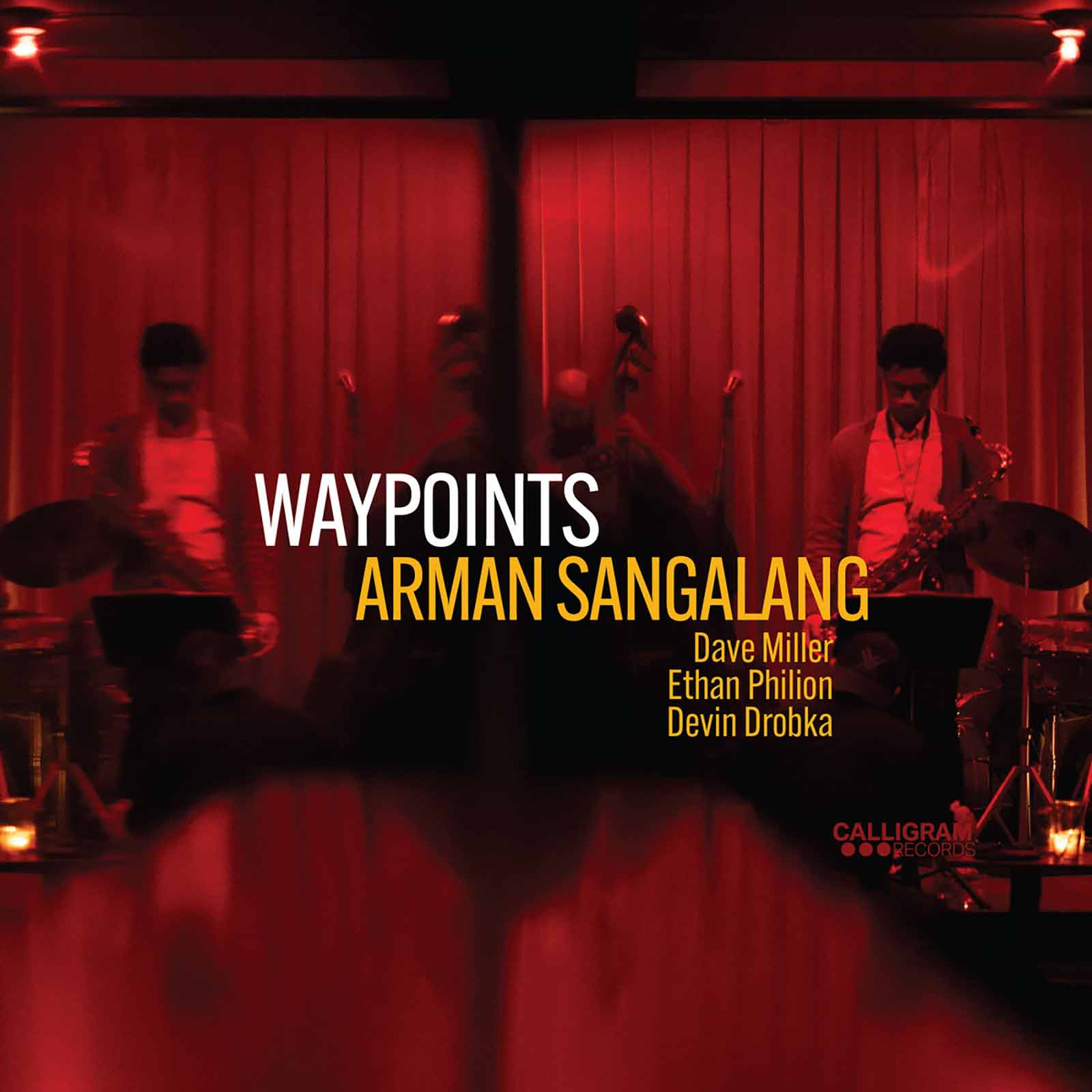
Before pressing play on Waypoints, the saxophonist’s second album, I deliberately avoided reading biographies, interviews or reviews. I wanted the music to speak first. A striking red album sleeve rested beside the mixing console, quietly inviting attention. I pressed play.
What emerged from the studio monitors was not simply music. It was an entire world.
The opening piece, “Nina,” immediately brought to mind the sense of wonder I felt when I first saw Ridley Scott’s Blade Runner in 1982. Not because the music resembles a soundtrack, but because it shares that same futuristic, dreamlike atmosphere where space, silence and emotion seem to exist in perfect balance. Then comes “Easy Does It,” confirming an impression that quickly becomes impossible to ignore. Arman Sangalang writes less like a conventional composer than like a filmmaker. Every piece unfolds with the patience of a carefully framed scene, each one revealing another chapter in a larger narrative.
It is not simply his originality that makes Waypoints memorable. It is the confidence and emotional coherence of his artistic vision. Sangalang never appears interested in compromise. Instead, he commits fully to a musical language that is personal, expansive and refreshingly free of convention.
The album marks an important step forward in his artistic journey. It features eight original compositions alongside one jazz standard, all written during two years of constant travel between Chicago and Monterey, California, where Sangalang divided his time between teaching, performing and participating in artistic residencies.
“Recording our first album (Quartet, 2023) taught me a great deal about balancing written material with improvisation,” Sangalang explains. “I wrote this music specifically for these musicians, but I never give them many instructions. I wanted them to feel free to make the music their own.”
That philosophy becomes one of Waypoints’ defining strengths. Music written at this level requires complete trust between composer and performers. Sangalang clearly understands the individual personalities of the musicians around him, allowing them space to shape every composition from within. Their freedom never feels uncontrolled. Instead, it creates the impression of four musicians engaged in an honest conversation, each voice essential to the whole.
Very little on this record feels accidental. Sangalang’s compositions travel across both musical and geographical landscapes. “Nina,” co-written with bassist Oliver Wattles during the Boysie Lowery Living Jazz residency in Delaware, was inspired by a collage at the Delaware Contemporary Art Museum depicting the silhouette of a woman composed entirely of flowers. The result is one of the album’s most evocative moments, delicate yet emotionally resonant.
Elsewhere, subtle tributes to jazz visionaries such as Thelonious Monk and Ornette Coleman appear naturally throughout the program, never as imitation but as respectful acknowledgments of artists who helped redefine the language of jazz. The album concludes with a beautifully restrained interpretation of “Body and Soul,” the piece that traditionally closes Sangalang’s concerts. It is understated, lyrical and quietly moving, providing a graceful ending to a remarkably cohesive record.
Sangalang’s résumé already reflects a musician held in high regard by his peers. He has collaborated with Jon Irabagon, Dana Hall, Clark Sommers, Bruce Forman, Sharel Cassity, Essiet Okon Essiet, Sylvia Cuenca and many others. His music has been presented at the Hyde Park Jazz Festival, the Clifford Brown Jazz Festival and the Chicago Jazz Festival. His performances have also taken him to respected venues including The Green Mill, Andy’s Jazz Club, Hungry Brain, The California Clipper, The Whistler, Mr. Tipple’s Jazz Club and the Logan Center for the Arts.
The quartet assembled for Waypoints is exceptional. Guitarist Dave Miller has become an essential part of the group’s sonic identity through his imaginative use of effects pedals. His luminous textures shape the opening moments of “Nina,” while “Writer Agents” takes on the shadowy atmosphere of classic film noir. Throughout the album, Miller surrounds Sangalang’s solos with constantly evolving colors and textures that enrich every composition without ever drawing attention away from the music itself.
Bassist Ethan Philion, a more recent addition to the ensemble, quickly establishes an effortless connection with drummer Devin Drobka. Having previously performed together in groups led by fellow saxophonists Jimmy Farace and Max Bessesen, the two musicians provide a rhythmic foundation that is both subtle and remarkably responsive, giving the quartet its quiet confidence.
Waypoints is not an album designed for everyone, and that may ultimately be its greatest strength. It asks listeners to slow down, to surrender to mood and atmosphere rather than chase instant gratification. Those willing to make that journey will discover one of the year’s most quietly rewarding jazz recordings.
More importantly, Waypoints suggests that Arman Sangalang belongs to a generation of composers redefining contemporary jazz through narrative, texture and emotional depth rather than technical display alone. At a time when many recordings compete for immediate attention, Sangalang has created something rarer: an album that unfolds gradually, reveals new details with every listen and ultimately reminds us that the most compelling jazz still begins with imagination.
Thierry De Clemensat
Member at Jazz Journalists Association
USA correspondent for Paris-Move and ABS magazine
Editor in chief – Bayou Blue Radio, Bayou Blue News
PARIS-MOVE, July 6th, 2026
Follow PARIS-MOVE on X
::::::::::::::::::::::::
Musicians :
Arman Sangalang, saxophone & compositions
Dave Miller, guitar & effetcs pedals
Ethan Philion, bass
Devin Drobka, drums & cympals
Track Listing :
1. Nina
2. Easy Does It
3. Who’s It Going To Be?
4. Monkish 04:36
5. Prevailing Change 04:46
6. Writer Agents
7. Less Is…
8. Body & Soul
9. Chatterbox (Bonus Track)
Produced by Arman Sangalang
Recorded, Mixed and Mastered by Ken Christianson, at Pro Musica, Chicago, IL April 4th and 5th, 2025
Photography by Dominic Guanzon
Layout and Design by Chad McCullough
All tracks composed by Arman Sangalang and published by Arman Sangalang Music, ASCAP except track 1, by Arman Sangalang and Oliver Wattles, published by Arman Sangalang Music, ASCAP and Havarian Garland, ASCAP and track 8, composed by Johnny Green, and published by Druropetal Music, BMI