| Jazz |
Summary : With Indigo, Bria Skonberg delivers one of the most accomplished albums of her career. Blending exceptional vocal performances, sophisticated orchestration, and heartfelt storytelling, she explores the power of song with remarkable elegance. More than a showcase for her talents as a singer and trumpeter, Indigo is a deeply human album that celebrates connection, empathy, and artistic authenticity.
Bria Skonberg’s Indigo Review: A Masterclass in Vocal Jazz, Orchestration and Human Connection
I have always regarded Bria Skonberg as an artist in the noblest sense of the word, long before considering her a composer, a trumpeter, or a vocalist. The reason is remarkably simple. One only needs to look at the themes that have shaped her previous albums. Each project begins with an idea that genuinely matters to her, a subject she feels compelled to explore. What follows is the creative world she builds around that idea, music that feels entirely consistent with her personality and artistic vision. No two Bria Skonberg albums sound alike. The only constants are the unmistakable qualities of her trumpet playing and her vocal phrasing, signatures that make her instantly recognizable regardless of the musical landscape she chooses to inhabit.
There is never any reason to approach a new Bria Skonberg release with apprehension. She is, by nature, a perfectionist, an artist who remains stubbornly resistant to easy solutions and who consistently embraces genuine creative risk. With Indigo, however, listeners may find themselves entering territory that feels closer to the world of musical theater than anything she has attempted before.
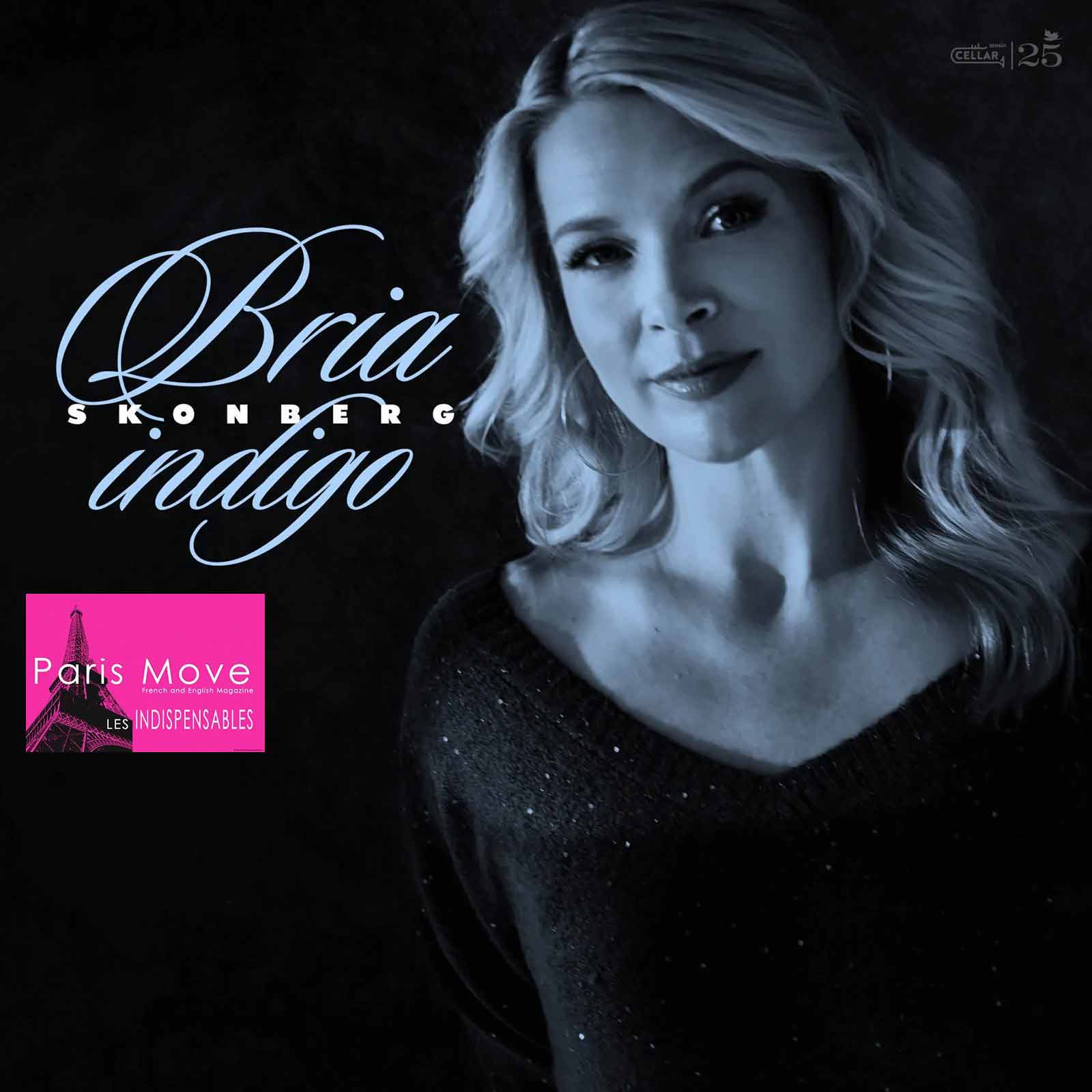
Set for release on July 3, 2026, through the Cellar Music Group label, Indigo reveals the full breadth of Skonberg’s vocal artistry. Conceived as the long-anticipated companion piece to Brass, her trumpet centered meditation released earlier in 2026, Indigo shifts the focus toward song, singing, and the art of orchestration, illuminating every shade and nuance of her vocal palette. Co-produced by Skonberg and longtime collaborator Matt Pierson, the two albums explore the complementary dimensions of her creative identity.
“After spending decades figuring out how the trumpet and voice could work together,” Skonberg explains, “I thought it would be interesting and challenging to explore them separately. It really is as simple as that.”
For years, audiences have asked whether she is a singer who plays trumpet or a trumpeter who sings. During the recording of Brass and Indigo, Skonberg arrived at a revelation: she is neither one nor the other. She is fully and unapologetically both. It is a realization that feels particularly fitting for an artist whom The New York Times once identified as one of the brightest contemporary voices carrying forward the spirit of classic hot jazz while simultaneously expanding its possibilities.
A master interpreter in every sense, whether working through her voice or her instrument, Skonberg approaches performance with the instincts of a storyteller. Her singing carries the emotional precision of a gifted actress, while her trumpet playing communicates with the same dramatic intent. Everything resides in the details of interpretation, in the subtle inflections, the pauses, the emotional shading. Once again, she has delivered a radiant and deeply considered album.
One of the album’s greatest achievements lies in its orchestral conception. The arrangements never function as mere accompaniment. Instead, they become active participants in the narrative. Throughout Indigo, colors emerge and recede with cinematic elegance. Woodwinds drift through the music like passing thoughts, brass passages offer warmth rather than power, and the rhythm section understands that restraint can often be more expressive than virtuosity. Matt Pierson and Skonberg have constructed soundscapes that support the emotional core of each song without ever overwhelming it. The result is an album whose sophistication reveals itself gradually, rewarding repeated listening.
When she takes on Duke Ellington’s “Mood Indigo,” one is reminded not of any specific predecessor but of a tradition of jazz singers capable of balancing fragility and emotional authority. Her vocal performance is at once ethereal and vulnerable, floating above the arrangement while retaining a raw emotional edge. There is a delicacy here that recalls the finest vocal jazz traditions without ever descending into imitation. Listeners familiar with the soundtrack of Steven Spielberg’s The Color Purple may recognize a similar emotional texture, a blend of intimacy, longing, and quiet resilience that permeates Skonberg’s interpretation.
The album closes on a note of unwavering optimism, a quality that has become one of Skonberg’s defining characteristics, both as an artist and as an individual navigating an increasingly fractured world. “We’ll Be Together Again” unfolds with delicate clarinet lines and an arrangement that gradually blossoms into something expansive and uplifting. Skonberg navigates the song’s wide intervallic leaps with remarkable technical ease, yet technical mastery is never the point. What ultimately guides her performance is the emotional truth at the heart of the composition.
“The feeling of togetherness is important to me,” she says. “The structure of the album forms a complete arc. ‘Watch What Happens’ is about allowing someone to speak to your heart and remaining open. The final thought becomes: let’s stay together in that space.”
The message could not be clearer. “I’m trying to bring people together as much as possible,” she explains. “If I can create a shared experience during a concert, regardless of people’s opinions or beliefs, that means a great deal to me.”
There can be little doubt that Skonberg’s relentless pursuit of excellence has once again resulted in an exceptional record. As a French listener, I approached her interpretation of Jacques Brel’s “If You Go Away” with a certain degree of skepticism. Brel’s work has inspired countless renditions over the decades, many of which have struggled under the weight of comparison. Yet this is the first version I have encountered that avoids that trap entirely. More importantly, it succeeds in capturing something of the dramatic intensity that made Brel unique. Rather than merely performing the song, Skonberg inhabits it. She understands that the song’s power lies not in its melody alone, but in its emotional architecture, in the tension between resignation and longing. It is an interpretation that feels lived rather than performed.
With Indigo, Bria Skonberg confirms her influence not only as a trumpeter and vocalist but also as a musical architect of rare imagination. She is unquestionably a major artist. Yet what ultimately elevates this album beyond technical achievement is the profound sense of humanity that runs through every note. In an era often dominated by spectacle, Indigo feels like an act of connection. It is a reminder that virtuosity matters most when it serves emotion, and that great artistry remains inseparable from empathy.
One additional aspect deserves mention. While Indigo is presented as the vocal counterpart to Brass, it would be a mistake to view it merely as a companion piece. The album stands comfortably on its own as a statement about communication itself: the power of the human voice to convey vulnerability, hope, memory, and shared experience. In that sense, Indigo may well prove to be one of the most revealing projects of Skonberg’s career, not because it showcases what she can do, but because it reveals who she is.
More broadly, Indigo reinforces Skonberg’s unique position within contemporary jazz. At a time when many artists feel compelled to choose between tradition and innovation, she continues to demonstrate that the two are not opposing forces but complementary ones. Her work draws from jazz history without becoming nostalgic, embraces popular song without sacrificing artistic depth, and borrows from theatrical storytelling without losing its musical integrity. Few contemporary musicians move so naturally between these worlds.
That ability may ultimately define her legacy. Bria Skonberg belongs to a generation of artists who refuse rigid categories and stylistic boundaries. She treats jazz not as a museum piece but as a living language, one capable of absorbing influences, expressing contemporary concerns, and bringing people together.
Indigo is therefore more than an excellent album. It is a compelling argument for what jazz can still be in the twenty first century: adventurous, emotionally generous, deeply personal, and profoundly human.
Thierry De Clemensat
Member at Jazz Journalists Association
USA correspondent for Paris-Move and ABS magazine
Editor in chief – Bayou Blue Radio, Bayou Blue News
PARIS-MOVE, June 19th, 2026
Follow PARIS-MOVE on X
::::::::::::::::::::::::
Musicians :
Bria Skonberg: trumpet and vocal
Gil Goldstein: piano, accordion, arranger
Eric Wheeler: bass
Darrian Douglas: drums, percussion
Antoine Silverman, Entcho Todorov: violins
Yuko Naito-Gotay: viola
Emily Brausa: violincello
Kathleen Nester: alto flute
Charles Pillow: bass clarinet
Track Listing :
Watch What Happens
I’m Glad There Is You
Mood Indigo
Between the Devil and the Deep Blue Sea
If You Go Away
Fragile
So It Goes
Tell Him I Said Hello
We’ll Be Together Again
Executive Producer: Larissa Roesch & Cory Weeds
Produced by Matt Pierson & Bria Skonberg
Recorded at The Samurai Hotel Recording Studio, NYC on 7/29 and 7/30/2025
Engineered by Christopher Allen
Mixed and Mastered by Christopher Allen
Arrangements: Gil Goldstein
Production Manager: Dominic Duchamp
Photography by Shervin Lainez
Design and layout by John Sellards