| Jazz |
Summary: A commemorative live recording of Latin jazz brings together Bobby Matos and the Heritage Ensemble, captured in the San Francisco Bay Area, showcasing richly layered Afro-Latin rhythms, rare performances, and a striking interpretation of “All Blues” by Miles Davis.
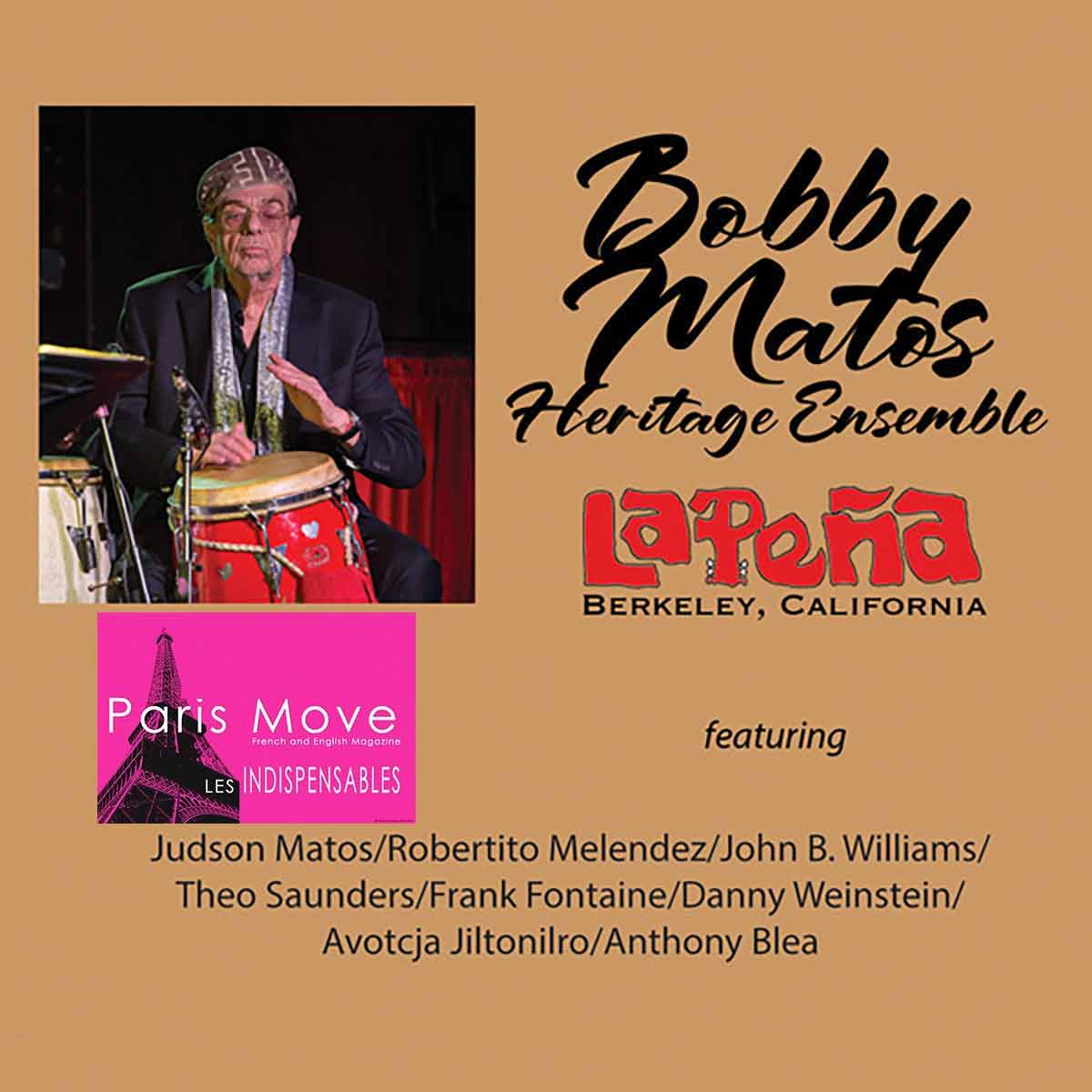
Bobby Matos & the Heritage Ensemble: A rare live Latin jazz recording in the San Francisco Bay Area, in service of a lasting musical legacy
For listeners attuned to the warmth, complexity, and irrepressible momentum of Latin percussion, this album approaches necessity. It is not merely a recording, but a document of memory, community, and continuity, structured around the legacy of one of its central figures: Bobby Matos.
Matos, who died in November 2017 at the age of 76, was a percussionist of quiet demeanor and rare authority. His career unfolded fluidly across genres and artistic worlds, bringing him into collaboration with an unusually wide spectrum of performers—from Ben Vereen and Bette Midler to Fred Neil, Jim Croce, Joe Loco, Ray Rivera, and Miriam Makeba. Yet his most enduring contribution may lie less in these associations than in the way he conceived Latin jazz itself: as a living, evolving conversation, one that binds tradition, diaspora, improvisation, and community into a singular rhythmic language.
Recorded with the Heritage Ensemble (also known as the Afro-Latin Jazz Ensemble), the album stands as a posthumous affirmation of that vision. It gathers not just musicians but a cultural continuum, artists for whom rhythm is both inheritance and invention. In that sense, the recording functions less as retrospective than as reassertion: of identity, shared history, and the persistent vitality of Latin jazz as a global form.
The origins of the recording reflect an unexpected convergence of planning and improvisation, mirroring the music itself. In August 2007, Matos and the Heritage Ensemble were scheduled to perform at the San Jose Jazz Festival. On paper, it was a standard festival appearance. But as word of Matos’s presence spread through the Bay Area’s jazz community, a broader momentum began to take shape.
Geography matters here as much as music. San Jose lies roughly fifty miles south of San Francisco, Oakland, and Berkeley, yet culturally, the Bay Area operates less as a collection of separate cities than as an interconnected ecosystem. As anticipation grew, LifeForce Jazz—the label with which Matos was then associated, began receiving an increasing number of requests for additional performances in the northern part of the region.
What followed would fundamentally alter the trajectory of the engagement.
Originally, Matos was to arrive from Los Angeles with his ensemble the day before the San Jose concert—a schedule that would have confined the music to the formal, structured setting of the festival stage. The local community, however, intervened. Through a combination of enthusiasm and grassroots logistical coordination, the group’s arrival was moved forward.
That shift opened a decisive window.
Rather than waiting for the festival spotlight, the ensemble performed that very evening at La Peña Cultural Center in Berkeley. What might have been a minor scheduling adjustment became a defining moment: an intimate, spontaneous performance captured at the height of the ensemble’s creative intensity, even before its official presentation the following day.
It is from that Berkeley concert that the bulk of the album is drawn.
Recorded by Mauricio Acevedo, who also handled the venue’s live sound, the album is marked by remarkable fidelity. The clarity of the mix preserves both the immediacy of the space and the precision of the playing. Nothing is flattened by time: the recording breathes with unusual transparency. The percussion resonates within the room’s natural acoustics, the horns unfold cleanly across the stereo field, and the ensemble’s dynamic range is maintained without excessive artifice. This is a live document that has aged not as a relic, but as a fully realized production.
It is therefore fitting that the album appears on LifeForce Jazz Records, a label closely intertwined with Matos’s artistic trajectory. Co-founded by Billy Higgins and Dawan Muhammad, the imprint became an important platform for Latin jazz expression, with Matos emerging as one of its most consistent creative forces. Over time, he expanded his role from musician to producer and artistic director, helping shape the label’s identity. He would later found his own label, Café Con Bagels, extending his commitment to artistic independence and cultural hybridity.
The result is a rare document: a performance born of preparation, transformed by circumstance, and preserved with exceptional care. The Heritage Ensemble brings together leading musicians and composers, several of whom had prepared original works and arrangements for the San Jose festival. Yet the Berkeley performance reveals something else entirely—a music still in motion, still defining itself.
That sense of discovery finds its most striking expression in the ensemble’s interpretation of “All Blues” by Miles Davis.
Here, the familiar modal framework of the original is not simply transposed but refracted. The interpretation retains the contemplative openness of Davis’s structure while subtly reconfiguring its rhythmic architecture through a Latin jazz lens. The percussion does not merely accompany, it shifts the center of gravity. The musical flow becomes more layered, more dialogic, less linear. Harmonic phrasing unfolds with restraint but also with a quiet propulsion, deeply rooted in Afro-Latin tradition.
What makes this reading especially compelling is its balance. The ensemble avoids excess or overstatement, favoring clarity and restraint, allowing tensions and resolutions to emerge organically. This is neither imitation nor gratuitous reinvention, but a form of musical translation in the deepest sense: a transfer of meaning from one form to another without loss of substance.
Even for listeners unfamiliar with Cuban rhythmic structures or the vocabulary of Latin jazz, the album remains immediately accessible. Nothing demands prior knowledge; the music simply invites attention. Its layers reveal themselves gradually, rewarding repeated listening without ever becoming opaque or exclusionary. It is music that welcomes more than it instructs.
Throughout the album, that same logic prevails. Recognizable compositions sit alongside lesser-known pieces, yet the listening experience never fractures into “familiar” and “new.” Everything is absorbed into a single musical space, luminous, dense, and in constant motion.
At a moment when cultural memory often feels fragile, recordings like this take on particular resonance. They are not merely performances fixed in the past; they function as active archives of exchange between communities, traditions, and generations. They remind us that jazz is not a static repertoire but an ongoing negotiation between inheritance and invention.
What ultimately endures is not only the sound of Bobby Matos and the Heritage Ensemble at a moment of rare creative convergence. It is also the broader testament to what can happen when a musical community listens closely enough to itself to transform circumstance into art.
The album stands both as archive and argument: collaboration is a form of legacy, and in music, that legacy is never still. It continues to move, as long as we continue to listen.
Thierry De Clemensat
Member at Jazz Journalists Association
USA correspondent for Paris-Move and ABS magazine
Editor in chief – Bayou Blue Radio, Bayou Blue News
PARIS-MOVE, April 13th 2026
Follow PARIS-MOVE on X

::::::::::::::::::::::::
JazzMusicArchives.com’s Website
Musicians :
Bobby Matos, timbles & Vocals
Other musicians : Heritage Ensemble
Track Listing :
CD 1 :
Song For Jude
After Thought
La Patria Del Son
Gratitude
Cubop Bailabre
The Jazz Nessenger
All Blues
Mi Bomba de Corazon
CD 2 :
Cuban Fantasy
Free South Africa
Cuando Baila Ramon
You Don’t Love
Ucle David’s Egg Cremes
No Me Diga Na
Listen here
Mi Bomba De Corazon
Recorded 2007 at La Peña Art Center