| Jazz |
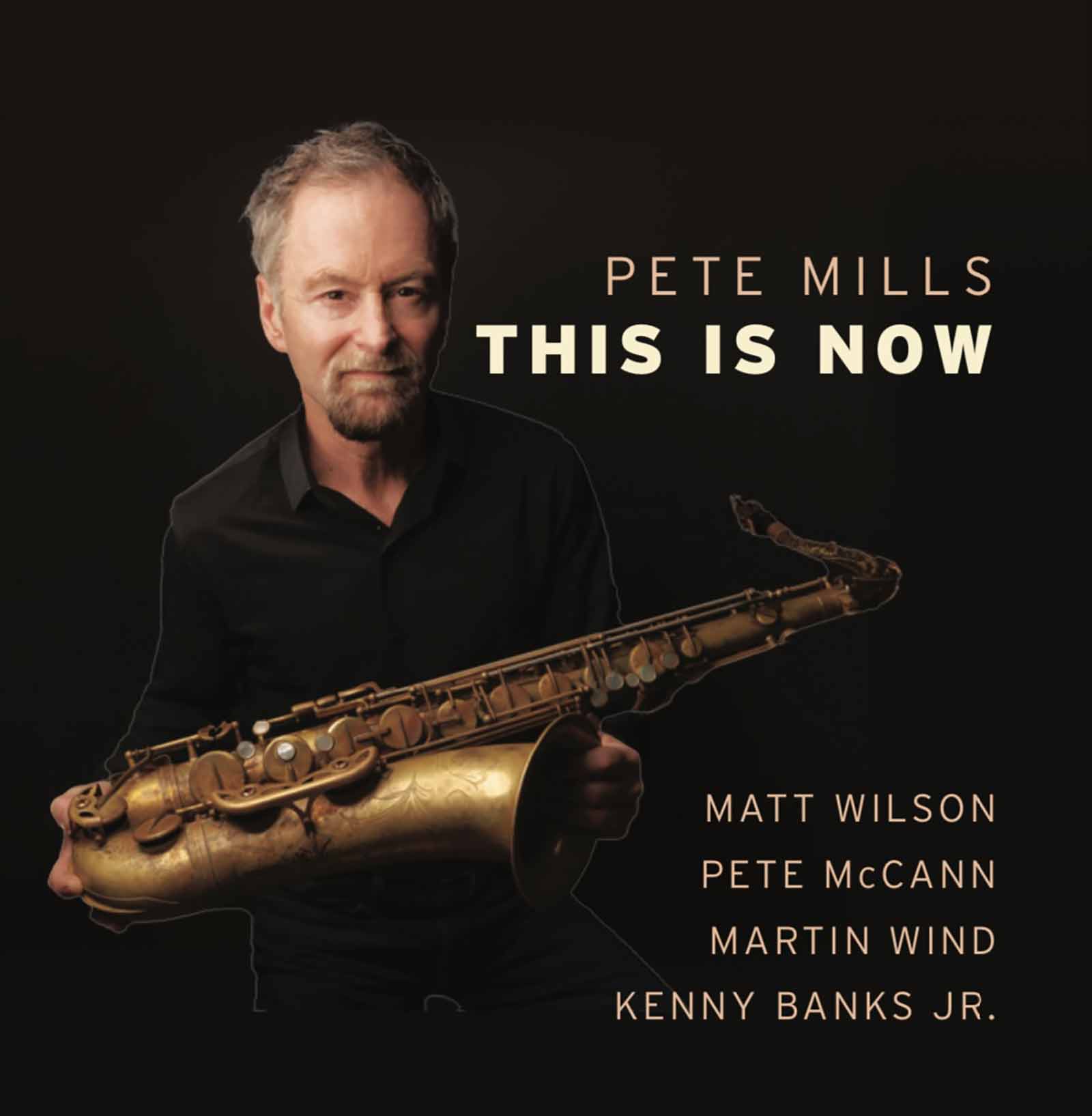
Summary: Peter Mills’ This Is Now is a modern jazz album rooted in tradition, rich in detail, and built for deep listening.
Peter Mills’ This Is Now: A Refined Jazz Album Between Tradition and Reflection
This is not the first time I’ve written about Peter Mills. But This Is Now makes a clearer argument than ever: that tradition, when fully absorbed, can become a living, flexible language rather than a constraint. Mills’ music, firmly rooted in a relatively classical conception of jazz, does not feel nostalgic for its own sake. Instead, it reads as a deliberate exploration of how the past continues to shape the present, both musically and emotionally.
That grounding is no accident. Mills’ academic path, with degrees from the Eastman School of Music and the University of North Texas, places him in a lineage of rigorously trained jazz musicians who move fluidly between pedagogy and performance. North Texas in particular has long been a breeding ground for players who are as comfortable on stage as they are in the classroom, and Mills embodies that dual identity: precise, articulate, but never sterile.
His musical language is dense, sometimes deceptively so. In his phrasing, one hears echoes of Dexter Gordon, that relaxed yet deliberate elasticity, but the comparison only goes so far. Where Gordon leaned into narrative looseness, Mills often gravitates toward structure. His compositions can feel almost architectural in their construction, marked by a careful balance between control and expression. At times, that rigor risks creating a certain emotional distance; the listener is invited to admire as much as to feel. And yet, it is precisely within that tension that the album finds its voice.
The title, This Is Now, offers a useful entry point. It suggests not immediacy, but reflection, a present moment shaped by what has just passed. The music frequently evokes the atmosphere of mid-century American cinema, particularly the shadowed ambiguity of 1950s noir. You can picture it: a smoke-filled bar, a door creaking open, a figure pausing in the half-light. Think of Humphrey Bogart, not in action, but in suspension, caught between decision and consequence. Mills’ compositions inhabit that same in-between space, where resolution feels close, but never fully settled.
If the conceptual framework leans toward introspection, the execution is anything but static. The album’s production is rich, even luxurious, yet it avoids the common pitfall of excess. Guitarist Pete McCann integrates seamlessly into the ensemble, often blurring the line between lead and accompaniment, while pianist Kenny Banks Jr. brings a clarity and depth that anchor the harmonic landscape. There is an audible chemistry here: these musicians don’t simply perform together, they listen to one another, leaving space, responding in real time.
That sense of space is one of the album’s defining strengths. Where many contemporary jazz recordings collapse under layers of density, This Is Now remains remarkably transparent. Each instrument retains its presence; each line, its intelligibility. The arrangements—subtle, often ingenious—reward repeated listening. This is not music that reveals itself in a single pass. It unfolds gradually, detail by detail, inviting the listener back.
Tracks like Exit Strategy provide some of the album’s most intriguing departures. Here, the guitar adopts a textural role reminiscent of a Hammond organ, creating a sound world that feels both playful and slightly unexpected. It’s a reminder that Mills is not confined to the boundaries he so carefully constructs. Elsewhere, other compositions reinforce his strengths: strong thematic writing, controlled improvisation, and a clear sense of narrative pacing. Still, one occasionally wishes for a moment of greater risk, an instance where the structure might loosen, if only briefly, to let something less predictable emerge.
Critical reception has, unsurprisingly, been enthusiastic. Mills has been described as “virtuosic,” “magnificent,” and “versatile,” with JazzTimes noting “a tenor that turns heads.” The Columbus Dispatch has highlighted the “impressive” nature of his compositions, praising solos that “open the ear” and a sound that is both broad and richly textured. Such acclaim feels well-earned, even if it only captures part of what makes this music compelling.
Because ultimately, what This Is Now offers is not spectacle, but engagement. It asks the listener to pay attention, to linger, to question, to notice the small decisions that shape the larger whole. This is jazz that resists immediacy in favor of depth, that values coherence over display. It may not overwhelm on first listen. But given time, it settles in, revealing its quiet confidence.
In a contemporary jazz landscape often defined by extremes, either hyper-virtuosity or radical deconstruction, Peter Mills takes a different path. He builds carefully, listens closely, and trusts the material. And in doing so, he delivers something increasingly rare: an album that doesn’t demand attention, but earns it.
Thierry De Clemensat
Member at Jazz Journalists Association
USA correspondent for Paris-Move and ABS magazine
Editor in chief – Bayou Blue Radio, Bayou Blue News
PARIS-MOVE, April 12th 2026
Follow PARIS-MOVE on X

::::::::::::::::::::::::
Musicians :
Pete Mills, saxophone & compositions, (except 12. Billy Strayhorn)
Matt Wilson (drums)
Martin Wind (bass)
Pete McCann (guitar)
Kenny Banks Jr. (piano)
Track Listing :
This Is Now
Sunset Stx
Daddies
Up To Go Down
Bird Lives
Exit Strategy
3 Kisses
Don’t Stomp On My Dream
Window Shopping
Sliver Of Silver
Boubar
U.M.M.G