| Jazz |
Summary: At 80, Joachim Kühn defies nostalgia with Young Lions, a bold new album and ensemble blending youthful energy with masterful, forward-looking jazz.
Young Lions: Joachim Kühn’s Bold New Chapter with a Rising Generation
Anyone who has witnessed Joachim Kühn on stage even once tends to recall the moment with unusual clarity: the pianist leaning into the keyboard, sculpting sound with a mix of ferocity and architectural precision, as if each phrase were being discovered and dismantled in real time. At eighty, Kühn remains less a venerable elder than a restless modernist, one of Europe’s most formidable pianists and composers, still propelled by a refusal to look backward. Asked in 2024 how he felt about turning eighty, his answer was characteristically direct: aging irritates him. Rather than indulge in nostalgia or anniversary rituals, he resists the premise altogether, channeling his energy into something more urgent, warding off boredom, distraction, and, above all, any hint of artistic stagnation.
That resistance has long defined Kühn’s place in European jazz. Emerging in the 1960s and associated with the continent’s free jazz movement, he built a reputation for pushing against formal constraints while maintaining a rigorous sense of structure. Across decades of collaborations and recordings, he has occupied a singular space, bridging abstraction and lyricism, intellect and instinct, never settling into a fixed identity. Stagnation, in his case, is not merely avoided; it is systematically dismantled.
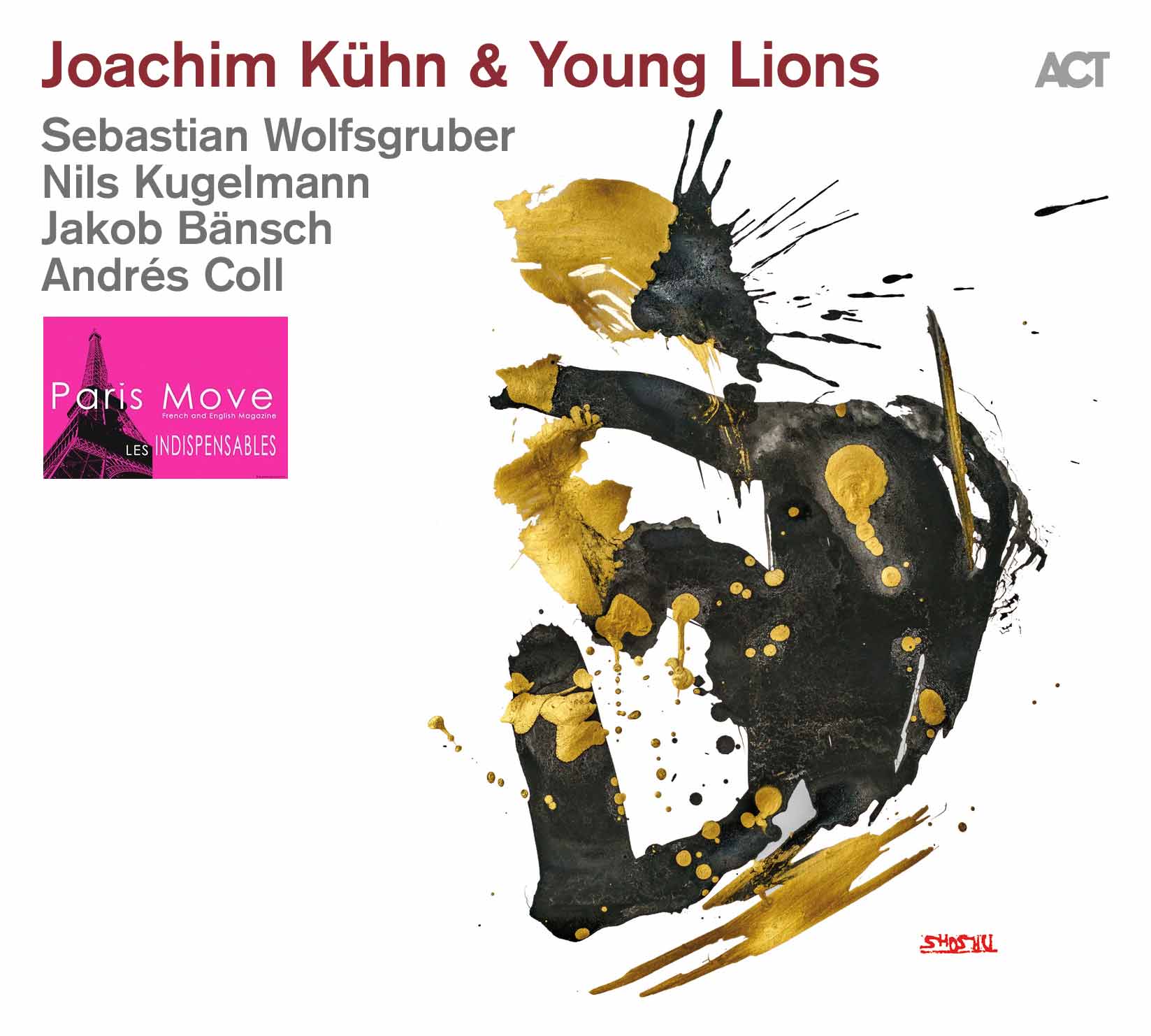
His latest album, Young Lions, makes that ethos newly tangible. The title refers not only to the recording itself but to Kühn’s newly formed ensemble, also called Young Lions, comprising a younger generation of musicians whom he leads with a mix of exacting discipline and quiet trust. The project offers a vivid illustration of his ongoing reinvention: music that feels uncannily ahead of its time, yet anchored in a lifetime of exploration. From the outset, Kühn complicates the language of musical expression, bending it toward something nearly pictorial, music that does not simply unfold but interrogates, challenges, and refracts itself.
“I am more productive than ever,” he has said. “My daily routine revolves entirely around music. I compose and I improvise. Every day, for hours on end.” For Kühn, being over eighty signifies above all a refusal to squander time: to practice, to create, to move forward. “What I want,” he adds, “is to play with even greater freedom, like the great musicians at the end of their lives, Johann Sebastian Bach, perhaps, or John Coltrane.”
Freedom, in Kühn’s lexicon, is anything but formless. It exists within a carefully controlled architecture, he determines the entry and the exit, the structural spine of a piece. What unfolds in between is something closer to an intellectual transcription of the self, an expression composed of sound, vision, and deep structural intent. Between December 2024 and January 2025, Kühn composed a new body of work with the explicit aim of recording it alongside musicians he had never previously encountered. “From a sonic standpoint, my idea rested on the pairing of trumpet and marimba,” he recalls.
One collaborator was never in doubt: Andrés Coll, whom Kühn discovered on his adopted island of Ibiza, would take the vibraphone part. “He’s an extraordinary talent,” Kühn says. Finding the remaining members of Young Lions proved more exacting. “Identifying the ideal trumpeter was not simple,” he admits. After auditioning numerous candidates without conviction, a recommendation from Roland Spiegel, head of the jazz department at Bayerischer Rundfunk, proved decisive. Spiegel introduced him to the young Jakob Bänsch. “From the very first minute, I knew he had to be part of this project,” Kühn recalls.
Bänsch soon traveled to Ibiza, where, alongside Coll, he rehearsed with Kühn for four days, grappling with music of formidable technical and expressive demands, particularly for the trumpet. The effort was unmistakably worthwhile. On Young Lions, Bänsch achieves a rare equilibrium: his reading of Kühn’s intricate themes is both lucid and forceful, while retaining the agility and nuance required for passages of free improvisation. Around him, the ensemble coalesces with striking cohesion, guided by Kühn’s vision yet never constrained by it.
Listening to the album, one begins to understand the sound world Kühn was pursuing. A drummer of near-metal intensity anchors the music, creating a dense, propulsive foundation over which piano and trumpet converge, collide, and ignite. The effect is at once physical and cerebral: a music that invites both analytical attention and visceral response. One can easily imagine how such energy might translate to the festival stage, audiences rising, heads nodding, bodies moving, drawn into a performance that feels at once rigorously composed and explosively alive.
Kühn has long possessed a rare gift for elevating those around him, drawing from each collaborator their most vital and adventurous selves. With Young Lions, the album and the ensemble, he extends that gift into a kind of intergenerational dialogue, positioning himself not as a figure of authority but as a catalyst. The result is music that resists hierarchy as much as it resists stasis: a collective sound shaped by experience, yet invigorated by youth.
If the closing impression lingers, it is not as a statement of legacy but as a moment in motion: Kühn at the piano, leaning forward, releasing a final cascade of notes that seem less like an ending than a point of departure. One senses that, for him, the work is never finished, only continually unfolding. And if Young Lions proves anything, it is that even now, eight decades in, Joachim Kühn remains committed to the same imperative that has always defined him: not to look back, but to press, relentlessly, into what comes next.
Thierry De Clemensat
Member at Jazz Journalists Association
USA correspondent for Paris-Move and ABS magazine
Editor in chief – Bayou Blue Radio, Bayou Blue News
PARIS-MOVE, March 26th 2026
Follow PARIS-MOVE on X

::::::::::::::::::::::::
Musicians:
Joachim Kühn, composer, piano
Sebastian Wolfburger, drums
Nils Kugelman, bass
Jakob Bänsch, Trumpet
Andrés Coll, Marimba
Track Listing :
Slick Tuff
Station i22
Everyday
Prof. Stief
Elliott Carter
Renata’s Sleep
Attakee