| Jazz |
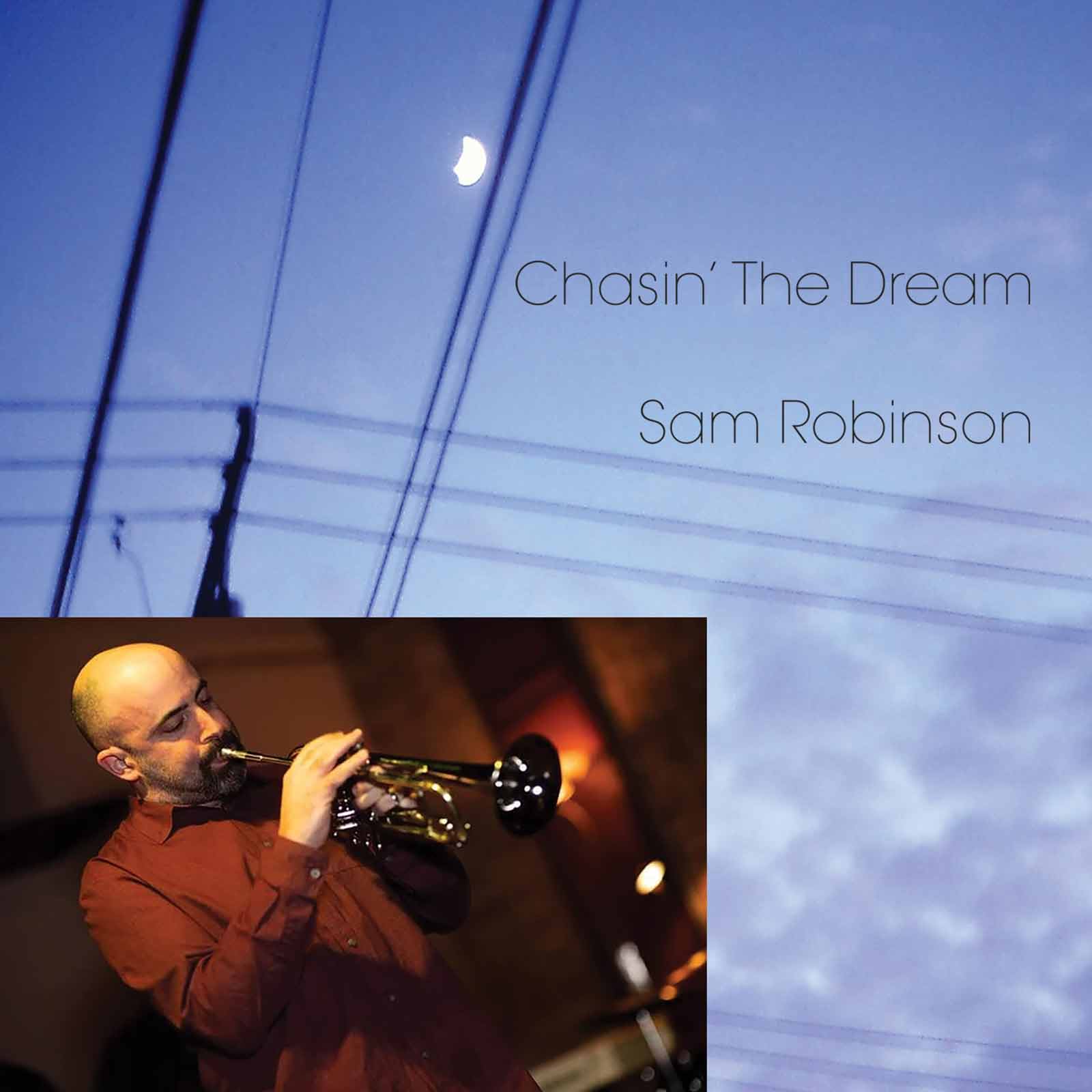
This is an album that will appeal to listeners who cherish a jazz language that is immediately accessible, music that moves confidently along the well-charted shores of post-bop. Trumpeter and bandleader Sam Robinson delivers a recording that feels almost defiantly live. Each track carries the intimacy and urgency of what sounds like a single take, as though the quintet stepped into the studio, counted off, and trusted the moment. The compositions are original, yet their spirit is steeped in tradition, revealing a musician less interested in reinvention than in reaffirmation, in the patient pursuit of authenticity.
Within contemporary jazz, the term “post-bop” has grown elastic, stretched to accommodate electronic textures, genre fusion and harmonic abstraction. Few artists commit themselves wholly to the idiom’s mid-century grammar. Robinson does. Chasin’ the Dream could easily have been recorded in the late 1950s; only the depth and spatial clarity of the recording betray its present-day origins. The production is warm and unembellished, no obvious overdubs, no studio gloss, no atmospheric effects layered to simulate depth. Instead, what emerges is the organic sound of five musicians occupying the same acoustic space, listening closely.
The album opens with an up-tempo number that sets the tone: crisp horn phrasing over a walking bass line that never hurries, drums that swing rather than drive. A mid-album ballad, built around a muted trumpet melody that unfolds with lyrical restraint, becomes a centerpiece, its improvisation shaped less by virtuoso display than by narrative contour. Elsewhere, a hard-swinging quintet piece gives the pianist room to stretch harmonically before yielding to a bass solo that recalls the clarity and propulsion of classic small-group recordings. Throughout, Robinson’s trumpet tone remains centered and rounded, favoring melodic development over angular experimentation.
The lineage is unmistakable. Listeners may hear echoes of the classic Blue Note era, of the poised lyricism associated with figures such as Clifford Brown, or the structured yet elastic ensemble interplay reminiscent of Art Blakey’s small groups. Yet Robinson avoids imitation. The familiarity lies not in quotation but in syntax, the way themes are stated clearly, solos unfold logically, and ensembles return to the head with unforced cohesion.
Listeners should not approach this album expecting stylistic disruption. There are no abrupt metric shifts, no electronic interventions, no deliberate subversions of form. For some, this devotion to tradition may register as conservatism. In an era when jazz often asserts its vitality through hybridization, Robinson’s restraint might feel almost countercultural, or, to skeptics, overly cautious. But there is also conviction in that choice. By refusing to chase novelty, he allows the focus to settle on interaction: the subtle adjustments in tempo, the way the drummer feathers the ride cymbal beneath a trumpet phrase, the quiet authority of the bass anchoring harmonic transitions.
Authenticity, here, seems to mean trust in process. The arrangements leave breathing room. The written themes function as frameworks rather than blueprints. Improvisations are neither indulgent nor truncated; they unfold at a human scale, guided by collective listening. The result is music that feels lived-in rather than engineered.
For students of jazz, Chasin’ the Dream may prove especially instructive. The quintet’s architecture, the careful balance between written passages and improvisational freedom, offers a lucid case study in small-ensemble management. One hears how solos are cued, how dynamics are negotiated, how tension is built and released without grand gestures. In that sense, the album functions almost pedagogically, demonstrating the grammar of acoustic post-bop with clarity and discipline.
There is a reason that jazz clubs continue to program groups built around this format. Returning to fundamentals is not regression; it is preservation. In intimate rooms, low ceilings, tables pressed close to the bandstand, this kind of ensemble thrives. One can imagine Robinson’s quintet in such a space: the trumpet’s bell catching the stage light, the pianist leaning into a reharmonized turnaround, the drummer stretching the time just enough to make the audience lean forward. It is in those live settings that risk quietly enters, tempos breathe differently, solos extend, the band responds to the mood of the room. Recordings such as this one hint at that elasticity, but the full voltage likely resides onstage.
Chasin’ the Dream follows Robinson’s debut, Sweet Love of Mine (2019), as well as Be With Me: Live at the Eastgate Café (2022) and Third Time’s a Charm (2023). Curiously, the musician maintains little digital footprint beyond a modest Facebook presence promoting performances. The absence of a comprehensive biography or official website makes it difficult to situate him within a broader narrative arc, a limitation for critics seeking context, but perhaps consistent with the ethos of the music itself: let the sound speak first.
For listeners beginning to explore jazz, Chasin’ the Dream offers a generous and approachable entry point. It does not demand theoretical fluency or historical decoding. It invites patience. And for seasoned devotees, it provides something equally valuable: a reminder that within established forms, there remains ample room for sincerity, swing and quiet renewal.
Thierry De Clemensat
Member at Jazz Journalists Association
USA correspondent for Paris-Move and ABS magazine
Editor in chief – Bayou Blue Radio, Bayou Blue News
PARIS-MOVE, March 1st 2026
Follow PARIS-MOVE on X

::::::::::::::::::::::::
Musicians :
Scott Robinson – Trumpet
Scott Angst – Tenor Saxophone
Aaron Krings – Bass
Jack Macklin – Guitar
Chase Wilkins – Drums
Tracklisting:
1 The Gatekeeper (5:24)
2 Big C’s Chart (6:49)
3 Leia (7:38)
4 Sam’s Dig (6:24)
5 Brian’s Tune (8:26)
6 Bienvenue (4:57)
*All compositions by Sam Robinson